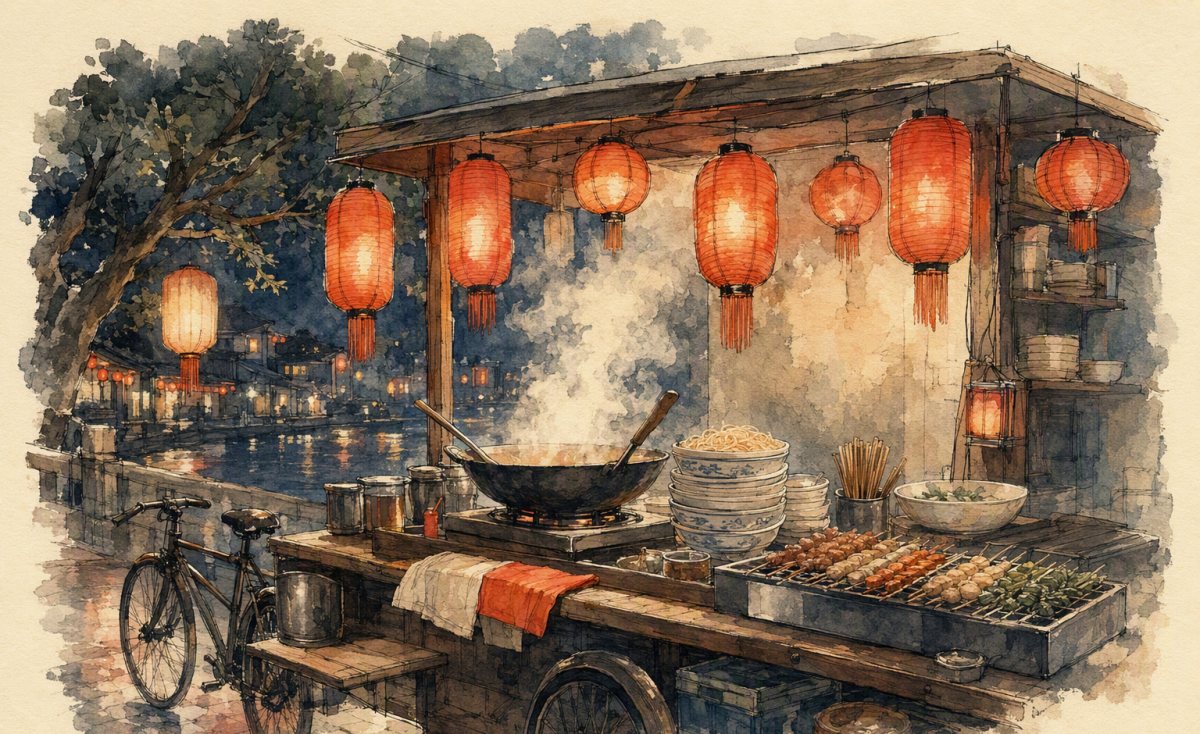
Changsha is the capital of Hunan and one of China’s most rewarding food cities, though it rarely appears on a first-timer’s itinerary. It is the home of Hunan chilli cooking, the birthplace of the black-skinned stinky tofu most visitors have only heard about, and a city whose nightlife runs later than almost anywhere else in the country. It is also unusually cheap to sightsee: the river island, the mountain, the old university and the provincial museum are all within a short metro ride of one another. This guide covers what to eat, what to see, when to go and how Changsha fits into a wider Hunan route.
What to eat in Changsha
Hunan food is not Sichuan food. It is sharper, drier and more purely chilli-driven, with sour pickles and smoked pork doing much of the work. The dishes below are the ones locals actually queue for.
Stinky tofu (chou doufu). Changsha’s version is fermented until the skin turns black, then deep-fried so the outside crisps and the inside stays soft, and served with chilli sauce and chopped garlic. Huogongdian, in the old fire-palace building, is the best-known address; the queues are long and the portions small, which is normal.
Crayfish. From late spring through summer, whole streets fill with tables of red-shelled crayfish eaten by hand with beer. The season is genuinely seasonal, so if this is the point of your trip, check before you book.
Rice noodles for breakfast. Changsha eats noodles in the morning, either in broth or dry-tossed with shredded pork, pickles and chilli. Corner shops open early and sell out; go before mid-morning.
Milk tea and retro streets. Chayan Yuese and Wenheyou both began here and have since expanded across China. Both are cheaper and less crowded at the source, though Wenheyou’s themed dining complex is as much a spectacle as a restaurant.
If you are travelling with dietary restrictions, Hunan cooking uses lard and meat stock freely, so read our guide to halal and vegetarian food in China before you rely on a menu translation.
What to see
Orange Isle (Juzizhou). A long island in the Xiang River, reachable by metro, with a statue of the young Mao Zedong at its southern tip. Weekend firework displays over the river have run on and off for years; schedules change and are sometimes suspended, so confirm current arrangements locally rather than assuming a Saturday show.
Yuelu Mountain and Yuelu Academy. A forested hill on the west bank containing a university founded in the tenth century and still operating. The summit paths are at their best in autumn, when the gingko and maple turn. Allow most of a day if you walk up rather than take the cable car.
Hunan Provincial Museum. Home to the Mawangdui tomb finds, including a remarkably preserved 2,100-year-old body and a large collection of silk. Entry has historically been free, but Chinese museums increasingly require advance booking with a passport, and daily quotas fill quickly in peak season. Check the museum’s own page for the current reservation process before you travel.
Taiping Old Street and IFS. A restored Qing-era lane of snack stalls sits a few minutes from a luxury mall topped by a large sculpture that has become the city’s most photographed object. The contrast is the point.
Wuyi Square at night. The commercial centre of a city that eats, drinks and shops very late. It is loud, bright and best experienced on foot.
When to go and how to get there
Spring and autumn are the most comfortable seasons. Summer in Changsha is genuinely punishing, with high humidity and temperatures to match the cuisine; winter is damp and grey rather than cold in the northern sense. October is a strong month across central China, and our guide to China in October covers what that means for crowds and weather.
Changsha South station is a major high-speed rail hub. Services connect it to Zhangjiajie, Guangzhou and Wuhan among other cities, with journey times that make day-trip and loop itineraries practical. Timetables and seat classes change, so confirm times and availability on the official 12306 platform or your booking app rather than trusting any fixed figure, including ours. Our step-by-step guide to booking on 12306 explains how to register with a foreign passport.
Practicalities for foreign visitors
Changsha is a cashless city. WeChat Pay and Alipay both accept foreign cards, but setup is easier before you arrive than after. Mobile data matters more here than in most Chinese cities, because you will be scanning QR codes to order, pay and book. An eSIM installed before departure avoids the airport SIM queue entirely.
English is limited outside hotels and major attractions. A translation app with offline Chinese downloaded will carry you through menus and taxi conversations. Metro signage is bilingual and easy to follow. For the wider picture, see our China travel tips and the beginner’s checklist for first-time visitors.
Building a Hunan itinerary
Changsha works best as the start or end of a loop. The classic combination pairs it with Zhangjiajie’s sandstone pillars and the riverside old town of Fenghuang, both reachable overland, with Changsha functioning as the rail gateway. Two nights in Changsha is enough for the food and the main sights; three if you want the museum and Yuelu properly.
If you are planning with an AI tool, be careful: these tools routinely invent opening hours and reservation rules. Our guide to using AI for a China itinerary without invented opening hours explains how to use them safely.
Frequently asked questions
Is Changsha worth visiting for the food alone?
Yes, for anyone who likes chilli. The city’s food culture is deep, cheap and available at almost any hour, and it is distinct from the Sichuan cooking most visitors already know. If you dislike heat, you will find the local cuisine difficult.
Do I need to book the Hunan Provincial Museum in advance?
Chinese museums commonly require a timed reservation made through their own WeChat account or website, with passport details, and quotas can fill days ahead in high season. Check the museum’s official channel for the current rule rather than relying on older guides.
How many days should I spend in Changsha?
Two full days covers the main food streets, Orange Isle and either Yuelu or the museum. Three days lets you do both properly and still eat well. Most travellers combine it with Zhangjiajie.
Are the Orange Isle fireworks still running?
They have been suspended and reinstated at various points, and the schedule is not fixed. Ask at your hotel or check local announcements during your stay rather than planning a trip around a specific night.
Can I pay with a foreign card in Changsha?
Large hotels and malls usually accept international cards, but small restaurants and street stalls generally do not. Set up WeChat Pay or Alipay with your foreign card before arrival, and carry a small amount of cash as a backup.
Changsha rewards travellers who treat it as more than a rail stop between better-known destinations. Eat where the queues are, confirm museum and firework arrangements on official channels before you go, and build the trip around the high-speed network rather than a fixed schedule.