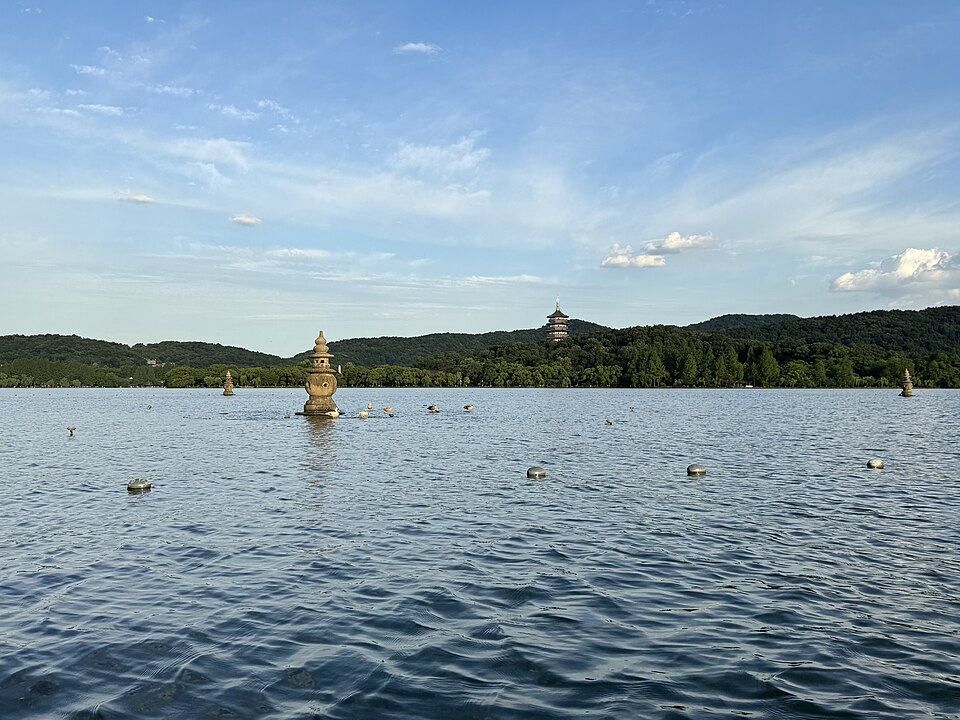
West Lake is the photograph everyone takes, and it earns the attention. But Hangzhou’s geography rewards anyone who steps past the shoreline: a national wetland park threaded with punt channels, a working canal that still carries coal barges under Ming-era stone arches, and, two hours west, a reservoir scattered with forested islands. This guide covers those three, plus a few smaller West Lake-area alternatives, and explains how to check the details that change — timetables, reservations, boat schedules — rather than trusting a figure printed months ago.
Xixi National Wetland Park
Xixi is the closest of the three to central Hangzhou and the easiest to do as a half day. It is a water forest rather than a lake: narrow reed channels, low bridges, and a network of paths that only makes sense once you accept you will move partly by boat. The electric punts are the standard way in, and the experience changes sharply by season — spring is green and quiet, autumn brings the persimmon orchards into colour and the waterside farmhouses into their hairy crab period.
Two practical points. First, the park is large enough that walking the whole thing is a poor use of a day; pick either the boat route or the outer dikes, not both. Second, bicycle rental on the outer dikes is a genuinely good option if the weather is dry, but confirm the rental point and return time on arrival rather than assuming a fixed closing hour. Entry arrangements, boat ticket tiers and any advance reservation requirement should be checked on the park’s official channels or a current booking platform before you travel — look specifically for whether a timed reservation is required and whether the boat ticket is sold separately from admission.
The Grand Canal, Southern End
The Grand Canal runs from Beijing to Hangzhou, and the southern terminus is a UNESCO World Heritage site that is still doing its original job. At Gongchen Bridge you can watch working barges slide past stone arches, which is a rarer sight than any reconstructed old town. The bridge itself is the anchor; the surrounding streets are where you spend the time.
Xiaohe Old Street, a short distance away, is the canalside neighbourhood most visitors miss. Go at dusk, when the lanterns come on and the water reflects the whitewashed houses. It is a residential area as much as a sightseeing one, so keep noise down and treat the lanes as someone’s front yard. There is no ticket to walk the canal or the old street; individual museums and halls along the route may charge separately, and those hours shift seasonally, so verify on site or via the site’s official listing rather than planning around a number from a blog.
For getting around the city generally, the metro is the reliable backbone, and the canal area is reachable from central stations. If you are new to Chinese metro systems, the payment and entry mechanics are worth reading up on before you arrive — see this guide to riding China’s metro in 2026.
Qiandao Lake (Thousand Island Lake)
Qiandao Lake is a reservoir in Chun’an county, roughly two hours west of Hangzhou by road. It holds over a thousand forested islands, and the water colour — an improbable turquoise in good light — is the reason people make the trip. Meifeng Island has the cable car and the classic panorama; the lake’s organic fish-head soup is the local dish worth ordering at least once.
The 140km greenway around the lake is a serious cycling route, not a casual loop. If you intend to ride it, plan it as its own day or multi-day, arrange the bike in advance, and check the current state of the greenway and any bike-rental terms locally. Boat routes between islands change with season and demand; buy on the day or verify the current schedule at the pier rather than relying on a published itinerary. Cable car operating hours and any closure for maintenance should be confirmed at the ticket office.
Smaller West Lake-area alternatives
The China National Tea Museum sits in the Longjing tea plantations and, at the time of writing, has no admission charge — but free museums in China often still require a timed reservation, so check the museum’s official booking channel before you go. The Nine Creeks (Jiu Xi) walking trail runs through the tea hills and is the best half-day walk in the area if you want shade and running water rather than crowds. Qinghefang historic street is the more commercial option: a Song-dynasty-themed pedestrian lane with shops and snacks, useful on a wet afternoon.
For eating around the lake and the old streets, our Hangzhou street food guide covers the specific dishes and where to find them.
Getting there and getting around
Hangzhou East railway station is the main rail hub, with frequent high-speed services to Shanghai and connections onward to Huangshan and Ningbo. Journey times and departure frequencies change with each timetable revision, so check the current schedule when you book. Booking itself is the part most first-timers find awkward; if you are using the official 12306 system, this step-by-step 12306 booking guide covers passport registration and seat selection. Seat classes and onboard food differ more than people expect, which is explained in this piece on high-speed rail seat classes.
For Qiandao Lake and Xixi, a private vehicle with driver is the efficient choice if your group is three or more, because both involve a final leg that public transport handles slowly. For multi-stop Jiangnan routes, an AI planner can help with sequencing, but be careful: models frequently invent opening hours. This guide to using AI for a China itinerary without invented opening hours explains how to use one safely. Spring and autumn remain the best windows; if you are weighing exact months, the seasonal guides for October and November set out the trade-offs.
Frequently asked questions
Do I need to reserve Xixi Wetland Park in advance?
Often yes, particularly at weekends and during autumn. Check the park’s official booking channel or a current Chinese ticketing platform for a timed-entry requirement, and note whether the boat ticket is separate from admission. Do not rely on a figure or rule quoted in an older article.
Is the Grand Canal area free to visit?
Walking the canal, Gongchen Bridge and Xiaohe Old Street costs nothing. Individual museums and halls nearby may charge, and their hours change seasonally — verify on site or via the venue’s official listing.
Can I visit Qiandao Lake as a day trip from Hangzhou?
It is possible but rushed, given roughly two hours each way by road. Most visitors get more from it with an overnight stay, which also makes the lake’s boat routes and the greenway feasible without watching the clock.
How do I get to Hangzhou from Shanghai?
High-speed rail from Hangzhou East is the standard option and is quick, but frequencies and journey times change with each timetable. Check the current schedule when booking, and confirm whether your passport is registered correctly on 12306 before departure.
What should I check before trusting an itinerary I generated with AI?
Opening hours, closing days, reservation requirements and transport timings. Cross-check each against the operator’s own page. AI is useful for sequencing a route; it is unreliable for anything that changes.
Treat every specific figure in this guide as something to confirm at the source: park booking channels for Xixi, the pier ticket office for Qiandao Lake boat routes, the railway app for timetables, and each museum’s own page for hours and reservations. The scenery does not move; the logistics do.