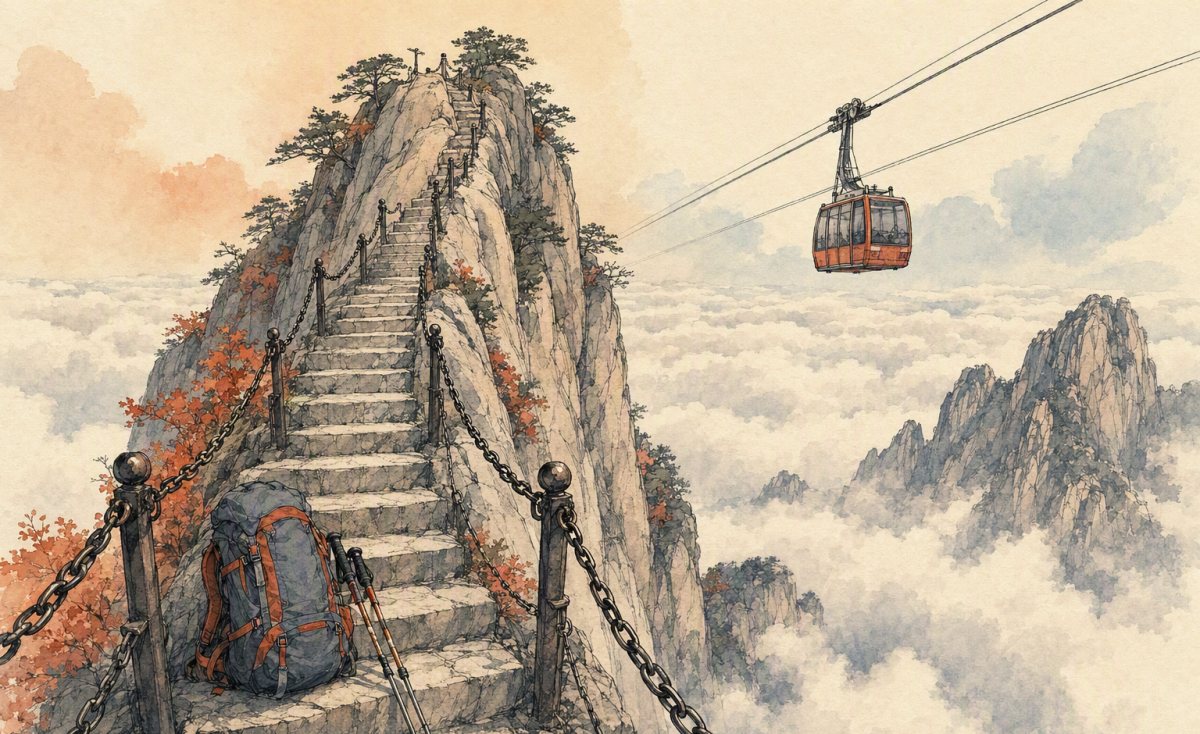
You do not need to be a mountaineer for Huangshan. Almost every path on the mountain is cut as stone steps with railings, and the walking itself is straightforward. What decides whether your legs survive day two is route choice: which cableway you take up, how much of the ridge you try to cover, and whether you sleep on the summit or at the base. This guide sets out the realistic options, the order that works best, and the things worth checking before you commit.
Cable car or steps: choosing your ascent
Huangshan has several cableways, and the two most useful for a first visit serve different parts of the massif. The Yungu cableway on the eastern side is the standard ascent, running up towards the ridge near the main summit hotel cluster. It is the sensible choice if you plan to sleep up top, because it puts you close to where you will stay and leaves the afternoon free for the West Sea. The Jade Screen cableway serves the southern side and lands near the Guest-Greeting Pine, which makes it the natural exit if you are doing the mountain in a single day and want to finish at the famous pine before descending.
Walking up instead of riding is possible on the eastern steps. It is a long, relentless staircase rather than a trail, and it takes most fit walkers a good half-day with a pack. Do it because you want the climb, not because you think it saves time. Cableway operating hours, seasonal closures for maintenance, and last-run times change through the year, so check the official Huangshan scenic area page or your hotel before you travel and look specifically for the current first and last departure times for each cableway.
The two-day route, and why it works
Go up by the Yungu cableway, walk out to Begin-to-Believe Peak, then check into a summit hotel and drop your bag. In the afternoon, walk the West Sea Grand Canyon, the deep slot between the rock pillars that is the most dramatic section of the mountain. Allow two to three hours, and note that a sightseeing monorail climbs out of the first section if your legs have had enough. Finish with sunset from Danxia Peak or Bright Summit, both a short walk from the summit hotels.
Day two starts with sunrise, then Flying-Over Rock, Bright Summit, and the walk down past the Guest-Greeting Pine to the Jade Screen cableway. This order puts the hardest walking on day one while you are fresh and keeps the second morning short, which matters when you are up before dawn in the cold.
The one-day version
If you only have a day, take the Yungu cableway up, walk to Begin-to-Believe Peak, shuttle across the ridge to Bright Summit, then descend via Jade Screen past the Guest-Greeting Pine. You will see the essence of the mountain. You will miss the sunrise, and you will sleep well afterwards. Trying to add the West Sea on top of this in one day is where people get caught out by the last cableway.
Training, packing and money on the mountain
Walk stairs with a loaded daypack for a couple of weeks before you go. That is the specific fitness the mountain asks for. Pack layers, because the summit runs noticeably colder than the valley below; a headlamp for the pre-dawn walk to a viewpoint; gloves for the chain sections; and snacks, since food on the mountain is carried up by porters and priced accordingly. Cards and phone payments are widely used in China, and our China cashless travel guide explains how WeChat Pay and Alipay work for foreign visitors, including how to check whether your card is supported before you rely on it.
Connectivity on the ridge is patchy in places. Sort your data before you arrive rather than on the cableway; the guide to Wi-Fi, eSIM and roaming in China covers the options and how to test them before you fly.
Where to stay
Summit hotels around Beihai, Shilin and Xihai are basic and expensive, and worth it for a zero-commute sunrise. Tangkou, at the base near the gates, is the budget option and works if you accept an early start and a queue. Hongcun, the village below the mountain, is the atmospheric choice for the night before or after. Availability at the summit is limited and peak-season dates sell out, so book early and confirm directly with the property that they accept foreign guests; our guide to hotels that accept foreign guests explains what to check.
Getting there and combining the trip
Most visitors reach Huangshan by high-speed rail and then take a bus or private car to Tangkou. Train seats on the relevant routes fill on weekends and holidays, so read the step-by-step guide to booking on 12306 and book as soon as your dates are fixed. Many travellers pair the hike with Hongcun and Qiandao Lake; a private car and driver solves the luggage-and-station problem, and an AI planner can draft the sequence, though you should verify every time and ticket against the operator.
Frequently asked questions
Do I need to be very fit to climb Huangshan?
No, but you need to be comfortable with stairs. The paths are stepped and railed, and cableways remove most of the ascent. The West Sea and the ridge walks involve hours of up-and-down steps, so train on stairs with a pack beforehand.
Can I see Huangshan in one day?
Yes, via the Yungu cableway up and Jade Screen down, with Bright Summit and the Guest-Greeting Pine in between. You will not see sunrise or the West Sea, and you must keep an eye on the last cableway departure time, which you should confirm on the official scenic area page.
Is it worth sleeping on the summit?
For sunrise, yes. Summit rooms are basic and costly, but they remove a pre-dawn descent and climb. If you are on a tight budget, stay in Tangkou and accept the early start.
How do I pay for things on the mountain?
Mobile payment is standard across China, including at many mountain vendors, but coverage and acceptance vary. Carry a backup card and check in advance whether your card works with the payment apps.
When should I go?
Spring and autumn are the most comfortable for walking. Whatever you choose, check the forecast for the summit rather than the valley, and verify current cableway hours and any maintenance closures before booking.
Plan the mountain around verified timings rather than optimistic ones: confirm cableway hours, summit availability and train seats first, then build the rest of the trip around them.