China is one of the most rewarding and one of the least intuitive places to visit for the first time. Nothing about it is dangerous or difficult — but a lot of it is different, and the travellers who have a rough trip are usually the ones who discovered the differences on day one instead of at home.
Here are the twelve things worth sorting before you book anything.
1. Entry rules for your passport
China has expanded visa-free entry considerably in the past two years for a growing list of nationalities, and its 240-hour transit-without-visa arrangement now covers dozens of countries and dozens of ports of entry. Rules, permitted stays and eligible entry points change often, so verify against official immigration sources close to booking rather than trusting a forum post from last year. If you do need a visa, apply before your peak travel season, not after.
2. Payments: QR wallets first, cards second
Everyday China pays by QR code. The two major wallets now accept foreign cards, and setup takes ten minutes — do it at home, with a small test transaction, not standing at a noodle stall. Card acceptance in cities is far better than its reputation, but markets, street food and small shops are QR-only. Carry some cash for your first day until the wallets are proven.
3. Connectivity before departure
This is the single highest-leverage item on the list. Maps, translation, ride-hailing, ride tickets and hotel directions all require data, and you need them within minutes of landing. A travel eSIM installed at home from a QR code avoids the airport queue and the in-store passport registration that domestic SIMs require. Plans are on our travel eSIM page.
4. WeChat, installed and verified early
WeChat is messaging, calls, payments, mini-programs and increasingly how hotels and drivers reach you. Register before you travel, have a friend message you so the account verifies, and add your travel companions. Do not leave this to arrival day: verification codes are the classic first-day blocker.
5. A route that respects distance
Chinese distances defeat European-sized intuitions. Before booking hotels, plot your candidate cities on the interactive map planner and read the kilometres on each segment. Two days per city minimum, a full day per transfer, and anything over 400 km between consecutive stops needs a train or a flight. Four stops in ten days is comfortable; six is a logistics exercise.
6. Decide rail versus car, leg by leg
High-speed rail is superb between major cities — cheap, fast, station-to-centre. A charter car with a driver-guide is the right call for mountain regions, rural towns, photography stops and any day with more than two places to reach. Because a car is priced per vehicle, it becomes good value from two travellers up. Mixing the two is what a well-built itinerary looks like.
7. Book the two things that sell out
Train seats on festival weekends and peak-season mountain park entry. Everything else can stay flexible so you can extend the city you like. And know the two calendars to avoid: National Day week in early October, and the Spring Festival week in January or February.
8. Offline everything
Download offline map regions for each city, camera-translation language packs, and playlists. Signal is excellent in cities and thin exactly where you want it — mountain trails, tunnels, deep old-town lanes.
9. Health and medication
Carry prescription medicines in original packaging with a copy of the prescription, plus a small first-aid kit and any regular medication for the whole trip. Air quality varies by city and season; if you are sensitive, pack masks and check forecasts. Travel insurance covering medical care abroad is standard practice and worth reading properly.
10. Packing for the reality of the itinerary
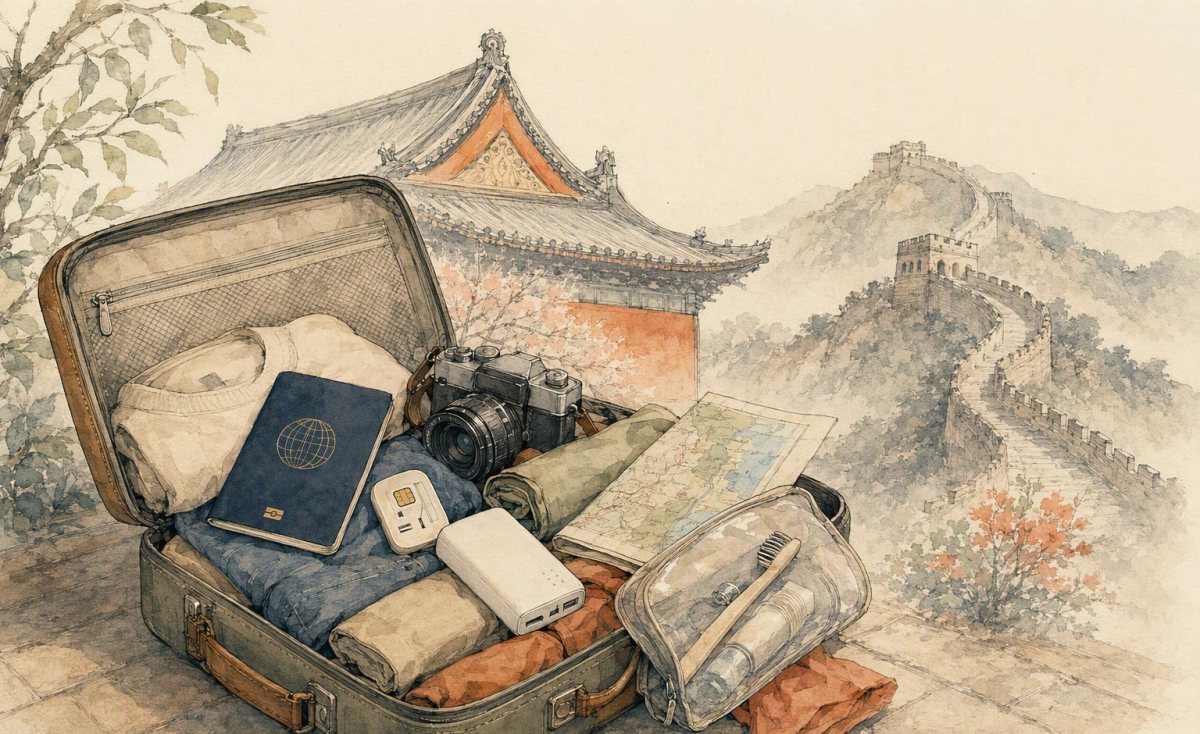
Comfortable broken-in shoes are non-negotiable — imperial sites and old towns involve kilometres of walking on hard stone. Pack layers for the season, a rain shell for southern summers, and a warm hat for northern winters. Bring a universal power adapter, and a power bank for long sightseeing days.
11. Language expectations, set honestly
English signage and staff are plentiful at airports, stations, four-star hotels and major attractions, and much thinner in smaller towns. A camera translator handles menus and timetables brilliantly. Learn three phrases — thank you, sorry/excuse me, and how much — and you will get warm reactions everywhere.
12. Decide what you want to remember
It sounds soft, but the trips people regret are the ones built entirely from a top-ten list. Choose one thing to do slowly — a market breakfast, an evening wall walk, a teahouse with no plan — and protect it in the schedule. Everything else on this checklist exists to make that possible.
Putting it in order
- Confirm entry rules for your passport.
- Choose dates outside the two peak weeks.
- Plot and cut the route on the map planner.
- Book flights, then the sell-out trains and parks.
- Set up wallets and WeChat at home; test one payment.
- Buy and install your data plan; download offline maps.
- Leave the last day of each city deliberately empty.
If you would rather hand the whole thing over, our designers turn a plotted route into a day-by-day plan with a driver-guide and hotels, from $200 — and you keep the itinerary either way.
Frequently asked questions
Is China difficult for a first-time visitor?
No — it is orderly, safe and punctual. The friction is language and digital setup, both of which are solvable at home.
How many days do I need?
Ten days covers one region well. Two weeks adds a second anchor city without rushing. Under a week, pick a single city and its surroundings.
Is it better to join a tour or plan independently?
Independent travel works well in the major cities. A private car and guide is worth it for mountain regions, rural routes and travelling with limited time.
What should I book first?
Flights and the two or three things that sell out. Leave the rest loose enough to change your mind on the ground.
A 90 / 60 / 30 / 1-day timeline
Ninety days out
Confirm entry rules for your passport. Choose dates away from the two peak weeks. Plot the route and cut it to size. Book long-haul flights.
Sixty days out
Reserve hotels in the first two cities and anything that sells out — mountain lodges, festival-week trains. Buy train tickets for peak dates as soon as sales open. Arrange travel insurance.
Thirty days out
Set up WeChat and verify it. Link your card to a QR wallet and test a small payment. Check your phone is unlocked and eSIM-capable. Book any guiding you want at major museum sites.
One week out
Buy and install your data plan — plans are on our travel eSIM page. Download offline maps and translation packs. Print or screenshot addresses in Chinese. Pack a small medical kit and any prescription in original packaging.
Day of
Charge everything. Screenshot your hotel address and route. Keep one card separate from the rest as an emergency reserve.
Packing by season, briefly
- Spring: layers, a light shell, comfortable shoes. Pollen is real in the north.
- Summer: breathable fabric, rain shell for the south, sun hat; expect humidity that makes wool trousers a mistake.
- Autumn: the easiest packing — warm days, cold mountain mornings, one fleece.
- Winter: proper coat, thermal base layers for the north, and lip balm; central heating is wonderful, buildings are warm, the walk to the taxi is not.
Three mistakes that are entirely avoidable
Booking six cities in ten days. You will remember the trains.
Leaving digital setup until arrival. Every hour lost to a verification code is an hour not spent at a site.
Assuming the trip is dangerous. It is not. China is orderly, punctual and safe for travellers; the challenge is unfamiliar systems, and unfamiliar systems are exactly what a checklist defeats.