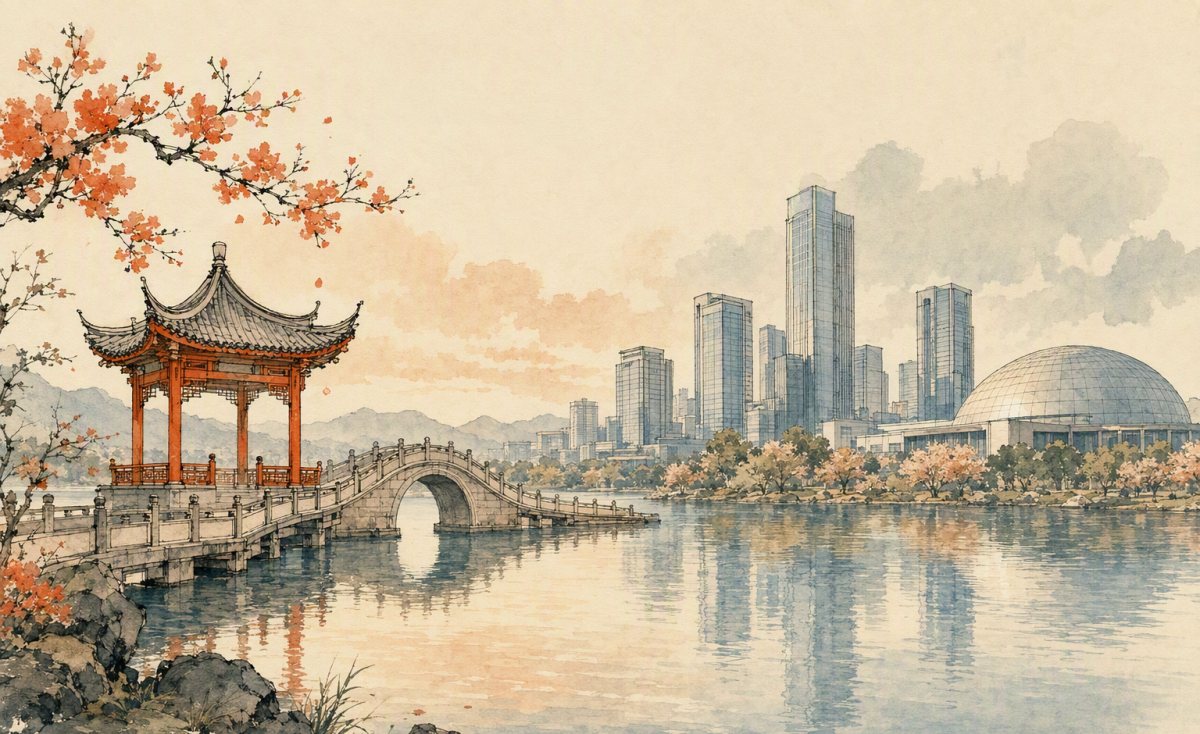
Hefei is the quiet overachiever of Chinese cities. Officially styled a comprehensive national science centre, it is also the provincial capital of Anhui, a lakeside city on one of China’s five great freshwater lakes, and the gateway to a water town that predates most of Europe’s surviving towns. It rarely tops anyone’s China list, which is precisely why it works: you get genuine sights, low crowds and a position that makes it the natural hinge between Huangshan’s mountains to the south and Nanjing’s history to the east. This guide covers what to see, what to eat, how to get there and how to plan it honestly.
What to see in Hefei
Chao Lake (Chaohu). The fifth-largest freshwater lake in China sits on the city’s southern edge. The lakeside boardwalks are the easy draw, and Mu Shan island, reached by boat, holds a temple and a short climb with wide views. The lake is at its most atmospheric in morning mist, which is a year-round phenomenon rather than a seasonal one. Boat timetables and any island entry arrangements change with weather and season, so check locally or on the operator’s page on the day rather than trusting a printed schedule.
Sanhe Ancient Town. Around 40 minutes from the city, Sanhe is a water town of stone bridges, covered lanes and Ming-Qing guild halls. Its history runs back roughly 2,500 years, and it is noticeably quieter than the better-known water towns around Suzhou. It is also a working town rather than a stage set, which is part of the appeal. Some halls and residences charge separate admission; confirm current arrangements at the gate or on the town’s official channel.
Science Island and the science museums. Hefei’s reputation in quantum computing and fusion research is real, and the campus area known as Science Island is its public face. The city’s science and technology museum is the practical stop for visitors. Access rules for research campuses are stricter than for ordinary attractions and can change, so verify what is open to the public before you travel rather than assuming a campus tour.
Lord Bao Memorial Temple and Xiaoyaojin Park. Bao Zheng, the incorruptible Song dynasty judge, was born in Hefei, and the memorial temple and his tomb site are the city’s most visited historical stop. Xiaoyaojin, a classical garden and park on an ancient battlefield, pairs naturally with it for a half-day.
Emerald Lake and the university district. The tree-lined campuses and café culture around the universities give Hefei a younger, more relaxed texture than its industrial reputation suggests. This is a good area for an unhurried afternoon.
Eating Anhui: what Hui cuisine actually is
Anhui cooking, or Hui cuisine, is one of China’s eight great regional traditions, and Hefei is a good place to try it without a tasting-menu price tag.
Stinky mandarin fish is the signature dish and tastes far better than its name suggests: the fish is fermented before cooking, which gives it a deep savoury edge rather than a rotten one. Li Hongzhang hotchpotch is a braised mix of meats, seafood and vegetables, attributed to the Qing statesman Li Hongzhang, who was himself from Hefei. Sanhe rice-pudding shrimp is the local speciality of Sanhe town and worth ordering if you go there for lunch. If you keep halal, vegetarian or otherwise restricted diets, plan ahead rather than improvising, and see this practical guide to halal and vegetarian food in China for how to phrase requests and where to look.
Getting there and onward: Hefei as a hinge
Hefei’s main advantage is rail. High-speed services run south to Huangshan in roughly an hour and a half, east to Nanjing in about an hour, and on to Shanghai in around two hours. Those are indicative journey times, not a timetable: check actual departures, seat classes and prices on the official booking channel or a reputable agent for your dates. For the mechanics, see this step-by-step guide to booking train tickets on 12306, and for what the different carriages actually get you, this explainer on high-speed rail seat classes and onboard food.
The practical result is a clean Anhui loop: Huangshan and Hongcun in the south, Hefei in the middle, Nanjing to the east. Hefei works either as a two-night base or as a single-night waypoint between the mountains and the Yangtze delta. If you are coming from Shanghai specifically, this guide to visiting Huangshan from Shanghai covers the mountain leg in detail.
When to go
April to May and September to November are the most comfortable months, with moderate temperatures and less rain than summer. Summer in the Yangtze basin is hot and humid, and winter is cold and grey without snow to compensate. The lake is worth seeing in any season if you go early, since the mist is the point. October and November are particularly good across Anhui as a whole; see this guide to travelling in China in November for what that means for crowds and conditions elsewhere on your route.
Practical planning notes
Chao Lake, Sanhe and the city sights are spread out, and public transport between them is slow. A private car charter for a day or two links the lake, the water town and the mountain transfer comfortably, and is usually the difference between seeing three things and seeing one. Ask for the price in writing, including waiting time and tolls, before you commit.
As with anywhere in China, sort the basics before you fly: payment apps, a data plan that works on arrival, and any attraction reservations. Some sites now require advance booking with a passport, and the rules differ by city. This guide to attraction reservations for foreign visitors explains which places genuinely need one. If you want help drafting an Anhui loop, an AI planner can structure the route well, but it will invent opening hours and prices if you let it; this piece on using AI for a China itinerary without invented opening hours shows how to use it safely.
Frequently asked questions
How many days does Hefei need?
Two nights is enough for Chao Lake, Sanhe and the central sights at a relaxed pace. One night works if you are using it purely as a rail waypoint between Huangshan and Nanjing, though you will have to choose between the lake and the water town.
Is Sanhe Ancient Town worth it compared with Suzhou’s water towns?
Yes, if you value quiet over polish. Sanhe is smaller and less restored, with fewer shops aimed at visitors. If you want the full canal-and-garden experience with more to see, Suzhou and its satellites remain the stronger choice.
Do I need to book Hefei attractions in advance?
Some museums and memorial sites in China now require a passport-linked reservation, and Hefei is no exception for certain venues. Check each site’s official channel a few days ahead, and carry your passport, since it is the document the booking is tied to.
Can I visit Chao Lake without a car?
It is possible using buses and local taxis, but slow and awkward, particularly for Mu Shan island. A chartered car for the day is the practical option if your time is limited.
What should I eat in Hefei if I do not eat pork or seafood?
Hui cuisine leans heavily on both, so ask clearly and expect limited options at traditional restaurants. Vegetarian and halal food is available in the city, but you will need to search for it rather than assume it; the food guide linked above covers how to ask.
Hefei rewards travellers who treat it as a real destination rather than a station stop. Give it two nights, go to the lake early, eat properly, and let it break the journey between the mountains and the delta.