
Posted on — Leave a comment

China Weekend Trips: 10 Ideas You Can Do in 2–3 Days (2026)

A China weekend trip is a short getaway, usually 48 to 72 hours, built around one destination you can reach quickly from a major hub. The trick is picking somewhere with enough to see for two days but close enough that you are not spending the whole weekend on a train. This guide covers the best China weekend trips by base city, how to get there, and what realistically fits before Sunday night.

How to choose a China weekend trip

Three rules keep a short trip from turning into an ordeal. First, cap one-way travel at roughly three hours; high-speed rail is the backbone of almost every good weekend route, so plan around stations rather than airports where you can. Second, pick a place with two or three anchor sights, not ten. Third, book the return train before you go, because weekend departures on popular corridors fill quickly.

It also helps to understand what you are buying. Seat classes, luggage space and onboard food vary by train type, and the differences matter more on a tight schedule than on a long trip. Our guide to China high-speed rail seat classes and onboard food explains the categories so you can choose sensibly. For the booking mechanics themselves, including passport registration and collection, see how to book train tickets in China on 12306. Ticket release windows and ID requirements change, so confirm the current rules on the official 12306 site or app rather than relying on any third-party summary.

Best China weekend trips at a glance

The table below lists commonly used weekend pairings by base city. Travel times are indicative only and depend on the specific service you book; check the operator’s timetable for your date rather than assuming a fixed duration.

Base city Weekend destination Best for Private car?
Beijing Mutianyu or Jinshanling Great Wall Hiking, photography Recommended
Beijing Chengde Mountain Resort Imperial gardens No
Shanghai Zhujiajiao or Wuzhen water towns Canals, lanterns Helpful
Shanghai Suzhou gardens Classical gardens, silk No
Shanghai Hangzhou and West Lake Lakes, tea, temples No
Chengdu Leshan Giant Buddha Ancient scale, food No
Chengdu Mount Emei Sunrise, temples Recommended
Guilin Yangshuo Karst peaks, rafting Helpful
Xi’an Huashan Dramatic peaks No
Guangzhou Shamian Island and Canton food Food, colonial streets No

From Beijing

The Great Wall is the obvious China weekend escape, and Mutianyu suits a short trip: restored sections, a cable car up and a toboggan down, and generally fewer visitors than Badaling. Opening hours, cable car operation and ticket arrangements change with season and weather, so check the site’s official channel before you commit to a day. For something quieter, Chengde’s Mountain Resort is a straightforward rail hop and gives you imperial gardens without Beijing’s crowds. Note that some Beijing attractions now require advance timed reservations for foreign visitors; our guide to booking attractions in China covers which ones typically do and how the passport-based process works.

From Shanghai

The Jiangnan water towns are made for a weekend. Suzhou pairs classical gardens with an old-town canal walk; Hangzhou’s West Lake can absorb a full two days of tea houses and causeways. If you only have one day, pick a single water town rather than cramming three. For a longer look at the lake city, see the five-day Hangzhou itinerary, which you can trim to a weekend by dropping the outer districts. Huangshan is also reachable from Shanghai if you accept a longer transfer and want mountain scenery instead of canals.

From Chengdu, Guilin and Xi’an

Chengdu makes an easy base for a Leshan Giant Buddha day: take an early train, walk the cliff path, eat before heading back. Add a night on Mount Emei if you have a full weekend and want sunrise above the clouds. From Guilin, base yourself in Yangshuo rather than Guilin to cut transfer time; the Guilin to Yangshuo three-day itinerary shows how the pieces fit and which parts to drop for a 48-hour version. From Xi’an, Huashan is the classic short escape, though the cable car queues and trail conditions determine how much you actually see. Check current cable car hours and weather warnings locally.

Weekend trip planning tips

Sort connectivity before you fly. A travel eSIM or roaming arrangement determines whether maps and train apps work the moment you land, and the options differ in cost and setup. Our explainer on internet access, Wi-Fi and eSIMs in China sets out how to verify what works on your handset. Beyond that: buy rail tickets as early as the release window allows, leave luggage at your base hotel rather than hauling it, and keep the itinerary to one region. Public holidays distort everything, so check the calendar before booking. If you would rather not assemble the train, driver and hotel yourself, a custom trip designer can bundle them, but confirm exactly what is included in writing.

Frequently asked questions

What is the easiest China weekend trip from Shanghai?

Suzhou or Hangzhou. Both are short high-speed rail hops and give you a full day of sights without long transfers. Check the current timetable for your date, as journey times vary by service.

Is two days enough for Yangshuo?

Yes for the highlights: a Li River or Yulong raft, one cave, and an evening on West Street. Base yourself in Yangshuo rather than Guilin to save transfer time. Raft operating hours and river conditions vary, so confirm locally.

Do I need a private car for a weekend trip?

Not for city or rail-served stops. A car helps for Great Wall sections, Mount Emei and rural water towns where buses are slow or infrequent. Agree the price and waiting time in advance.

How far in advance should I book a China weekend trip?

Book train seats and popular hotels several days ahead. Around public holidays, allow considerably more. Ticket release windows are set by the rail operator, so check the official 12306 channel for the current rule.

Can I do a weekend trip on a visa-free transit stay?

Possibly, but eligibility depends on your nationality, ports of entry and exit, and the current scheme rules. Verify against the official immigration source for your itinerary before booking anything non-refundable.

Treat any weekend plan as provisional: confirm transport times, opening arrangements and entry requirements on the operator’s or official page before you pay, and build in slack so a delayed train does not cost you the whole trip.

Posted on — Leave a comment

17 Best China Souvenirs: What to Buy, Prices & Fake-Avoidance Guide

China is an easy place to buy gifts and a difficult place to buy good ones. The same street that sells a hand-tied silk scarf will sell you a polyester one at the same price, and the difference only becomes obvious once you are home. This guide sorts gift ideas by budget, explains how to tell real materials from convincing fakes, and points you towards the checks that matter before you hand over money. Treat the bands below as rough groupings rather than fixed prices: costs move with season, city and shop, so always confirm the current figure with the seller or on the official page before you commit.

Under a modest budget: stocking fillers that travel well

Small, light and flat is the rule for cheap gifts, because anything bulky eats luggage allowance and anything fragile rarely survives a connecting flight. Fridge magnets stamped with a landmark are the classic, and they are genuinely popular. Bookmark sets with Great Wall or terracotta motifs, tea sampler tins, chopstick sets and paper-cut art all pack flat. Framed paper-cut art turns a cheap item into a proper present. Panda plush toys are widely sold, but the ones from the official base shops look noticeably better made than the market versions; if you are visiting Chengdu, see our Chengdu and the Giant Panda Base guide for how a visit there actually runs.

At this level, buy on appearance rather than claims. If a seller says something is handmade, silver or old, ask what it is made of and watch whether the answer stays consistent. Verify any price on the shop’s own sign or receipt rather than a guide’s quoted figure.

Mid-range: tea, silk and small craft pieces

This is where Chinese gifts get interesting, and where a little knowledge pays off.

Tea is the safest mid-range gift because it is consumable, light and genuinely appreciated. Longjing (Dragon Well) from the Hangzhou area is the best-known green tea; gift tins from spring harvest are the ones to look for. Pu-erh is sold as compressed cakes and improves with age, which makes it an unusual present. Buy from shops that let you smell and, where possible, taste before buying, and ask for the harvest date rather than accepting a vague “this year”. Our Hangzhou itinerary covering lakes, tea and silk shows where tea and silk shopping fits into a real trip.

Silk scarves from Suzhou are the other staple. A simple test: pull a loose thread and burn it. Real silk smells like burning hair and leaves a crushable ash; polyester melts into a hard bead and smells of plastic. Ask before you test, and only test a thread you can spare.

Cloisonné boxes, tea sets and a carved personal seal round out this band. For jade, do not buy from a tourist-street stall on impulse; read the fake-spotting notes below first.

Higher budgets: pieces people keep

At the top end you are buying craft, provenance and time. Hand-knotted silk carpets from established workshops are the obvious example; the difference between a workshop piece and a machine-made tourist rug is visible in the back of the carpet, where hand-knotting shows individual knots and slight irregularity. Bronze replicas of Shang-dynasty vessels are sold with foundry certification at reputable dealers. Yixing teapots from recognised potters, embroidery panels and calligraphy by a working artist all fall here.

For anything at this level, ask for written documentation of the maker, the material and, where relevant, the certificate. If a seller cannot or will not provide it, treat the item as decorative rather than collectible and price it accordingly. Check whether large purchases qualify for a departure refund; the rules and thresholds change, so confirm the current process on our China tax refund for tourists guide before you assume anything.

Fakes: how to check before you pay

Three checks cover most of what tourists get caught by.

Jade. Real jade feels cool against the skin and is hard enough that a steel blade will not scratch it easily. Glass imitations warm up quickly in the hand, feel lighter than expected, and scratch readily. Hold the piece for a minute before deciding.

Silk. As above: burn a spare thread. Polyester stretches and springs back; silk does not behave that way.

“Antiques”. Anything sold as antique on a tourist street is almost certainly a replica. That is fine if it is priced as a replica and the seller says so plainly. It is not fine if you are paying an antique price for a modern copy. Ask directly: “Is this new or old?” A straight answer is a good sign.

Practicalities: money, packing and getting it home

Most shops in cities now expect mobile payment, and foreign cards do not always work the way you expect. Our China cashless travel guide explains how WeChat Pay and Alipay work for visitors, and how to check whether your card is supported before you rely on it.

Packing matters as much as buying. Tea and paper items go flat in the middle of a suitcase; ceramics need wrapping and should travel in hand luggage if they matter to you. Silk and textiles crease, so roll rather than fold. If you are carrying high-value craft items, keep receipts and certificates together in case customs asks.

Frequently asked questions

How do I know if a silk scarf is real?

Burn a single loose thread. Real silk smells like burnt hair and leaves soft ash; synthetic fibre melts into a hard bead and smells chemical. Ask the seller first, and only test a thread you do not need.

Is it worth buying jade as a souvenir?

Only if you can check it properly and the price matches what you are actually getting. Hold it to see how quickly it warms, and try a light scratch test with steel. If you are unsure, buy something else or treat the piece as decorative.

Can I get a tax refund on gifts bought in China?

Refund schemes exist for eligible purchases, but the thresholds, participating shops and paperwork requirements change. Check the current rules on the official tax refund page and confirm with the shop before you buy, rather than relying on an old figure.

Where should I buy tea?

Shops that let you smell and taste, and that can tell you the harvest date, are the ones worth your money. Gift tins of Longjing and compressed pu-erh cakes travel well and are easy to pack.

Will my gifts survive the flight home?

Flat, light and well-wrapped items almost always do. Ceramics and anything fragile should go in hand luggage, textiles should be rolled, and tea should be kept away from strong smells in your bag.

Buy less than you think you need, check materials before you pay, and confirm any price, refund rule or opening detail at the source rather than from a guide written months earlier. A well-chosen tea tin or a scarf you have actually tested will be remembered far longer than a suitcase of souvenirs you were not sure about.

Posted on — Leave a comment

China on a Budget: How to Travel for $50 a Day (Honestly)

Yes, China on $50/day is genuinely doable in 2026 – here’s the honest breakdown (and where NOT to cut corners). Bookmark for the group chat.

The Real Budget Math

Yes, China on $50/day is genuinely doable in 2026 – here’s the honest breakdown (and where NOT to cut corners). Bookmark for the group chat.

Where $50 Goes

Hostels ¥80-150 ($12-20) · street/local food ¥30-60/day ($5-8) · metro everywhere ¥10-20/day ($2-3) · one paid attraction/day ¥60-120 ($8-16) · bullet train legs $10-40 each. Total: ~$40-55/day before splurges.

Budget Hacks That Work

Eat where queues form (turnover = freshness + local prices) · hostels with kitchens in expensive cities · museum days (state museums are FREE – book ahead) · night trains for long routes (save a hotel night) · student/senior discounts at most sights (bring ID) · university districts for cheap eats.

Where to Splurge Instead

Three splurges that transform budget trips: (1) one private Great Wall morning ($100) – worth ten metro rides, (2) a real Peking duck banquet ($25 vs $6 street dinner), (3) a day with a private guide in one city ($100) – unlocks everything else.

Our Budget-Conscious Services

Seat-in-coach day tours ($40-80) + shared transfers + free AI itinerary planning = private-tour quality at backpacker-adjacent prices where it counts.

Turn Inspiration Into a Trip

Everything above is bookable or plannable: free AI itinerary planner · WhatsApp travel designer +86 180 3801 6100 · full guide library.

Posted on — Leave a comment

10 China Travel Myths That Are Completely Wrong (2026 Edition)

Ask a group of people who have never been to China what they expect, and the same handful of assumptions tends to surface: that it is dangerous, that nothing works online, that cash is king, that trains belong to another era. Most of these ideas come from 1990s travel writing, second-hand news coverage, or rules that have since changed. The result is that people talk themselves out of a trip they would almost certainly enjoy. This page takes the most common myths one by one and replaces them with what you can actually expect on the ground, plus how to verify the details that matter before you book.

Myth: China is dangerous for tourists

Violent crime against visitors is rare, and walking around major cities at night is generally unremarkable. The more realistic risks are ordinary ones: traffic, pickpocketing in dense crowds, and petty scams around the most heavily touristed areas. Standard precautions apply, as they would in any large city anywhere.

What surprises many first-timers is the visible security presence: cameras in public spaces, bag checks at metro stations, and ID checks at some attractions. This is part of everyday infrastructure rather than something aimed at you. Carry your passport, since it may be requested when buying tickets or entering certain sites. If you take medication regularly, read up on healthcare in China for travellers so you know how pharmacies and clinics work before you need them.

Myth: You cannot get online in China

Internet access works, but some foreign platforms and services are not reachable on local networks. Whether a particular app or tool functions during your trip depends on your network, your roaming arrangement and the current situation on the ground, so treat any confident claim, in either direction, as something to check rather than believe.

The practical approach is to sort out connectivity before you fly. Decide between roaming, a travel eSIM or a local SIM, install and test whatever you plan to use while you are still at home, and have a backup. Our guide to internet access, Wi-Fi, eSIM and roaming walks through the options, and the eSIM setup guide covers installing and testing before departure.

Myth: China runs on cash

The opposite is closer to the truth. QR code payment is the default for everything from metro fares to street food, and many stalls simply do not keep change for notes. Foreign cards can often be linked to the major payment apps, but eligibility and limits change, so confirm the current process on the app’s own help pages rather than relying on a blog post, including ours.

Carry a small amount of cash as a fallback, and keep a physical card for hotels and larger purchases. If you want the detail on linking a foreign card and using QR payments, see the cashless travel guide. Tipping is not expected in most situations; the etiquette guide explains where it is and is not appropriate.

Myth: The trains are slow and outdated

China’s high-speed rail network is extensive, punctual and often the most sensible way to move between cities, with stations close to city centres and no airport-style security queues. Seat classes range from second class through to business, and onboard food is available, though many travellers bring their own.

Booking is the part that trips people up. Tickets usually open for sale a set number of days ahead, seats on popular routes sell out, and you need your passport details to book. The exact release window changes, so check the official 12306 site or app for the current rule. Our step-by-step guides to booking train tickets on 12306 and to seat classes and onboard food cover the process in detail.

Myth: You need a month, and a pile of paperwork

Neither is true. Visa-free transit schemes allow short stays for eligible nationalities arriving under the right conditions, and there are bilateral visa-free arrangements with a number of countries. The rules differ by passport, port of entry and route, and they change, so check the official immigration or embassy page for your nationality and read the conditions carefully, particularly the requirement to travel onward to a third country.

Itinerary length is flexible too. A long weekend in one city is a legitimate trip. If you are using a transit entry, our visa-free transit checklist sets out what to prepare. For a first visit, the first-time checklist covers the things worth sorting before you book.

Where the myths come from

Most of them were accurate at some point. Travel writing from the 1990s described a different country with different infrastructure and different entry rules. Media coverage tends to focus on politics rather than the ordinary experience of buying a train ticket or eating lunch. And old visa requirements linger in people’s memories long after they change. The sensible response is not to assume China is easy or difficult, but to check the specific thing you are worried about on an official source, then plan around it.

Frequently asked questions

Is China safe for a solo traveller?

Generally yes, including for women travelling alone. Violent crime against visitors is uncommon and public transport is well used at most hours. The usual precautions apply: watch your belongings in crowds, use official taxis or ride-hailing apps, and avoid unlit areas late at night as you would anywhere.

Can I use my normal apps and websites?

Some foreign services are not reachable on local networks, and the situation can change. Rather than assuming either way, test your essential apps before you leave, arrange a connectivity backup, and check current information close to your departure date.

Do I need cash, or can I pay by phone?

QR payment is standard and widely accepted. Many foreign cards can be linked to the main payment apps, but eligibility and limits change, so verify on the app’s own pages. Carry a small cash float and a physical card as backup.

How far ahead should I book train tickets?

Tickets open for sale a fixed number of days before departure, and the figure is adjusted from time to time. Check the official 12306 site or app for the current window, then book as soon as your dates open, especially for popular routes and around public holidays.

Do I need a visa, or can I use visa-free entry?

It depends on your nationality, your route and how long you plan to stay. Visa-free transit and bilateral visa-free arrangements have specific conditions, including onward travel requirements. Confirm the current rules on your country’s official immigration or embassy page before booking flights.

Treat every claim on this page, including ours, as a starting point rather than a final answer, and confirm the details that affect money, entry and timing on the operator’s or government’s own page. Once those are settled, the trip itself is far more straightforward than the myths suggest.

Posted on — Leave a comment

One Week in China: 5 Perfect 7-Day Itineraries (For Every Traveler)

One week in China is a real constraint, not a marketing problem. Domestic travel is fast but distances are large, and every extra city costs you half a day in transfers. The five outlines below are the ones we plan most often, each matched to a different kind of traveller. Treat them as shapes rather than fixed itineraries: pick the one that sounds like you, then adjust the internal days. Before booking anything, confirm current entry requirements on the official Chinese embassy or consulate site for your nationality, and check attraction reservation rules, since several major sites now require advance booking with your passport.

Classic first-timer: Beijing, Xi’an, Shanghai

Three days in Beijing covers the Great Wall, the Forbidden City and a hutong walk. Two days in Xi’an covers the Terracotta Army, cycling the city wall and the Muslim Quarter. Two days in Shanghai covers the Bund and the former French Concession. The three cities sit on one high-speed rail corridor, so you travel by train rather than flying and keep your luggage with you.

Book the Forbidden City and the Terracotta Army in advance. Both use timed entry and passport-linked reservations, and the process for foreign visitors is not always the same as for domestic travellers — our guide to attraction reservations for foreigners walks through what actually needs booking. For trains, read how to book train tickets on 12306 before you try, because the passport verification step trips up most first-timers.

Nature lover: Chengdu, Jiuzhaigou, Leshan

Chengdu for two days, Jiuzhaigou for two, Leshan for one, then two slower days back in Chengdu with teahouses and no alarm clock. This is the soft, green side of the southwest: pandas, turquoise lakes and a giant carved Buddha.

Two practical warnings. Jiuzhaigou is high-altitude and its entry system is capacity-controlled, so check the official scenic area page for how tickets are released and whether your dates need a reservation. Leshan and the Chengdu panda base both get crowded early; go at opening. For the panda base specifically, our realistic day at the Chengdu panda base explains the timing that actually works. If you are considering adding Tibet to a southwest week, note that Tibet requires permits arranged through a licensed operator — see the Tibet travel guide for how that process works.

Photographer’s week: Beijing, Guilin, Yangshuo

Two days in Beijing for a Great Wall sunrise, then fly south to Guilin for the Li River, then two days in Yangshuo for cycling and early light, finishing with one city day in Shanghai on the way home. The light is the point: dawn on the wall, mist on the karst, golden hour over the Yulong River.

This route only works if the flights line up, so build in slack. The Li River cruise is a scheduled departure rather than a private boat, and which section you sail depends on water levels — the Li River cruise guide covers the route options. For the Guilin–Yangshuo leg, the 3-day Guilin to Yangshuo itinerary is a useful base to compress.

Deep culture: Xi’an, Pingyao, Beijing, Tianjin

Xi’an for two days, Pingyao for one, Beijing for three, and a final day in Tianjin for food. This is the museum-and-dynasty week: the Ming walled town at Pingyao, the major Beijing collections, and the older layers of Xi’an. The alternative version is the Jiangnan week — Shanghai, Hangzhou and Suzhou — which trades imperial history for gardens, canals and tea.

Pingyao is small and walkable, and the train connections via Pingyao Ancient City station are straightforward, but verify current schedules rather than trusting an old timetable. Hangzhou deserves more than a day if you take the Jiangnan option; the 5-day Hangzhou itinerary shows what a longer stay looks like.

What every one-week route has in common

Three things decide whether a seven-day trip feels calm or frantic. First, transport: high-speed rail is fast but stations sit outside city centres, so count door-to-door time, not just the timetable. Second, payments and connectivity: set up a payment method and a data plan before you fly, and test both. Third, reservations: the headline attractions increasingly require them.

On payments, check the current status of international card linking inside WeChat Pay and Alipay on the official apps themselves rather than relying on any article, including ours. On data, decide between roaming, a physical SIM and an eSIM, and confirm what your own carrier offers — the eSIM versus physical SIM comparison sets out the trade-offs. For hotels, confirm in writing that your chosen property accepts foreign guests, since registration rules vary; our guide to hotels that accept foreign guests explains what to ask.

Frequently asked questions

Is one week in China enough?

For two or three cities on one rail corridor, yes. For four or more cities spread across the country, no — you will spend the week in transit. Choose one region and go deeper.

Should I book trains in advance?

Yes, especially on popular routes and around public holidays. Tickets typically open on a rolling window before departure; confirm the current window on the official 12306 site or app, and note that foreign passports need verified accounts.

Do I need a visa for a seven-day trip?

It depends entirely on your nationality and your route. Some travellers qualify for visa-free transit schemes with specific port and onward-ticket conditions; others need a visa. Check the official Chinese embassy site for your country and read the conditions carefully rather than assuming.

Can I do this without speaking Chinese?

Yes, in the cities above, with a translation app and screenshots of addresses in Chinese. Expect less English outside Beijing, Shanghai and Xi’an, and plan for it — see our guide to translation apps and phrases.

How much will it cost?

Costs vary too much by season, city and standard to quote a figure here. Build a rough budget from current train fares, hotel rates and attraction prices on official sites, and check our 10-day cost breakdown for the categories that matter most.

Pick the route that matches how you actually like to travel, then verify the moving parts — reservations, train windows, entry rules and payment setup — on the official pages before you commit. A well-checked seven days beats a rushed fourteen.

Posted on — Leave a comment

China With Kids: The Perfect Family Trip (Ages 3-15 Guide)

One anchor activity per day, an afternoon pool break, a food market or dumpling dinner in the evening, and no 4 AM starts. That is the pacing behind every family tour we plan, and it is the reason children remember the trip rather than the coach. This guide is the shareable version of that formula: what works at each age, what parents actually need to pack and book, and how to turn the ideas below into a real itinerary without guessing at opening hours or ticket rules.

The family formula: one anchor activity per day

The single biggest cause of miserable family travel in China is over-scheduling. Cities are large, attractions are spread out, and a “three sights before lunch” plan collapses the moment a four-year-old refuses to walk. Our rule is one anchor activity per day — the panda base, a section of the Great Wall, the Terracotta Army — and everything else is optional filler. Book the anchor in advance where reservations are required, then leave the rest of the day loose. Many major sights now expect timed online booking, and the rules differ by site and by passport type, so check the official page for the attraction itself and look specifically for the reservation window, the ID document accepted and whether a same-day ticket exists. Our guide to attraction reservations foreigners actually need walks through the current pattern.

Afternoons belong to the hotel pool or a quiet hour indoors. This is not a compromise; it is what makes the evening work. Children who have swum and rested will happily eat their way through a night market at 7 PM. Children dragged through a fourth temple will not.

By age: 3 to 6

Chengdu is the strongest first stop for this age group. The Giant Panda Base rewards slow mornings, and the younger enclosures hold attention far longer than any museum. Check the base’s official channels for the current opening time and last entry, and go early for cooler weather and more active animals — our realistic day at the Chengdu Panda Base covers the layout and timing. Shanghai Disneyland is the other obvious anchor; two days works better than one with small children because it removes the pressure to sprint. Between the big-ticket days, rotate aquariums, science museums and boat trips through the water towns — travelling by canal rather than on foot keeps tired legs happy.

By age: 7 to 12

This is the age for the memory that gets retold at school. The toboggan descent from the Mutianyu section of the Great Wall is that memory for most families; check the site’s own information for current operating status, as weather and maintenance affect it. Xi’an pairs the Terracotta Army with a noodle-making or dumpling-folding class, which turns dinner into an activity. Build in a “try one weird thing” game at night markets — it works on reluctant eaters. For city-to-city legs, the high-speed rail is itself entertainment at this age; read up on seat classes and onboard food before you book so you choose the right carriage for a family group.

By age: 13 to 15

Teenagers respond to scale and to things they have already seen on a screen. Zhangjiajie’s sandstone pillars carry instant credibility. Beijing’s 798 district and Shanghai’s sheer urban density work for the same reason. A calligraphy class lands better than you would expect at this age, particularly if it is short and hands-on. In Yangshuo, cycling or e-biking through the karst countryside gives teenagers an hour of independence while parents keep the route short — see our Guilin to Yangshuo itinerary for how that fits into three days.

Parent logistics cheat sheet

Book a seven-seat MPV for a standard family and a larger vehicle for three generations travelling together; specify child seats at the time of booking, not on arrival, and confirm the supplier actually provides them rather than assuming. Choose hotels with pools and confirm the pool is open during your dates, since seasonal closures are common. Western breakfast is widely available in larger cities but not guaranteed in smaller towns, so treat it as a bonus rather than a plan. Strollers work at most major sights but not all — stepped temple complexes and some wall sections are the usual exceptions. For payments, transport and connectivity basics, start with our first-time in China checklist, which covers what to sort before booking.

Turning inspiration into a trip

Everything above is bookable or plannable. An AI planner can draft a route and a day structure quickly, but it will sometimes invent opening hours, so verify every timed detail against the operator’s own page — our notes on using AI for a China itinerary without invented opening hours explain where it breaks. If you would rather have a person handle pacing, vehicle type and reservations, a travel designer can build the same structure around your children’s ages and your travel dates.

Frequently asked questions

How many cities should a family trip to China cover?

Fewer than you think. With one anchor activity per day and an afternoon break, two or three bases in a week is realistic. Each internal move costs roughly half a day once you account for station transfers, luggage and settling in.

Do we need to book attractions in advance?

For popular sites, often yes, and the process can differ for foreign passports. Check the attraction’s official booking page for the release window, the accepted ID document and whether tickets are released daily or in blocks, then book as soon as your dates are fixed.

Is high-speed rail practical with young children?

Generally yes, and it is usually easier than flying for medium distances. Book seats together, allow extra time at large stations, and confirm the current ticket-booking requirements for foreign passports on the official 12306 platform or an authorised agent before you travel.

What should we pack that families commonly forget?

Child seats confirmed in writing, a refillable water bottle per person, layers for air-conditioned trains and museums, and any medication your child uses regularly in its original packaging. Check current rules on carrying medicines before you fly.

When is the best time of year for a family trip?

Shoulder seasons usually suit children better than peak summer heat or deep winter. Autumn and spring generally give milder conditions for walking and outdoor anchors, but check regional climate, school holiday crowds and public holiday dates before committing.

Plan the anchor activities first, protect the afternoon break, and let the evenings be about food. That structure holds up whether you are travelling with a three-year-old or a fifteen-year-old, and it is the difference between a trip children endure and one they ask to repeat.

Posted on — Leave a comment

China Month by Month: Where to Go Every Month of the Year

China is huge, so there is no single “best time” — the right month depends on where you are going. This calendar takes it month by month: what is in season, where to head, and which weeks to avoid because of weather or domestic-holiday crowds.

The short version

Spring (April–June) and autumn (September–October) are the safest bets almost everywhere. Summer is great for Yunnan, the far north and the coast, tough in central cities. Winter is best for Harbin’s ice festival, mild Sanya beaches, and empty, snow-dusted sights elsewhere.

China month by month

Month Go to Skip / watch out
Jan Harbin ice festival, Sanya beaches Cold north; pre-Spring-Festival travel rush
Feb Sanya, lantern festivals Spring Festival — everything crowded and pricey
Mar Nanjing, Wuhan blossoms, Yunnan North still chilly and dusty
Apr Guilin, Hangzhou, Longji planting Qingming holiday weekend
May Jiuzhaigou, Zhangjiajie, Tibet Labour Day — worst crowds of spring
Jun Inner Mongolia, Qinghai, Guizhou Plum-rain season in the east/south
Jul Qinghai Lake, Yunnan, coastal Qingdao Hot, humid central cities; school-holiday crowds
Aug Xinjiang, grasslands, Guizhou highlands Peak heat and domestic tourism
Sep Zhangjiajie, Huangshan, Guilin Mid-Autumn / early Golden Week
Oct Arsenal of autumn colour: Alxa, Kanas, Emei Golden Week (1–7 Oct) — avoid
Nov Guilin, Zhangjiajie foliage, Hong Kong Rain tapering in the south
Dec Sanya, Harbin prep, city breaks Cold north; short days

The crowds to avoid

Three windows wreck even the best-planned trip: Spring Festival (late Jan–Feb), Labour Day (early May), and National Day Golden Week (1–7 October). Domestic travel explodes and prices jump. If those are your only dates, book everything weeks ahead and expect queues.

FAQ

What is the best month to visit China overall?

April–May and September–October give the most reliably pleasant weather across the popular routes, with fewer crowds than summer.

Which months should I avoid in China?

The public-holiday weeks — Spring Festival, Labour Day, and National Day Golden Week — when trains, flights and attractions are jammed.

Is summer too hot for China travel?

Central and eastern cities are very hot and humid in July–August. Head north or up to the Yunnan and Qinghai highlands instead.

Can I visit China in winter?

Yes — Harbin’s ice festival is spectacular, Sanya stays warm, and the big sights are quiet and often snow-covered. Just pack for the cold in the north.

Posted on — Leave a comment

20 Chinese Foods You Must Try (That You Can’t Get at Home)

China’s regional cuisines differ so much that a single list can only ever be a starting point, but the 20 dishes below cover the range: banquet classics, street breakfasts, night-market staples and a few things that take nerve on the first bite. What follows is not a ranking. It is a working menu for a trip, grouped by how easy each dish is to find and what it asks of you. Prices, opening hours and seasonal availability change constantly, so treat any specific venue as something to confirm locally rather than a fixed fact.

The icons: dishes worth building a city stop around

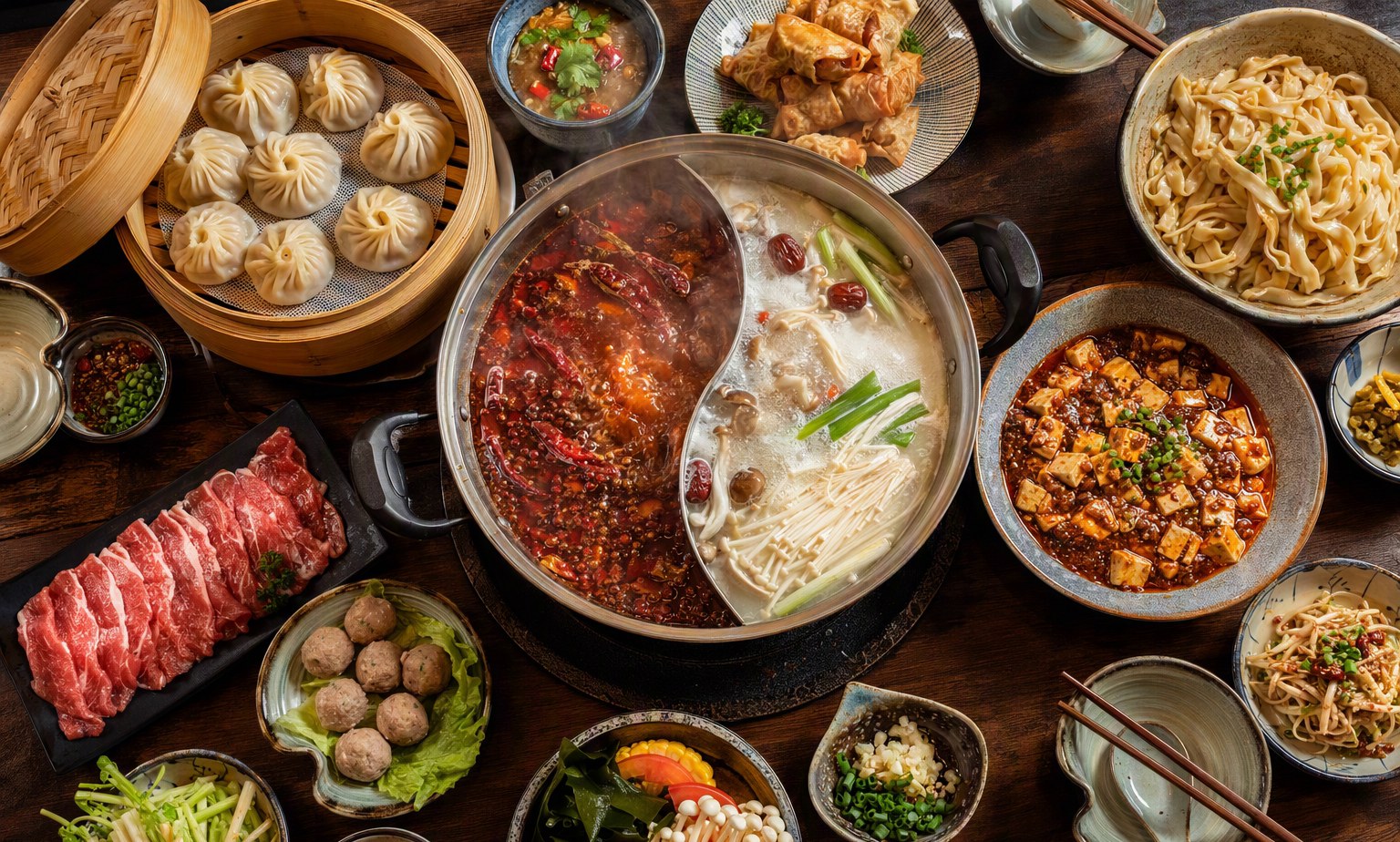
Eight dishes anchor most first trips. Peking duck is carved tableside in Beijing, and the ritual matters as much as the meat: crisp skin first, then pancakes with spring onion and sweet bean sauce. Xiaolongbao, the soup dumplings of Shanghai and the wider Jiangnan region, reward a careful bite rather than a quick one. Sichuan hotpot in Chengdu is a social meal built on numbing peppercorns and chilli oil, ordered by choosing broth strength and ingredients rather than a fixed set menu.

In Xi’an, biangbiang noodles are wide, hand-pulled and usually dressed with chilli and vinegar. Guangzhou’s dim sum is a morning affair, ordered from a card or a phone rather than a trolley in many modern restaurants. Lanzhou beef noodles appear in almost every city, which makes them the easiest dish on this list to try without travelling far. Crawfish in garlic is a summer night-market fixture, and jianbing, the savoury breakfast crepe, is sold from street carts in the early morning. For a city-by-city breakdown, see the Xi’an city guide and the Chengdu city guide.

Regional legends: dishes tied to a place

Some dishes only make sense where they come from. Mapo tofu is at its best in Chengdu, where the balance of doubanjiang, peppercorn and silken tofu is a local standard rather than an approximation. Hairy crab is a Shanghai autumn ritual, generally eaten between October and December; check the current season with a restaurant or market before planning around it. Buddha jumps over the wall is a Fuzhou banquet soup with a long ingredient list and a price to match, so ask what is in it before ordering.

Yunnan mushroom hotpot depends on the foraging season and varies by month, so confirm what is available when you arrive. Crossing-the-bridge noodles in Kunming arrive as separate bowls you combine yourself. Xinjiang lamb skewers and naan reflect Uyghur cooking and are widely sold across northern and western cities. Tea-smoked duck is a Sichuan preparation distinct from the Beijing version. If you are travelling with dietary restrictions, the halal and vegetarian food guide covers how to ask and what to expect.

The adventurous five

Stinky tofu is fermented, deep-fried and far milder in taste than in smell; Changsha is often cited as the benchmark. Century egg with tofu is a cold dish of preserved duck egg, usually served with soy and sesame — the texture is the hurdle, not the flavour. Chicken feet are a standard dim sum item, braised and eaten with the fingers. Sea cucumber is a banquet ingredient valued for texture rather than taste. Mooncakes appear around the Mid-Autumn Festival only, so their availability is genuinely seasonal; if you want to try them, plan the trip around the festival rather than expecting them year-round.

How to eat through this list without wasting a trip

Two or three dishes per city is a realistic pace. Breakfast dishes such as jianbing and dim sum belong in the morning, while hotpot, skewers and crawfish suit late evenings. Payment is worth sorting before you arrive: many stalls and small restaurants take QR payments, and the cashless travel guide explains how WeChat Pay and Alipay work for foreign visitors.

Menus are the main practical barrier. Photographing a dish you want and showing the picture works well, and translation tools help with ingredient lists. The language barrier guide covers apps and phrases that hold up in restaurants. If you want to learn a dish rather than just eat it, cooking classes exist in most major cities; check what is included and whether the class is in English before booking.

Turning the list into an itinerary

A food-focused route usually follows the regions: Beijing for duck, Xi’an for noodles, Chengdu and Chongqing for heat, Guangzhou for dim sum, Shanghai for Jiangnan cooking. High-speed rail connects these cities comfortably, and seat classes and onboard food are explained in the rail seat classes guide. Book trains through the official 12306 channel or an agent, and verify current ticket rules rather than relying on older advice.

Frequently asked questions

Do I need to book restaurants in advance?

For popular Peking duck houses and high-end banquet restaurants, reservations are common, especially at weekends and during public holidays. For noodles, dumplings, street food and night markets, walk-in is normal. Where a restaurant takes bookings, the usual route is a phone call or a booking platform in Chinese, so ask your hotel to help if you cannot do it yourself.

Is street food safe to eat?

Stall food is widely eaten and generally fine, but use judgement: choose busy stalls with high turnover, watch food being cooked to order, and be cautious with anything left standing at room temperature. If you have a sensitive stomach, ease in over the first few days. Pharmacies are common in cities, and the healthcare guide for travellers explains what to do if something goes wrong.

Can I eat these dishes as a vegetarian?

Some translate easily, such as mapo tofu (ask for it without minced pork), mushroom hotpot and most vegetable dishes. Others do not: hotpot broths, banquet soups and many noodle bowls use meat stock. Clear communication matters more than the menu description, and it is worth learning the phrase for “no meat” in Chinese before you go.

When is the best time of year for a food trip?

Autumn is popular for hairy crab and comfortable temperatures, while summer brings night markets and crawfish. Mid-Autumn determines when mooncakes appear. Rather than chasing a single best month, match the season to the dishes you care about and confirm current availability locally.

How do I find the authentic version of a dish?

Look for the city or region in the restaurant’s name, expect a short menu focused on one speciality, and check whether locals are eating there at normal mealtimes. Guidebook listings age quickly, so cross-check recent reviews and ask staff at your hotel for a current recommendation.

Treat this list as a framework rather than a checklist to complete. Pick the dishes that match the cities already on your route, leave room for the things you find by accident, and verify anything time-sensitive — seasons, reservations, ticket rules — close to departure rather than months ahead.

Posted on — Leave a comment

China Packing List: What to Bring (And What to Leave Home)

Packing for China is not a single list. A July week in Shanghai, a January trip to Harbin and a September visit to Lhasa ask for genuinely different bags, and the mistakes travellers make are seasonal rather than random. This guide covers the items worth carrying year-round, the gear each season demands, the things you can safely leave at home because they are cheap and easy to buy locally, and the digital preparations that matter as much as socks. Figures such as power bank limits, altitude medication advice and visa entitlements change and vary by airline or region, so where a number matters, verify it with the airline or the official source rather than trusting a list.

The core kit that applies in every season

Start with documents and power. Carry your passport and a printed copy of whatever entry permission you are travelling under, and check the current rules on the official immigration or embassy page before you fly, since categories and eligibility change. For electricity, China uses Type A, C and I sockets at 220V, so a universal adapter covers most devices; check the plug type on your own charger rather than assuming. A power bank is close to essential for long sightseeing days, but airlines set their own limits on capacity and carriage, so confirm the rule with your carrier before check-in.

Two apps do most of the work. Alipay and WeChat Pay are the default payment methods in cities, and both can be set up with a foreign card before departure; the setup steps and current limits are covered in our China cashless travel guide. Internet access is the other piece: whether a service works, and whether your usual apps load, depends on your SIM or eSIM choice and any tools you install, so test everything before you fly. Our guide to Wi-Fi, eSIM and roaming in China explains how to check what will work for your phone and plan.

Beyond that: comfortable walking shoes, because Chinese attractions involve far more steps and stairs than most itineraries suggest; layers rather than one heavy garment; pocket tissues and hand sanitiser, since not every public restroom supplies paper; and any prescription medication in its original packaging with a copy of the prescription. If you have ongoing health needs, our guide to pharmacies, clinics and insurance in China is worth reading before you go.

Summer: June to August

Heat and humidity dominate most of the country, with heavy rain in the south and along the coast. Pack breathable, quick-drying fabrics, a compact umbrella that handles both sun and downpours, and more shirts than you think you need. Deodorant is less common on Chinese shelves than in Europe or North America, so bring your preferred brand. Sunscreen matters even on overcast days. If your summer trip includes mountain or plateau regions, remember that altitude, not temperature, is the issue there.

Winter: November to March

Northern China is genuinely cold, and the cold is dry and wind-driven rather than damp. A serious down jacket, a thermal base layer, gloves, a hat and a scarf are the minimum for Beijing, Xi’an or Harbin. Hand warmers and similar heat packs are widely sold locally and cost little, so there is no need to fly with them. For Harbin’s ice festival, slip-on ice grips for your shoes are the difference between a pleasant evening and a painful one. Note that indoor heating is strong, so dress in removable layers rather than one heavy outfit.

Tibet and high-altitude travel

Lhasa sits above 3,600 metres, and altitude affects people unpredictably. Sun protection needs doubling at that elevation: high-factor sunscreen, sunglasses, a hat and lip balm. Any decision about altitude medication is a medical one, so discuss it with your own doctor well before departure rather than taking advice from a packing list. Permits, route rules and the practicalities of getting there are separate matters entirely; our Tibet and Lhasa planning guide covers permits, altitude and itinerary structure.

Leave at home, or buy it there

Hotels in China, from budget to luxury, almost universally provide a hair dryer and towels, so both are wasted luggage space. Heavy toiletries are pointless when convenience stores are on every block. Formal wear rarely gets worn; nobody checks. Cash is worth carrying in small amounts as a backup, but the ATM and mobile payment network is extensive. What is worth buying locally: slippers, umbrellas and cold-weather gear, all of which are widely available and often considerably cheaper than at home. If you are unsure where you can stay as a foreign guest, and therefore what amenities to expect, check our guide to hotels that accept foreign guests.

Small things that make a real difference

Pocket tissues, a few small gifts from home as icebreakers, offline maps downloaded before you leave, and a card showing each hotel’s name and address in Chinese characters. Keep a spare battery case or charging cable for photography-heavy days. A translation app with offline Chinese installed saves a great deal of pointing and guessing.

Frequently asked questions

Can I buy winter clothing in China instead of packing it?

Yes, and it is often cheaper. Down jackets, thermals, gloves and heat packs are widely available in northern cities from autumn onwards. If you land in Harbin in January and buy there, allow time on arrival before heading to outdoor sites, and check sizing carefully.

Do I need a VPN, and will it work?

Whether you need one depends on which services you rely on, and whether any given tool works changes over time. Install and test before you fly, and treat any specific claim about availability as something to verify yourself rather than assume. Our internet access guide sets out how to check.

How much cash should I carry?

Less than you might expect. Mobile payment covers almost everything in cities, and ATMs are common. Carry a small amount as a fallback for small vendors or rural areas, and check your bank’s foreign transaction fees before you travel.

What should I pack for a trip that spans several regions?

Build around layers. A thermal base, a mid-layer and a weatherproof outer shell handle everything from a Shanghai winter to a cool Guilin morning. Add region-specific items, such as sun protection for plateau areas, only for the parts of the trip that need them.

Is there anything I should sort out before packing?

Yes. Confirm your entry permission, set up a payment app, decide on your SIM or eSIM, and download offline maps and a translation app. Our first-time China checklist walks through those steps in order.

Pack for the season you are actually travelling in, not for an imaginary average, and treat the digital preparation as part of the same list. Get the documents, payments, connectivity and footwear right, and everything else can be bought on the ground for less than it costs to carry.

Posted on — Leave a comment

Çin’e İlk Kez Gelenlerin 15 Yaygın Hatası (Ve Her Birinden Nasıl Kaçınılır)

We have debriefed thousands of first trips to China, and the same handful of errors keep surfacing. Almost none of them are about China being difficult. They are about assumptions carried in from other destinations: that attractions can be decided on the day, that a city block is a short walk, that a card will simply work, that a queue behaves the way it does at home. Each mistake below is avoidable, usually with one line of preparation. Treat this as a pre-departure checklist rather than a warning list.

Book the big attractions before you fly

The single most common regret is arriving at a headline sight and finding timed entry sold out. Major sites in China increasingly run on advance reservation systems, sometimes released on a fixed schedule and sometimes capped per day. The Forbidden City in Beijing and the Terracotta Warriors in Xi’an are the classic examples, but the pattern extends to many museums, panda bases and popular mountain parks.

The practical approach is to identify every ticketed site on your route, find its official booking channel, and note when slots open relative to your travel date. Our guide to attraction reservations foreigners actually need walks through which sites require this and how foreign passports fit the process. Do not rely on a hotel concierge to solve it on the morning, and do not assume a tour operator’s inclusion covers a slot you have not confirmed.

Stop underestimating distance and scale

Chinese cities are large, and the interesting parts are spread across them. A “walking distance” that looks reasonable on a map can be a forty-minute hike along an eight-lane road with no shade. Beijing in particular punishes optimistic itineraries.

Two habits fix most of this. First, plan around the metro rather than on foot; our China metro guide covers ticketing, transfers and the security checks at every entrance. Second, treat day trips as transport problems first and sightseeing problems second. A do-it-yourself trip that burns four hours in connections is a day you will not get back, which is exactly the case for pre-arranged transfers or a private driver. Build slack into each day rather than filling every hour.

Money, apps and the cashless reality

China runs on mobile payment, and a foreign visitor without it will spend the trip asking strangers for help. Set up Alipay or WeChat Pay before departure, link a card, and test it with a small purchase while you still have a fallback. Our cashless travel guide explains the setup steps and the verification quirks that trip people up.

On cash: airport exchange kiosks are consistently the worst rates you will see, so change a small amount in town if you need it, and check before you travel whether your home bank card works in Chinese ATMs. Carry a modest cash reserve for small vendors and rural areas. Tipping is not expected in the way it is in North America; rounding up or leaving something for a driver who has helped with luggage is a courtesy rather than an obligation. For the detail, see our guide to tipping and etiquette in China. At unmarked stalls, agree a price before the transaction rather than after.

Dates that quietly ruin a trip

Golden Week and the Spring Festival travel period move enormous numbers of domestic travellers at once. Attractions, trains and hotels all feel it, and prices follow. If your dates are flexible, check the public holiday calendar before booking flights and shift around the peaks. Regional weather matters just as much: our guides to China in October and China in November show how much the experience changes month to month.

Late-night arrivals deserve their own plan. Airport taxi queues, last metro times and the availability of ride-hailing all vary by city and hour, so decide your transfer before you land rather than improvising at midnight.

Small cultural details that matter

Most of these take one line to learn and prevent real awkwardness. Hand business cards and gifts with two hands. Understand that a “yes” in conversation often signals that someone has heard you, not that they agree, so confirm important arrangements in writing. Queues can be loose, and gentle firmness works better than indignation. Never stand chopsticks upright in a bowl of rice, which carries funeral associations. When photographing people, particularly elders, gesture and smile first; permission is usually given warmly, and a refusal should be accepted without pressing.

Language is the other quiet friction. A translation app with offline Chinese downloaded, plus a handful of phrases, changes how a day goes. Our guide to the language barrier covers what to install and practise.

The meta-mistake: overplanning

The travellers who enjoy China most leave gaps. Deliberate slack absorbs a delayed train, a site that takes longer than expected, or an invitation to dinner you did not anticipate. A schedule with no room to breathe turns every small disruption into a crisis. Build in one lighter day per three, keep one evening unbooked, and resist the urge to chain cities back to back.

Frequently asked questions

Do I need to book trains in advance?

Often yes, especially on popular routes and around public holidays, when the best departure times sell out. Booking opens on a rolling window before travel, and foreign passports have their own verification steps. Check the current window and process on the official 12306 platform or your booking channel rather than assuming, and see our step-by-step guide to booking train tickets on 12306.

Is it true that many places no longer take cash?

Cash remains legal tender, but in practice many businesses expect mobile payment and may struggle to give change. Set up a payment app before you arrive and keep a small cash buffer. Verify current app availability, card support and limits on the provider’s own pages, as these change.

How much should I tip?

Tipping is not a standard expectation in mainland China. Rounding up a fare or leaving a small amount for a driver who assisted with bags is a friendly gesture, not a requirement. Restaurants and hotels do not build a tip into staff pay, so there is no obligation to add one.

Should I travel during Golden Week?

Only if your dates are fixed. Expect heavy domestic crowds at major sites and on transport, and book everything well ahead. If you can move your trip by a week or two either side, the same itinerary is usually calmer and easier to arrange.

What should I sort before booking flights?

Your entry permission, a payment app, an internet solution, and reservations for any must-see ticketed site. Our first-time China checklist lists the items worth completing in order.

None of the above requires expert knowledge, only a few hours of preparation before you fly. Confirm every figure, opening time and rule on the operator’s or official page close to your travel date, since these change, and leave room in the plan for the things you cannot schedule.