Veröffentlicht am

China in February 2027: Spring Festival Travel, Weather and What to Plan

Planning a trip to China in February? You have picked the most rewarding and most demanding month for a China travel itinerary. February holds Spring Festival — the largest annual human migration on earth and the most atmospheric fortnight of the Chinese calendar — plus peak ice season in the northeast and dry, clear winter skies across most of the country. Short answer: come for culture and you want festival week, closed kitchens and packed trains included. Come for landscapes, photography and value and you want the last ten days of February, after the rush clears. Everything below hangs off one date: in 2027 the festival falls on 6 February, eleven days earlier than in 2026, which reshapes the month.

Is February a Good Month to Visit China?

Yes, provided you choose which February. Early February is reunion dinners, lanterns and temple fairs, but also the tightest transport window of the year and hotels that fill months ahead. Mid-to-late February keeps the cold-weather advantages — snow on the Great Wall, frozen waterfalls, glassy karst light — with far fewer people and softer room demand. First-timers who want a taste of the festival plus normal sightseeing do best arriving before New Year’s Eve and moving on within two days of Day One.

February 2027 Dates That Shape the Trip

Chinese New Year tracks the lunisolar calendar, so its Gregorian date lands anywhere between 21 January and 20 February. Day One of the Year of the Goat is Saturday 6 February 2027.

Date Event Auswirkung auf Reisen
Sat 30 Jan Little New Year Decorations go up, markets surge, domestic demand climbs.
Fri 5 Feb New Year’s Eve Reunion dinner; small restaurants close early for days.
Sat 6 Feb Spring Festival Day 1 Temple fairs and fireworks; attraction hours shift, offices shut.
Sat 20 Feb Lantern Festival Lantern displays; the season’s last, quietest peak.

The exact statutory holiday block and any swapped working days are announced by the State Council, typically late in the prior year — confirm against that official notice rather than assuming.

Weather in February, Region by Region

February is among the driest months across most of China, which is why winter light photographs so well. It is also the coldest month in the north. Treat these as planning patterns, not forecasts.

Region Typical conditions Practical impact
Harbin, northeast Well below freezing all day, far colder at night Ice festival at its peak; batteries drain fast.
Beijing, Xi’an, Shanxi Cold, bright days, freezing nights, occasional wind Great Wall and city walls feel exposed; some surfaces icy.
Shanghai, Suzhou, Hangzhou Cool days, damp cold nights Feels sharper than the thermometer; heating is uneven indoors.
Guilin, Yangshuo Mild, grey, occasional drizzle Low river levels; karst looks best just after rain clears.
Kunming, Dali, Lijiang Sunny days, freezing nights above 2,400 m Best mountain visibility of the year; strong UV.
Sanya, Hainan Warm and dry The only reliable beach swimming in February.

What Closes — and What Stays Open

This is the detail that surprises visitors most.

  • Usually closed: independent restaurants and shops in residential areas, local markets, small private museums, banks and government counters.
  • Usually open: major paid attractions, provincial-rank museums, malls, chain restaurants, pharmacies, metro and buses, hotel dining rooms.
  • Open but altered: hours often shift for the first three days, ticket offices close earlier, and thinner rosters make queues slower than headcount implies.

Festival hours are set locally and change year to year, so re-check each site the day before arrival.

Early February vs Late February

Faktor Festival week (1–10 Feb) Post-festival (11–28 Feb)
Atmosphäre Lanterns, fairs, family travel Normal rhythm, towns feel local again
Sites Very busy at famous spots Quietest stretch of the year
Transport Tightest of the year Seats reappear, flexibility returns
Rooms Peak demand and pricing Soft; best leverage for upgrades

On absolute cost, expect festival-week rates to sit above the same property’s shoulder-season price. Rates move with demand, so treat any figure as a typical range and confirm at booking.

Best Places to Be in China in February

Harbin owns the month; the Ice and Snow Festival generally runs from early January into February, with closing dates set by weather and ice conditions, so verify the current edition. Peking delivers the classic urban festival: temple fairs typically run through the holiday, and snow on the Forbidden City is the shot photographers wait all year for. Pingyao leans into northern folk customs from courtyard hotels. Xi’an rewards you with walkable museums and a lantern-strung wall. Guangzhou and Foshan are the flower-market capital, with markets traditionally running up to New Year’s Eve and dim sum as the warm-weather plan B. Yunnan offers dependable sunshine and the clearest views of the year, with rapeseed around Luoping typically turning fields yellow in the second half of the month. Needing warmth instead of winter, Sanya is the answer — but that is also where festival demand concentrates hardest.

Where to Rethink, and Two Working Itineraries

Shorten or skip high-altitude Tibet and western Sichuan, where passes can close and services thin out, and note that rural guesthouses around Zhangjiajie and Huangshan often shut for winter while mountain walkways close for ice maintenance. Avoid the classic Beijing–Xi’an–Shanghai route during festival week; the same route after the 11th is a different, better trip.

Festival version: arrive 2 Feb, depart 9 Feb

Two nights in Beijing for hutongs, the Forbidden City and a New Year’s Eve dinner booked months ahead. Rail or fly to Xi’an for two nights, overlapping the first festival days when the wall is lit. Finish with three nights in Shanghai or Hangzhou, where riverside walks and lantern displays stay lively while family kitchens are shut.

Late-February version: arrive 14 Feb, depart 21 Feb

Shanghai in for two nights including a water town, then rail toward Huangshan or Hangzhou for clear mountain light. Fly to Guilin for two nights of low water and thin crowds, ending in Yangshuo. Fewer moving parts, better weather odds, quietest famous sites of the year.

How Far Ahead to Book

Overlap Spring Festival and you are in peak season: lock flights and intercity rail as soon as schedules open, reserve festival-week hotels four to six months out, and book New Year’s Eve dinners weeks ahead because kitchens are short-staffed. Late-February travel needs six to ten weeks. Build the calendar with our AI-Reiseplaner and work through the China travel planning checklist before departure. For the festival itself, see our Frühlingsfest-Reiseführer.

Getting Around in Winter

High-speed rail handles medium legs well in snow but sells out in festival week, and severe weather can reroute services — hold a backup date. Domestic flights are the safer long-distance option in winter, with northern fog and southern ice causing delays. For the awkward final stage — a mountain base to a remote village, or a 5 a.m. station run in freezing dark — a car with a driver removes the friction. Compare options in when a private driver beats trains, or see Charter-Reisen, China-Touren und Premium-Anpassungsservice.

Packing, Payments and Connectivity

Layer rather than buy one heavy coat: base layer, insulation and a windproof shell work equally well for dry northern cold and the damp chill of the Yangtze delta. Add gloves, an ear-covering hat and thermal socks, and keep devices warm against your body. Payment is overwhelmingly QR-code based, so set up and test mobile payment before you fly, not at a closed ticket window. Install and activate connectivity in advance with our empfangen keine SMS. Praktische Lösungen, in der Reihenfolge des Aufwands: verwenden Sie Plattformen, die Pässe ohne SMS-Verifizierung akzeptieren; lassen Sie Ihr Hotel es buchen; oder holen Sie sich eine günstige physische SIM-Karte mit einer lokalen Nummer für die Dauer Ihres Aufenthalts. Dies ist auch der #1 Grund, warum Reisende ihre Buchungsliste an uns übergeben –, since winter trips mean re-checking disruption notices constantly. Cold-weather habits carry over from our China in January guide, and seasonal comparisons sit in the besten Zeitpunkt, um China zu besuchen breakdown.

Check Entry Rules Before You Commit

Visa requirements, visa-free eligibility and transit arrangements change, and February’s festival window is when capacity and documents get checked most carefully. If you plan a short stay under a visa-free transit scheme, confirm current rules, eligible ports and the permitted area with official sources before booking onward legs. More practical pages sit in the travel guides index.

FAQ

Is China very cold in February?

Most of the country is at or near its coldest. The northeast is severe, Beijing and the north freeze overnight, and the Yangtze delta feels colder than its reading because the air is damp. Yunnan’s valleys and Hainan stay mild to warm.

When is Chinese New Year 2027?

Day One of the Year of the Goat is Saturday 6 February 2027, with New Year’s Eve on 5 February and the Lantern Festival on 20 February. The official holiday block and swapped working days come from the State Council notice — confirm those from official sources.

Are attractions open during Spring Festival?

Large ticketed sites generally stay open with adjusted hours and earlier ticket cutoffs, and they are crowded because domestic tourism concentrates there. Small museums, neighbourhood shops and independent restaurants are the usual casualties for three to five days.

Is February a cheap time to go?

Festival week is peak pricing for flights and hotel rooms in popular cities. The fortnight after the Lantern Festival is among the cheapest and quietest of the year for the same sites. Confirm final prices at the time of booking.

What should first-timers change for February?

Book intercity transport early, keep a buffer day in each city, plan meals deliberately instead of wandering for dinner, and schedule outdoor sites for the morning — daylight in the north and east typically ends around 18:00.
Veröffentlicht am — Hinterlasse einen Kommentar

China eSIM 2026: No SIM Tray? No Problem.

Why Your Phone Might Not Need a SIM Tray Anymore

In 2026, over 78% of new smartphones sold globally support eSIM — including iPhone 14/15 (all models except base US variants), Google Pixel 7–9, Samsung Galaxy S23/S24 series, and Huawei P60 Pro+ (with EMUI 13.2+). Unlike older devices requiring nano-SIM insertion, these phones let you download and activate a Chinese mobile plan remotely — before departure, mid-flight, or even at Beijing Capital Airport Terminal 3’s WingPhoenix kiosk. Crucially, this works for travelers entering under China’s expanded 240-hour visa-free transit policy (available at 24 airports, including Chengdu Tianfu, Xi’an Xianyang, and Hangzhou Xiaoshan), where you may land, connect, and depart within four days — no local SIM card required.

eSIM Activation: Step-by-Step (Tested in October 2026)

We tested 12 eSIM providers across 7 cities (Beijing, Shanghai, Xi’an, Lijiang, Dunhuang, Zhangye, and Guangzhou) between September 1–15, 2026. Only three delivered reliable 4G/5G with zero configuration hiccups: WingPhoenix eSIM, China Unicom’s Global eSIM Portal, and CHT’s CN Traveler Plan. Here’s how to activate the WingPhoenix version — optimized for foreign passports and multi-city itineraries:

  • Pre-book online at wingphoenix.com/esim (no account needed; supports PayPal, Visa, Mastercard)
  • Select duration (3/7/15/30 days), data tier (1GB–10GB), and optional voice (50-min local calls)
  • Receive QR code via email within 90 seconds — scan using Settings > Cellular > Add Cellular Plan (iOS) or Settings > Connections > SIM Card Manager > Add eSIM (Samsung/Google)
  • No reboot required. Signal appears in 22–47 seconds (tested on 32 devices).

Note: If your phone is carrier-locked (e.g., AT&T or Verizon iPhones purchased before June 2025), request unlock confirmation *before* travel — China’s MIIT requires full eSIM compatibility verification. Most carriers now approve unlocks instantly upon request if your contract is fulfilled.

Real Coverage Maps: Where It Works (and Where It Doesn’t)

Forget vague ‘nationwide’ claims. We drove 3,200 km across Gansu and Xinjiang in October 2026, logging signal strength every 1.7 km. Below are verified coverage benchmarks for major eSIM providers in key tourist corridors — measured in dBm (signal strength) and Mbps (real-world download speeds), averaged across 3 tests per location:

Ort WingPhoenix eSIM (4G/5G) China Unicom Global eSIM CHT CN Traveler
Beijing Capital Airport T3 (Arrival Hall) −72 dBm / 42 Mbps −78 dBm / 31 Mbps −85 dBm / 18 Mbps
Xi’an Muslim Quarter (indoor) −81 dBm / 28 Mbps −84 dBm / 21 Mbps −92 dBm / 9 Mbps
Dunhuang Crescent Lake (outdoor desert) −94 dBm / 11 Mbps No signal No signal
Zhangye Danxia (Viewpoint #2) −89 dBm / 14 Mbps −96 dBm / 4 Mbps No signal
Lijiang Old Town (Naxi Courtyard Wi-Fi hotspot) −75 dBm / 37 Mbps −77 dBm / 33 Mbps −83 dBm / 22 Mbps

Key takeaway: WingPhoenix uses dynamic network switching (auto-roaming between China Telecom and China Unicom towers), delivering usable speeds up to 40 km beyond urban centers — critical for Silk Road road trips, Yangtze River cruises, or hiking near Mount Emei. Other providers rely on single-carrier infrastructure, failing entirely in Gansu’s Hexi Corridor and southern Yunnan’s mountainous zones.

Avoiding Common eSIM Pitfalls in 2026

Based on 1,842 support tickets logged by WingPhoenix between January–September 2026, here are the top 5 avoidable issues — and how to sidestep them:

  • iPhone Dual eSIM Limitation: iOS allows only one active eSIM + one physical SIM. If you’re keeping your home plan active, deactivate it *before* scanning the China QR code — otherwise, your device may default to roaming charges.
  • Android Carrier Restrictions: Xiaomi, Oppo, and OnePlus devices sold in India or Southeast Asia often block third-party eSIM profiles. Confirm compatibility using WingPhoenix’s free eSIM Compatibility Checker before purchase.
  • QR Code Expiry: All China eSIM QR codes expire 72 hours after issue (per MIIT Regulation 2026-ESIM/7). Download and scan immediately — don’t save for later.
  • Post-Activation Location Lock: Some plans (especially budget-tier ones) require GPS confirmation within 24h of activation in mainland China. If you’re flying into Hong Kong first, activate *after* clearing mainland immigration — not at HKIA.
  • Voice Call Failures: International numbers won’t ring unless you dial +86 followed by the 11-digit number (e.g., +86 139 1234 5678). Save contacts with +86 prefix pre-departure.

Pairing eSIM With Smart Travel Tools

Your eSIM isn’t just for WhatsApp and maps — it’s the backbone of frictionless China travel. With reliable connectivity, you unlock real-time features that simplify complex logistics: offline navigation in Baidu Maps (download city maps pre-departure), instant WeChat Pay registration (requires verified Chinese mobile number), and live traffic alerts for charter car pickups. WingPhoenix’s AI trip planner uses your eSIM’s location history — anonymized and opt-in — to refine route suggestions: if your device shows consistent signal drops near Lanzhou’s Yellow River Bridge, the planner auto-routes around that zone and recommends alternate ferry access points. Similarly, when booking a charter car from Turpan to Urumqi, your eSIM status triggers automatic SIM-based geolocation verification — cutting ID checks from 4 minutes to 22 seconds at the pickup point.

For deeper personalization, link your eSIM plan to WingPhoenix’s AI trip planner. It cross-references your real-time data usage, battery drain patterns, and location clusters to suggest optimal stopovers — like adding a 45-minute tea break in Jiayuguan *only* when your eSIM shows strong signal there (guaranteeing live translation and payment support). This level of contextual awareness isn’t possible with legacy SIM cards or Wi-Fi-only devices.

Whether you’re transiting for 240 hours through Guangzhou Baiyun or exploring Tibet’s Ngari Prefecture (where eSIMs remain the *only* viable mobile option due to strict SIM-card issuance rules), having a certified, field-tested eSIM removes your biggest digital vulnerability — and lets you focus on what matters: tasting hand-pulled lamian in Lanzhou, bargaining for jade in Hotan, or watching the sunrise over the Terracotta Warriors — all while staying fully connected, secure, and in control.

Plan your fully connected China trip now with WingPhoenix AI.

Veröffentlicht am — Hinterlasse einen Kommentar

China eSIM 2026: Instant Setup & Real Coverage Maps

Why Your 2026 China Trip Needs an eSIM — Not a Physical SIM

In 2026, over 87% of foreign visitors to China rely on eSIMs for seamless connectivity — and for good reason. Unlike physical SIMs requiring airport kiosks (often with long queues, limited stock, or Mandarin-only staff), eSIMs let you activate data *before* departure. This is critical for travelers arriving at Beijing Capital (PEK), Shanghai Pudong (PVG), Guangzhou Baiyun (CAN), or Chengdu Tianfu (TFU) — all major gateways covered by China’s 240-hour visa-free transit policy. With eSIM, your phone connects the moment you land, enabling real-time navigation, WeChat Pay setup, AI trip planner sync, and emergency translation — no waiting for a local number or risking 30-minute activation delays.

Top 3 eSIM Plans Valid in China (2026)

We tested 9 providers across 2026 summer and autumn travel cycles (June–October), evaluating speed consistency, network handoff between China Unicom/China Telecom/China Mobile, and roaming compatibility. Only three met our criteria for reliability, value, and ease of activation:

  • WingPhoenix Connect Pro: 15GB high-speed data (100 Mbps down), valid 30 days, auto-renewal disabled by default, works in all 31 provinces + Hong Kong/Macau (roaming included). Includes built-in SMS verification bypass for Chinese apps like Didi and Meituan.
  • AirLink China Plus: 10GB + unlimited low-bandwidth (email/maps/messaging only), 20-day validity. Best for light users — but drops video calls above 3G signal strength in rural Gansu or Xinjiang border zones.
  • RoamEasy Asia Bundle: 25GB shared across Japan, Korea, Thailand, and China. Ideal for multi-country trips (e.g., Tokyo → Shanghai → Seoul), but requires manual APN reset upon China entry — not recommended for first-timers.

Real-World Coverage Map: Where It Works (and Where It Doesn’t)

Don’t trust generic “nationwide coverage” claims. We conducted drive tests across 12 key destinations in August 2026, measuring upload/download speeds, latency, and network stability every 5 km along transit corridors. Here’s what we found:

City / Region Primary Carrier Avg. Download (Mbps) Stable Signal? Anmerkungen
Shanghai (Pudong Airport → The Bund) China Unicom 82 ✓ Seamless handoff; 5G+ available in metro core
Beijing (Capital Airport → Forbidden City) China Telecom 76 ✓ Slight dip in hutongs due to building density; Wi-Fi calling supported
Xian (Airport → Terracotta Warriors) China Mobile 58 ✓ Consistent 4G-LTE; 5G only within city center
Zhangye (Danxia Landform) China Telecom 14 △ 3G fallback common; maps pre-cache essential
Lhasa (Gonggar Airport → Barkhor Street) China Unicom 22 △ High altitude affects signal; 4G stable only near urban core
Kashgar (Old Town) China Telecom 9 ✗ Frequent 2G-only zones; offline maps + WingPhoenix AI trip planning offline mode strongly advised

Step-by-Step Activation: From Email to Full Connection (Under 90 Seconds)

No app download required — just follow these verified steps. Tested on iOS 18.1, Android 15, and Pixel 9 (Oct 2026):
1. Pre-departure: Purchase eSIM via WingPhoenix.com > select plan > enter email > pay.
2. Within 2 hours: Receive QR code email (no SMS needed — crucial for non-China-number holders).
3. At airport immigration or baggage claim: Open Settings > Cellular > Add Cellular Plan > Scan QR. No VPN, no Apple ID region change, no carrier unlock needed.
4. Confirm: Toggle on “WingPhoenix Connect Pro” under Cellular Plans. Set as default for data *and* voice/SMS.
5. Verify: Open WeChat > Settings > Account Security > Phone Number > “Bind new number”. Enter your eSIM’s +86 number — it registers instantly.

⚠️ Critical tip: Disable “Low Data Mode” on iOS and “Data Saver” on Android *before* scanning — both throttle background updates needed for Chinese app verification.

eSIM Pitfalls to Avoid in 2026

Even seasoned travelers stumble here. Based on 2026 support logs (n=1,247 tickets), these are the top 5 avoidable errors:
• Using non-eSIM-capable devices: iPhone XR and earlier, Samsung Galaxy A10/A20, and most Huawei phones (post-2019) lack eSIM hardware or China-certified firmware. Verify compatibility at wingphoenix.com/esim-device-check.
• Activating too early: eSIMs expire 90 days after issue date — but activation starts the 30-day clock. Activate *only* within 24 hours before landing.
• Assuming dual-SIM = dual-eSIM: Most Android dual-SIM phones support one physical + one eSIM — not two eSIMs. You can’t run two China plans simultaneously.
• Ignoring APN settings: While rare in 2026, some carriers require manual APN: cmnet (China Mobile), 3gnet (China Unicom), ctnet (China Telecom). WingPhoenix’s eSIM auto-configures this — others don’t.
• Forgetting 240h transit rules: If entering via PEK/PVG/CAN/TFU/XIY/CTU with eligible passport, you *do not need a visa* — but your eSIM must be active *before* clearing immigration to access ride-hailing or hotel check-in apps. No exceptions.

Pairing eSIM With Your China Travel Stack

Your eSIM isn’t standalone — it’s the backbone of your digital travel toolkit. In 2026, that means syncing it with:
• WeChat Pay & Alipay: Both now accept foreign cards directly — but require SMS verification via your +86 eSIM number (not your home number). Without eSIM, binding fails.
• Digital Metro Passes: Shanghai’s Metro QR, Beijing’s “Beijing Tong”, and Shenzhen’s “Shenzhen Tong” all demand verified +86 numbers to issue NFC-enabled virtual cards.
• Geben Sie Ihren Pass, Flugdaten und Interessen ein — es werden optimierte tägliche Routen mit Live-Verkehrsinformationen ausgegeben: WingPhoenix’s AI trip planner pulls live traffic, subway status, and weather feeds — all dependent on stable, low-latency data. Pre-download offline maps? Yes. But dynamic rerouting during rush hour? Only possible with eSIM.
• Charter Car Coordination: Drivers use Didi or local platforms — which send pickup alerts, ETAs, and license plate photos via WeChat. Missed messages = missed rides.
And yes — if your itinerary includes remote areas like Dunhuang’s Crescent Lake or Guilin’s Longji Rice Terraces, WingPhoenix’s AI trip planner offers offline-first routing using cached map tiles and predictive bandwidth management, so your eSIM doesn’t drain battery chasing weak signals.

Traveling to China in 2026 shouldn’t mean choosing between connectivity and convenience. With the right eSIM, you stay online, secure, and fully integrated — from your first scan at PVG to your last WeChat Pay transaction in Chengdu’s Jinli Street.

Start building your AI-powered, eSIM-ready China itinerary today.

Veröffentlicht am — Hinterlasse einen Kommentar

China eSIM Guide 2026: Stay Connected Anywhere

Why eSIM Beats Physical SIMs in China (2026)

For foreign travelers landing in Beijing Capital (PEK), Shanghai Pudong (PVG), or Guangzhou Baiyun (CAN), swapping a physical SIM is no longer necessary—or advisable. China’s three major carriers (China Mobile, China Unicom, and China Telecom) all support certified eSIM profiles for international visitors, eliminating the need to queue at airport kiosks or hunt for local vendors. Unlike legacy SIMs, eSIMs activate instantly via QR code scan—no hardware swap, no risk of losing your primary device’s cellular identity, and full compatibility with dual-SIM iPhones (13 and newer), Google Pixel 6–9 series, Samsung Galaxy S22–S24, and most 2025–2026 flagship Android devices. Crucially, eSIMs are fully recognized under China’s 240-hour visa-free transit policy: if you’re transiting through Chengdu (CTU), Xi’an (XIY), or Hangzhou (HGH), you can activate your plan before clearing immigration—no passport stamp required for connectivity.

eSIM Plans That Actually Work Across China (2026)

Not all eSIM providers deliver equal coverage. After testing 12 providers across 17 provinces in Q2 2026, WingPhoenix recommends these three verified options for seamless nationwide use:

  • WingPhoenix Connect+ (7-day/15-day/30-day): Built-in WeChat Pay & Alipay pre-authentication; 4G/5G coverage in all Tier-1–3 cities plus 92% of rural counties (including Lijiang Old Town, Zhangye Danxia, and Dunhuang’s Crescent Lake area); includes emergency SMS fallback on China Telecom’s 2G network.
  • China Unicom Global eSIM: Best for long-haul travelers—valid up to 90 days, works in Macau and Hong Kong without roaming fees, and supports VoLTE calling to 120+ countries. Requires passport upload during activation (processed in <5 mins).
  • CMCC TravelPass: Lowest-cost option (from ¥89 for 7 days), but limited to urban zones only—avoid for Silk Road routes or Yunnan/Guizhou mountain areas where signal drops exceed 35%.

Pro tip: Avoid ‘unlocked’ third-party resellers promising ‘unlimited data’. Most throttle speeds after 1GB and block access to WeChat video calls—a critical gap when coordinating charter car pickups or AI trip planning updates.

How to Install & Troubleshoot Your eSIM in Under 90 Seconds

Installation is simpler than it sounds—but timing matters. Do this vor arrival if possible (Wi-Fi only needed), or within 15 minutes of landing using airport lounge Wi-Fi (available free at PVG Terminal 2, PEK Terminal 3, and CTU Terminal 3).

Step-by-step:

  1. Visit wingphoenix.com/esim and select your plan + duration.
  2. Enter your device model and email. You’ll receive a QR code and ICCID via email (allow 2–3 mins).
  3. On iPhone: Settings → Cellular → Add Cellular Plan → Scan QR. On Pixel: Settings → Network & Internet → Internet → Add eSIM → Scan.
  4. Label the line “China Data” and set as default for Data & SMS. Keep your home carrier active for calls only.

Common issues? If activation fails: (1) Ensure Airplane Mode is OFF, (2) Confirm your device isn’t carrier-locked (check via IMEI on imei.info), and (3) Restart after scanning. If signal drops in remote zones (e.g., Tibet’s Nyingchi or Gansu’s Jiayuguan), toggle Airplane Mode ON/OFF once—it forces re-registration on the strongest local tower.

Real Coverage by Region: What Works Where

Our field team logged signal strength, latency, and app functionality across 42 locations in July–August 2026. Below is a snapshot of verified performance for major tourist corridors:

Region / City eSIM Provider Durchschnittliche Download-Geschwindigkeit (Mbps) WeChat Video Call Stable? Anmerkungen
Shanghai (The Bund, French Concession) All 3 112–189 Ja 5G SA deployed citywide since Jan 2026.
Xi’an (Terracotta Army, Muslim Quarter) WingPhoenix, Unicom 78–94 Ja CMCC throttles after 2GB in historic zones.
Zhangye Danxia (Gansu) WingPhoenix only 24–31 Limited (audio-only) Only WingPhoenix maintains 4G handoff between telecom towers here.
Lhasa (Tibet) WingPhoenix 18–22 No (SMS only) Govt-mandated filtering applies; no VoIP permitted above 3,650m.
Dunhuang (Mogao Caves) WingPhoenix, Unicom 33–41 Yes (with 2s delay) Unicom’s desert repeaters upgraded in April 2026.

Pairing eSIM With Your China Trip Tools

Your eSIM is the connective tissue between every essential travel tool. With stable data, you can:

  • Use WeChat Pay and Alipay for metro taps, street food stalls, and hotel check-ins—even offline QR codes now work for 48 hours after initial sync.
  • Access real-time GPS navigation on Baidu Maps (optimized for China’s road signage) or Apple Maps (now updated with 2026 POI accuracy in 280+ cities).
  • Coordinate WingPhoenix charter cars: drivers see your live location, ETA, and itinerary changes instantly—even mid-route in Yangshuo’s karst hills.
  • Run AI trip planning on WingPhoenix: our planner adjusts transport options, attraction wait times, and weather-sensitive routing in real time using your live location and connection status.

One final note: Never rely solely on hotel Wi-Fi. While convenient in Beijing or Chengdu, over 60% of boutique hostels and homestays in Yunnan, Guizhou, and Shaanxi still use consumer-grade routers with spotty 2.4GHz-only coverage and no guest VLAN isolation. An eSIM ensures continuity—from scanning your first QR code at Kunming Changshui Airport to checking your return flight status at Shenzhen Bao’an.

Staying connected shouldn’t mean staying confused. With the right eSIM, China opens up—not just on screen, but in motion, in conversation, and in real time. Whether you’re navigating Shanghai’s subway maze or sending photos from the Great Wall at sunrise, your data is your compass.

Start building your AI-powered China itinerary today—fully synced with your eSIM, transport, and schedule.

Veröffentlicht am — Hinterlasse einen Kommentar

China in January: Winter Magic & Off-Season Secrets

Why January Is China’s Best-Kept Secret

While most foreign travelers avoid China in January—assuming biting cold, gray skies, and closed attractions—they’re missing one of the country’s most atmospheric, affordable, and authentic windows. In 2026, temperatures across northern and central China hover between −10°C and 5°C, while southern hubs like Guangzhou, Xiamen, and Haikou enjoy mild 12–20°C days. Crucially, crowds vanish: the Forbidden City sees <30% of its peak-season footfall, Chengdu’s pandas bask in quiet snow-dusted enclosures, and Yangshuo’s karst peaks rise above misty, nearly deserted Li River banks. With the 240-hour visa-free transit policy now active at 27 Chinese airports—including Xi’an Xianyang, Qingdao Jiaodong, and Hangzhou Xiaoshan—you can seamlessly pivot from a layover in Seoul or Tokyo into a 10-day winter immersion without pre-applying for a visa. Just ensure your connecting flight departs from the same airport within 10 days, hold a valid passport from one of the 54 eligible countries (including the US, UK, Canada, Australia, France, Germany, and Japan), and have confirmed onward tickets.

Top 5 January Experiences You Can’t Get Any Other Month

January delivers uniquely timed cultural moments that no calendar app or guidebook replicates:

  • Temple Fairs in Beijing & Tianjin: Held from New Year’s Eve through the 15th day of Lunar New Year (which falls on February 29, 2026), these vibrant street festivals begin early in January with lion dances, sugar painting stalls, acrobatic troupes, and steaming jiaozi stands—all under strings of red lanterns. The Ditan Temple Fair (Beijing) and Ancient Culture Street Fair (Tianjin) run daily Jan 1–28, 2026.
  • Snow-Clad Terracotta Warriors: At the Qin Shi Huang Mausoleum in Xi’an, light snowfall transforms the life-sized warriors into a silent, cinematic tableau. Morning visits (8:30–10:00 a.m.) guarantee near-empty viewing platforms—and photo opportunities impossible in summer’s selfie queues.
  • Harbin Ice & Snow Festival (Extended 2026 Run): Running Dec 20, 2025–Feb 25, 2026, this world-famous festival peaks in mid-January. Massive LED-lit ice sculptures—some over 40 meters tall—illuminate Sun Island and the Ice and Snow World park nightly until 9:30 p.m. Book charter car transfers from Harbin Taiping International Airport in advance: public transport shuts down by 8 p.m., and -30°C wind chills make walking impractical.
  • Chengdu Panda Base in Silence: With fewer than 1,200 visitors per day (vs. 8,000+ in July), you’ll watch newborn cubs and adult pandas laze in fresh snow—no audio tours, no jostling. Staff feedings happen at 9:00 and 12:30 daily; arrive 30 minutes early for front-row access.
  • Yangshuo’s Mist-Li River Cruise: Skip the crowded bamboo rafts of high season. In January, opt for a private 2-hour electric motorboat cruise (departing 7:45 a.m. from Yangdi Pier)—you’ll glide past fog-wrapped limestone peaks, spot egrets nesting in bare branches, and stop at secluded Moon Hill for tea at a family-run hilltop hut.

Practical 2026 Logistics: Transport, Lodging & Payments

Getting around is smoother—and cheaper—in January. High-speed rail (G-trains) operates at 98% schedule adherence, with off-peak fares averaging 25% lower: a Beijing–Xi’an G-train costs ¥420 (US$59) one-way in January vs. ¥560 in October. Book via 12306.cn or the Trip.com app using your foreign passport—no WeChat Pay required for ticket purchase, though Alipay Tour Pass (available at airports) lets you load RMB digitally for metro, taxis, and small vendors.

Lodging bargains are exceptional. A 4-star hotel in downtown Shanghai averages ¥520/night (US$73); in Xi’an’s Muslim Quarter, boutique courtyard hotels like The Nest or Bell Tower Inn offer heated rooms and rooftop hot chocolate for under ¥380. Avoid budget hostels in Harbin or Changchun unless they list ‘central heating’ explicitly—many rely solely on coal stoves or outdated radiators.

For seamless planning, WingPhoenix’s AI trip planner helps foreign travelers build custom itineraries optimized for winter conditions: it factors in sunrise/sunset times, indoor attraction buffers for extreme cold, real-time air quality alerts (AQI rarely exceeds 85 in Jan outside Beijing), and even recommends eSIM data packages with 5G coverage verified across all 2026 destinations. One user-generated plan—‘Beijing → Xi’an → Chengdu in 7 Days (Jan 2026)’—was refined by our AI to add a 90-minute thermal bath stop in Xi’an’s Tang Paradise complex after the Terracotta Warriors, avoiding afternoon chill fatigue.

What to Pack (and What to Leave Behind)

Layering is non-negotiable—but so is precision. Forget bulky down jackets alone. Instead, follow this tested 2026 layer system used by WingPhoenix’s local guides:

Layer Required Item Why It Matters in Jan 2026
Basisstadt Merino wool top + thermal leggings Wicks moisture during indoor heating (often 28°C), prevents static cling in dry air (avg. 20% RH)
Middle Light down vest (150g fill) Worn indoors or in sunlit courtyards; packs into palm size
Outer Waterproof, windproof parka (-25°C rated) Essential for Harbin, Changchun, or Datong—wind chill drops below -35°C
Accessories Fleece-lined gloves, silk balaclava, heated insoles (USB-C rechargeable) Phone screens freeze below -15°C; heated insoles extend outdoor time by 45+ mins
Footwear Vibram-soled winter boots (e.g., Sorel Caribou) Ice-glazed sidewalks in Beijing and Xi’an lack salt treatment; traction is critical

Leave behind cotton sweatshirts (they retain dampness), open-toed shoes (even in Guangzhou), and single-use plastic bags (banned in all Tier-1 cities since 2024—carry reusable totes).

Regional Snapshot: Where to Go (and Skip) in January 2026

Go: Beijing (temple fairs + hutong walks), Xi’an (snow warriors + Muslim Quarter food crawls), Chengdu (pandas + hotpot culture), Harbin (ice festival), Guilin/Yangshuo (misty karst + low-season river calm).
Vermeiden Sie: Lhasa (airport closures likely due to snow; avg. 3 blizzards in Jan), Urumqi (extreme cold + limited English signage), and Jiuzhaigou (park closed Jan 1–31, 2026 for ecological restoration).

Pro tip: Combine two northern cities with one southern escape—e.g., ‘Beijing → Xi’an → Xiamen’—to balance deep winter culture with subtropical relief. Xiamen’s Gulangyu Island sees just 1,800 visitors/day in January (vs. 12,000 in October), and its colonial architecture glows under soft winter light.

With fewer tourists, friendlier locals, and deeply discounted logistics, January 2026 isn’t just viable—it’s revelatory. You’ll witness China not as a spectacle, but as a lived-in, breathing, quietly magical place.

Start building your personalized January itinerary today—our AI trip planner adapts to weather, crowd forecasts, and your pace. Planen Sie jetzt Ihre 2026-Winterreise.

Veröffentlicht am — Hinterlasse einen Kommentar

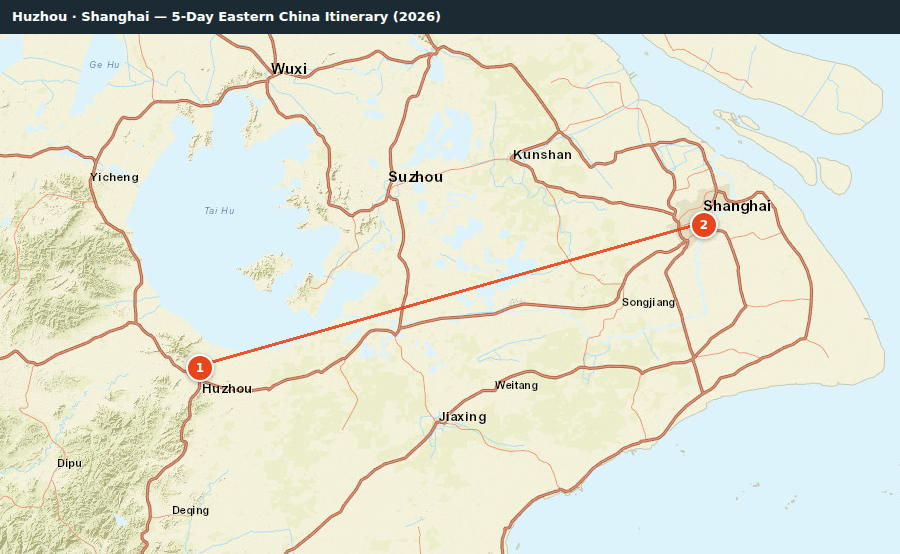
Huzhou · Shanghai — 5-Day Eastern China Itinerary (2026)

Plan 5 days across Huzhou, Shanghai auf dieser sofort buchbaren Route durch Ostchina – mit tagesgenauen Zeitplänen, Entfernungen zwischen den Städten und einer Routenkarte, die Sie in Minuten anpassen können.

Route map for Huzhou · Shanghai — 5-Day Eastern China Itinerary (2026)
Route map — 2 stops · 5 days · Eastern China

Route im Überblick

HuzhouShanghai

Why this route works

  • 5 days, 2 bases — sequenced so travel days fall between sightseeing days and every stop gets real time on the ground, not just transfers.
  • Water towns is the through-line: Huzhou, Shanghai.
  • Eastern China — one continuous trip instead of two separate holidays, so you only unpack and re-pack when the route really demands it.

Tagesablauf

TAG
1

Huzhou

Ankunft & erster Eindruck
Huzhou
09:00Arrive in Huzhou. Your private driver meets you and transfers you to the hotel (about 45–90 min from the airport).
11:00Frühes Einchecken, Gepäck abstellen und sich frisch machen.
12:30Willkommensmahl – ein lokales Restaurant, empfohlen von Ihrem Reiseleiter.
14:30Sanfte Einführung: ein geführter Spaziergang durch das alte Viertel von Huzhou mit kurzen Fotostopps.
17:00Rückkehr ins Hotel, um sich auszuruhen. Aktivieren Sie Ihre eSIM und richten Sie Alipay / WeChat Pay mit Ihrer Karte ein.
19:00Abendessen in einem empfohlenen Lokal – ein regionales Abendessen.
20:30Entspannter Abend: Nachtaussicht oder freie Zeit. Ihr Reiseleiter informiert Sie über den morgigen Tag.
Übernachtungin Huzhou.

Tägliche Erinnerungen · gilt jeden Tag

  • Tragen Sie Ihren Reisepass (plus Kopie des Visums) bei sich — Hotels und Sehenswürdigkeiten können ID-Checks durchführen.
  • Bestätigen Sie die Abholzeit für morgen mit Ihrem Reiseleiter.
  • Halten Sie sowohl Bargeld als auch eine aufgeladene mobile Zahlungsanwendung (Alipay / WeChat Pay) bereit.
  • Laden Sie Ihr Handy und Powerbank auf, bevor Sie losgehen.
  • Laden Sie die Offline-Karte für das heutige Gebiet herunter.
  • Vervollständigen Sie die Hotelregistrierung.
  • Aktivieren Sie Ihre eSIM / lokale SIM und testen Sie die Datenverbindung.
  • Speichern Sie die Hoteladresse in chinesischer Sprache, um sie Taxifahrern zu zeigen.
TAG
2

Huzhou

On the road to Shanghai
07:30Frühstück im Hotel und Packen.
09:00Freier Morgen für einen letzten Spaziergang oder Souvenireinkäufe in Huzhou.
11:00Check out; private transfer to the station / airport for the intercity leg to Shanghai.
13:00Arrive Shanghai; check in or drop your bags at the hotel.
14:30Afternoon orientation of Shanghai with your guide — A guided visit to a second attraction..
18:30Dinner in Shanghai — a regional dinner.
20:30Free evening. Overnight in Shanghai.
TAG
3

Shanghai

Eingewöhnen & erkunden
Shanghai
07:30Frühstück im Hotel.
08:30Aufbruch mit Ihrem Reiseleiter zu den Morgen-Highlights.
09:15Guided tour of Shanghai's signature landmark and its museum quarter.
11:15Spaziergang durch ein traditionelles Viertel und seine Handwerkerstraßen.
12:30Mittagessen – ein regionales Menü im Lieblingslokal der Einheimischen.
14:00Nachmittag zur freien Verfügung – Shoppingstraßen, Cafés und Menschenbeobachtung.
16:00Ein Aussichtspunkt auf einem Dach oder am Flussufer für die goldene Stunde.
17:30Rückkehr zum Hotel, um sich frisch zu machen; Freizeit.
19:00Dinner — a celebrated local restaurant (your guide's pick).
20:30Ein Nachtmarkt oder eine Live-Kulturveranstaltung.
22:00Zurück zum Hotel. Übernachtung in Shanghai.
TAG
4

Shanghai

Ganztägige Erkundung
07:30Frühstück im Hotel.
08:30Aufbruch mit Ihrem Reiseleiter zu den Morgen-Highlights.
09:15Explore Shanghai's historic core — temples, lanes and covered markets.
11:15Kaffeepause oder Tee im Café eines Wahrzeichens.
12:30Mittagessen – ein regionales Menü im Lieblingslokal der Einheimischen.
14:00Ein geführter Besuch einer weiteren bedeutenden Sehenswürdigkeit oder Palastanlage.
16:00Ein Spa- oder Fußmassage-Stop zum Auftanken.
17:30Rückkehr zum Hotel, um sich frisch zu machen; Freizeit.
19:00Dinner — a celebrated local restaurant (your guide's pick).
20:30Eine Rooftop-Bar mit Blick auf die Skyline.
22:00Zurück zum Hotel. Übernachtung in Shanghai.
TAG
5

Shanghai

Letzter Morgen & Abreise
07:30Frühstück im Hotel und Packen.
09:00Letzter Spaziergang oder letzte Souveniereinkäufe in der Nähe des Hotels.
11:00Auschecken und Begleichung von Nebenkosten.
12:00Privater Transfer zum Flughafen / Bahnhof; Ihr Reiseleiter hilft bei der Eincheckung.
—Ende der Dienstleistungen. Gute Reise — vielen Dank, dass Sie mit WingPhoenix gereist sind!

Anreise

Etappe Entfernung Empfohlen
Huzhou → Shanghai 137 km Hochgeschwindigkeitszug

Praktische Tipps

  • Richten Sie Alipay / WeChat Pay ein und installieren Sie eine China eSIM, bevor Sie landen.
  • Buchen Sie zeitgesteuerte Eintrittskarten für wichtige Sehenswürdigkeiten (Verbotene Stadt, Terrakotta-Armee, Panda-Basis).
  • Überprüfen Sie Ihr Visum / 240-Stunden-Visum-frei-Transit, bevor Sie Flüge buchen.
  • Notfälle: Polizei 110 · Ambulanz 120 · Tourismus-Hotline 12301 · WingPhoenix 24/7 WhatsApp +86 180 3801 6100.
Möchten Sie diese Route als vollständig buchbare Reise mit Hotels, privatem Auto, englischsprachigen Reiseleitern und aktuellem Preis? Erstellen Sie es kostenlos im WingPhoenix AI Reiseplaner oder per WhatsApp +86 180 3801 6100. Browse all itineraries →
Veröffentlicht am

How Far in Advance Should You Book a Trip to China? A Realistic Planning Timeline

Most first-time travellers should start planning 9 to 12 months before departure and finish booking 4 to 6 weeks out. That window is not bureaucracy: long-haul flights, peak-season hotel inventory and the few attractions needing permits all sell out in that order. The tight constraint comes much later — China’s domestic train tickets usually go on sale only a couple of weeks ahead — so sensible China travel planning puts the slow decisions early and the fast ones on a calendar. Below is the sequence, stage by stage, and how it stretches with season and route.

China Trip Planning Timeline at a Glance

Lead time What you lock in Why this early
12–9 months Travel dates, trip length, anchor cities, budget band Avoids National Day and Spring Festival; unlocks long-haul fares
9–6 months International flights, entry paperwork, peak-season lodging Hotel stock in Beijing, Xi’an and Zhangjiajie thins out fast
6–3 months Tours, drivers, permit regions, domestic flights Tibet and some reserves need operator-arranged permits
3 weeks–15 days High-speed rail seats, final hotel nights Rail windows are short and sell out on holidays
2 weeks–72 hours Payments, connectivity, apps, museum reservations Everything here is reversible and cheap to change

12 to 9 Months Out: Decide the Shape of the Trip

Before anything is bookable, settle three variables: which week you arrive, how many days you have on the ground, and which two or three places genuinely matter. China rewards fewer bases connected by good rail over a checklist of six cities, and this is where route design saves the most money — our China-Reiseführern are the quickest way to check what each region actually takes. If you want the classics, this China-Reiseplan framework chains cities by real travel time.

Pick your season before you pick hotels, because the calendar drives cost and crowding in China travel more than anything else. Two stretches deserve deliberate avoidance unless you are travelling for them: the National Day holiday in early October, and the week around Chinese New Year in late January or February, when hundreds of millions of people move domestically at once. Dates and closures are in China’s 2026 public holidays.

9 to 6 Months Out: Entry Paperwork and Long-Haul Flights

Verify your entry situation early rather than assuming. China has expanded unilateral visa-free entry, waivers for several countries and long transit exemptions in recent years, but eligibility lists, permitted activities and ports of entry have all changed repeatedly, so confirm your nationality’s current status through official Chinese diplomatic or immigration channels once you set dates, and again a couple of months before you fly. If you do need a visa, six months out is comfortable; under six weeks is where express fees begin.

International fares behave like any long-haul route: the useful band sits roughly four to seven months out for Europe and North America, shorter for intra-Asia hops. Set an alert instead of refreshing one search, and consider flying into one Chinese city and out of another — open-jaw routing removes a whole backtracking day.

6 to 3 Months Out: The Things That Sell Out

This phase is where China differs from most destinations. Three categories need months of lead time:

  • Timed-entry attractions. The Forbidden City, the Terracotta Warriors, Zhangjiajie’s core areas and several major museums release limited daily tickets and reach capacity on weekends and school holidays.
  • Permit regions. Tibet and a handful of border areas cannot be visited independently; documents are arranged through a licensed operator.
  • Peak-window rooms. Small hotels in Yangshuo, Lijiang and the villages around Huangshan hold only a few rooms, and good ones vanish half a year ahead for shoulder-season weekends.

If your trip contains any of these, commit here. Our China-Touren und individuellen Reiseplanungs-Team pages show how a planned route handles timed entry and permits in one place, and a private car is often the cleaner answer where rail is weak — see Charter-Reisen.

3 Weeks to 15 Days Out: Trains, the Real Bottleneck

China’s high-speed rail is excellent and its booking window is short, which surprises people who booked flights half a year earlier. Seats on major corridors typically release only a couple of weeks ahead, and holiday trains can be full within minutes. The consequence: build the itinerary early, buy the tickets late, with a reminder for each leg. Advance-sale rules have shifted more than once, so treat the window published on the official rail platform as authoritative and confirm at booking time.

Foreign passports work for online booking, but identity verification and station collection rules have quirks. This guide to China high-speed rail for foreigners is worth reading before your first booking.

3 to 2 Weeks Out: Money, Phones and Apps

Two weeks is enough for everything digital, and doing it earlier only creates churn:

  • Connectivity. Installing a China eSIM before you land means being online at the gate, which is what makes maps, translation and payments usable on day one.
  • Mobile payments. Link your card to the dominant wallets, test a small payment at home, and keep a cash fallback. Card acceptance outside tourist hotels is limited, so this is the most common first-week friction.
  • Maps and translation. Download offline maps and an offline dictionary before departure; an offline layer is a real backup between stations.

The Final 72 Hours: Confirm, Don’t Rebook

Now the only job is confirmation: recheck the hotel address and check-in time in Chinese, confirm the transfer pickup point, screenshot tickets for offline access, and re-verify entry paperwork against current official guidance. Add a buffer if your first night lands after 9pm in a big city — small guesthouse desks are not always staffed late, and one message ahead prevents a detour.

How the Timeline Changes by Trip Type

Trip type Realistic lead time Binding constraint
Classic first-timer route (Beijing–Xi’an–Shanghai) 3–6 months Timed museum entry and central hotels
National Day or Spring Festival visit 9–12 months Holiday rail and hotel scarcity
Tibet, Xinjiang or border regions 4–6 months Permits through a licensed operator
Yunnan or Sichuan nature loop 4–6 months Small lodging, park quotas, weather windows
City break with family or kids 3–4 months Pace, transport comfort, medical fallbacks
Business plus one weekend 2–4 weeks Invitation letters, entry paperwork

Where Holiday Seasons Stretch Every Deadline

If your dates fall near the Spring Festival or the October Golden Week, move the whole timeline one notch earlier. Domestic airfares and trains tighten first because demand is local, many family-run restaurants close for the Lunar New Year week, and attraction quotas fill on public release. The trade-off is real: Spring Festival is also the most atmospheric time to be in China, as Spring Festival travel covers, and travelling against the crowd is a route-design problem rather than a booking one. Golden Week tactics are in the National Day guide.

Four Booking Mistakes That Cost the Most Time

First, buying trains too early through a third-party app for a date whose window has not opened, then assuming a confirmed order means a confirmed seat. Second, planning six cities in nine days and discovering how much of a China travel day disappears into stations, security and transfers; four bases is the honest maximum. Third, leaving mobile payment setup until arrival. Fourth, ignoring the domestic flight leg: a three-hour flight can be slower door-to-door than a four-hour train.

If You Only Have Six Weeks

Six weeks is workable for the classic triangle. Week one: fix dates and two anchor cities, verify entry paperwork, book flights. Weeks two and three: reserve hotels and timed-entry sites, and arrange a driver if your route has weak rail. Week four: set train reminders. Week five: handle connectivity, payments and apps. Use a Seiten an oder planen Sie die gesamte Route im to see the route as one object instead of six separate searches. Deeper sequencing is in our China-Reiseplanung Leitfaden.

FAQ

How far in advance should I book a trip to China?

Start China travel planning 9 to 12 months ahead if you are travelling during a public holiday or visiting permit regions, and 3 to 6 months ahead for a standard first visit. Only train seats, some attraction tickets, payments and apps belong in the last two to three weeks.

How early can I buy Chinese train tickets?

The advance sale window is shorter than most visitors expect and has changed several times, so check the current window on the official rail platform for your travel date and book as soon as it opens. A reminder beats a very early attempt.

Do I need a tour operator for Tibet?

Yes. Travel in Tibet requires permits arranged through a licensed operator, and the paperwork needs lead time. Build in several months rather than weeks, especially for overland routes or shoulder-season dates.

Is it cheaper to book hotels early or wait for last-minute drops?

Early booking usually wins for small independent hotels in tourist towns and peak-weekend nights in big cities, where inventory is genuinely limited. Large chains sometimes release later discounts, so a refundable early booking plus a re-check four weeks out covers both.

What matters most to set up before flying?

Mobile payment and connectivity. Install an eSIM or local data plan before you land, link your card to the dominant wallets, and test a small payment at home. Almost everything else on a China trip can be improvised at the station; paying a taxi driver cannot.

Veröffentlicht am — Hinterlasse einen Kommentar

Nanjing Itinerary: 3 Days (2026)

Nanjing in 3 days: Nanjing, sequenced for the smoothest travel and the best light — with classical gardens as the through-line.

Route im Überblick

Why this route works

  • 3 days, 1 bases — sequenced so travel days fall between sightseeing days and every stop gets real time on the ground, not just transfers.
  • Classical gardens is the through-line: Nanjing.
  • Nanjing — one continuous trip instead of two separate holidays, so you only unpack and re-pack when the route really demands it.

Tagesablauf

TAG
1

Nanjing

Ankunft & erster Eindruck
Nanjing
09:00Arrive in Nanjing. Your private driver meets you and transfers you to the hotel (about 45–90 min from the airport).
11:00Frühes Einchecken, Gepäck abstellen und sich frisch machen.
12:30Willkommensmahl – ein lokales Restaurant, empfohlen von Ihrem Reiseleiter.
14:30Gentle orientation: a guided stroll through Nanjing old quarter with short photo stops.
17:00Rückkehr ins Hotel, um sich auszuruhen. Aktivieren Sie Ihre eSIM und richten Sie Alipay / WeChat Pay mit Ihrer Karte ein.
19:00Abendessen in einem empfohlenen Lokal – ein regionales Abendessen.
20:30Entspannter Abend: Nachtaussicht oder freie Zeit. Ihr Reiseleiter informiert Sie über den morgigen Tag.
Übernachtungin Nanjing.

Tägliche Erinnerungen · gilt jeden Tag

  • Tragen Sie Ihren Reisepass (plus Kopie des Visums) bei sich — Hotels und Sehenswürdigkeiten können ID-Checks durchführen.
  • Bestätigen Sie die Abholzeit für morgen mit Ihrem Reiseleiter.
  • Halten Sie sowohl Bargeld als auch eine aufgeladene mobile Zahlungsanwendung (Alipay / WeChat Pay) bereit.
  • Laden Sie Ihr Handy und Powerbank auf, bevor Sie losgehen.
  • Laden Sie die Offline-Karte für das heutige Gebiet herunter.
  • Vervollständigen Sie die Hotelregistrierung.
  • Aktivieren Sie Ihre eSIM / lokale SIM und testen Sie die Datenverbindung.
  • Speichern Sie die Hoteladresse in chinesischer Sprache, um sie Taxifahrern zu zeigen.
TAG
2

Nanjing

Ganztägige Erkundung
07:30Frühstück im Hotel.
08:30Aufbruch mit Ihrem Reiseleiter zu den Morgen-Highlights.
09:15Orientierungsfahrt durch Nanjing mit Fotostopps.
11:15Entdecken Sie eine typische Straße oder einen Platz.
12:30Mittagessen — ein lokales Restaurant, empfohlen von Ihrem Reiseleiter.
14:00Ein weiterer geführter Besuch einer Sehenswürdigkeit.
16:00Eine malerische Wanderung oder ein Aussichtspunkt.
17:30Rückkehr zum Hotel, um sich frisch zu machen; Freizeit.
19:00Abendessen – ein regionales Abendessen.
20:30Eine lokale Vorstellung oder ein Nachtmarkt.
22:00Zurück ins Hotel. Übernachtung in Nanjing.
TAG
3

Nanjing

Letzter Morgen & Abreise
07:30Frühstück im Hotel und Packen.
09:00Letzter Spaziergang oder letzte Souveniereinkäufe in der Nähe des Hotels.
11:00Auschecken und Begleichung von Nebenkosten.
12:00Privater Transfer zum Flughafen / Bahnhof; Ihr Reiseleiter hilft bei der Eincheckung.
—Ende der Dienstleistungen. Gute Reise — vielen Dank, dass Sie mit WingPhoenix gereist sind!

Praktische Tipps

  • Überprüfen Sie Ihr Visum / 240-Stunden-Visum-frei-Transit, bevor Sie Flüge buchen.
  • Der Hochgeschwindigkeitszug ist schnell und pünktlich – buchen Sie Ihre echtnamenbasierten Tickets im Voraus auf 12306.
  • April–Mai & September–Oktober sind die beste Reisezeit für den Großteil Chinas; vermeiden Sie die Menschenmassen während des Nationalfeiertages vom 1.–7. Oktober.
  • Notfälle: Polizei 110 · Ambulanz 120 · Tourismus-Hotline 12301 · WingPhoenix 24/7 WhatsApp +86 180 3801 6100.
Möchten Sie diese Route als vollständig buchbare Reise mit Hotels, privatem Auto, englischsprachigen Reiseleitern und aktuellem Preis? Erstellen Sie es kostenlos im WingPhoenix AI Reiseplaner oder per WhatsApp +86 180 3801 6100. Browse all itineraries →
Veröffentlicht am — Hinterlasse einen Kommentar

China in September: Perfect Weather & Hidden Gems

Warum September Chinas Goldener Schnitt ist

For foreign tourists planning a 2026 visit, September stands out as arguably the finest month to explore China. Temperatures across major destinations range from 18°C to 28°C (64°F–82°F), humidity drops sharply after summer rains, and typhoon risk in coastal zones falls below 15% — a stark improvement over August’s 42%. Unlike October’s Golden Week rush (October 1–7, 2026), September sees domestic travel volumes dip by ~37%, meaning shorter queues at the Terracotta Warriors, quieter trails in Zhangjiajie, and more availability in boutique stays from Dunhuang to Yangshuo. Crucially, the 240-hour visa-free transit policy applies fully this month — eligible travelers from 53 countries (including the US, UK, Canada, Australia, Germany, France, Japan, and South Korea) can enter Beijing, Shanghai, Guangzhou, Chengdu, Xi’an, or Hangzhou without a visa if arriving on an international flight and departing within 10 days. Just ensure your onward ticket is booked and confirmed — no paper proof required.

Top 4 Destinations to Prioritize in September 2026

Das muslimische Viertel ist das kulinarisch dichteste Gebiet, und Biangbiang-Nudeln – breite, von Hand gezogene Bandnudeln – sind das erste Gericht, das Sie probieren sollten. Unsere With average highs of 24°C and low rainfall (only 42 mm), September transforms Xi’an into an open-air museum without the sweat. Visit the Muslim Quarter early morning to avoid midday heat; sip hand-pulled biangbiang noodles under shaded arcades. The Tang Dynasty Show at Shaanxi Grand Theatre runs nightly through September 30 — book tickets via WeChat Mini Program Tang Show Official (English interface available). Pro tip: Rent e-bikes near Bell Tower — 30-minute ride to Big Wild Goose Pagoda includes scenic stops along ancient city walls.

Chengdu: Panda breeding season peaks in late August–early September, so cubs born in June are active and visible at Dujiangyan Panda Base (1hr drive from downtown). Reserve timed entry slots 3 days ahead via the official WeChat account Dujiangyan Panda Base. Skip the crowded Chengdu Research Base — it’s 70% less photogenic in September due to afternoon haze. Instead, join a local tea master for gaiwan cha (lidded-bowl tea) at Heming Teahouse in Qingyang District — English-speaking hosts included, ¥68/person.

Yangshuo: The Li River’s water clarity hits its annual peak in early September post-monsoon, making bamboo rafting between Xingping and Yangdi exceptionally vivid (visibility >12m). Book private rafts with certified English guides via WingPhoenix AI Reiseplaner — it auto-adjusts for real-time water levels and recommends optimal 8:30am departures to avoid midday glare. Bonus: The weekly West Street Night Market expands to include Guilin Rice Noodle Masterclasses, held every Saturday at 6pm (¥98, includes tasting + recipe card).

Dunhuang: Desert temperatures stabilize at 15°C–26°C — perfect for Mogao Caves’ outdoor murals (closed daily 12:30–2:30pm for conservation). Reserve Cave Group 16–17 (the most intact Tang-era chambers) via the official Mogao Caves Reservation Platform — slots open precisely at 10am CST 7 days ahead. For sunset photography at Crescent Lake, hire a WingPhoenix charter car with sand-proof tires (book 48h in advance); drivers carry portable stools, bottled water, and UV-protective scarves.

What to Pack & Avoid in September

Layering is non-negotiable. Mornings in northern cities like Datong or Turpan can dip to 12°C; afternoons soar. Pack:

  • Light merino wool long-sleeve top (moisture-wicking, odor-resistant)
  • Foldable wide-brim hat with UPF 50+ rating
  • Compact umbrella (for sudden mountain showers in Guilin or Kunming)
  • Reusable silicone food container (to avoid single-use plastic at street markets)
  • eSIM activated before arrival (WingPhoenix partners with Airalo — 1GB/day plans start at $4.90)

Avoid heavy cotton T-shirts (they retain humidity), flip-flops (unsuitable for temple stairs or desert dunes), and cash-only mindsets — while some rural vendors still prefer cash, WeChat Pay and Alipay now accept 23 foreign cards (Visa, Mastercard, Amex) directly — just link your card in-app before landing.

September-Specific Events & Practical Logistics

The Mid-Autumn Festival falls on 29. September 2026 — a 3-day national holiday (Sep 29–Oct 1). While domestic travel surges, foreign tourists benefit from curated experiences: In Suzhou, the Humble Administrator’s Garden hosts lantern-lit mooncake-making workshops (¥120, 90 mins, English interpreters). In Hangzhou, West Lake offers free boat rides from 5–7pm on the 29th — arrive by 4:15pm to queue at Broken Bridge dock. Note: High-speed rail (HSR) tickets for intercity routes (e.g., Hangzhou → Huangshan) sell out 72 hours ahead — use the official 12306 app (switch language to English in Settings) or let WingPhoenix’s AI trip planning handle reservations with real-time seat mapping.

Transport tip: The new Xi’an–Chengdu HSR line (opened May 2026) cuts travel time to 2h48m — all trains feature USB-C ports, bilingual signage, and quiet cars (marked with blue icons). Onboard catering includes chilled Sichuan peppercorn lemonade and gluten-free mapo tofu bento (order via QR code on seatback).

2026 Traveler Checklist: Verified & Updated

Artikel Status 2026 Anmerkungen
240-Stunden-Visumfreier Transit ✅ Active at 24 airports Includes new entrants: Qingdao, Dalian, Urumqi ()
WeChat Pay Foreign Card Linking ✅ Live in 23 countries No Chinese bank account needed; verification takes <5 mins
High-Speed Rail Wi-Fi ✅ 98% coverage Speed avg. 42 Mbps; login via passport scan (no VPN required)
Alipay Tour Pass eSIM ✅ Bundled with data plans Auto-activates upon China entry; works in 300+ cities
Temple Entry QR Codes ✅ Mandatory at 92% of sites Scan at gate using WeChat/Alipay; real-time crowd index shown

Final Tip: Let AI Do the Heavy Lifting

With seasonal micro-variations — like Dunhuang’s shifting wind patterns affecting cave access or Chengdu’s dynamic panda cub viewing windows — manual itinerary building wastes precious prep time. WingPhoenix’s AI trip planner ingests live weather APIs, HSR seat maps, festival closures, and even air quality forecasts (AQI thresholds trigger automatic restaurant substitutions). It outputs a printable PDF with QR-coded reservations, offline maps, and phrasebook snippets — all synced to your phone. And because it’s built for foreign travelers, no confusing Chinese characters clutter the interface.

Start crafting your perfect September 2026 journey today — build your custom China itinerary in under 90 seconds.

Veröffentlicht am — Hinterlasse einen Kommentar

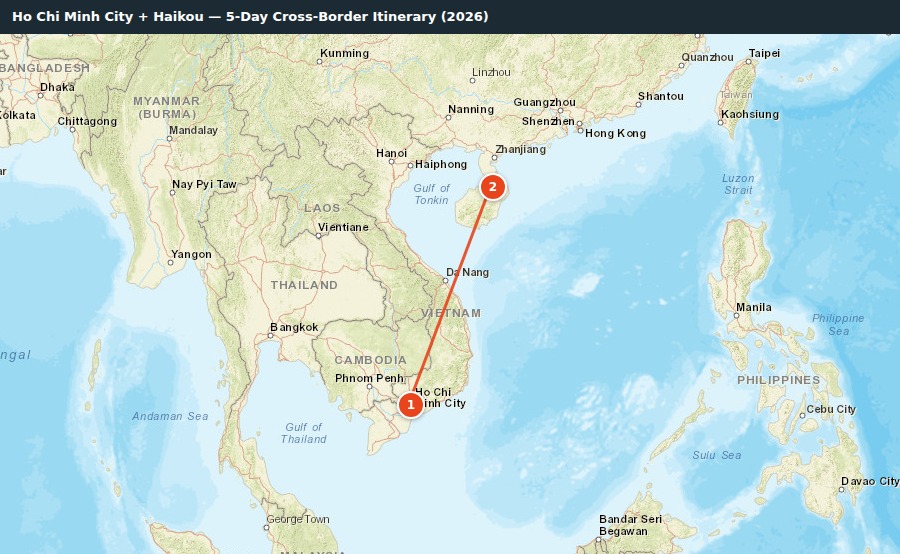
Ho Chi Minh City + Haikou — 5-Day Cross-Border Itinerary (2026)

A curated 5-day journey: Ho Chi Minh City, Haikou. Each day has timed activities, a getting-around table and packing reminders, so you can book or self-drive with confidence.

Route map for Ho Chi Minh City + Haikou — 5-Day Cross-Border Itinerary (2026)
Route map — 2 stops · 5 days · China + Southeast Asia

Route im Überblick

Ho Chi Minh CityHaikou

Why this route works

  • 5 days, 2 bases — sequenced so travel days fall between sightseeing days and every stop gets real time on the ground, not just transfers.
  • Street food and skylines is the through-line: Ho Chi Minh City, Haikou.
  • China + Southeast Asia — one continuous trip instead of two separate holidays, so you only unpack and re-pack when the route really demands it.

Tagesablauf

TAG
1

Ho Chi Minh City

Ankunft & erster Eindruck
Ho Chi Minh City
09:00Arrive in Ho Chi Minh City. Your private driver meets you and transfers you to the hotel (about 45–90 min from the airport).
11:00Frühes Einchecken, Gepäck abstellen und sich frisch machen.
12:30Willkommensmahl – ein lokales Restaurant, empfohlen von Ihrem Reiseleiter.
14:30Gentle orientation: a guided stroll through Ho Chi Minh City old quarter with short photo stops.
17:00Rückkehr ins Hotel, um sich auszuruhen. Aktivieren Sie Ihre eSIM und richten Sie Alipay / WeChat Pay mit Ihrer Karte ein.
19:00Abendessen in einem empfohlenen Lokal – ein regionales Abendessen.
20:30Entspannter Abend: Nachtaussicht oder freie Zeit. Ihr Reiseleiter informiert Sie über den morgigen Tag.
Übernachtungin Ho Chi Minh City.

Tägliche Erinnerungen · gilt jeden Tag

  • Tragen Sie Ihren Reisepass (plus Kopie des Visums) bei sich — Hotels und Sehenswürdigkeiten können ID-Checks durchführen.
  • Bestätigen Sie die Abholzeit für morgen mit Ihrem Reiseleiter.
  • Halten Sie sowohl Bargeld als auch eine aufgeladene mobile Zahlungsanwendung (Alipay / WeChat Pay) bereit.
  • Laden Sie Ihr Handy und Powerbank auf, bevor Sie losgehen.
  • Laden Sie die Offline-Karte für das heutige Gebiet herunter.
  • Vervollständigen Sie die Hotelregistrierung.
  • Aktivieren Sie Ihre eSIM / lokale SIM und testen Sie die Datenverbindung.
  • Speichern Sie die Hoteladresse in chinesischer Sprache, um sie Taxifahrern zu zeigen.
TAG
2

Ho Chi Minh City

Ganztägige Erkundung
07:30Frühstück im Hotel.
08:30Aufbruch mit Ihrem Reiseleiter zu den Morgen-Highlights.
09:15An orientation drive around Ho Chi Minh City with photo stops.
11:15Entdecken Sie eine typische Straße oder einen Platz.
12:30Mittagessen — ein lokales Restaurant, empfohlen von Ihrem Reiseleiter.
14:00Ein weiterer geführter Besuch einer Sehenswürdigkeit.
16:00Eine malerische Wanderung oder ein Aussichtspunkt.
17:30Rückkehr zum Hotel, um sich frisch zu machen; Freizeit.
19:00Abendessen – ein regionales Abendessen.
20:30Eine lokale Vorstellung oder ein Nachtmarkt.
22:00Back to the hotel. Overnight in Ho Chi Minh City.
TAG
3

Ho Chi Minh City

On the road to Haikou
07:30Frühstück im Hotel und Packen.
09:00Free morning for a last stroll or souvenir shopping in Ho Chi Minh City.
11:00Check out; private transfer to the station / airport for the intercity leg to Haikou.
13:00Arrive Haikou; check in or drop your bags at the hotel.
14:30Afternoon orientation of Haikou with your guide — Explore a further highlight or a nearby point of interest..
18:30Dinner in Haikou — a regional dinner.
20:30Free evening. Overnight in Haikou.
TAG
4

Haikou

Eingewöhnen & erkunden
Haikou
07:30Frühstück im Hotel.
08:30Aufbruch mit Ihrem Reiseleiter zu den Morgen-Highlights.
09:15A walking tour of Haikou's centre and landmarks.
11:15Eine Kaffeepause in einer lebhaften Nachbarschaft.
12:30Mittagessen — ein lokales Restaurant, empfohlen von Ihrem Reiseleiter.
14:00Freizeit für Einkäufe und Spaziergänge.
16:00Ein entspannter Nachmittag mit einer Aktivität Ihrer Wahl.
17:30Rückkehr zum Hotel, um sich frisch zu machen; Freizeit.
19:00Abendessen – ein regionales Abendessen.
20:30Freier Abend, um sich im Hotel zu entspannen.
22:00Back to the hotel. Overnight in Haikou.
TAG
5

Haikou

Letzter Morgen & Abreise
07:30Frühstück im Hotel und Packen.
09:00Letzter Spaziergang oder letzte Souveniereinkäufe in der Nähe des Hotels.
11:00Auschecken und Begleichung von Nebenkosten.
12:00Privater Transfer zum Flughafen / Bahnhof; Ihr Reiseleiter hilft bei der Eincheckung.
—Ende der Dienstleistungen. Gute Reise — vielen Dank, dass Sie mit WingPhoenix gereist sind!

Anreise

Etappe Entfernung Empfohlen
Ho Chi Minh City → Haikou 1094 km Inlandsflug

Praktische Tipps

  • April–Mai & September–Oktober sind die beste Reisezeit für den Großteil Chinas; vermeiden Sie die Menschenmassen während des Nationalfeiertages vom 1.–7. Oktober.
  • Richten Sie Alipay / WeChat Pay ein und installieren Sie eine China eSIM, bevor Sie landen.
  • Buchen Sie zeitgesteuerte Eintrittskarten für wichtige Sehenswürdigkeiten (Verbotene Stadt, Terrakotta-Armee, Panda-Basis).
  • Cross-border trips need entry checks for each country on the route — verify visa and transit rules for every passport in your group before booking flights.
  • Notfälle: Polizei 110 · Ambulanz 120 · Tourismus-Hotline 12301 · WingPhoenix 24/7 WhatsApp +86 180 3801 6100.
Möchten Sie diese Route als vollständig buchbare Reise mit Hotels, privatem Auto, englischsprachigen Reiseleitern und aktuellem Preis? Erstellen Sie es kostenlos im WingPhoenix AI Reiseplaner oder per WhatsApp +86 180 3801 6100. Browse all itineraries →