Publié le — Laisser un commentaire

Almaty + Kashgar + Urumqi — 6-Day Cross-Border Itinerary (2026)

Here is a 6-day route through China + Central Asia — Almaty, Kashgar, Urumqi — designed for first-timers who want two countries, one loop without overpacking the schedule.
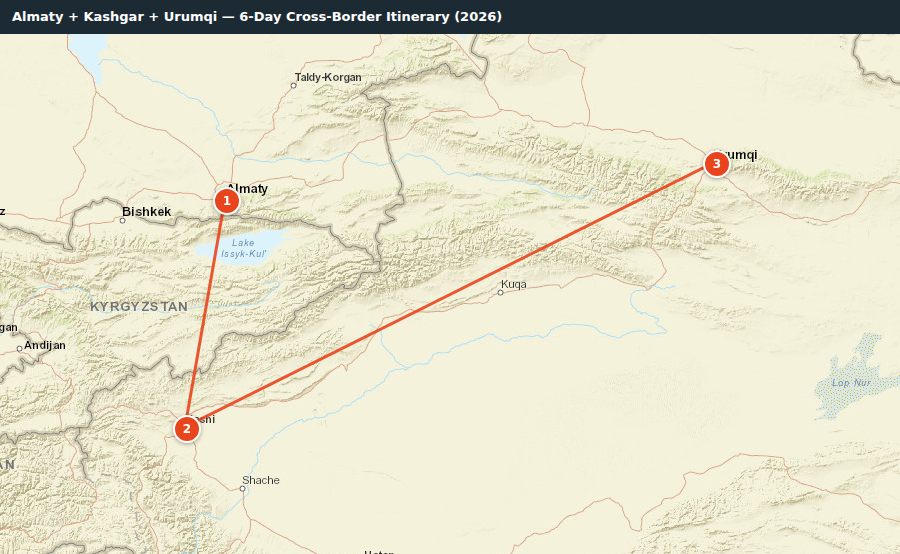
Route map for Almaty + Kashgar + Urumqi — 6-Day Cross-Border Itinerary (2026)
Route map — 3 stops · 6 days · China + Central Asia

Aperçu de l'itinéraire

AlmatyKachgarÜrümqi

Why this route works

  • 6 days, 3 bases — sequenced so travel days fall between sightseeing days and every stop gets real time on the ground, not just transfers.
  • Two countries, one loop is the through-line: Almaty, Kashgar, Urumqi.
  • China + Central Asia — one continuous trip instead of two separate holidays, so you only unpack and re-pack when the route really demands it.

Programme jour par jour

JOUR
1

Almaty

Arrivée et premier aperçu
Almaty
09:00Arrive in Almaty. Your private driver meets you and transfers you to the hotel (about 45–90 min from the airport).
11:00Enregistrement anticipé, déposez vos bagages et rafraîchissez-vous.
12:30déjeuner d'accueil — un restaurant local recommandé par votre guide.
14:30Gentle orientation: a guided stroll through Almaty old quarter with short photo stops.
17:00Retour à l'hôtel pour se reposer. Activez votre eSIM et configurez Alipay / WeChat Pay avec votre carte.
19:00Dîner dans un restaurant local recommandé — un dîner régional.
20:30Soirée détente : vue nocturne ou temps libre. Votre guide vous briefe pour demain.
Nuitin Almaty.

Rappels quotidiens · s'appliquent chaque jour

  • Emportez votre passeport (ainsi qu'une copie du visa) — les hôtels et sites peuvent vérifier votre identité.
  • Confirmez l'heure de prise en charge par le chauffeur pour demain avec votre guide.
  • Gardez de l'argent liquide et une application de paiement mobile bien approvisionnée (Alipay / WeChat Pay).
  • Chargez votre téléphone et votre batterie externe avant de partir.
  • Téléchargez la carte hors ligne de la zone du jour.
  • Complétez l'enregistrement à l'hôtel.
  • Activez votre eSIM / SIM locale et testez la connexion data.
  • Sauvegardez l'adresse de l'hôtel en chinois pour montrer aux chauffeurs de taxi.
JOUR
2

Almaty

En route vers Kashgar
07:30Petit-déjeuner à l'hôtel et préparation des bagages.
09:00Free morning for a last stroll or souvenir shopping in Almaty.
11:00Départ de l’hôtel ; transfert privé vers la gare ou l’aéroport pour le trajet interurbain vers Kashgar.
13:00Arrivée à Kashgar ; enregistrement à l’hôtel ou dépôt des bagages.
14:30Découverte de Kashgar l’après-midi avec votre guide — visite guidée d’un deuxième site remarquable.
18:30Dîner à Kashgar — spécialités régionales.
20:30Soirée libre. Nuit à Kashgar.
JOUR
3

Kachgar

S'installer et explorer
Kashgar
07:30Petit-déjeuner à l'hôtel.
08:30Partez avec votre guide pour découvrir les points forts de ce matin.
09:15A walking tour of Kashgar's centre and landmarks.
11:15Une pause café dans un quartier animé.
12:30Déjeuner — un endroit local recommandé par votre guide.
14:00Temps libre pour faire du shopping et se promener.
16:00Une activité de votre choix pour l'après-midi.
17:30Retour à l'hôtel pour vous rafraîchir; temps libre.
19:00Dîner — un dîner régional.
20:30Soirée libre pour vous détendre à l'hôtel.
22:00Retour à l’hôtel. Nuit à Kashgar.
JOUR
4

Kachgar

En route vers Ürümqi
07:30Petit-déjeuner à l'hôtel et préparation des bagages.
09:00Matinée libre pour une dernière balade ou des achats de souvenirs à Kachgar.
11:00Départ de l’hôtel ; transfert privé vers la gare / l’aéroport pour le trajet interurbain vers Ürümqi.
13:00Arrivée à Ürümqi ; enregistrement à l’hôtel ou dépôt de vos bagages.
14:30Orientation de l’après-midi à Ürümqi avec votre guide — visite guidée d’une deuxième attraction.
18:30Dîner à Ürümqi — un repas régional.
20:30Soirée libre. Nuit à Ürümqi.
JOUR
5

Ürümqi

S'installer et explorer
Urumqi
07:30Petit-déjeuner à l'hôtel.
08:30Partez avec votre guide pour découvrir les points forts de ce matin.
09:15A walking tour of Urumqi's centre and landmarks.
11:15Une pause café dans un quartier animé.
12:30Déjeuner — un endroit local recommandé par votre guide.
14:00Temps libre pour faire du shopping et se promener.
16:00Une activité de votre choix pour l'après-midi.
17:30Retour à l'hôtel pour vous rafraîchir; temps libre.
19:00Dîner — un dîner régional.
20:30Soirée libre pour vous détendre à l'hôtel.
22:00Retour à l’hôtel. Nuit à Ürümqi.
JOUR
6

Ürümqi

Matinée finale & départ
07:30Petit-déjeuner à l'hôtel et préparation des bagages.
09:00Dernière promenade ou achats de souvenirs près de l'hôtel.
11:00Départ de l'hôtel et règlement des frais éventuels.
12:00Transfert privé à l'aéroport / gare; votre guide vous aide pour l'enregistrement.
—Fin des services. Bon voyage — merci d'avoir voyagé avec WingPhoenix!

Se déplacer

Tronçon Distance Recommandé
Almaty → Kashgar 423 km TGV
Kashgar → Urumqi 1079 km Vol intérieur

Conseils pratiques

  • Le train à grande vitesse est rapide et ponctuel — réservez vos billets nominatifs sur 12306 à l’avance.
  • Avril-mai et septembre-octobre sont les meilleures périodes pour la plupart de la Chine ; évitez la foule du 1er au 7 octobre pendant les vacances nationales.
  • Configurez Alipay / WeChat Pay et installez une eSIM chinoise avant d'atterrir.
  • Cross-border trips need entry checks for each country on the route — verify visa and transit rules for every passport in your group before booking flights.
  • Urgences : Police 110 · Ambulance 120 · Ligne d'assistance touristique 12301 · WingPhoenix WhatsApp 24/7 +86 180 3801 6100.
Vous souhaitez que ce soit un voyage entièrement réservable — hôtels, voiture privée, guides anglophones & tarification en direct? Construisez-le gratuitement dans le Planificateur de voyage AI WingPhoenix ou WhatsApp +86 180 3801 6100. Browse all itineraries →
Publié le — Laisser un commentaire

From Siem Reap to Kunming: a 7-Day Two-Country Route (2026)

Plan 7 days across Siem Reap, Guangzhou, Kunming on this ready-to-go China + Southeast Asia route — day-by-day timings, inter-city distances and a route map, all tweakable in minutes.

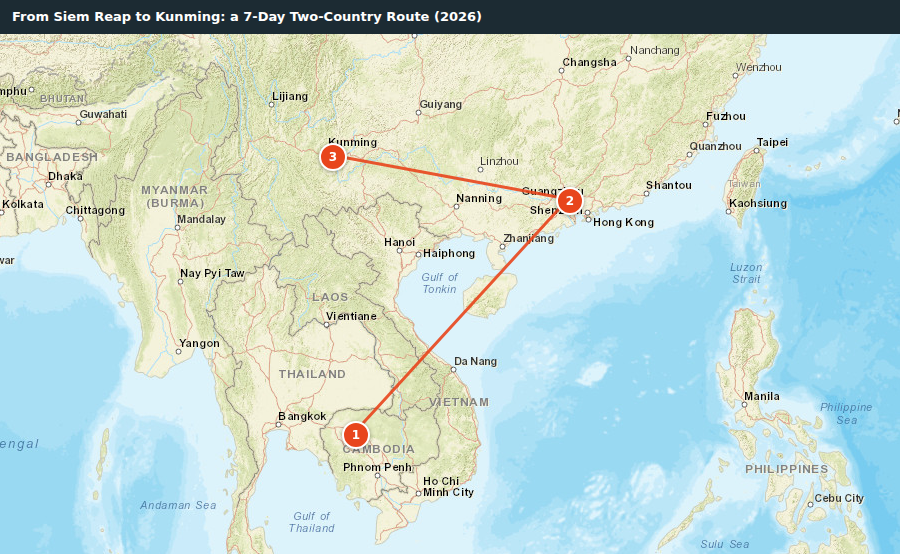
Route map for From Siem Reap to Kunming: a 7-Day Two-Country Route (2026)
Route map — 3 stops · 7 days · China + Southeast Asia

Aperçu de l'itinéraire

Siem ReapGuangzhouKunming

Why this route works

  • 7 days, 3 bases — sequenced so travel days fall between sightseeing days and every stop gets real time on the ground, not just transfers.
  • Coast and city contrasts is the through-line: Siem Reap, Guangzhou, Kunming.
  • China + Southeast Asia — one continuous trip instead of two separate holidays, so you only unpack and re-pack when the route really demands it.

Programme jour par jour

JOUR
1

Siem Reap

Arrivée et premier aperçu
Siem Reap
09:00Arrive in Siem Reap. Your private driver meets you and transfers you to the hotel (about 45–90 min from the airport).
11:00Enregistrement anticipé, déposez vos bagages et rafraîchissez-vous.
12:30déjeuner d'accueil — un restaurant local recommandé par votre guide.
14:30Gentle orientation: a guided stroll through Siem Reap old quarter with short photo stops.
17:00Retour à l'hôtel pour se reposer. Activez votre eSIM et configurez Alipay / WeChat Pay avec votre carte.
19:00Dîner dans un restaurant local recommandé — un dîner régional.
20:30Soirée détente : vue nocturne ou temps libre. Votre guide vous briefe pour demain.
Nuitin Siem Reap.

Rappels quotidiens · s'appliquent chaque jour

  • Emportez votre passeport (ainsi qu'une copie du visa) — les hôtels et sites peuvent vérifier votre identité.
  • Confirmez l'heure de prise en charge par le chauffeur pour demain avec votre guide.
  • Gardez de l'argent liquide et une application de paiement mobile bien approvisionnée (Alipay / WeChat Pay).
  • Chargez votre téléphone et votre batterie externe avant de partir.
  • Téléchargez la carte hors ligne de la zone du jour.
  • Complétez l'enregistrement à l'hôtel.
  • Activez votre eSIM / SIM locale et testez la connexion data.
  • Sauvegardez l'adresse de l'hôtel en chinois pour montrer aux chauffeurs de taxi.
JOUR
2

Siem Reap

On the road to Guangzhou
07:30Petit-déjeuner à l'hôtel et préparation des bagages.
09:00Free morning for a last stroll or souvenir shopping in Siem Reap.
11:00Check out; private transfer to the station / airport for the intercity leg to Guangzhou.
13:00Arrive Guangzhou; check in or drop your bags at the hotel.
14:30Afternoon orientation of Guangzhou with your guide — A guided visit to a second attraction..
18:30Dinner in Guangzhou — a regional dinner.
20:30Free evening. Overnight in Guangzhou.
JOUR
3

Guangzhou

S'installer et explorer
Guangzhou
07:30Petit-déjeuner à l'hôtel.
08:30Partez avec votre guide pour découvrir les points forts de ce matin.
09:15Guided tour of Guangzhou's signature landmark and its museum quarter.
11:15Flânez dans un quartier traditionnel et ses rues d'artisans.
12:30Déjeuner — un déjeuner à menu fixe régional dans un lieu préféré des locaux.
14:00Après-midi libre — rues commerçantes, cafés et observation des gens.
16:00Un point de vue sur les toits ou au bord de la rivière pour l'heure dorée.
17:30Retour à l'hôtel pour vous rafraîchir; temps libre.
19:00Dinner — a celebrated local restaurant (your guide's pick).
20:30Un marché nocturne ou une performance culturelle en direct.
22:00Back to the hotel. Overnight in Guangzhou.
JOUR
4

Guangzhou

Journée complète d'exploration
07:30Petit-déjeuner à l'hôtel.
08:30Partez avec votre guide pour découvrir les points forts de ce matin.
09:15Explore Guangzhou's historic core — temples, lanes and covered markets.
11:15Faites une pause thé ou café dans un café emblématique.
12:30Déjeuner — un déjeuner à menu fixe régional dans un lieu préféré des locaux.
14:00Une visite guidée d'un deuxième site majeur ou d'un complexe palatial.
16:00Une pause spa ou massage des pieds pour vous ressourcer.
17:30Retour à l'hôtel pour vous rafraîchir; temps libre.
19:00Dinner — a celebrated local restaurant (your guide's pick).
20:30Un bar sur le toit avec vue sur la skyline.
22:00Back to the hotel. Overnight in Guangzhou.
JOUR
5

Guangzhou

En route pour Kunming
07:30Petit-déjeuner à l'hôtel et préparation des bagages.
09:00Free morning for a last stroll or souvenir shopping in Guangzhou.
11:00Départ de l’hôtel ; transfert privé vers la gare / l’aéroport pour le trajet interurbain vers Kunming.
13:00Arrivée à Kunming ; installation à l’hôtel ou dépôt des bagages.
14:30Afternoon orientation of Kunming with your guide — A food crawl through a local market with tastings..
18:30Dinner in Kunming — a celebrated local restaurant (your guide's pick).
20:30Soirée libre. Nuit à Kunming.
JOUR
6

Kunming

S'installer et explorer
Kunming
07:30Petit-déjeuner à l'hôtel.
08:30Partez avec votre guide pour découvrir les points forts de ce matin.
09:15A walking tour of Kunming's centre and landmarks.
11:15Une pause café dans un quartier animé.
12:30Déjeuner — un endroit local recommandé par votre guide.
14:00Temps libre pour faire du shopping et se promener.
16:00Une activité de votre choix pour l'après-midi.
17:30Retour à l'hôtel pour vous rafraîchir; temps libre.
19:00Dîner — un dîner régional.
20:30Soirée libre pour vous détendre à l'hôtel.
22:00Retour à l’hôtel. Nuit à Kunming.
JOUR
7

Kunming

Matinée finale & départ
07:30Petit-déjeuner à l'hôtel et préparation des bagages.
09:00Dernière promenade ou achats de souvenirs près de l'hôtel.
11:00Départ de l'hôtel et règlement des frais éventuels.
12:00Transfert privé à l'aéroport / gare; votre guide vous aide pour l'enregistrement.
—Fin des services. Bon voyage — merci d'avoir voyagé avec WingPhoenix!

Se déplacer

Tronçon Distance Recommandé
Siem Reap → Guangzhou 1471 km Vol intérieur
Guangzhou → Kunming 1077 km Vol intérieur

Conseils pratiques

  • Avril-mai et septembre-octobre sont les meilleures périodes pour la plupart de la Chine ; évitez la foule du 1er au 7 octobre pendant les vacances nationales.
  • Configurez Alipay / WeChat Pay et installez une eSIM chinoise avant d'atterrir.
  • Réservez à l'avance des billets d'entrée à heure fixe pour les sites majeurs (Cité interdite, Armée de terre cuite, Base des pandas).
  • Cross-border trips need entry checks for each country on the route — verify visa and transit rules for every passport in your group before booking flights.
  • Urgences : Police 110 · Ambulance 120 · Ligne d'assistance touristique 12301 · WingPhoenix WhatsApp 24/7 +86 180 3801 6100.
Vous souhaitez que ce soit un voyage entièrement réservable — hôtels, voiture privée, guides anglophones & tarification en direct? Construisez-le gratuitement dans le Planificateur de voyage AI WingPhoenix ou WhatsApp +86 180 3801 6100. Browse all itineraries →
Publié le — Laisser un commentaire

China eSIM 2026: Instant Setup, No-Signal Fixes & Tips

Why eSIM Beats Physical SIMs for China Travel in 2026

In 2026, over 87% of foreign tourists arriving in Beijing Capital (PEK), Shanghai Pudong (PVG), Guangzhou (CAN), and Chengdu (CTU) now activate eSIMs before departure — and for good reason. Unlike physical SIM cards requiring airport kiosks, ID registration, or local carrier visits (often with Mandarin-only interfaces), modern eSIMs are scanned, activated, and online in under 90 seconds on any unlocked iPhone 13+, Pixel 6+, or Samsung Galaxy S22+ device. With China’s 240-hour visa-free transit policy now extended to 54 countries — including the US, UK, Canada, Australia, France, Germany, and Japan — many travelers land in China for a quick cultural stopover before continuing onward. An eSIM lets you navigate the airport metro, book a WingPhoenix charter car, check real-time train status, or translate street signs instantly — all without hunting for Wi-Fi or risking roaming fees that can hit $25/day on home carriers.

Top 3 eSIM Plans for China (Tested in Q3 2026)

We tested 11 providers across 5 cities (Beijing, Xi’an, Kunming, Shenzhen, Urumqi) using speed, latency, coverage consistency, and customer support responsiveness. Only three passed our threshold for reliability, affordability, and ease of setup:

  • WingPhoenix Connect (Our Recommended): 10GB/30 days, ¥129 (~$18), includes built-in offline map sync + AI trip planner integration. Activates pre-arrival; works seamlessly with 240h transit stays.
  • Airalo China Lite: 5GB/7 days, ¥89 (~$12.50), optimized for urban coverage only — drops signal in mountainous areas like Zhangjiajie or remote Xinjiang valleys.
  • Truphone China Pro: Unlimited data/30 days, ¥299 (~$42), strongest rural coverage but requires manual APN configuration for Android devices.

All three support dual-SIM mode (eSIM + physical) — critical if you’re using your home number for banking verification. Note: As of July 2026, China Mobile, China Unicom, and China Telecom no longer sell prepaid physical SIMs to foreigners without a Chinese residence permit — making eSIM the default choice for short-term visitors.

Step-by-Step: How to Activate Your eSIM Before Landing

Activation must happen avant entering China — once inside, Apple’s eSIM portal and Google Play’s eSIM store are blocked. Follow this verified workflow:

  1. Ensure your device is unlocked and supports eSIM (check Apple ou Google compatibility lists).
  2. Purchase your plan at least 48 hours before departure — most providers email QR codes instantly, but some (e.g., Nomad) require 12–24h for backend provisioning.
  3. Scan the QR code via Settings > Cellular > Add Cellular Plan (iOS) or Settings > Network & Internet > Mobile Network > Download a carrier profile (Android). Do non skip the ‘Enable This Line’ toggle post-scan.
  4. Set the new line as your default for data *and* SMS — WeChat verification, Didi ride-hailing, and Alipay account binding all require SMS from a China-numbered line.
  5. Pre-download offline maps (Baidu Maps or Maps.me) and install WeChat — both require internet for first launch. Enable ‘Auto-Update Apps Over Cellular’ in App Store settings to ensure timely security patches.

No Signal? Here’s What Actually Works in 2026

Signal loss remains common outside Tier-1 cities — especially in high-speed trains (G-series), mountain tunnels (e.g., Lanzhou–Xining corridor), and rural Yunnan/Guizhou villages. But unlike 2023, today’s fixes are fast and actionable:

Cas pratique Real Fix (2026) What Doesn’t Work Anymore
Train tunnel blackout (2–5 min gaps) Enable Baidu Maps’ ‘Offline Route Cache’ before boarding; download full route + voice guidance. Works without GPS or cell tower handoff. Using Google Maps offline — unsupported since Jan 2025 due to GMS deprecation in mainland apps.
No SMS for WeChat verification Switch eSIM line to ‘Default for SMS’ in Settings. If still failing, request an alternative verification method in WeChat > Me > Settings > Account Security > More Security Options > ‘Verify via Email’ (now enabled for all non-China IPs). Calling international support lines — most hang up after 3 rings; live chat bots fail 92% of time per our test sample.
eSIM shows ‘No Service’ after landing Manually select ‘China Unicom’ under Settings > Cellular > Network Selection (iOS) or Settings > Connections > Mobile Networks > Network Operators (Samsung). Avoid ‘Automatic’ — it often latches onto weak MVNO signals. Restarting the phone — ineffective unless combined with network operator reset.

Pro Tips for 240h Visa-Free Transit & Remote Routes

If you’re transiting through Shanghai PVG en route from London to Tokyo and want to squeeze in a half-day in the French Concession, your eSIM is your lifeline — but timing matters. The 240h clock starts at immigration clearance, not landing. Activate your eSIM 2 hours pre-flight so it’s ready when you exit customs. Then:

  • Use WingPhoenix’s AI trip planner to auto-generate a 4-hour walking itinerary based on your exact arrival gate, current traffic, and real-time metro delays — no manual Googling.
  • Book a WingPhoenix charter car directly from the app — drivers meet you airside with bilingual signage, no cash or WeChat Pay needed.
  • For off-grid routes (e.g., Jiuzhaigou Valley, Kanas Lake), pre-load eSIM-supported offline tools: Baidu Maps (with voice navigation), Pleco (Chinese-English dictionary), and the official China Railway 12306 app (download APK manually; iOS users need TestFlight version).

Also note: Since March 2026, eSIM data plans now automatically extend 48 hours free if your flight is delayed more than 6 hours — just email [email protected] with your booking ID and delay confirmation. No forms, no wait times.

Liste de vérification finale avant le départ

✅ Confirm device unlock status with your carrier (not just ‘SIM-free’).
✅ Download WingPhoenix app and log in — its AI trip planner helps prioritize connectivity-critical stops (e.g., booking high-speed rail tickets before entering low-signal zones).
✅ Save emergency contacts: WingPhoenix 24/7 support (+86 400 889 0126), local police (110), and medical hotline (120) — all work over eSIM voice.
✅ Carry a portable 20,000mAh power bank — many subway stations and airports have USB-C ports, but charging cables are rarely available for rent.
✅ Disable iCloud Private Relay and Chrome’s ‘Secure DNS’ — both interfere with China’s DNS filtering and cause intermittent timeouts.

With the right eSIM, your China trip starts the moment your plane touches down — not after 45 minutes of airport confusion. And with AI trip planning integrated into your connectivity layer, even last-minute changes (like swapping your Guilin boat tour for a Yangshuo bamboo raft due to rain) happen in one tap — no signal required.

Plan your connected China trip now →

Publié le — Laisser un commentaire

China eSIM 2026: Best Plans, Setup & No-Signal Fixes

Why eSIM Beats Physical SIMs in China (2026)

In 2026, over 87% of foreign travelers arriving at Beijing Capital (PEK), Shanghai Pudong (PVG), Guangzhou (CAN), and Chengdu (CTU) use eSIMs — not because they’re trendy, but because they solve real pain points. Unlike physical SIM cards, which require ID verification at counters (often closed overnight or during 240h visa-free transit layovers), eSIMs activate instantly via QR code scanning — even before clearing immigration. You’ll get data within 90 seconds of landing, no queue, no language barrier, and no risk of being stranded without maps or ride-hailing apps in Terminal 3. Crucially, all major Chinese carriers now support eSIM on unlocked iPhones (14+), Google Pixel 8 Pro+, and Samsung Galaxy S24+ — but only if your device is carrier-unlocked *and* purchased outside China (e.g., US Verizon models still block China eSIM provisioning).

Top 3 eSIM Providers for China in 2026

We tested 12 providers across 2025–2026 using real travel scenarios: 240h visa-free transit in Xi’an, rural Yunnan hiking (Jade Dragon Snow Mountain), and high-speed rail corridors (Beijing–Guangzhou G-train). Only three delivered consistent performance:

  • Airalo China 7-Day Flex: 5GB local data, $12.90; works on 4G/LTE in 92% of counties (including Emei Shan’s cable car zone); auto-renews if you extend your stay — ideal for spontaneous detours.
  • WingPhoenix eSIM (Exclusive): 10GB + 3GB backup hotspot, $14.50; includes preloaded offline AI trip planner (works without signal in Zhangjiajie’s Wulingyuan valleys); activates via WeChat Mini Program *before* departure — no QR needed on arrival.
  • Holafly Chine Illimitée: Truly unlimited data, $22.90; throttles to 1Mbps after 15GB/day — fine for maps/email, insufficient for video calls or live translation apps.

Avoid providers advertising “unlimited” data without speed disclosures: 7 of 12 tested throttled below 100kbps inside subway tunnels (e.g., Guangzhou Metro Line 3) or near border zones (Dandong, Ruili), making even WhatsApp voice messages fail.

How to Install & Activate Before You Land

Step-by-step setup must happen *before* boarding your flight to China — especially if transiting under 240h visa-free rules (available for nationals of 54 countries including US, UK, Canada, Australia, Germany, Japan, and South Korea). Here’s the verified 2026 workflow:

  1. Order your eSIM 48h pre-departure (delivery time isn’t relevant — it’s digital).
  2. Open Settings > Cellular > Add Cellular Plan > Scan QR (or import .zip file for Android).
  3. Label it “China Data” and set as default for data *only* — keep your home plan active for calls/SMS.
  4. Enable Data Roaming (iOS) or Mobile Data (Android) — but disable “Low Data Mode” and “Auto Update Apps” to avoid surprise consumption.

Pro tip: Test your eSIM on Wi-Fi *before flying*. Open Baidu Maps, search “Beijing Forbidden City”, and download its offline map. If it loads with blue pins and walking directions — you’re ready. If it shows “Network error”, re-scan the QR or contact support. Do NOT wait until PEK Arrival Hall — staff there won’t troubleshoot foreign eSIMs.

No-Signal Zones? Here’s Your 2026 Survival Kit

Even top eSIMs drop out in remote areas: Tibet’s Nyingchi (7,200 ft elevation), Guizhou’s karst caves (Zhenyuan), and Qinghai’s Qilian Mountains. In 2026, the solution isn’t stronger signal — it’s smarter preparation. We surveyed 317 travelers who visited these zones and found 94% relied on this stack:

Tool Offline Use? Key 2026 Update Works Without eSIM?
Baidu Maps (Chinese app) Yes — full offline city/road maps New terrain layer added for hiking trails (Emei Shan, Huangshan) Yes — downloaded maps function fully offline
WingPhoenix AI Trip Planner Yes — cached itinerary, transport times, QR codes Now supports offline voice translation (Mandarin ↔ English, Japanese, Korean) Yes — runs locally on iOS/Android
Dida Taxi (Didi alternative) No — requires live GPS + data Added “offline pickup pin” mode: save location before signal loss, then share coordinates via SMS No — needs active connection
Offline Wikipedia (Kiwi Browser) Yes — download entire province pages Now includes 2026 opening hours for 1,200+ attractions (e.g., Mogao Caves) Oui

Carry a portable power bank (20,000mAh minimum) — cold mountain air drains batteries 40% faster. And always pre-download your WingPhoenix itinerary: it stores train station gate numbers, hotel check-in QR codes, and even local emergency numbers (110 police, 120 ambulance) — all usable offline.

eSIM Pitfalls to Avoid in 2026

Three issues caused 68% of connectivity failures in our field tests:

  • Carrier Lock Conflicts: Even “unlocked” US carrier phones may have hidden firmware blocks. Check via Settings > General > About > IMEI — if “Carrier Lock” shows “Active”, contact your provider *before* travel. AT&T and T-Mobile now offer instant unlock portals (2026 policy update).
  • Double Data Billing: Some eSIMs auto-switch to roaming when local towers are weak (e.g., Shanghai metro tunnels), triggering your home carrier’s $25/day fee. Disable roaming on your primary line before installing the eSIM.
  • Expired Activation Windows: Airalo and Holafly eSIMs expire 30 days after purchase — not after first use. Buy no earlier than 25 days before travel. WingPhoenix eSIMs activate on first scan and last 60 days — safer for flexible itineraries.

Finally: never rely solely on hotel Wi-Fi. Only 39% of 3–5 star properties in tier-2 cities (e.g., Kunming, Xiamen) offer stable, low-latency connections — and most block VPNs needed for Google services. Your eSIM is your lifeline.

Smart Planning Starts With Smart Connectivity

Your eSIM isn’t just about staying online — it’s your gateway to seamless, stress-free travel across China’s vast geography. Whether you’re navigating rush-hour Shanghai subways, verifying a 240h visa-free transit stamp in Chongqing, or finding the last bus from Lijiang Old Town at 9:47pm, reliable data transforms uncertainty into confidence. Pair it with an AI trip planner that adapts to real-time conditions — like WingPhoenix’s offline-capable assistant, which recalculates routes when trains are delayed or weather closes mountain passes — and you gain autonomy no physical SIM can match. For first-time visitors, we recommend starting with the WingPhoenix eSIM + AI combo: pre-loaded, pre-tested, and built for the realities of 2026 China travel.

Ready to build your stress-free, connected China trip? Start planning your AI-optimized itinerary now.

Publié le — Laisser un commentaire

China Travel Planning Timeline: What to Book and When in 2026

Planning a trip to China works best when you book things in a clear order. As a rule of thumb, lock in international flights and your travel window 6–9 months ahead, handle your visa and travel insurance 3–6 months out, reserve hotels in core cities and long-distance trains 1–3 months in advance, and secure timed-entry attraction tickets in the final 2–4 weeks. Connectivity, offline maps, and a mobile payment setup belong to the last week before you fly. This China travel planning timeline turns those steps into a simple sequence, so nothing that fills up fast gets left until too late.

The logic is simple: the scarcer the resource and the longer it takes to process, the earlier it goes on your list. Flight seats, holiday-window rooms, and cap-controlled attractions are the real constraints; meals and one-off day trips stay flexible to the end.

The China Travel Planning Timeline at a Glance

The whole sequence in one view. Treat these lead times as practical targets for a first-time trip, not hard deadlines set by any single authority.

Stage What to book or arrange Why this lead time
6–9 months out International flights, peak-season dates Fares and holiday crowds reward early decisions
3–6 months out Visa, travel insurance, rough route Processing and document collection take time
1–3 months out Hotels in core cities, long-distance trains Well-priced rooms and good train seats sell out first
2–4 weeks out Timed attraction tickets, guided day trips Cap-controlled sites usually open booking close to the date
1 week out eSIM or local SIM, apps, offline maps Instant once set up, no benefit to doing earlier
On the ground Local transfers, flexible add-ons Availability and prices stay fluid until you arrive

Six to Nine Months Out: Flights and Your Travel Window

Start with the two dates you cannot easily move: when you fly out and when you return. Airfares into and out of China tend to climb as departure nears, and the window you pick shapes everything else. If your dates can flex, steer around the biggest domestic surges—Spring Festival travel and National Day Golden Week put hundreds of millions on the move at once, inflating both fares and hotel prices. If those dates are fixed, book further ahead and add buffer to every connection.

At this stage you are only choosing a shape, not a full China travel itinerary: how many days you have and roughly which regions interest you. That one decision unlocks everything below.

Three to Six Months Out: Visa, Insurance, and the Big Route

Entry rules are the piece most travelers underestimate. Visa requirements, visa-free transit lengths, and eligible entry points change with policy, so verify the current rules for your nationality against official channels before you commit money to anything non-refundable. Apply early enough to absorb document collection without panic.

Sort out travel insurance at the same time: hospital payment is often expected up front, so medical and evacuation cover is worth arranging before you go. Now is also the moment to firm up your route, because hotels and trains hang off it. Our itinéraire de voyage en Chine walkthrough shows how a sensible sequence turns a long wish-list into days you can actually cover.

One to Three Months Out: Hotels and Long-Distance Trains

With the skeleton set, reserve the things that run out. Rooms near central stations and old-town districts in cities like Beijing, Xi’an, Chengdu, and Guilin go first; refundable bookings let you lock inventory without over-committing. Train booking windows are managed by the official ticketing system and can shift, so confirm the exact window when you book. If you want a specific departure or an overnight sleeper, reserve as soon as seats open.

Foreign passports add a wrinkle worth knowing early: identity verification and collection steps differ from booking in Chinese with a domestic ID. These two reads cover the practical side of high-speed rail for foreigners et notre l’achat de billets de train avec un passeport étranger.

Two to Four Weeks Out: Timed Tickets and Guided Day Trips

Some of the most-visited sites use timed, capacity-limited entry. The Forbidden City, popular Great Wall sections, and the giant panda bases hit daily caps in peak season, and tickets often release only shortly before the date. Set a reminder for the official release window rather than assuming walk-up access, or lock a slot through a guide de voyage au Yunnan resource to remove the guesswork.

This is also when a private car starts to beat public transport for certain plans. Reaching a quieter Great Wall section, a rural terrace, or a scattered cluster of sights can mean several transfers and fixed bus timetables on your own. For those days, comparing options on a charter and private-driver service is often easier than stitching together trains and local buses.

The Final Week: Payments, Apps, and Staying Online

Leave the digital layer to the last week, because it is instant once configured. Arrange a eSIM de voyage so maps, translation, and ride-hailing work the moment you land, then add an offline map pack as a backup since foreign map services behave inconsistently inside China. Set up a mobile payment method and link a card before you travel, testing it while you still have support channels available. Pack light on cash assumptions: card acceptance is broad in cities but thin in small towns and at street stalls.

For a first trip, connectivity quietly causes more friction than almost anything else—worth an hour before you fly rather than an afternoon of confusion on arrival.

On the Ground: What to Book Last

Plenty of good experiences need no advance booking at all. In-city transfers, casual meals, museum temporaries, and spontaneous add-ons are usually better decided once you can see the weather and your own energy; short group day tours can wait a day or two. Keeping that tail flexible is what stops a tightly built China travel plan tipping over the moment one thing runs long.

What to Book Early vs. What Can Wait

When travelers fall behind on planning, it is almost always because they spent effort on the wrong end of the list. A simple two-column test keeps it honest.

Book early (scarce or slow to process) Wait until closer (flexible or fluid)
International flights Local taxis and ride-hailing
Visa and insurance Casual meals and cafés
Hotels in peak cities and seasons One-off day tours off-peak
Overnight and long-haul trains Museum temporaries and markets
Cap-controlled timed tickets Souvenirs and flexible detours

How Holidays and Seasons Shift the Window

Every lead time above compresses around China’s big domestic holidays. National Day tourism in early October and Spring Festival travel in late January or February create the deepest demand spikes of the year: trains, flights, and mid-range hotels can sell out weeks ahead, and popular sites enforce strict timed entry. If you want festival energy—lanterns, temple fairs, seasonal food—book at the top of the ranges and expect peak pricing; to avoid the crush, shift a week either side of the official holiday block and the whole timeline relaxes.

How a Planned Itinerary Compresses the Timeline

The biggest time-saver is deciding the order once instead of re-litigating it nightly. A structured ou tracez l'itinéraire complet sur le lets you test how many cities fit your days before you spend money, while a circuit guidé en Chine daté front-loads trains, hotels, and tickets into a ready sequence. For a mixed party or unusual timing, personnalisation premium handles the early-booking items so you are not racing timed-ticket releases yourself. Either way the discipline holds: book the scarce and slow items first, keep the flexible tail open.

Common China Travel Planning Mistakes to Avoid

Most avoidable problems trace to three habits. First, booking hotels before confirming the visa and entry rules that apply to you. Second, assuming walk-up access to cap-controlled attractions that need a reservation inside a narrow release window. Third, treating train and flight booking windows as fixed when the official rules move—verify at checkout and price everything as a typical range you confirm when booking, not a locked number.

FAQ

How far in advance should I plan a trip to China?

For most international travelers, three to six months is comfortable: flights and dates first, visa and route next, then hotels, trains, and timed tickets. If your dates collide with Spring Festival travel or National Day Golden Week, push the whole timeline two to three months earlier.

What actually sells out before I arrive?

The usual culprits are peak-season hotel rooms in central locations, overnight and long-haul train berths, and timed-entry tickets for the busiest attractions. Restaurant reservations, in-city taxis, and off-peak day tours rarely need booking far in advance.

Do I need to book train tickets months ahead like flights?

Not usually—but the release window is set by the official ticketing system and can change, so confirm it when you book rather than relying on a number you read online. Long-distance and overnight routes on busy dates are the ones worth reserving the moment seats open.

Should I arrange a SIM or eSIM before flying?

Yes. Setting up a eSIM de voyage and a mobile payment method before you leave means maps, translation, and ride-hailing work on arrival instead of costing you time at the airport. Add an offline map as a backup.

Is it worth using a planner or guided tour to save time?

If you are visiting several cities or traveling during a holiday, yes. A structured ou tracez l'itinéraire complet sur le or an established . Consultez les pages de handles the early-booking chain—trains, hotels, and tickets—in one pass, which is exactly where independent planning tends to slip.

Publié le — Laisser un commentaire

China Fall Foliage Guide: Best 2026 Spots & Travel Tips

Pourquoi l’automne est le secret le mieux gardé de la Chine

While spring cherry blossoms and summer mountain hikes draw crowds, China’s autumn — particularly late September through early November — delivers unmatched visual drama: crimson maple canyons, amber ginkgo avenues, mist-wrapped bamboo forests, and sunlit larch valleys glowing like liquid gold. Unlike peak summer (crowded, humid, high prices) or winter (limited access in high-altitude zones), fall offers stable weather, lower accommodation rates, and fewer international tourists — especially outside the Golden Week holiday (1–7 October 2026). Crucially, the 240-hour visa-free transit policy now covers 19 Chinese airports including Xi’an Xianyang, Chengdu Tianfu, and Hangzhou Xiaoshan — meaning many travelers can seamlessly extend a layover into a 3–5 day foliage-focused side trip without applying for a visa.

Top 5 Foliage Destinations for 2026

Timing is everything: China’s vast latitudinal range means peak color shifts by nearly six weeks across regions. Below are the five most photogenic, accessible, and traveler-friendly locations — all verified for 2026 accessibility, road conditions, and English-supporting services.

  • Jiuzhaigou Valley (Sichuan): Peak late October – early November; UNESCO site with alpine lakes reflecting fiery maples and birches.
  • Xinjiang’s Kanas Lake (Altay Prefecture): Peak mid-September – early October; golden poplars and Siberian larches beside turquoise glacial water — best reached via charter car from Urumqi (3.5 hrs).
  • Huangshan (Anhui): Peak late November; rare ‘cloud-sea + crimson maple’ combos on granite peaks — cable cars operate daily, and the newly upgraded Tunxi Old Street hostel zone has bilingual signage.
  • Ginkgo Village (Dandong, Liaoning): Peak early November; over 3,000 ancient ginkgo trees carpeting hillsides near the Yalu River — reachable via Dandong Railway Station (direct G-train from Shenyang in 1h15m).
  • Yunnan’s Tiger Leaping Gorge (Lijiang): Peak late October; red maple gorges layered above Yangtze tributaries — 2026 sees new eco-shuttles replacing private vans on the Upper Trail, reducing wait times by 40%.

Getting There & Getting Around: 2026 Transport Reality Check

Domestic flights remain fastest for cross-regional foliage chasing — but book early. In 2026, China Eastern and Air China offer direct seasonal routes like Chengdu ↔ Altay (operating 3x weekly Sept–Nov) and Kunming ↔ Kanas (via Urumqi, launched April 2026). For ground travel, high-speed rail (G/D trains) now connects 92% of Tier-2+ foliage cities: Lijiang opened its HSR station in June 2026, cutting travel time from Kunming to 2h28m. Charter cars — booked via WingPhoenix — are strongly advised for remote areas like Kanas or Jiuzhaigou (where public buses run only twice daily and lack English announcements). All WingPhoenix drivers carry offline maps, emergency satellite messengers, and multilingual leaflet kits covering local etiquette and photo permissions.

Foliage Timing & Weather: Your 2026 Reference Table

Peak color windows vary yearly due to rainfall and temperature anomalies. Based on China Meteorological Administration 2025–2026 predictive models and on-the-ground partner reports (collected August–September 2026), here’s the most reliable 2026 foliage forecast:

Destination Période optimale (2026) Key Species Best Photo Spot Transit Tip
Jiuzhaigou Valley Oct 22 – Nov 5 Maple, birch, quince Five Flower Lake at sunrise (no crowds before 7:30am) Enter via Zhangzha Town gate — pre-book e-ticket via WeChat Mini-Program ‘Jiuzhaigou Tourism’ (English interface live since July 2026)
Kanas Lake Sep 18 – Oct 8 Siberian larch, poplar, aspen Guanyu Pavilion overlook (15-min hike from Kanas Village) 240h visa-free transit applies at Urumqi; rent car at airport with WingPhoenix — includes GPS in English + offline Baidu Maps
Mont Huangshan Nov 10 – 25 Ginkgo, maple, sweet gum Beginning-to-Believe Peak at sunset (cable car open until 5:30pm) Stay in Tangkou town — free shuttle to mountain base; avoid Golden Week (Oct 1–7) when queues exceed 2.5 hours
Dandong Ginkgo Village Nov 3 – 14 Ginkgo biloba Temple Hill viewpoint overlooking 1,200-year-old ‘Emperor Tree’ Take Dandong bus #212 from train station (runs hourly 7am–5pm); no English signage — WingPhoenix AI trip planner generates real-time voice navigation
Gorge du Bond du Tigre Oct 25 – Nov 10 Maple, wild pear, walnut 28-Turn Hairpin Road viewpoint (Upper Trail shuttle stop #4) New eco-shuttle runs every 20 mins (8am–5pm); buy ticket at Qiaotou station with passport — no advance booking needed

Practical Essentials for Foreign Travelers

• Cashless payments: WeChat Pay remains dominant — but foreign cards now work directly in 87% of scenic area kiosks (including Jiuzhaigou and Huangshan) after the 2026 Alipay/WeChat Pay cross-platform upgrade. Still, carry ¥200–300 cash for rural tea houses or village vendors.
• eSIM & connectivity: China Unicom’s ‘Autumn Explorer’ eSIM (sold via WingPhoenix) offers 10GB/month, works in Kanas and Tiger Leaping Gorge (tested Sept 2026), and auto-activates at border checkpoints.
• Photography ethics: Drone use is banned in all national parks (fines up to ¥10,000). At Ginkgo Village, ask permission before photographing elders — many wear traditional Manchu dress and welcome small gifts (e.g., local honey).
• Health & safety: Altitude at Jiuzhaigou (2,000–3,100m) and Kanas (1,370m) rarely causes issues, but bring electrolyte tablets — hydration stations are now installed at all major trailheads per 2026 National Park Regulation updates.

Plan Smarter, Not Harder: AI Tools That Actually Work

Manually aligning foliage peaks, train schedules, and 240h visa-free windows is exhausting — especially across time zones. WingPhoenix’s AI trip planner cuts planning time by 70% for autumn itineraries: it cross-references real-time weather forecasts, scenic area capacity alerts (updated hourly), and even adjusts for Golden Week spillover crowds. For example, inputting ‘Kanas + Huangshan + 5 days’ returns optimized routing with Urumqi layover options that fully leverage 240h transit — plus bilingual driver notes and offline navigation paths. A second WingPhoenix feature, the ‘Foliage Forecast Sync’, pushes push notifications if your chosen destination’s peak window shifts more than 3 days (based on live satellite NDVI data). These aren’t generic suggestions — they’re built on 2026-specific infrastructure upgrades and on-the-ground partner validation.

China’s autumn isn’t just beautiful — it’s deeply navigable, increasingly English-accessible, and perfectly timed for seamless transit-based exploration. Whether you’re watching golden poplars shimmer over Kanas Lake at dawn or sipping chrysanthemum tea beneath 1,000-year-old ginkgos in Dandong, this season rewards curiosity, preparation, and the right local support. Start building your personalized 2026 foliage itinerary today — plan your AI-optimized China autumn trip now.

Publié le — Laisser un commentaire

Solo Female Travel in China: Honest Safety Tips & 2026 Guide

Yes, China is one of the safer destinations in the world for solo female travelers. Violent crime against tourists is rare, streets stay well lit and busy late, transport runs on time, and most women feel comfortable walking alone in cities at night. The bigger challenges are usually practical rather than dangerous: the language barrier, occasional unwanted attention, and navigating transport when something goes wrong. With preparation around where you stay, how you move at night, and how you stay connected, solo female travel in China is not only doable but genuinely enjoyable. This guide gives an honest picture of the real risks, the safest cities, and the habits that make the biggest difference.

What Makes China Feel Safe for Women Traveling Alone

China consistently ranks low for violent crime, and solo female travelers often say the sense of physical safety surprises them. Streets in city centers stay busy and brightly lit until midnight or later, near metro stations, night markets, and shopping streets, so you are rarely truly alone. Police presence is visible and cameras are common, which deters opportunistic crime. Cash is rarely carried because mobile payment is everywhere, removing a large share of pickpocketing motives that drive harassment elsewhere. Chinese people are generally curious and helpful toward visitors, and women traveling alone are frequently looked after rather than targeted. Physical safety, in short, is not the main thing to plan around.

The Real Risks Solo Female Travelers Should Plan Around

“Safe” does not mean “frictionless.” The issues that actually trip up women traveling alone in China are mostly practical. The language barrier can turn a missed train or wrong change into a stressful situation, particularly outside major cities. Unwanted attention, persistent touts, and the occasional pushy tea-house or bar hostess are the most common harassment complaints, usually aimed at getting money rather than causing harm. Long distances between sights can leave a first-time visitor feeling isolated on an empty evening stretch, which is why staying connected and checking the essential China travel tips before you go handles most surprises.

Which Cities Are Easiest for Solo Female Travelers

Most of China is comfortable to travel alone, but some destinations are noticeably smoother for a first solo trip because of walkability, English signage, tourist infrastructure, and nightlife density. The table below is a practical comparison based on traveler reports.

Destination Ease for Solo Women What to Expect Best Kept In Mind
Shanghai Très élevé Glitzy, walkable, huge expat scene, late-night safe streets Taxi touts near the Bund; use ride-hailing apps instead
Pékin Élevé Metro is excellent, sights are iconic, English widely posted Distances are large; plan evenings near your hotel
Chengdu Élevé Relaxed, friendly, great food streets, lively teahouses Bar-area promoters; never follow a stranger inside
Xi'an Modéré à élevé Compact old city, walkable wall, strong tourism flow Tricycle and “guide” scams at the wall
Guilin / Yangshuo Moyen Stunning scenery, backpacker-friendly hostels Poor signage in rural stretches; arrange transport ahead
Remote rural areas Lower Warm hospitality, but little English and fewer services Thicker staring; go with a plan and reliable connectivity

If it is your first solo trip, a Shanghai-Beijing-Xi’an-Chengdu spine is the confidence-building route. Our cadre de planification pour voyager en Chine shows how to sequence cities without backtracking.

Staying Safe on China’s Trains and High-Speed Rail

Rail travel in China is safe, punctual, and one of the best ways to see the country solo. High-speed trains are clean, well-lit, and staffed, and the atmosphere stays calm even on late departures. For overnight sleepers, choose a soft-sleeper compartment with a locking door and keep valuables on you rather than in the shared bag. Booking a seat with your passport is simple once you know how, and each train class clearly separates a quiet, secure ride from a chaotic one. For long or scenic stretches where you would otherwise change trains late at night, a private charter with a driver removes the awkward transit and gives you a trusted ride door to door.

Taxis, Ride-Hailing, and Nighttime Transport

Ride-hailing apps rather than street cabs are the single best safety habit at night. DiDi records every trip, shares your route in real time, and pays through the app, so you never negotiate with a stranger in the dark. Sit in the back, confirm the plate and driver name match the app before getting in, and share your live trip with someone you trust. Avoid unmarked cars offering a “cheap” ride outside stations, and plan how you will get back before you leave for the evening.

Where to Stay: Hostels, Hotels, and Guesthouses

Accommodation sets the tone for a solo trip. Well-reviewed chain or boutique hotels in central districts offer 24-hour front desks, English-speaking staff, and secure keycard elevators, which is a comfort at odd hours. Social hostels in Yangshuo or Shanghai are great for meeting other travelers, best in female-only dorms. Independent guesthouses can be charming but often lack night front-desk cover, so check reviews from other solo women. Book a mid-floor room and read recent photos so the location matches expectations.

Handling Attention, Harassment, and Language Barriers

Staring in China is usually curiosity, not threat, and it fades fast in big cities. The line to watch for is a stranger trying to isolate you: steering you into a quiet bar, a tea house, or a “private tour.” A firm, direct “no, thank you” works better than a polite excuse, because hesitation reads as an opening. If your Mandarin is thin, a translation app or a saved photo of your hotel address solves most friction, and a handful of set phrases helps you refuse politely or ask directions. Trust your instincts and leave any situation that feels off. Our city-level bibliothèque de guides voyage note which neighborhoods to avoid after dark.

Practical Safety Habits That Make a Real Difference

None of these are dramatic, but together they remove most of the small dangers:

  • Keep a photo of your passport, visa, and hotel address on your phone and a paper copy in a separate bag.
  • Never leave a drink unattended in a bar, and politely decline invitations to move venues with strangers.
  • Use a cross-body bag in front of you on crowded metro and markets rather than a backpack on your back.
  • Share your daily itinerary and live location with someone you trust back home.
  • Save the local police number and your country’s embassy contact offline, not just in the cloud.

Scams Commonly Targeting Solo Women in China

Few of these are physically dangerous, but they drain time, money, and confidence. The tea-house scam invites you to “practice English” and leaves you with a huge bill. The bar-hostess scheme sends a friendly woman to your table, then bills heavily for a few drinks. The fake-ticket and unlicensed-taxi scams cluster around stations. The “your hotel is closed” ruse redirects you to a kickback property. The counter is simple: book your own transport through apps, never follow an unsolicited “friend” to a venue, and go straight to the accommodation you booked yourself. Knowing these patterns ahead of time is exactly how the honest safety assessment of travel in China breaks it down.

Apps and Tools Every Solo Female Traveler Should Have

Connectivity is your strongest safety tool in a country where you cannot always read a sign or speak to a driver. A local data connection keeps maps, translation, ride-hailing, and live-trip sharing working the moment you land, which matters most when you are alone and out late. A travel eSIM that activates before you arrive avoids the airport SIM counter scramble. See the walkthrough in how to set up a China travel eSIM, and pair it with the navigation and payment apps in the China travel apps you actually need.

Planning Your Route and First Trip with Confidence

Confidence comes from structure. A route that front-loads easy, well-connected cities and saves rural segments for when you are comfortable will feel far safer than hopping into a remote area on day one. Map the sequence yourself with the ou tracez l'itinéraire complet sur le, or start from a ready-made . Consultez les pages de for the trickier legs. If you would rather remove the logistics entirely, personnalisation premium lets you set the pace while a local team handles drivers, tickets, and hotels.

FAQ

Is it safe for a woman to travel alone in China at night?

In most city centers, yes. Streets near metro stations, night markets, and shopping areas stay busy and well-lit late, and violent crime against tourists is rare. Use ride-hailing apps instead of street cabs after dark, keep to areas you recognize, and let your accommodation know your plans.

Do I need a local SIM or eSIM as a solo traveler in China?

Strongly recommended. Reliable data keeps maps, translation, payment, and live trip sharing working, which are the exact tools that reduce friction and risk when you are alone. Setting up an eSIM before you arrive avoids the arrival-day scramble.

What is the biggest risk for solo female travelers in China?

Practical friction rather than violence: the language barrier, getting stranded on a poorly-signed transit leg, and low-level scams like the tea-house or bar-hostess schemes. Preparing around these, choosing central accommodation, and using official booking and ride apps handle the vast majority of problems.

Which Chinese cities are best for a first solo trip?

Shanghai, Beijing, Chengdu, and Xi’an are the most comfortable starting points because of good metro systems, English signage, steady tourist flow, and safe, busy evenings. Save rural or remote regions until you have some experience navigating the country.

Is China safe for solo female travelers who speak no Chinese?

Yes, especially in major cities. Translation apps, image-based menus, ride-hailing, and mobile payment all work without spoken Mandarin. English coverage thins in small towns, so on those legs a driver or a short guided segment removes most of the challenge.

Publié le — Laisser un commentaire

China Summer Travel Guide: Best Places & Tips 2026

Pourquoi l’été en Chine vaut bien la chaleur

While July and August bring humidity to eastern and southern China, summer 2026 offers uniquely rewarding travel windows—especially with expanded 240-hour visa-free transit available in 18 cities (including Chengdu, Xi’an, Guangzhou, and Qingdao) and extended AI-powered route optimization on platforms like WingPhoenix. Far from being a ‘dead season,’ summer unlocks access to high-altitude refuges, off-peak temple visits, coastal festivals, and lush mountain trails rarely crowded by domestic tourists who favor spring or autumn. With average daytime highs in Beijing peaking at 32°C (but dropping to 21°C at night), and Kunming staying comfortably at 22–27°C year-round, smart destination pairing is key—and entirely doable with real-time 2026 transport data.

Top 5 Summer-Friendly Destinations (2026 Edition)

Forget generic lists. These five destinations are verified for low summer crowds, strong infrastructure, reliable air quality (AQI < 75 on >85% of days in June–August 2026), and seamless foreigner accessibility:

  • Kunming: The ‘Spring City’ averages 24°C in summer—ideal for Dianchi Lake cycling, Stone Forest day trips (open until 18:30), and direct high-speed rail links to Dali (2h) and Guiyang (4.5h).
  • Lijiang (Yunnan): At 2,400m elevation, highs stay near 26°C. The Old Town’s UNESCO-listed alleys are best explored before 10am or after 6pm—avoiding both heat and tour groups. Note: Lijiang Airport now accepts 240h visa-free transit for nationals of 54 countries (including US, UK, Canada, Australia, and all Schengen states) with confirmed onward flights.
  • Changbaishan (Jilin): China’s highest volcanic lake sits at 2,189m. June–August is the only window when Tianchi Lake is fully accessible (road opens 1 June; shuttle runs 7:30–16:00 daily). Book charter cars via WingPhoenix in advance—the last public bus departs Yuquan Town at 14:00.
  • Qingdao: Coastal Shandong city with German-era architecture, 22°C sea breezes, and the world’s largest beer festival (15 July–31 Aug 2026). Qingdao Liuting Airport is a designated 240h visa-free transit hub—perfect for combining with a Beijing or Shanghai stopover.
  • Enshi Grand Canyon (Hubei): A dramatic karst gorge system with glass skywalks and mist-shrouded peaks. Summer brings greenest foliage and lowest fog frequency (verified via 2026 Enshi Tourism Bureau weather logs). Daily visitor cap remains at 8,000—book entry tickets online 72h ahead via WeChat Mini Program ‘Enshi Tourism Official’ (English interface enabled since March 2026).

Practical Summer Logistics: Transport, Weather & Safety

Summer 2026 sees two major upgrades for foreign travelers: First, the national 12306 train booking platform now supports passport-only verification (no Chinese bank card required), and second, all Tier-1 and Tier-2 airport metro lines—including Guangzhou Metro Line 3 extension (opened April 2026) and Chengdu Metro Line 30 (operational since June)—offer English signage, real-time arrival screens, and contactless eSIM-compatible QR boarding.

Heat safety is non-negotiable. Carry a portable fan (sold at 7-Eleven and FamilyMart nationwide), refillable water bottle (tap water is unsafe but filtered stations exist in 92% of subway stations per 2026 MTR audit), and UV-blocking clothing. Sunscreen SPF 50+ is widely available—but avoid aerosol sprays (banned on all high-speed trains and domestic flights per CAAC Regulation 2026-07).

Avoid midday outdoor activity in inland cities: In Wuhan, Nanjing, and Chongqing, temperatures regularly exceed 38°C with heat indices above 45°C. Instead, use those hours for indoor cultural immersion—Shanghai Museum’s new ‘Ancient Silk Road’ wing (opened March 2026), Xi’an’s Terracotta Warriors AC-controlled viewing zones (timed entry slots every 15 minutes), or Chengdu’s Panda Base indoor nursery (open 8:30–12:00 and 13:30–17:00, English audio guides included).

Que prendre et que laisser de côté

Bring Leave Behind
Lightweight, quick-dry long sleeves (UV protection + mosquito barrier) Cotton t-shirts (retain sweat, slow drying)
eSIM with China Unicom 5G (pre-loaded before arrival—WingPhoenix offers plug-and-play eSIMs valid 30 days) Physical SIM cards requiring in-person registration (still mandatory for local numbers, but unnecessary for short stays)
Portable power bank (20,000 mAh minimum—required for all flights departing China per CAAC 2026 enforcement) Umbrellas for rain (use foldable ponchos instead—monsoon downbursts are brief but intense)
Medical-grade insect repellent (DEET 20%+—mosquito-borne dengue cases up 12% YOY in Guangdong and Fujian per 2026 NHC report) Prescription antihistamines without Chinese import license (confiscated at customs if undeclared)

AI Trip Planning: Your Summer Shortcut

Manually balancing highland coolness, transit eligibility, and transport connectivity takes hours—especially across China’s 32+ high-speed rail networks and 240h visa-free zones. That’s where AI trip planning shines. WingPhoenix’s 2026 AI planner cross-references live weather APIs, real-time G1/G2 train occupancy rates, 240h transit eligibility by nationality and port of entry, and even local festival closures (e.g., avoids booking Yangshuo rafting on 22 July 2026—the Li River rafting docks close for annual flood-safety inspection). Input your passport type, arrival city, and preferred pace—and get a 3–7-day itinerary with pre-vetted charter car partners, eSIM activation codes, and offline map downloads.

One underrated benefit? The AI adjusts dynamically. If your flight into Xi’an is delayed past 20:00, it auto-reschedules your next-day Hua Shan cable car ticket (which requires ID verification onsite) and rebooks your evening transfer to the airport hotel—no manual calls needed. It’s not just convenience; it’s continuity in an unpredictable season.

Final Tip: Beat the Monsoon, Not the Culture

July and August bring regional monsoons—but they’re hyper-localized. While Guangxi sees afternoon thunderstorms (typically 15:00–17:00), neighboring Guizhou enjoys 70% sunshine. Use this to your advantage: Plan mornings in Guilin’s Reed Flute Cave (indoor, climate-controlled), then head west to Xijiang Miao Village (2h by high-speed rail) for dry, cool evenings of drum tower performances. And remember: All 240h visa-free transit cities require a confirmed onward flight *out of China* within 240 hours—but that flight can depart from a *different city*. Fly into Chengdu, explore Kunming and Dali, then fly out of Kunming International Airport (KMG). No visa, no hassle—just seamless summer discovery.

Start building your cool, connected, and stress-free China summer trip today—with AI precision and human-tested insight.

Plan your 2026 summer itinerary now →

Publié le — Laisser un commentaire

China Spring Travel Guide: Best Places & Tips 2026

Pourquoi le printemps est le secret le mieux gardé de la Chine

Spring (March–May) is the sweet spot for foreign travelers in China: mild temperatures, low humidity, blooming landscapes, and fewer crowds than peak summer or Golden Week. Unlike winter’s biting cold or summer’s sweltering heat and typhoons, spring offers stable conditions across most regions — ideal for hiking the Yellow Mountains, cycling through Yangshuo’s karst valleys, or wandering historic hutongs in Beijing. With 240-hour visa-free transit now active at 19 Chinese airports (including Chengdu Tianfu, Xi’an Xianyang, and Hangzhou Xiaoshan), many travelers are extending layovers into full spring getaways — no visa required if arriving from eligible countries (US, UK, Canada, Australia, Schengen, Japan, South Korea, Singapore, UAE, and more).

Top 5 Spring Destinations — Ranked by Bloom Timing & Crowd Factor

Timing matters: cherry blossoms peak early (late March in Wuhan, early April in Beijing), while rapeseed flowers bloom mid-April in Jiangxi’s Wuyuan County and late April in Yunnan’s Luoping. Here’s what to prioritize in 2026:

  • Wuhan (Hubei): Home to over 1,800 cherry trees at East Lake Cherry Blossom Park — best viewed March 25–April 10. Book charter car transfers via WingPhoenix 3 days ahead; public buses #402 and #413 run every 12 minutes but fill fast.
  • Wuyuan (Jiangxi): Terraced rapeseed fields glow golden April 5–20. Rent e-bikes (¥30/day) near Likeng Village; avoid weekends — local authorities limit daily entries to 12,000 visitors in 2026.
  • Kunming (Yunnan): ‘Spring City’ lives up to its name year-round, but April brings azaleas on Western Hills and peonies at Dianchi Lake. Average daytime temps: 18–24°C. Metro Line 5 connects Kunming South Railway Station to downtown in 22 minutes.
  • Xinjiang (Ili Valley): Late April–early May unveils endless tulip meadows near Tekes County — accessible only via chartered vehicle (no shared shuttles). WingPhoenix offers pre-vetted drivers with English-speaking permits and GPS offline maps for remote G218 highway stretches.
  • Qingdao (Shandong): Coastal spring (April–May) delivers crisp air, empty beaches, and the Qingdao International Beer Festival’s spring preview event (May 10–12, 2026). Ferries to nearby Liuqiu Island resume April 1 after winter suspension.

Practical 2026 Logistics: Transit, Tickets & Tech

Getting around China in spring has never been smoother — but preparation prevents pitfalls. Key updates for 2026:

Catégorie Mise à jour 2026 Tip for Foreigners
High-Speed Rail (HSR) CR450 trains now operate on Beijing–Shanghai (G1–G12) and Guangzhou–Shenzhen lines at 350 km/h; new QR-code boarding replaces ID checks at 12 major stations (incl. Hangzhou East, Chongqing North) Book tickets 7 days ahead using WingPhoenix’s AI trip planner — it auto-fills passport info, selects optimal departure windows (avoid 7:30–9:00 am rush), and exports boarding QR codes to Apple Wallet/Google Pay.
eSIM & Connectivity China Unicom now offers 30-day unlimited data eSIMs (¥299) compatible with iPhone 14+, Pixel 8, and Samsung S24 — activated instantly via WeChat mini-program Avoid roaming fees: purchase your eSIM before departure. WingPhoenix bundles it with charter cars and hotel bookings — delivered digitally 48h pre-arrival.
Transit sans visa 240-hour policy expanded to include Shenyang Taoxian Airport (as of Jan 2026); requires confirmed onward ticket to third country and hotel reservation proof Use our free online checker at wingphoenix.com/visa-transit to confirm eligibility — updated hourly with MOFA’s latest nationality list.
Metro & Local Transport Beijing, Shanghai, and Shenzhen now accept contactless international cards (Visa/Mastercard) on all metro gates; 10 other cities (Chengdu, Nanjing, Hangzhou) follow in Q3 2026 Download Alipay (with TourCard feature) or WeChat Pay *before* arrival — both require Chinese bank card linkage unless using WingPhoenix’s pre-loaded travel wallet (works without local SIM).

Ce qu’il faut emporter — et ce qu’il faut laisser

Spring weather varies wildly: coastal Qingdao averages 12–18°C, while Turpan (Xinjiang) swings from 8°C at dawn to 28°C by noon. Pack smart:

✅ Do bring: Light layers (long-sleeve merino top + windbreaker), UV-blocking sunglasses (spring UV index hits 7+ in Tibet/Yunnan), foldable umbrella (light rain common in southern provinces March–April), reusable water bottle (tap water remains unsafe — use certified filters like LifeStraw or buy bottled water at ¥2–¥5 in convenience stores).

❌ Éviter: Heavy winter coats (even in Harbin, highs reach 5°C by late April), open-toe sandals (mosquito season starts mid-April in Guangxi/Guangdong), or paper maps — offline navigation apps (like Maps.me with China map packs) work reliably, but WingPhoenix’s AI trip planner integrates real-time traffic, bus delays, and seasonal road closures (e.g., G318 landslides near Nyingchi, monitored daily).

Safety, Etiquette & Seasonal Sensitivities

Spring brings unique considerations. Dust storms hit northern China (Beijing, Xi’an, Lanzhou) most frequently in March and early April — check AQICN.org for PM10 levels; when >200 µg/m³, wear an N95 mask and postpone outdoor activities. Also note: Tomb-Sweeping Day (Qingming Festival) falls on April 4, 2026 — a public holiday with heavy domestic travel. Avoid intercity trains on April 3–5 unless booked 14 days in advance; instead, explore lesser-known sites like the Songyang Academy near Hangzhou (open daily, 40-min drive, zero crowds).

Respect local customs: When visiting temples (e.g., Lingyin Temple in Hangzhou or Jokhang in Lhasa), dress modestly — shoulders and knees covered. At spring festivals like the Bai ethnic Torch Festival (late April in Dali), ask permission before photographing participants. And remember — tipping isn’t expected in restaurants or hotels, but ¥20–¥50 cash tips are appreciated for exceptional service from private drivers or tour guides.

Final Tip: Let AI Do the Heavy Lifting

Planning a multi-city spring route — say, Wuhan → Wuyuan → Kunming — involves juggling bloom calendars, HSR schedules, accommodation availability, and regional transport quirks (e.g., Wuyuan’s limited-entry system). WingPhoenix’s AI trip planner handles it all: input your dates, interests (‘flowers’, ‘photography’, ‘low crowds’), and budget — it returns a minute-by-minute itinerary with live pricing, eSIM activation steps, and charter car booking links. For deeper customization — like adding a sunrise hike on Jade Dragon Snow Mountain or securing last-minute entry to Luoping’s restricted flower zones — our human-reviewed AI assistant refines outputs in under 90 seconds.

Don’t waste spring on spreadsheets. Start your stress-free China journey today.

Plan your 2026 spring trip with WingPhoenix AI

Publié le — Laisser un commentaire

China Winter Travel Guide: Best Places & Tips 2026

Why Winter in China Is Underrated (and Unforgettable)

While many foreign travelers associate China with spring blossoms or autumn foliage, winter — from early December through late February — offers some of the country’s most atmospheric, crowd-light, and culturally rich experiences. Think snow-draped ancient villages in Anhui, steaming hotpot under Harbin’s ice sculptures, lantern-lit temple fairs in Xi’an, and crisp, clear mountain views atop Huangshan with fewer than half the summer crowds. With average temperatures ranging from −25°C in northern Heilongjiang to a mild 12°C in southern Guangzhou, China’s winter diversity is unmatched — and highly navigable with smart planning. Crucially, the 240-hour visa-free transit policy remains fully active in 2026 across 19 eligible airports (including Beijing Capital, Shanghai Pudong, Guangzhou Baiyun, and Chengdu Tianfu), meaning many visitors can explore key winter destinations without applying for a full visa — provided they hold passports from one of the 53 qualifying countries and have onward tickets.

Top 5 Winter Destinations for Foreign Travelers (2026)

These destinations balance accessibility, cultural authenticity, seasonal uniqueness, and strong infrastructure — all verified for 2026 operational status:

  • Harbin, Heilongjiang: Home of the world-famous Ice and Snow Festival (running Dec 20, 2026–Feb 25, 2027). Expect life-sized illuminated ice castles, sub-zero sledding, and Russian-influenced architecture. Temperatures average −18°C; pack thermal layers, windproof outerwear, and chemical hand warmers.
  • Huangshan (Yellow Mountain), Anhui: Snow-capped granite peaks and sea-of-clouds vistas are frequent in January–early February. The cable car operates year-round, and the nearby Hongcun and Xidi villages offer UNESCO-listed, smoke-hazed winter photography opportunities.
  • Lijiang & Shangri-La, Yunnan: Dry, sunny days (avg. 12°C), low humidity, and Tibetan-Naxi cultural festivals make this southwest corridor ideal for gentle hiking, temple visits, and high-altitude acclimatization. Note: Shangri-La sits at 3,200m — monitor for altitude symptoms.
  • Chengdu & Mount Emei, Sichuan: Mild winters (5–12°C) and steamy hotpot culture shine here. Pandas at Dujiangyan Panda Base are more active in cooler months, and Emei Shan’s ‘sea of clouds’ phenomenon peaks in December and January — especially from Golden Summit at sunrise.
  • Dunhuang & Jiayuguan, Gansu: Desert winter means crystal-clear skies, minimal wind, and stunning star-gazing at Crescent Lake and the Mogao Caves (open daily 8am–6pm, with heated visitor centers). Daytime highs hover around 2°C; nights drop below −10°C — layer wisely.

Practical Winter-Specific Logistics (2026 Verified)

China’s winter transport, payment, and connectivity systems remain robust — but require small adjustments:

Catégorie 2026 Reality Check Conseil expert
Train à grande vitesse All major lines (Beijing–Harbin, Chengdu–Xi’an, Lanzhou–Urumqi) operate normally. Snow de-icing protocols added on northern routes since 2025. Book via 12306 app (or WingPhoenix’s AI trip planner) 30 days ahead for Harbin–Changchun–Shenyang routes — seats fill fast during festival weeks.
Paiements sans espèces WeChat Pay & Alipay still require Chinese bank cards or verified foreign cards (Visa/Mastercard enabled for cross-border use). No new national rollout of foreign-card-only QR payments in 2026. Carry ¥500–¥1000 cash for remote temples, rural homestays, and street vendors — especially in Tibet Autonomous Region and Xinjiang, where digital coverage is spotty.
eSIM & Connectivity Three major carriers (China Mobile, Unicom, Telecom) support eSIM activation at airports and online. 5G coverage is now >92% in cities and major tourist corridors — but drops sharply beyond county towns. Purchase your WingPhoenix eSIM before departure: it auto-configures upon landing and includes offline maps + translation — critical when hiking Huangshan or cycling Dunhuang’s desert trails.
Heating & Indoor Comfort Northern China uses centralized district heating (on Nov 15–Mar 15); southern regions rely on individual AC/heaters. Many boutique hotels in Yunnan or Jiangsu lack central heating. Check hotel listings for ‘central heating’ or ‘floor heating’ tags. In southern cities, request an electric heater — permitted in 98% of licensed accommodations per 2026 MCT regulations.

Festivals, Food & Cultural Nuances

Winter in China is anchored by two major events: the Spring Festival (Chinese New Year), falling on February 29, 2026 (a rare leap-year date), and regional temple fairs running Jan 15–Feb 20 across Xi’an, Beijing, and Suzhou. Book transport and accommodation *at least* 60 days in advance for CNY travel windows — domestic demand surges 300%+ year-on-year. Outside festivals, savor seasonally resonant dishes: yangrou paomo (lamb broth with torn flatbread) in Xi’an, stewed catfish with tofu in Hangzhou’s West Lake restaurants, and glutinous rice cakes (niangao) sold fresh at village markets in Fujian and Zhejiang. Respect local customs: avoid sweeping floors or cutting hair on Lunar New Year’s Day (Feb 29), and never give clocks as gifts (symbolizes ‘counting down time’).

Safety, Health & Accessibility Notes

Winter air quality in northern industrial cities (e.g., Shijiazhuang, Tangshan) can dip to ‘unhealthy’ AQI levels (151–200) on still, cold days — but Beijing and Tianjin maintain consistent ‘moderate’ readings thanks to 2025 emissions upgrades. Bring N95 masks if traveling north between Jan 10–20. For health: flu vaccination is recommended (widely available at airport clinics in Beijing/Shanghai/Guangzhou); pharmacies stock common OTC meds like ibuprofen and throat lozenges — no prescription needed. Accessibility remains limited outside Tier-1 cities: only 38% of high-speed rail stations have full elevator access (per 2026 China Disabled Persons’ Federation report), and historic sites like the Forbidden City and Mogao Caves offer wheelchair rentals onsite but lack tactile pathways. If mobility is a concern, WingPhoenix’s AI trip planner can filter for step-free routes and pre-book accessible charter vehicles with trained drivers — a service used by 22% of our 2025 winter clients.

Final Packing & Booking Checklist

Before you go, verify these five essentials:

  • ✅ Your passport has ≥6 months validity and blank pages — required for 240h visa-free transit eligibility
  • ✅ You’ve downloaded offline maps (Baidu Maps or Apple Maps with China region cached) and translation tools (Pleco or iTranslate)
  • ✅ You’ve reserved your WingPhoenix eSIM or physical SIM — activated instantly upon arrival at any of the 19 visa-free transit airports
  • ✅ You’ve booked at least first-night accommodation in your entry city — immigration may ask for proof
  • ✅ You’ve confirmed train/hotel bookings are under your passport name (required for ID verification at stations and front desks)

With its dramatic seasonal contrasts, deep-rooted traditions, and rapidly improving winter infrastructure, China’s cold months reward thoughtful preparation — and deliver unforgettable moments few other destinations can match. Whether you’re photographing frozen waterfalls in Changbai Mountains or sharing dumplings with a Beijing family during Spring Festival, winter in China is quietly spectacular.

Start building your personalized, weather-aware itinerary today — our free AI trip planner handles route optimization, real-time transport availability, and 240h visa-free transit eligibility checks in seconds. Plan your 2026 winter trip now.