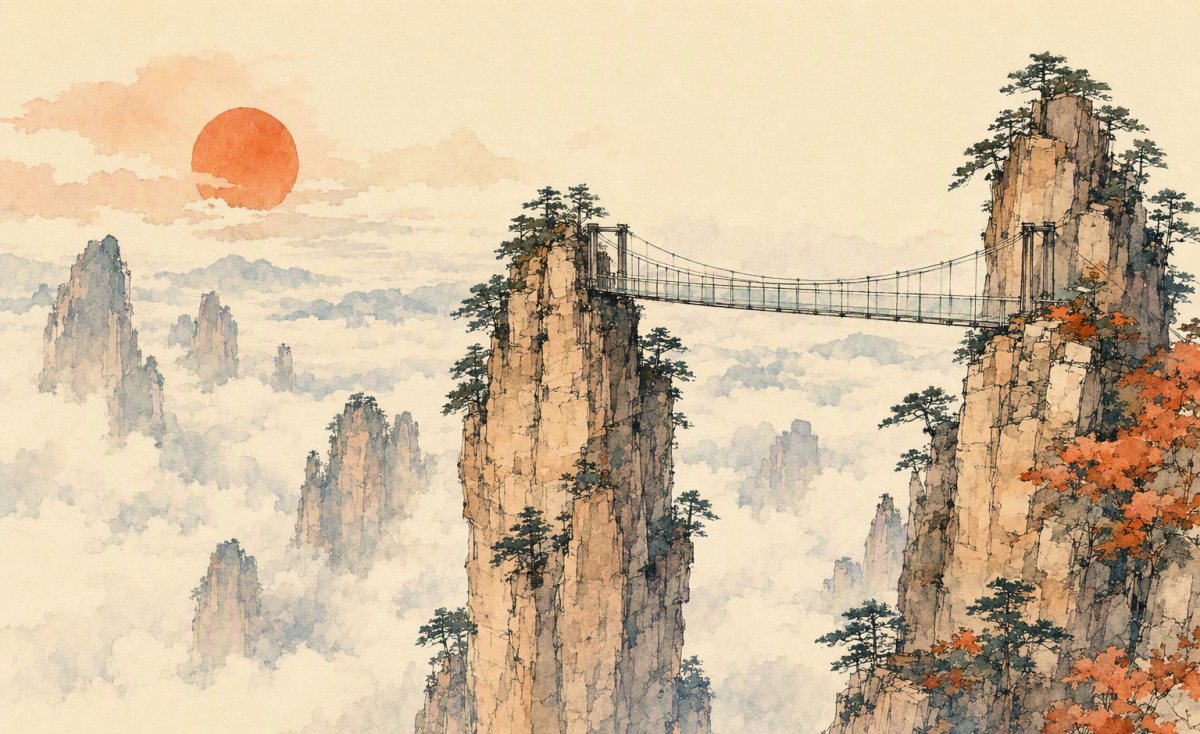
Four days is the right number for Zhangjiajie. Two days go to the national park at Wulingyuan, one to Tianmen Mountain above the city, and one to a choice: the glass bridge over the Grand Canyon, Fenghuang Ancient Town, or Huanglong Cave. This guide sets out how to sequence those days, what to book in advance, how to move between the sites, and what to check before you commit. Prices, opening hours and transport schedules change, so where a figure matters this guide tells you where to verify it rather than quoting one.
Day 1: Wulingyuan and the Avatar pillars
Start at the Wulingyuan gate, the park’s main entrance. The Hundred Dragon Elevator, a cliff lift built into the sandstone, takes you up towards Yuanjiajie — the dense pillar forest usually described as the inspiration for Avatar’s floating mountains. From the top, a boardwalk circuit links the main viewpoints. Expect crowds mid-morning; arriving at opening is the simplest way to stay ahead of the tour groups.
In the afternoon, take the park shuttle to Tianzi Mountain for the west-sea stone forest, a broader and often quieter panorama. Overnight in Wulingyuan town, which puts you close to the gate for day two. Note that the park entry ticket and the elevator, cable cars and shuttle network are separate: check the official Wulingyuan park page for the current entry ticket validity, which lifts are included, and whether real-name booking with your passport is required for your dates.
Day 2: Streams, galleries and the cloud sea
Golden Whip Stream is a flat riverside walk of roughly two and a half hours beneath the towers, with macaques along the path. Keep food out of sight; the monkeys are quick and persistent. In the afternoon, choose between the Ten-Mile Gallery scenic tram and the quieter boat on Baofeng Lake.
If it rained overnight, change the plan. The cloud sea — mist pooling between the pillars — is the single best reason to re-climb Yuanjiajie, and it only appears after rain. Check the park’s live notices or ask at your guesthouse before committing; visibility forecasts for the park are unreliable, and a clear morning in town does not mean a clear morning up top.
Day 3: Tianmen Mountain
Tianmen Mountain sits directly above Zhangjiajie city and is a separate ticket from the national park. The long cable car runs from the city up to the summit; below it, the 99-bend road climbs to the same plateau. At the top, cliff-hung walkways trace the rim, and the Tianmen Cave arch is reached by a long staircase — count the steps on the day rather than trusting a number, as access sections close for maintenance.
The glass skywalk section is optional and costs extra; it is a short segment, so decide when you see the queue. Descend in the late afternoon for better light on the road below. Cable car operating hours, last ascent times and any closure days vary by season and weather — confirm on the official Tianmen Mountain operator page before you travel, and build in a spare half-day in case high winds stop the cable car.
Day 4: Glass bridge, Fenghuang or Huanglong Cave
Option A is the glass bridge over the Grand Canyon, a structure spanning the gorge with a transparent deck. Option B is Fenghuang Ancient Town, roughly two and a half hours away by road, with its stilt houses and lantern-lit riverfront — it deserves an overnight if you can spare one. Option C is Huanglong Cave, whose chambers are among the largest in the region and make a good wet-weather substitute.
Whichever you pick, book timed entry where the operator offers it. The glass bridge in particular uses timed slots and caps daily numbers; check the official Grand Canyon scenic area page for slot times, passport requirements and whether bags or cameras are restricted on the deck.
Tickets, booking and timing
Two things trip people up. First, the national park entry ticket does not cover the elevator, cable cars or the Tianmen cableway — budget separately and verify each price on the operator’s own page. Second, most sites now use real-name booking, so carry the passport you booked with. Payment inside the park is overwhelmingly mobile; if you have not set up WeChat Pay or Alipay, sort that before you arrive — see this guida al viaggio cashless in Cina.
On seasons: spring and autumn generally give the best mix of mist and visibility, while winter brings snow on the pillars and far shorter queues at the cost of cold and occasional ice closures. Summer is hot, wet and busy. Before fixing dates, check the calendario dei giorni festivi in Cina — national holiday weeks fill hotels and park shuttles well beyond comfort.
Come arrivare e muoversi
Zhangjiajie has its own airport and a treno ad alta velocità station, Zhangjiajie West, connected to the main national network. For booking trains with a foreign passport, see this guide to buying China train tickets. Inside the park, free shuttle buses link the gates, lifts and viewpoints, and they are the only practical way to move between zones.
For the Fenghuang and Huanglong Cave days, a private car with driver removes a lot of logistics, since public buses run to fixed timetables and drop you short of some entrances. Mobile coverage inside the park is patchy in the valleys; if you rely on maps, download offline copies and check your data allowance against a realistic estimate — this calcolo giornaliero dei dati is a useful starting point.
Domande frequenti
Is four days enough for Zhangjiajie?
Yes, for the national park, Tianmen Mountain and one further day trip. It is tight if you want both Fenghuang and the glass bridge; add a night in Fenghuang rather than trying to do it as a day return.
Do I need to book park tickets in advance?
Real-name booking is standard at the main sites and timed slots apply at some. Check each operator’s official page for your dates, and carry the passport used for the booking.
What if it rains?
Rain is not necessarily bad news — it produces the cloud sea over Yuanjiajie. Cable cars and the glass bridge can close in high wind or storms, so keep one flexible day in your plan.
Can I visit without speaking Chinese?
Yes, with preparation. Signage at major viewpoints is bilingual, but shuttle announcements and guesthouse staff may not be. Translation apps and offline maps help; set up mobile payment before arrival.
Dove devo alloggiare?
Wulingyuan town for the park days, Zhangjiajie city for Tianmen Mountain, and a night in Fenghuang if you choose that option. Verify current reviews rather than relying on older write-ups.
Treat the itinerary above as a framework rather than a fixed schedule: confirm tickets, lift operating times and transport on the official operator pages close to your travel dates, keep one day flexible for weather, and the four days will cover the essentials without feeling rushed.