게시됨 — 댓글 남기기

Shanghai City Guide 2026: Bund, Yu Garden & AI Travel Tips

Why Visit Shanghai in 2026?

Shanghai remains China’s most cosmopolitan gateway — a dynamic fusion of colonial architecture, futuristic skylines, and hyper-connected infrastructure. In 2026, foreign travelers benefit from expanded 240-hour visa-free transit across 18 Chinese cities, including Shanghai Pudong (PVG) and Hongqiao (SHA) airports — making it an ideal entry or exit point for multi-city itineraries. With high-speed rail links to Hangzhou (45 min), Nanjing (1 hr), and Beijing (4.5 hrs), Shanghai serves as both a vibrant destination and a strategic hub. Its English signage, widespread Wi-Fi, and growing number of bilingual staff make it one of the most accessible major Chinese cities for first-time visitors — especially when paired with AI trip planning tools that adapt in real time to transport updates, weather shifts, or last-minute museum closures.

Getting There & Visa-Free Transit Explained

If you’re arriving on an international flight from London, Los Angeles, Tokyo, or Dubai, check eligibility for China’s 240-hour visa-free transit policy. As of 2026, this applies to nationals of 53 countries (including the US, UK, Canada, Australia, Germany, France, Japan, and South Korea) transiting through Shanghai PVG or SHA en route to a third country or region. You must hold confirmed onward tickets departing within 240 hours (10 days), stay only within Shanghai Municipality (or extend to Jiangsu/Zhejiang provinces if pre-registered via the “Shanghai Transit Pass” app), and present your passport, boarding pass, and hotel reservation at immigration. Note: This is not a tourist visa — but it *is* enough time to explore thoroughly. Many WingPhoenix users book their initial Shanghai stay under this policy, then use our AI trip planner to auto-generate day-by-day itineraries validated against live transit data and attraction capacity limits.

Must-See Neighborhoods & How to Move Between Them

Shanghai sprawls across 6340 km² — but its core attractions cluster within four compact, well-connected zones:

  • The Bund & Huangpu Riverfront: Colonial-era banks, the iconic Waibaidu Bridge, and panoramic views of Pudong’s skyscrapers.
  • Yuyuan Garden & Old Town: Ming-dynasty classical garden, narrow alleyways (nongtangs), and bustling bazaar streets like Chenghuangmiao.
  • Xintiandi & French Concession: Tree-lined boulevards, boutique cafés, art galleries, and preserved Shikumen architecture.
  • Pudong Lujiazui: Shanghai Tower (632m), Oriental Pearl Tower, and the Shanghai World Financial Center — all linked by the ultra-fast Maglev (430 km/h) to Pudong Airport.

Public transport is efficient and English-friendly. The Shanghai Metro operates 20 lines (including Line 2, which connects PVG Airport → Lujiazui → People’s Square → Jing’an Temple → Hongqiao Transport Hub). A QR-based Shanghai Public Transportation Card (via Alipay or WeChat Pay) works on metro, buses, and ferries — no physical card needed. Taxis are affordable (~¥14 base fare) and accept digital payments; Didi (China’s Uber) is fully functional for foreigners using international phone numbers. For group travel or late-night transfers, WingPhoenix’s charter car service offers English-speaking drivers, real-time GPS tracking, and fixed-rate pricing — no haggling, no confusion.

Eat, Sip & Shop Like a Local

Shanghai cuisine (Hu Cai) balances sweetness, umami, and delicate textures — think braised pork belly (hongshao rou), xiaolongbao (soup dumplings), and drunken crab. Here’s where to experience it authentically in 2026:

관람지 대표 메뉴 2026년 팁
Nanxiang Steamed Bun Restaurant (Yu Garden) Fresh xiaolongbao, served every 12 mins Book via WeChat Mini Program — queues exceed 90 mins daily; no walk-ins accepted post-2025 renovation.
Fu He Hui (Jing’an) Michelin-starred vegetarian Hu Cai Reserve 7+ days ahead; tasting menu includes seasonal osmanthus-glazed lotus root (Oct–Nov).
Found 158 (French Concession) Shanghai-style coffee & baozi fusion Try the soy-milk latte + scallion pancake croissant — open until 10 PM, accepts credit cards.
Qibao Ancient Town (Metro Line 9) Street snacks: sticky rice balls, osmanthus wine cake Day-trip friendly (35 mins from People’s Square); best visited weekday mornings to avoid crowds.

For shopping: Nanjing Road East is retail-central but crowded; head instead to Jing’an Kerry Centre for design-forward boutiques (like SHUSHU/TONG), or the West Bund Art District for gallery-hopping and riverside cafés. Avoid counterfeit markets — the Shanghai Municipal Government cracked down on unlicensed vendors in 2025, and certified stores now display a QR-coded “Shanghai Quality Assurance” badge.

Practical 2026 Essentials: eSIM, Payments & Etiquette

Your connectivity and cash flow need zero friction. As of January 2026, over 95% of Shanghai venues accept contactless payments via Alipay Tour Pass or WeChat Pay — both usable with foreign cards (Visa/Mastercard). No need to carry RMB for daily transactions — though keep ¥200–300 cash for small street vendors or temple donations. For data, WingPhoenix’s 2026 eSIM plans offer instant activation at PVG/SHA arrival halls (no physical SIM swap), 5G coverage citywide, and automatic fallback to local carriers if signal dips — critical for navigating underground metro stations or older nongtang alleys. Download the Shanghai Tourism App (official, English-enabled) for real-time bus/metro status, AR-guided historical overlays at heritage sites, and emergency translation (voice-to-voice, 12 languages).

Etiquette note: Shanghai locals appreciate quiet on public transport (no loud calls), modest dress at temples (cover shoulders/knees), and a light nod or ‘사례합니다’ (thank you) — but don’t expect bowing or excessive formality. Tipping isn’t customary, except for premium charter car drivers (¥20–50 is generous).

Smart Itinerary Building for 2026

A 3-day Shanghai itinerary optimized for 2026 looks like this: Day 1 — Morning Bund photos at sunrise (fewer crowds), afternoon Yu Garden + Chenghuangmiao, evening Huangpu River cruise (book via WingPhoenix for English narration + snack box); Day 2 — French Concession walking tour (start at Fuxing Park, end at Sinan Mansions), followed by Xintiandi dinner and jazz at JZ Club; Day 3 — Pudong skyscraper hop (book Shanghai Tower timed entry online), then unwind at Century Park or take the Maglev to explore nearby Zhujiajiao Water Town. If you have 240h transit time, add a half-day high-speed rail trip to Suzhou (25 mins) for classical gardens and canals — just ensure your return train arrives before your outbound flight window closes.

WingPhoenix’s AI trip planner integrates real-time variables: metro line maintenance alerts (e.g., Line 10 partial closure Oct 2026 for upgrades), seasonal closures (Yu Garden’s pavilion restoration ends Sept 2026), and even air quality forecasts — suggesting indoor alternatives on high-pollution days. It also cross-checks your 240h clock, auto-calculating buffer time for immigration queues and security screening. One click builds your full plan — maps, translations, booking confirmations, and offline-accessible PDFs — all synced to your device before you land.

Ready to explore Shanghai — seamlessly, confidently, and authentically? Build your AI-powered Shanghai itinerary now.

게시됨 — 댓글 남기기

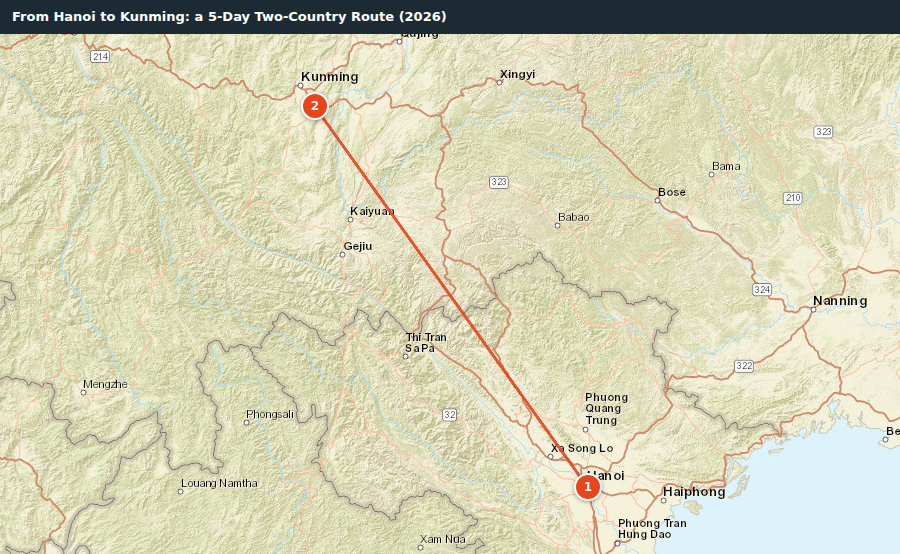
From Hanoi to Kunming: a 5-Day Two-Country Route (2026)

Plan 5 days across Hanoi, Kunming on this ready-to-go China + Southeast Asia route — day-by-day timings, inter-city distances and a route map, all tweakable in minutes.

Route map for From Hanoi to Kunming: a 5-Day Two-Country Route (2026)
Route map — 2 stops · 5 days · China + Southeast Asia

일정 요약

Hanoi쿤밍

Why this route works

  • 5 days, 2 bases — sequenced so travel days fall between sightseeing days and every stop gets real time on the ground, not just transfers.
  • Tea houses and towers is the through-line: Hanoi, Kunming.
  • China + Southeast Asia — one continuous trip instead of two separate holidays, so you only unpack and re-pack when the route really demands it.

하루별 일정

일정
1

Hanoi

도착 및 첫인상
Hanoi
09:00Arrive in Hanoi. Your private driver meets you and transfers you to the hotel (about 45–90 min from the airport).
11:00조기 체크인, 짐을 내려놓고 신선하게 정리하세요.
12:30환영 점심 — 가이드가 추천하는 현지 식당에서 즐기는 점심식사.
14:30Gentle orientation: a guided stroll through Hanoi old quarter with short photo stops.
17:00호텔로 돌아와서 휴식을 취하세요. eSIM을 활성화하고 Alipay / WeChat Pay에 카드를 등록하세요.
19:00추천 지역 식당에서 저녁식사 — 지역 특색 저녁.
20:30쉬운 저녁: 야경 관람 또는 자유 시간. 가이드가 다음 날 일정을 설명해드립니다.
숙박in Hanoi.

매일 확인 사항 · 매일 적용

  • 여권(비자 사본 포함)을 지참하세요 — 호텔이나 관광지에서 신분증을 확인할 수 있습니다.
  • 내일의 차량 픽업 시간을 가이드와 확인하세요.
  • 현금과 충전된 모바일 결제 앱(Alipay / WeChat Pay)을 준비하세요.
  • 외출 전 핸드폰과 파워뱅크를 충전하세요.
  • 오늘 방문할 지역의 오프라인 지도를 다운로드하세요.
  • 호텔 체크인 등록을 완료하세요.
  • eSIM/현지 SIM을 활성화하고 데이터를 테스트하세요.
  • 택시 기사에게 보여줄 중국어로 된 호텔 주소를 저장하세요.
일정
2

Hanoi

전일 관광
07:30호텔에서 조식
08:30가이드와 함께 오늘 아침의 하이라이트를 둘러보세요.
09:15An orientation drive around Hanoi with photo stops.
11:15대표적인 거리 또는 광장 탐방.
12:30午餐 — 导游推荐的当地午餐地点。
14:00두 번째 명소에 대한 가이드 투어.
16:00경치 좋은 산책로 또는 전망 포인트 방문.
17:30호텔로 돌아와서 정돈하고, 자유 시간.
19:00지역 특색 저녁 식사.
20:30현지 공연 또는 야시장 체험.
22:00Back to the hotel. Overnight in Hanoi.
일정
3

Hanoi

쿤밍으로 가는 길
07:30호텔에서 조식 후 짐을 싸세요.
09:00Free morning for a last stroll or souvenir shopping in Hanoi.
11:00체크아웃 후, 쿤밍행 도시간 이동을 위해 역/공항까지 전용 차량 이동.
13:00쿤밍 도착; 호텔 체크인 또는 짐 보관.
14:30Afternoon orientation of Kunming with your guide — Explore a further highlight or a nearby point of interest..
18:30쿤밍에서 지역 특색 식사.
20:30자유 시간. 쿤밍 숙박.
일정
4

쿤밍

정착 및 탐험
Kunming
07:30호텔에서 조식
08:30가이드와 함께 오늘 아침의 하이라이트를 둘러보세요.
09:15A walking tour of Kunming's centre and landmarks.
11:15繁华街区的咖啡休息时间。
12:30午餐 — 导游推荐的当地午餐地点。
14:00쇼핑과 산책을 위한 자유 시간.
16:00여유롭게 선택할 수 있는 오후 활동.
17:30호텔로 돌아와서 정돈하고, 자유 시간.
19:00지역 특색 저녁 식사.
20:30호텔에서 휴식을 취할 수 있는 자유 시간.
22:00호텔 복귀. 쿤밍 숙박.
일정
5

쿤밍

마지막 아침 및 출발
07:30호텔에서 조식 후 짐을 싸세요.
09:00호텔 근처에서 마지막 산책이나 기념품 쇼핑.
11:00체크아웃 및 잡비 정산.
12:00공항/역까지 개인 차량으로 이동; 가이드가 체크인을 도와드립니다.
—서비스 종료. 안전한 여행 되세요 — WingPhoenix와 함께해주셔서 감사합니다!

교통 정보

구간 거리 추천
Hanoi → Kunming 527 km 고속철도

실용적인 팁

  • 비행기 예약 전 비자/240시간 무비자 통과 확인.
  • 고속철도는 빠르고 정확합니다 — 12306에서 실명 티켓을 미리 예약하세요.
  • 대부분의 중국 지역에서 4월-5월 및 9월-10월이 가장 좋습니다. 10월 1일-7일 국경절 인파는 피하세요.
  • Cross-border trips need entry checks for each country on the route — verify visa and transit rules for every passport in your group before booking flights.
  • 비상 연락처: 경찰 110 · 구급차 120 · 관광 핫라인 12301 · WingPhoenix 24/7 WhatsApp +86 180 3801 6100.
호텔, 개인 차량, 영어 가이드, 실시간 가격을 포함한 완전히 예약 가능한 여행으로 원하시나요? 무료로 만들어보세요 WingPhoenix AI 여행 플래너 또는 WhatsApp +86 180 3801 6100. Browse all itineraries →
게시됨 — 댓글 남기기

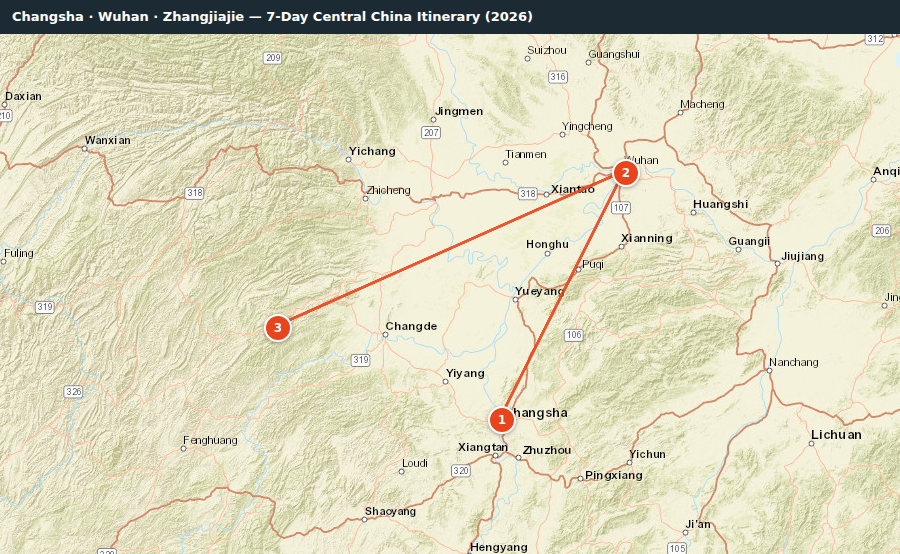
Changsha · Wuhan · Zhangjiajie — 7-Day Central China Itinerary (2026)

Central China in 7 days: Changsha, 우한, 장자제, sequenced for the smoothest travel and the best light — with terracotta wonders as the through-line.

Route map for Changsha · Wuhan · Zhangjiajie — 7-Day Central China Itinerary (2026)
Route map — 3 stops · 7 days · Central China

일정 요약

Why this route works

  • 7 days, 3 bases — sequenced so travel days fall between sightseeing days and every stop gets real time on the ground, not just transfers.
  • Terracotta wonders is the through-line: Changsha, Wuhan, Zhangjiajie.
  • 중부 중국 — one continuous trip instead of two separate holidays, so you only unpack and re-pack when the route really demands it.

하루별 일정

일정
1

창사

도착 및 첫인상
Changsha
09:00Arrive in Changsha. Your private driver meets you and transfers you to the hotel (about 45–90 min from the airport).
11:00조기 체크인, 짐을 내려놓고 신선하게 정리하세요.
12:30환영 점심 — 가이드가 추천하는 현지 식당에서 즐기는 점심식사.
14:30Gentle orientation: a guided stroll through Changsha old quarter with short photo stops.
17:00호텔로 돌아와서 휴식을 취하세요. eSIM을 활성화하고 Alipay / WeChat Pay에 카드를 등록하세요.
19:00추천 지역 식당에서 저녁식사 — 지역 특색 저녁.
20:30쉬운 저녁: 야경 관람 또는 자유 시간. 가이드가 다음 날 일정을 설명해드립니다.
숙박in Changsha.

매일 확인 사항 · 매일 적용

  • 여권(비자 사본 포함)을 지참하세요 — 호텔이나 관광지에서 신분증을 확인할 수 있습니다.
  • 내일의 차량 픽업 시간을 가이드와 확인하세요.
  • 현금과 충전된 모바일 결제 앱(Alipay / WeChat Pay)을 준비하세요.
  • 외출 전 핸드폰과 파워뱅크를 충전하세요.
  • 오늘 방문할 지역의 오프라인 지도를 다운로드하세요.
  • 호텔 체크인 등록을 완료하세요.
  • eSIM/현지 SIM을 활성화하고 데이터를 테스트하세요.
  • 택시 기사에게 보여줄 중국어로 된 호텔 주소를 저장하세요.
일정
2

창사

우한으로 이동 중
07:30호텔에서 조식 후 짐을 싸세요.
09:00Free morning for a last stroll or souvenir shopping in Changsha.
11:00체크아웃 후, 우한행 시외 교통편(기차/비행기)을 위해 호텔에서 전용 이동 서비스 제공.
13:00우한 도착; 호텔 체크인 또는 짐 보관.
14:30가이드와 함께하는 우한 오리엔테이션 — 두 번째 명소 방문.
18:30우한 지역 요리를 맛보는 저녁 식사.
20:30자유 시간. 우한 숙박.
일정
3

우한

정착 및 탐험
Wuhan
07:30호텔에서 조식
08:30가이드와 함께 오늘 아침의 하이라이트를 둘러보세요.
09:15A walking tour of Wuhan's centre and landmarks.
11:15繁华街区的咖啡休息时间。
12:30午餐 — 导游推荐的当地午餐地点。
14:00쇼핑과 산책을 위한 자유 시간.
16:00여유롭게 선택할 수 있는 오후 활동.
17:30호텔로 돌아와서 정돈하고, 자유 시간.
19:00지역 특색 저녁 식사.
20:30호텔에서 휴식을 취할 수 있는 자유 시간.
22:00호텔 복귀. 우한 숙박.
일정
4

우한

전일 관광
07:30호텔에서 조식
08:30가이드와 함께 오늘 아침의 하이라이트를 둘러보세요.
09:15사진 촬영 포인트가 있는 우한 시내 관광 드라이브.
11:15대표적인 거리 또는 광장 탐방.
12:30午餐 — 导游推荐的当地午餐地点。
14:00두 번째 명소에 대한 가이드 투어.
16:00경치 좋은 산책로 또는 전망 포인트 방문.
17:30호텔로 돌아와서 정돈하고, 자유 시간.
19:00지역 특색 저녁 식사.
20:30현지 공연 또는 야시장 체험.
22:00호텔 복귀. 우한 숙박.
일정
5

우한

On the road to Zhangjiajie
07:30호텔에서 조식 후 짐을 싸세요.
09:00Free morning for a last stroll or souvenir shopping in Wuhan.
11:00Check out; private transfer to the station / airport for the intercity leg to Zhangjiajie.
13:00Arrive Zhangjiajie; check in or drop your bags at the hotel.
14:30Afternoon orientation of Zhangjiajie with your guide — Explore a further highlight or a nearby point of interest..
18:30Dinner in Zhangjiajie — a regional dinner.
20:30Free evening. Overnight in Zhangjiajie.
일정
6

장자제

정착 및 탐험
Zhangjiajie
07:30호텔에서 조식
08:30가이드와 함께 오늘 아침의 하이라이트를 둘러보세요.
09:15Guided hike along Zhangjiajie's signature trail with viewpoint photo stops.
11:15경치 좋은 열린 공간에서 피크닉 아침식사.
12:30점심 — 지역 요리를 맛볼 수 있는 농가 식당 점심식사.
14:00날씨 여건에 따라 계곡을 가로지르는 보트 타기 또는 전망 포인트 순회.
16:00황금 시간대에 인근 전망 포인트까지 산책.
17:30호텔로 돌아와서 정돈하고, 자유 시간.
19:00저녁식사 — 계절 채소가 들어간 따뜻한 고산 스튜.
20:30별 관측 및 조기 취침.
22:00Back to the hotel. Overnight in Zhangjiajie.
일정
7

장자제

마지막 아침 및 출발
07:30호텔에서 조식 후 짐을 싸세요.
09:00호텔 근처에서 마지막 산책이나 기념품 쇼핑.
11:00체크아웃 및 잡비 정산.
12:00공항/역까지 개인 차량으로 이동; 가이드가 체크인을 도와드립니다.
—서비스 종료. 안전한 여행 되세요 — WingPhoenix와 함께해주셔서 감사합니다!

교통 정보

구간 거리 추천
Changsha → Wuhan 294 km 고속철도
Wuhan → Zhangjiajie 404 km 고속철도

실용적인 팁

  • 대부분의 중국 지역에서 4월-5월 및 9월-10월이 가장 좋습니다. 10월 1일-7일 국경절 인파는 피하세요.
  • 도착 전 알리페이/위챗페이 설정 및 중국 eSIM 설치.
  • 주요 관광지(금성, 병마용, 판다 보호구)의 시간 지정 입장권 미리 예약.
  • 비상 연락처: 경찰 110 · 구급차 120 · 관광 핫라인 12301 · WingPhoenix 24/7 WhatsApp +86 180 3801 6100.
호텔, 개인 차량, 영어 가이드, 실시간 가격을 포함한 완전히 예약 가능한 여행으로 원하시나요? 무료로 만들어보세요 WingPhoenix AI 여행 플래너 또는 WhatsApp +86 180 3801 6100. Browse all itineraries →
게시됨 — 댓글 남기기

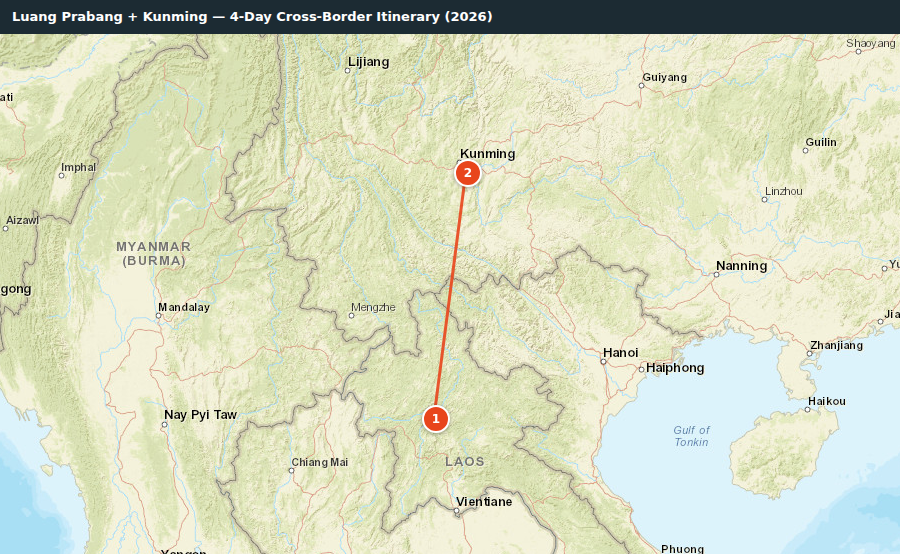
Luang Prabang + Kunming — 4-Day Cross-Border Itinerary (2026)

A curated 4-day journey: Luang Prabang, Kunming. Each day has timed activities, a getting-around table and packing reminders, so you can book or self-drive with confidence.

Route map for Luang Prabang + Kunming — 4-Day Cross-Border Itinerary (2026)
Route map — 2 stops · 4 days · China + Southeast Asia

일정 요약

Luang Prabang쿤밍

Why this route works

  • 4 days, 2 bases — sequenced so travel days fall between sightseeing days and every stop gets real time on the ground, not just transfers.
  • Street food and skylines is the through-line: Luang Prabang, Kunming.
  • China + Southeast Asia — one continuous trip instead of two separate holidays, so you only unpack and re-pack when the route really demands it.

하루별 일정

일정
1

Luang Prabang

도착 및 첫인상
Luang Prabang
09:00Arrive in Luang Prabang. Your private driver meets you and transfers you to the hotel (about 45–90 min from the airport).
11:00조기 체크인, 짐을 내려놓고 신선하게 정리하세요.
12:30환영 점심 — 가이드가 추천하는 현지 식당에서 즐기는 점심식사.
14:30Gentle orientation: a guided stroll through Luang Prabang old quarter with short photo stops.
17:00호텔로 돌아와서 휴식을 취하세요. eSIM을 활성화하고 Alipay / WeChat Pay에 카드를 등록하세요.
19:00추천 지역 식당에서 저녁식사 — 지역 특색 저녁.
20:30쉬운 저녁: 야경 관람 또는 자유 시간. 가이드가 다음 날 일정을 설명해드립니다.
숙박in Luang Prabang.

매일 확인 사항 · 매일 적용

  • 여권(비자 사본 포함)을 지참하세요 — 호텔이나 관광지에서 신분증을 확인할 수 있습니다.
  • 내일의 차량 픽업 시간을 가이드와 확인하세요.
  • 현금과 충전된 모바일 결제 앱(Alipay / WeChat Pay)을 준비하세요.
  • 외출 전 핸드폰과 파워뱅크를 충전하세요.
  • 오늘 방문할 지역의 오프라인 지도를 다운로드하세요.
  • 호텔 체크인 등록을 완료하세요.
  • eSIM/현지 SIM을 활성화하고 데이터를 테스트하세요.
  • 택시 기사에게 보여줄 중국어로 된 호텔 주소를 저장하세요.
일정
2

Luang Prabang

쿤밍으로 가는 길
07:30호텔에서 조식 후 짐을 싸세요.
09:00Free morning for a last stroll or souvenir shopping in Luang Prabang.
11:00체크아웃 후, 쿤밍행 도시간 이동을 위해 역/공항까지 전용 차량 이동.
13:00쿤밍 도착; 호텔 체크인 또는 짐 보관.
14:30가이드와 함께하는 쿤밍 오리엔테이션 — 두 번째 관광지 방문.
18:30쿤밍에서 지역 특색 식사.
20:30자유 시간. 쿤밍 숙박.
일정
3

쿤밍

정착 및 탐험
Kunming
07:30호텔에서 조식
08:30가이드와 함께 오늘 아침의 하이라이트를 둘러보세요.
09:15A walking tour of Kunming's centre and landmarks.
11:15繁华街区的咖啡休息时间。
12:30午餐 — 导游推荐的当地午餐地点。
14:00쇼핑과 산책을 위한 자유 시간.
16:00여유롭게 선택할 수 있는 오후 활동.
17:30호텔로 돌아와서 정돈하고, 자유 시간.
19:00지역 특색 저녁 식사.
20:30호텔에서 휴식을 취할 수 있는 자유 시간.
22:00호텔 복귀. 쿤밍 숙박.
일정
4

쿤밍

마지막 아침 및 출발
07:30호텔에서 조식 후 짐을 싸세요.
09:00호텔 근처에서 마지막 산책이나 기념품 쇼핑.
11:00체크아웃 및 잡비 정산.
12:00공항/역까지 개인 차량으로 이동; 가이드가 체크인을 도와드립니다.
—서비스 종료. 안전한 여행 되세요 — WingPhoenix와 함께해주셔서 감사합니다!

교통 정보

구간 거리 추천
Luang Prabang → Kunming 560 km 고속철도

실용적인 팁

  • 주요 관광지(금성, 병마용, 판다 보호구)의 시간 지정 입장권 미리 예약.
  • 비행기 예약 전 비자/240시간 무비자 통과 확인.
  • 고속철도는 빠르고 정확합니다 — 12306에서 실명 티켓을 미리 예약하세요.
  • Cross-border trips need entry checks for each country on the route — verify visa and transit rules for every passport in your group before booking flights.
  • 비상 연락처: 경찰 110 · 구급차 120 · 관광 핫라인 12301 · WingPhoenix 24/7 WhatsApp +86 180 3801 6100.
호텔, 개인 차량, 영어 가이드, 실시간 가격을 포함한 완전히 예약 가능한 여행으로 원하시나요? 무료로 만들어보세요 WingPhoenix AI 여행 플래너 또는 WhatsApp +86 180 3801 6100. Browse all itineraries →
게시됨 — 댓글 남기기

Xi’an City Guide 2026: Terracotta Warriors & Tang Charm

Why Visit Xi’an in 2026?

Xi’an isn’t just China’s oldest capital (13 dynasties, over 3,100 years of history) — it’s the most vividly layered city for first-time visitors. In 2026, it’s more accessible than ever: travelers from 54 countries (including the US, UK, Canada, Australia, France, Germany, Japan, and South Korea) qualify for the 240-hour (10-day) visa-free transit policy when entering through Xi’an Xianyang International Airport (XIY). No advance visa needed — just a confirmed onward ticket departing within 10 days and a passport valid for at least 3 months beyond your stay. That means you can drop into Xi’an mid-route between Europe and Southeast Asia, or tack it onto a Shanghai–Chengdu–Xi’an–Beijing loop with zero paperwork friction.

The Must-See: Beyond the Terracotta Army

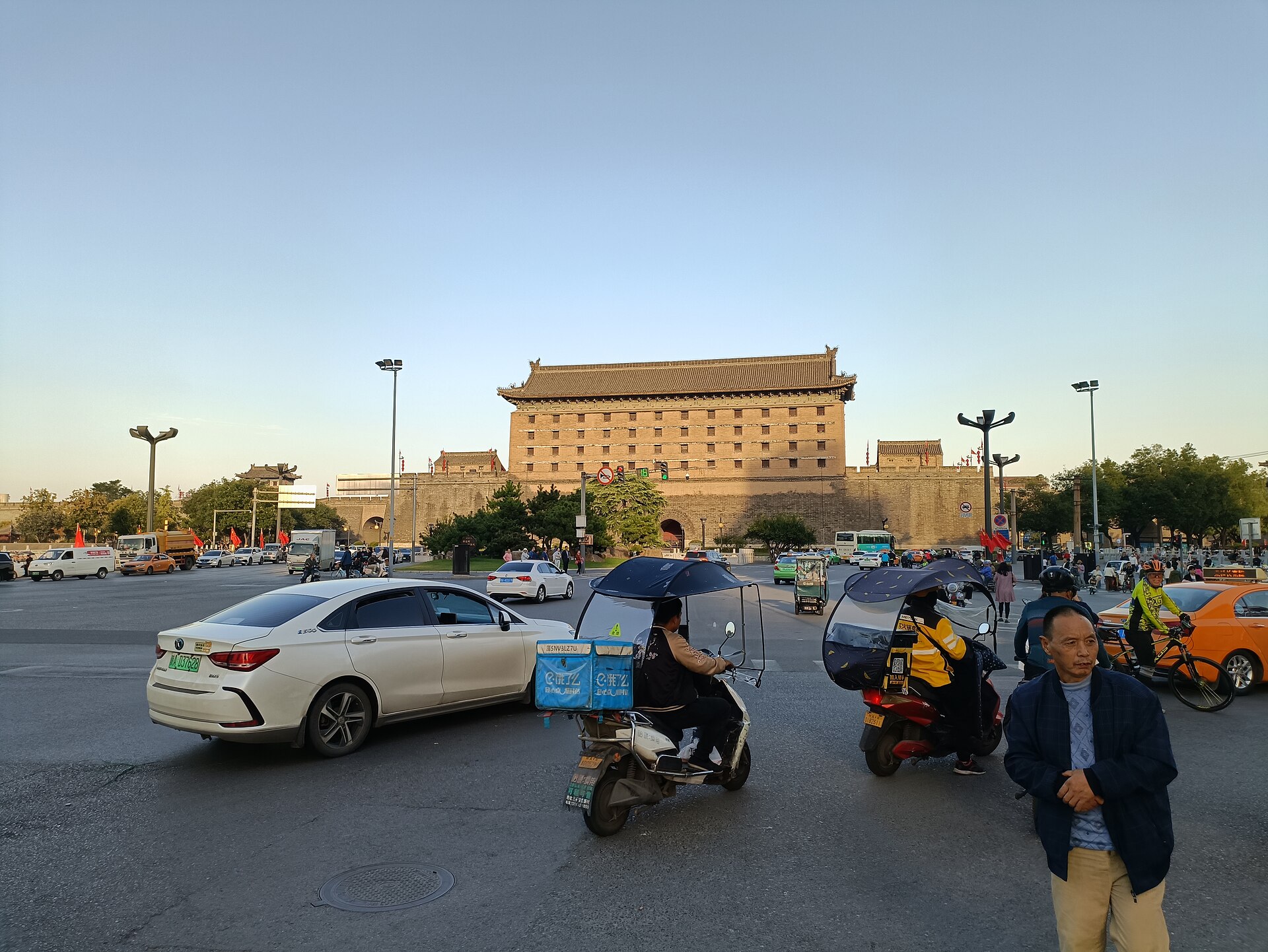
Yes, the Terracotta Warriors (discovered in 1974, now housed in three massive pits plus a new Imperial Mausoleum Exhibition Hall opened in early 2025) remain non-negotiable — but Xi’an rewards deeper exploration. The City Wall, the world’s largest intact Ming-era fortification, is best experienced by bike rental (¥45/day, helmets included) at sunrise — quiet, cool, and crowd-free before 8 a.m. Rent at the South Gate (Yongningmen) entrance and cycle counterclockwise for optimal light and photo angles.

Next, step into the Small Wild Goose Pagoda & Jianfu Temple complex — quieter, older (built 707 CE), and recently upgraded with AR-enabled info panels (scan QR codes on-site for English narration and 3D reconstructions of Tang-era temple life). Just west lies the Great Mosque, a 1,300-year-old Islamic landmark blending Chinese courtyard architecture with Arabic calligraphy — open to non-Muslim visitors daily 8:30 a.m.–5:30 p.m., no booking required.

Food That Tells a Story

Xi’an’s cuisine is Central Asian meets imperial court: wheat-based, boldly spiced, and historically shaped by Silk Road trade. Skip generic ‘Muslim Street’ (now heavily touristed and overpriced) and head instead to Yongningmen Night Market (open 5–11 p.m., weekdays only) or the lesser-known Huimin Street East Extension near Beiyuanmen — where locals queue for roujiamo (‘Chinese hamburger’, ¥12–18), 량피 (cold rice noodles with chili oil and gluten, ¥15), and baozi stuffed with lamb-and-cumin (¥20 for 4).

For an authentic sit-down meal, book ahead at Defu Chun (established 1920, near Bell Tower): try the 양러우 파오모 — slow-simmered lamb broth served with hand-torn flatbread — but arrive by 11:30 a.m. or 5:30 p.m. to avoid 45-minute waits. Vegetarians: Shan Shui Su Shi (‘Mountain-Water Vegetarian Food’) offers vegan versions of Xi’an classics using fermented soy, lotus root, and black fungus — reserve via WeChat Mini Program (English interface available).

Getting Around: Cars, Transit & Tech

Xi’an’s metro system now spans 9 lines (2026 total: 312 km), covering all major sites. A single ride costs ¥2–6; load the Xi’an Metro App (available in English) or use Alipay’s ‘Xi’an Metro’ mini-program — scan QR code at gates. Pro tip: Buy a Chang’an Tong transport card (¥20 deposit + top-up) at any station kiosk — works on buses, metro, and even some shared bikes.

For stress-free point-to-point travel — especially with luggage, kids, or after dark — WingPhoenix charter cars are pre-vetted, English-speaking, and include child seats, Wi-Fi hotspots, and real-time ETAs. Book 2–24 hours ahead via our app; drivers meet you inside arrivals hall at XIY with bilingual name signs. No haggling, no WeChat payment confusion — just fixed pricing (e.g., airport → Muslim Quarter: ¥180, 45 mins).

Stay connected with a WingPhoenix eSIM: activated before landing, works instantly upon arrival at XIY, and includes 5G data across all 9 metro lines and historic sites — critical for live translation (WeChat’s ‘Scan & Translate’ works offline with downloaded packs) and navigation (Baidu Maps remains the most accurate for Xi’an’s narrow alleys; download offline maps in advance).

Smart Timing & Practical 2026 Tips

Xi’an’s climate is ideal in spring (April–May) and autumn (September–early November). October 2026 is especially strategic: temperatures hover at 12–22°C, foliage begins turning gold in parks like Qujiang Pool Ruins Park, and National Day crowds have thinned post-October 7. Avoid October 1–7 (Golden Week) unless you’ve pre-booked everything — hotels triple in price and sites require timed-entry tickets booked 7 days ahead via WeChat Official Account: ‘Xi’an Cultural Heritage’.

Here’s what to book — and when — for a smooth 2026 visit:

항목 Where to Book Advance Notice 참고 사항
Terracotta Warriors (Pits 1–3 + Exhibition Hall) WeChat: ‘Emperor Qinshihuang’s Mausoleum Site Museum’ 7일 ¥120/person; ID required; entry windows every 30 min
Xi’an City Wall (bike rental) On-site at Yongningmen or Anyuanmen gates Same day Cash or Alipay only; helmet mandatory
Small Wild Goose Pagoda (AR experience) WeChat Mini Program: ‘Xi’an Pagoda Culture’ Same day Free entry; AR access requires ¥15 digital guide
Great Mosque (non-prayer hours) Walk-in 없음 No ticket; respectful dress required (shoulders/knees covered)

For independent travelers, 윙페닉스(WingPhoenix)의 AI 여행 계획 도구 helps optimize your 240h window: input your flight times, interests (history? food? photography?), and group size — it generates a minute-by-minute itinerary with real-time traffic, queue forecasts, and backup options if a site hits capacity. It also auto-syncs bookings (charter car, eSIM top-up, restaurant reservations) into one dashboard.

Where to Stay: Location > Luxury

Base yourself within 500 meters of the Bell Tower — the geographic and transit heart of Xi’an. Recommended 2026 stays:

  • Grand Mercure Xi’an Downtown (4★, ¥580/night): Rooftop terrace overlooking Bell Tower; 3-min walk to metro Line 2; includes WingPhoenix eSIM starter pack.
  • Orange Hotel Bell Tower (3★, ¥290/night): Reliable, English-speaking staff, free bike rentals, and soundproofed rooms facing away from the busy street.
  • Hostel 777 (budget, ¥110/bed): Social vibe, rooftop lounge, and free walking tours led by local history grads — runs daily at 9 a.m. (book via WeChat: ‘XiAn777’)

Pro note: Hotels near the railway station (e.g., ‘Xi’an Railway Station Plaza Hotel’) are convenient for HSR departures but far from culture — skip unless catching a 6 a.m. G-train to Chengdu.

Xi’an doesn’t just preserve history — it lives it. From sipping persimmon wine in a Tang-dynasty-style courtyard teahouse to watching drummers perform on the 14th-century City Wall at dusk, this city makes antiquity feel immediate, intimate, and deeply human. With 240h visa-free access, reliable infrastructure, and smart tools like WingPhoenix’s AI trip planning, there’s never been a simpler — or more resonant — time to begin your China journey here.

Plan your Xi’an itinerary in under 90 seconds — with AI precision, real-time logistics, and zero guesswork.

게시됨 — 댓글 남기기

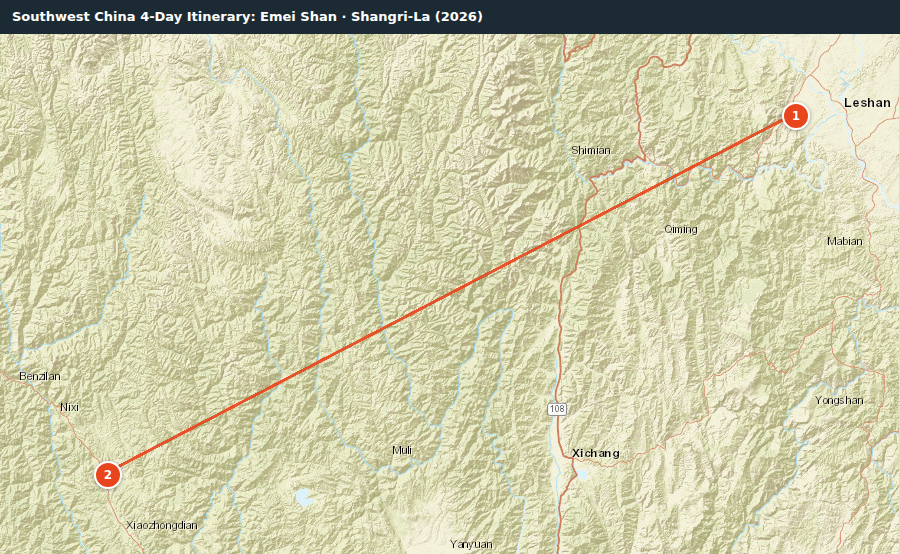
Southwest China 4-Day Itinerary: Emei Shan · Shangri-La (2026)

Here is a 4-day route through Southwest China — Emei Shan, 샹그릴라 — designed for first-timers who want ethnic villages without overpacking the schedule.

Route map for Southwest China 4-Day Itinerary: Emei Shan · Shangri-La (2026)
Route map — 2 stops · 4 days · Southwest China

일정 요약

어메이산샹그릴라

Why this route works

  • 4 days, 2 bases — sequenced so travel days fall between sightseeing days and every stop gets real time on the ground, not just transfers.
  • Ethnic villages is the through-line: Emei Shan, Shangri-La.
  • Southwest China — one continuous trip instead of two separate holidays, so you only unpack and re-pack when the route really demands it.

하루별 일정

일정
1

어메이산

도착 및 첫인상
Emei Shan
09:00Arrive in Emei Shan. Your private driver meets you and transfers you to the hotel (about 45–90 min from the airport).
11:00조기 체크인, 짐을 내려놓고 신선하게 정리하세요.
12:30환영 점심 — 지역 요리를 즐길 수 있는 농가 점심.
14:30부드러운 오리엔테이션: 에메이산 구시가지 산책 투어(가이드 동행, 짧은 사진 촬영 시간 포함).
17:00호텔로 돌아와서 휴식을 취하세요. eSIM을 활성화하고 Alipay / WeChat Pay에 카드를 등록하세요.
19:00추천 현지 레스토랑에서 저녁 식사 — 계절 야채가 들어간 따뜻한 고지대 스튜.
20:30쉬운 저녁: 야경 관람 또는 자유 시간. 가이드가 다음 날 일정을 설명해드립니다.
숙박에메이산에서.

매일 확인 사항 · 매일 적용

  • 여권(비자 사본 포함)을 지참하세요 — 호텔이나 관광지에서 신분증을 확인할 수 있습니다.
  • 내일의 차량 픽업 시간을 가이드와 확인하세요.
  • 현금과 충전된 모바일 결제 앱(Alipay / WeChat Pay)을 준비하세요.
  • 외출 전 핸드폰과 파워뱅크를 충전하세요.
  • 오늘 방문할 지역의 오프라인 지도를 다운로드하세요.
  • 호텔 체크인 등록을 완료하세요.
  • eSIM/현지 SIM을 활성화하고 데이터를 테스트하세요.
  • 택시 기사에게 보여줄 중국어로 된 호텔 주소를 저장하세요.
  • 날씨와 트레일 상태를 확인하세요.
  • 계층적으로 옷을 입으세요 — 고도가 높아 시원합니다.
  • 구불구불한 도로에서 멀미를 방지하기 위해 멀미약을 준비하세요.
일정
2

어메이산

샹그릴라로 가는 길
07:30호텔에서 조식 후 짐을 싸세요.
09:00에메이산에서 마지막 산책이나 기념품 쇼핑을 위한 자유 시간.
11:00체크아웃 후, 샹그릴라로 가는 시내 이동(기차역/공항까지 프라이빗 이동).
13:00샹그릴라 도착; 호텔 체크인 또는 짐 보관.
14:30Afternoon orientation of Shangri-La with your guide — Visit a nearby village or secondary sight at a relaxed pace..
18:30Dinner in Shangri-La — a warming highland stew with seasonal vegetables.
20:30자유 시간. 샹그릴라 숙박.
일정
3

샹그릴라

정착 및 탐험
Shangri-La
07:30호텔에서 조식
08:30가이드와 함께 오늘 아침의 하이라이트를 둘러보세요.
09:15A walking tour of Shangri-La's centre and landmarks.
11:15繁华街区的咖啡休息时间。
12:30午餐 — 导游推荐的当地午餐地点。
14:00쇼핑과 산책을 위한 자유 시간.
16:00여유롭게 선택할 수 있는 오후 활동.
17:30호텔로 돌아와서 정돈하고, 자유 시간.
19:00지역 특색 저녁 식사.
20:30호텔에서 휴식을 취할 수 있는 자유 시간.
22:00호텔 복귀. 샹그릴라 숙박.
일정
4

샹그릴라

마지막 아침 및 출발
07:30호텔에서 조식 후 짐을 싸세요.
09:00호텔 근처에서 마지막 산책이나 기념품 쇼핑.
11:00체크아웃 및 잡비 정산.
12:00공항/역까지 개인 차량으로 이동; 가이드가 체크인을 도와드립니다.
—서비스 종료. 안전한 여행 되세요 — WingPhoenix와 함께해주셔서 감사합니다!

교통 정보

구간 거리 추천
Emei Shan → Shangri-La 415 km 고속철도

실용적인 팁

  • 고속철도는 빠르고 정확합니다 — 12306에서 실명 티켓을 미리 예약하세요.
  • 대부분의 중국 지역에서 4월-5월 및 9월-10월이 가장 좋습니다. 10월 1일-7일 국경절 인파는 피하세요.
  • 도착 전 알리페이/위챗페이 설정 및 중국 eSIM 설치.
  • 비상 연락처: 경찰 110 · 구급차 120 · 관광 핫라인 12301 · WingPhoenix 24/7 WhatsApp +86 180 3801 6100.
호텔, 개인 차량, 영어 가이드, 실시간 가격을 포함한 완전히 예약 가능한 여행으로 원하시나요? 무료로 만들어보세요 WingPhoenix AI 여행 플래너 또는 WhatsApp +86 180 3801 6100. Browse all itineraries →
게시됨 — 댓글 남기기

Must-Eat China: A Regional Food Guide

China is not one cuisine but dozens, and the single most useful thing to understand before you eat your way through the country is that every region has its own ingredients, techniques and signature dishes. In practical terms: expect wheat noodles and dumplings in the north, fiery chilli and numbing spice in Sichuan, delicate dim sum and wok-fresh Cantonese in the south, and an extraordinary street-food culture everywhere in between. This China travel food guide maps the regional cuisines, names the must-try dishes worth planning a meal around, and shows how to order confidently even without the language.

China Is a Continent of Cuisines

It helps to think of China as a country the size of a continent, which is precisely why “Chinese food” is such an empty label. Climate, history and trade give each region a distinct pantry, and the differences are as real as those between, say, French and Japanese cooking. The broad, useful generalisation is north versus south: wheat grows in the drier north, so noodles, buns and dumplings dominate, while rice rules the wetter south. Layer on the famous regional schools — Sichuan, Cantonese, Shandong, Huaiyang, Hunan and more — and you have a lifetime of eating, not a single menu. Building your China travel itinerary around a few regional capitals turns meals into highlights rather than mere pit stops.

The Rough Map of Regional Flavours

Use this table as an orientation before we taste through the regions. It is a simplification, but a helpful one for deciding what to look for in each area.

지역 Staple Flavour profile Signature
North (Beijing, Xi’an) Wheat Savoury, hearty, wheat-forward Noodles, dumplings, Peking duck
Southwest (Sichuan, Hunan) Rice Spicy, numbing, bold Chilli hotpot, mapo tofu
South (Guangdong) Rice Fresh, mild, delicate Dim sum, roasted meats
East (Shanghai, Zhejiang) Rice Sweet-savoury, subtle Soup dumplings, river fish
West/Northwest Wheat & lamb Cumin, lamb, hand-pulled Lanzhou noodles, kebabs

Northern Noodles and Dumplings

The north is wheat country, and it shows in the best way. Hand-pulled and hand-torn noodles arrive in bowls big enough to be a full meal, tossed in rich sauces or clear, deeply flavoured broths. Dumplings — boiled, steamed or pan-fried — are a cultural institution, especially around festivals, with fillings from pork and cabbage to more adventurous combinations. Xi’an’s Muslim Quarter is a treasure hunt of wheat-based snacks, and Beijing pairs noodles with its famous roasted duck, wrapped in thin pancakes with scallion and sauce. If you love bread-and-butter comfort food, northern China quietly delivers on a grand scale.

Sichuan and the Fire of the Southwest

Sichuan cuisine is the one most travellers recognise and the one that converts the most sceptics, built around the interplay of chilli heat and the electric, tingling numbness of Sichuan peppercorn. Dishes like mapo tofu, dry-fried green beans and mouth-watering chicken showcase that signature “málà” flavour, while hotpot turns a meal into a bubbling, social event where you cook thin meats and vegetables at the table. If you are pairing food with a city visit, Chengdu — the UNESCO-recognised heart of this cuisine, and home to the giant pandas we cover in our Chengdu panda guide — is arguably the single best food destination in the country. Start mild if spice is new to you; the flavours reward curiosity more than toughness.

Cantonese Food and Dim Sum

If the southwest is about fire, Guangdong is about freshness and finesse. Cantonese cooking prizes high-quality ingredients handled lightly — steamed fish, crisp vegetables, and slow-roasted meats with lacquered skin. Its most joyful expression is dim sum: dozens of small dishes — har gow shrimp dumplings, siu mai, barbecue pork buns, sticky rice rolls — wheeled or ordered on trolleys and shared over tea, traditionally a leisurely morning or weekend ritual. This gentle, universally appealing style is a friendly entry point for cautious eaters and a genuine event for everyone else; a Guangzhou or Foshan food crawl alone justifies a southern stop on your route.

Street Food Culture You Should Try

Some of the best eating in China never touches a restaurant. Skewers sizzle over charcoal at dusk, breakfast stalls fry savoury dough and pour soy milk before dawn, and corner vendors grill, steam and stir-fry at prices that make grazing affordable all day. Street food is also where regional identity tastes most honest — a Lanzhou noodle stall, a bowl of Hunan rice noodles, a plate of spicy snacks piled high. The golden rule for comfort is volume and turnover: eat where locals queue and where food cooks fast and fresh in front of you. If navigating an English-free stall feels daunting, a couple of phrases and pointing go a long way.

Must-Try Signature Dishes

Rather than an endless list, anchor your eating around a few dishes worth travelling for. Peking duck is the ceremonial northern classic; a proper bowl of hand-pulled Lanzhou beef noodles is a breakfast revelation; soup dumplings from the east are a delicate, spoon-worthy experience; and a Sichuan hotpot or mapo tofu introduces the numbing-spicy soul of the southwest. Round it out with dim sum in the south and regional noodles wherever you go. Trying one true, local version of each beats a dozen familiarised, tourist-adapted plates, and it gives your meals a sense of purpose and place rather than repetition.

Ordering When You Don’t Speak the Language

Most travellers worry far too little about this, because it is easier than it looks. Look for pictures on menus, point to what other tables are eating, and let your host or a translation app bridge the rest. A few phrases — “this one, please,” “how much,” “not spicy, please” — solve most situations, and knowing whether a dish is spicy is worth asking before you order if you are sensitive to heat. Digital menus and photo-based ordering are common too. For the exact courtesy phrases and payment habits that make ordering painless, our travel phrases and etiquette guide is a handy companion, and a little manners at the table is appreciated everywhere.

Eating Safely and Comfortably

Food safety follows common sense more than fear. Stick to busy stalls with fast turnover and food cooked hot in front of you, peel fruit you cannot cook, and drink bottled or boiled water rather than tapping it — a point we expand on in our tap water guide. Probiotics and simple stomach settling in for the first couple of days are reasonable precautions for sensitive travellers, but the vast majority of visitors eat their way through China without incident. If you have allergies, learn to show the offending ingredient written in Chinese on your phone, which is clearer and safer than trying to explain it across a language barrier.

Regional Specialties Worth a Detour

Once you are comfortable with the big regional schools, the detours get wonderful. Yunnan brings wild mushrooms and flowery, herbal dishes unlike anywhere else; the northwest adds cumin-laced lamb and Central-Asian influences; coastal cities serve seafood at a freshness inland travellers rarely taste; and each province guards local breakfasts, noodle styles and snacks that define home to the people who eat them daily. These are the flavours that reward a route built around food, and many of them slot neatly into longer journeys — a Yunnan loop or a Silk Road run, for example — where eating well is part of the reason to go at all.

A First-Timer’s Food Itinerary

If you want a single, satisfying arc for a first trip, chain a few food capitals by rail. Begin in Beijing for roasted duck and northern noodles, take the fast train to Xi’an for its snack-rich Muslim Quarter, then on to Chengdu for the numbing-spicy soul of Sichuan, and finish in Guangzhou for dim sum and gentle Cantonese freshness. Each leg is a few comfortable hours by train, the flavours shift dramatically from city to city, and the whole route becomes an edible tour of the country’s core cuisines. Keep your bag light and your appetite generous — you will buy anything you forget, but you cannot buy the meals you skip.

자주 묻는 질문

Is Chinese food very spicy everywhere?

No. Spice is strongest in the southwest — Sichuan and Hunan especially — while Cantonese, eastern and many northern dishes are mild to savoury without heat. If you are spice-sensitive, simply avoid those two regions’ hottest dishes or ask for “not spicy,” and you will find plenty of gentle, deeply flavoured food across the country.

What is the single dish every first-timer should try?

It depends where you are, but a true local version of a regional classic beats a familiarised one: Peking duck in Beijing, hand-pulled beef noodles in the northwest, a proper Sichuan mapo tofu or hotpot, and dim sum in Guangdong. Choosing one authentic dish per region gives your trip a genuine sense of place through food.

중국에서 거리 음식을 먹어도 안전한가요?

Generally yes, if you use common sense. Choose busy stalls with fast turnover where food is cooked hot in front of you, peel fruit rather than eating it unpeeled, and drink bottled or boiled water. The busiest, freshest stalls are usually the safest, and eating them is one of the best parts of the trip.

Do restaurants take cards or is it cash only?

Most places use mobile payment rather than foreign cards, so having a working payment setup arranged before you travel matters more than cash. Keep modest physical currency as backup for smaller stalls and markets, but expect a phone tap to be the normal way to pay in most cities.

게시됨 — 댓글 남기기

China Travel Phrases & Etiquette Basics

You can travel comfortably across China without speaking a word of Mandarin, but a handful of phrases and a basic grasp of etiquette transform the experience — doors open, strangers warm up, and everyday transactions stop feeling like puzzles. The honest guidance: rely on a translation app and a linked mobile payment for the heavy lifting, then add about twenty courteous phrases and a few manners rules that signal respect. This China travel guide covers exactly which phrases matter, which etiquette most visitors trip over, and how to communicate warmly even when your vocabulary runs out.

Do You Actually Need Chinese to Travel in China?

No — and that is worth saying plainly, because fear of the language keeps some travellers over-organising or skipping the country entirely. Major attractions, hotels, transport hubs and chain restaurants increasingly work in English or through images, and a phone with a good translation app bridges most gaps instantly. What language skills do change is the human temperature: a attempted “hello” or “thank you” earns smiles and patience that pure app-translating rarely does. So treat Chinese as a courtesy tool, not a prerequisite — pair it with the connectivity and payment setup in our China travel apps guide and you are genuinely fine.

The Right Mindset: A Little Goes a Long Way

The goal is not fluency; it is effort. Local people respond far more to your attempt than to your accuracy, so a handful of well-practised phrases — greetings, thanks, please, numbers and a few questions — deliver most of the benefit. Learn to say them with roughly the right tone rather than perfect pronunciation, and keep your phrases short. The traveller who asks one polite question in Chinese opens up a whole interaction; the one who silently points at a phone screen gets the answer but misses the warmth. This is the single most useful China travel tip for human connection, as echoed in our travel tips guide.

Core Greetings and Courtesy Phrases

Start with the phrases you will use daily. The table shows a compact set that covers polite basics without overwhelming you.

Phrase 의미 When to use it
Nǐ hǎo 안녕하세요 Any first greeting
Xièxie 감사합니다 After any help or purchase
Qǐng wèn Excuse me / may I ask Before a question
Duìbuqǐ Sorry Bumps, mistakes, delays
Zàijiàn Goodbye Leaving a shop or guide
Bù kèqi You’re welcome In reply to thanks

Getting Around: Directions and Transport

A few navigational phrases turn confusing stations and taxi rides smooth. Learn “How do I get to…?” and “Where is the…?” and drop in place names your translation app shows on screen; showing a saved address beats describing it. For taxis, the killer phrase is simply the destination written in Chinese that you point to — drivers rarely read English, so have your hotel’s name and address in characters ready. Add “Stop here, please” for the ride home, and “Is it far?” to sanity-check a suggested detour. Combine these with offline maps so you always know roughly where you are.

Ordering, Paying and Shopping

Food and shopping are where phrases earn their keep. “This one, please” while pointing resolves most restaurant moments, and asking for the bill is a set phrase you will repeat daily. Learn “How much is it?” as your workhorse, plus yes/no and “too expensive” for markets. Because payment is overwhelmingly digital, the most valuable “phrase” is often showing your payment screen rather than speaking at all. A couple of courtesy words around the transaction — thanks, sorry to keep you waiting — smooth things more than fluent sentences ever would, and a little manners here is exactly what the etiquette sections below are about.

Numbers, Prices and Bargaining Basics

Counting from one to ten unlocks far more than it seems. Recognising numbers lets you check prices, confirm quantities and understand busier places where digits carry the meaning. Chinese also has a neat one-hand finger counting system you will see at markets — being able to read it helps you bargain non-verbally. In shops with fixed prices, do not haggle; in markets and informal stalls, friendly negotiation is expected, so ask the price, react mildly, and offer something reasonable with a smile. Keep it light and good-humoured; getting a few percent off is never worth souring an interaction, and locals appreciate a cheerful bargainer far more than a combative one.

Table Manners and Dining Etiquette

Meals are social events, and a few manners go a long way. In shared dining, dishes arrive for the table, not one person, and it is polite to let elders or guests start first. Never stick chopsticks upright in a bowl of rice — it echoes a funeral ritual — and rest them on the holder or plate edge when not in use. Slurping noodles is acceptable; leaving a little food can signal you are satisfied. If someone pours your tea, a couple of tapped fingers is a quiet thank-you. None of this needs to be perfect — making an obvious, good-natured effort is what people notice and appreciate.

Everyday Etiquette: Queues, Gifts and Face

The guiding concept is “face” — dignity and respect in public. Avoid open confrontation, raised voices or visibly embarrassing someone, which can escalate a minor issue far out of proportion; a calm, polite approach almost always works better. In queues and on transit, standards of orderly waiting are looser than in some countries, so expect gentle crowding at gates and board without taking it personally. When invited somewhere or when doing business, a small gift is warmly received, and receiving or giving items with both hands signals respect. Patience, a smile and a low-key manner smooth more situations than any fluent sentence.

Taboos and Sensitive Topics to Avoid

You will not offend anyone by being a visitor, but a few awareness points help. Steer clear of heavy political debates with strangers you have just met, and keep first conversations on food, travel, family and your home city — topics people genuinely enjoy discussing. Number associations matter around gifts, and certain colours carry ceremonial meanings, so avoid treating festive red or mourning white casually in the wrong context. Above all, watch people’s reactions: a brief, friendly exchange should feel comfortable, and if it does not, a smile and a change of subject reset the tone effortlessly.

Using Tone, Gestures and Translation Apps

Where your phrases run out, lean on tools and body language. A good translation app lets you speak or type into your phone and show the screen — perfect for pharmacies, directions and questions you cannot phrase yourself. Gestures are universal: pointing, nodding, thumbs up and writing a number on your phone resolve surprising amounts. On tone, do not obsess — Mandarin is tonal, so imperfect pronunciation occasionally lands oddly, but context and a little patience fill the gap. The winning combination is a translation app for precision and a few real phrases for warmth; together they cover almost everything a traveller needs.

How to Practice Before You Go

Ten minutes a day before your trip is enough to become noticeably more welcome. Drill the greetings and numbers until they feel automatic, then add a handful of survival questions you know you will ask. Practise out loud rather than reading silently, since your mouth and ear need the reps more than your memory needs the characters. Save key destinations in Chinese on your phone now — hotels, attractions and your neighbourhood — so you are not translating live. Arriving with even a small, well-practised toolkit changes how people treat you from the first interaction, and pairs naturally with the beginner basics in our starter guide for first-time visitors.

자주 묻는 질문

Can I get around China without speaking any Chinese?

Yes. With offline maps, a translation app, a linked mobile payment and destinations saved in characters, you can navigate cities, transport and restaurants confidently. A few polite phrases are not required, but they make every interaction warmer and easier.

What are the few most important phrases to learn?

Hello, thank you, excuse me, sorry, how much is it, and this one please. Add numbers one to ten and the words for yes and no, and you cover the vast majority of real conversations. Beyond that, lean on a translation app.

What table manners should I know before eating out?

Wait for elders or guests to start, avoid sticking chopsticks upright in rice, and rest them on the edge or holder when idle. Slurping noodles is fine. None of it must be flawless — a visible, friendly effort is what locals appreciate most.

Is bargaining expected everywhere in China?

No. Prices in shops, malls and restaurants are fixed, so do not haggle there. Friendly negotiation belongs in markets and informal stalls, where it is expected and enjoyed. Keep it light, smile, and walk away politely if the price does not suit you.

게시됨 — 댓글 남기기

What to Pack for a China Trip (Checklist)

Pack for a China trip around three priorities: documents you cannot replace, a tech kit that keeps you connected and paid, and light, layerable clothing suited to the season. Because you can buy almost anything in Chinese cities, the smartest packing strategy is to travel lean and carry the items that are annoying or impossible to improvise on arrival — your passport, a power adapter, a data plan, comfortable shoes and any prescription medicine. This China travel checklist covers exactly what to bring, what to leave home, and how to prep the small things that make the first days smooth.

The Short Answer: Pack Light, Bring the Right Tech

China is a shopper’s country with same-day delivery in most cities, so running short of a toothbrush, a jacket or a phone cable is a minor errand, not a crisis. The items that genuinely matter are the ones tied to entry, money and communication: valid documents, a working payment setup, and connectivity. Aim to fit everything in a carry-on plus a small day bag if you can — you will thank yourself on station stairs, crowded metro platforms and long taxi rides, where hauling two big suitcases turns every transfer into an ordeal.

Documents and Money to Carry

Before anything else, your passport needs to be valid for the whole trip, and your entry requirements — visa, visa-free or transit rules — are set by the authorities and can change, so confirm them against official sources well before you fly rather than relying on any guide. Carry paper and cloud copies of your passport, visa and insurance. For money, the practical reality is that daily life in China runs on mobile payment, so arriving with that already arranged matters more than a wallet full of cash; keep modest cash as a backup for markets and smaller vendors, and notify your bank before travel. This single prep step is the biggest difference between a smooth arrival and a frustrating one — our 중국 여행 팁 cover it in depth.

The Tech Kit That Actually Matters

Four items do the heavy lifting. A universal power adapter (or a couple of spares) handles China’s plugs across your devices. A decent power bank keeps your phone alive through long sightseeing days when you are relying on it for maps, translation and tickets. A reliable data connection — ideally an eSIM or local plan activated before you land — unlocks payment, ride-hailing and navigation the moment you step outside. And a small multi-port charger collapses several cables into one. Sort the connectivity piece in advance; our travel eSIM guide explains how to be online the minute you arrive.

Clothing: Layer, Don’t Overpack

Packing the wrong clothes is the most common first-timer mistake, because China spans very different climates and seasons. Build everything around layers you can add or shed: a base layer, a warm mid-layer, and a weatherproof outer shell that blocks wind and rain. Check your specific cities and month rather than assuming “China” is one climate — a coastal summer, an inland winter and a plateau trip demand very different wardrobes. Wash-and-wear fabrics and a compact laundry plan let you bring far less than you think, freeing suitcase space for things you cannot buy mid-transit.

Comfortable Shoes Are Non-Negotiable

You will walk more than you expect — temple courtyards, huge palace complexes, market streets and long station platforms are all on foot, often with stairs and no lifts. One pair of broken-in walking shoes that you can wear all day matters more than any fashion choice, and a second versatile pair covers dressier dinners or wet weather. Leave stiff new boots at home; blisters on day two derail a trip faster than anything else on this list. Slip-on-friendly shoes also save time at the security checks that guard stations and some attractions.

Health, Medicine and Toiletries

Bring your prescription medicines in original packaging with a copy of the prescription, plus a small first-aid kit for the first few days while you find a pharmacy. Over-the-counter basics are easy to buy locally, so you only need to cover your personal routine and any items you prefer to control — skincare you know suits you, glasses or contacts with a spare pair, and hand sanitiser. If you have specific health needs or are carrying restricted medications, verify current rules officially before you travel. A basic travel insurance policy is worth arranging regardless; see our 여행 가이드 for the wider planning context.

Connectivity and Payment Prep

Before departure rather than after arrival, set up the two systems you will use constantly: mobile payment and navigation. Link a payment method that works for visitors, download offline maps, and install the apps that make daily life simple — you can see which ones in our China travel apps guide. Doing this on your home Wi-Fi with everything downloaded means you are not troubleshooting a registration screen in a busy arrivals hall with no signal. A phone that can pay, translate and navigate is effectively your passport to getting around, so treat its setup as core packing, not an afterthought.

Luggage That Works on Trains and Streets

Choose bags suited to how you will actually move. China’s excellent rail network is luggage-friendly in theory but not always in practice — stations have stairs, carriages have modest overhead racks, and the space at the end of a carriage fills fast on busy routes. A medium suitcase plus a compressible duffel beats one enormous bag, and a secure anti-theft day pack keeps valuables on your body in crowds. If you are chaining several cities by rail, our 고속철도 가이드 explains what fits and how to board smoothly with bags in tow.

Season and Region Extras

The right extras depend entirely on when and where you are going, so match a small add-on kit to your itinerary rather than packing for every possibility.

Season / Setting Weather reality Key extras to pack
Coastal summer Hot, humid, rainy Breathables, umbrella, insect repellent
Inland winter Cold, dry, biting wind Thermal layers, hat, gloves, lip balm
Spring / autumn Mild, variable Light shell, layers, allergy meds
Plateau / mountains Intense sun, big day-night swings Sunscreen, warm layer, sun hat

Things People Overpack

Leave at home the bulk you will end up dragging around: multiple “just in case” outfits, heavy towels, umbrellas you can buy for almost nothing on a street corner, and bulky toiletries. Drinking water is always available bottled, tap water is not for drinking, and everyday toiletries sell everywhere, so carry a few days’ worth and refill the rest locally. The same goes for electronics hoarding — two good, charged devices beat five mediocre ones competing for one outlet. Lighter bags mean faster transfers and a more relaxed trip.

A Quick Pre-Departure Checklist

Tick these before you leave: passport valid and copied, entry rules confirmed officially, mobile payment linked and tested, offline maps downloaded, eSIM or data plan ready, power adapter and power bank charged, prescription meds in original packaging, one pair of broken-in walking shoes, layered clothing matched to each city and season, and a secure day pack for valuables. That is genuinely the whole list — everything else you can buy or borrow in China within an hour of deciding you need it, which is precisely why travelling light works so well here.

자주 묻는 질문

Do I need a power adapter for China?

Usually yes. China uses plug types that differ from many countries, so a universal adapter or a couple of spares ensure every device charges. Voltage is standard, so most modern electronics only need the physical adapter rather than a converter.

Can I just buy what I forget once I’m in China?

Almost always, and fast. Daily toiletries, clothing, umbrellas, cables and over-the-counter basics are widely available with rapid delivery in most cities. Plan instead around the things you cannot improvise: valid documents, your prescription routine, and connectivity.

Should I bring cash or rely on cards?

Expect to pay mostly by mobile wallet, which is why setting that up before you travel matters more than cash. Keep a modest amount of physical currency as backup for markets, small vendors and tips, but do not count on foreign cards being accepted at every counter.

What should I pack for changing seasons or regions on one trip?

Layer. A base, a warm mid-layer and a waterproof outer shell let you adapt to hot coasts, cool inland winters or big day-to-night swings in the mountains without packing separate wardrobes. Check the weather for each city you visit and add only the small extras that setting needs.

게시됨 — 댓글 남기기

Airport Transfers in China: Options & How to Book

Getting from a Chinese airport to your hotel is usually straightforward and inexpensive, and most travellers choose between three reliable paths: an airport express train or metro for speed and value, a taxi or app-hired car for door-to-door convenience, or a pre-arranged private transfer for a stress-free arrival. This China travel guide compares every option, explains how to book each with a foreign passport and phone, and gives the practical tips that turn your first hour in the country into a smooth one rather than a scramble.

The Short Answer: Which Transfer Should You Take?

If your hotel is near a metro or airport-rail line and you travel light, take the train — it is fast, cheap and immune to traffic. If you have heavy luggage, arrive late at night, or value a door-to-door ride, take a taxi or an app-hired car. If you want someone waiting at arrivals with a sign and zero negotiation, book a private transfer ahead. The good news is that China’s major airports are modern, well-signed in English, and connected to city centres, so there is no truly bad option — only the one that best fits your arrival time, budget and energy level. Deciding this in advance, while planning your China travel itinerary, removes almost all arrival stress.

Transfer Options at a Glance

Use this comparison to match an option to your situation before we dig into the details of each.

옵션 Cost level Convenience 최적의 경우
Airport express / metro 가장 한산함 Fast, fixed route Light bags, city-centre hotels
Taxi (metered) Low–medium Door-to-door Late nights, small groups
Ride-hailing app Low–medium App-priced, tracked Travellers with a local setup
Private / chartered car Medium–higher Greeter, no hassle Families, first arrivals, early flights
Airport shuttle bus 가장 한산함 Fixed stops Budget, hotel near a stop

Airport Express Trains and Metro Links

Most large Chinese airports connect to the city by dedicated express trains or regular metro lines, and these are often the fastest way to beat rush-hour traffic. Tickets are cheap, English signage is clear, and the rides are smooth and frequent through most of the day. The trade-offs are luggage: stairs, long corridors and crowded carriages can be tiring with big suitcases, and late-night arrivals may find the last train already gone. If your hotel sits near a station, rail is the smart default; if it is far from the network or you land small-hours, pair a short ride-hailing hop with the train, or skip rail entirely.

Taxis and Ride-Hailing at Chinese Airports

Airports run official taxi ranks with metered cars, and the fares into the city are typically a modest, predictable range — but confirm the exact amount at booking or on the meter, as rates and surcharges vary by city and time. The bigger convenience is ride-hailing: apps let you see the fare upfront, track the car and pay digitally, and English-friendly interfaces have made them far easier for visitors than hailing at a kerb. The catch is setup. You generally need a working mobile data connection and a linked payment method before you can order, which is exactly the moment most travellers are standing at arrivals with no signal. Sorting a data plan before you fly solves this; our travel eSIM guide explains how to be online the minute you land, and our China travel apps guide covers which apps to install.

Private Transfers and Chartered Cars

A pre-booked private transfer is the friction-free option: a driver meets you in the arrivals hall with a name board, helps with luggage, and drives you straight to your hotel with no queues, language barrier or fare disputes. It costs more than the metro but far less per-person than you might expect for a comfortable, reliable arrival, especially for couples, families or anyone on an early-morning or red-eye itinerary. The same arrangements extend to inter-city days and full charter routes when a public train is impractical — see how that compares in our private driver vs trains guide, or arrange airport pickups and beyond through 차터 여행.

Airport Shuttle Buses and Hotel Shuttles

Cheap and extensive, airport shuttle buses link terminals to major transport hubs and some hotel clusters, and a handful of hotels run their own free or low-cost shuttles. These are the most economical option of all, best when you are travelling light, not rushed, and your destination sits near a stop. The downsides are fixed routes and schedules, multiple stops that lengthen the ride, and English support that can be thin outside big hubs. Always confirm the stop closest to your hotel before you commit — a 30-minute bus can quietly become an hour-plus trek if your accommodation is at the wrong end of the route.

How to Book Each Option

Rail and shuttle tickets you buy on arrival at counters or machines with cash or card, no advance planning needed. Taxis you simply join at the official rank — never accept a fare from someone soliciting inside the terminal. Ride-hailing you order in-app once you have data and payment set up. Private transfers and chartered cars you book ahead, giving your flight number so the driver can track delays; this is also the option you can arrange as part of a broader plan through 우리 여행 계획 도구 or, for a fully handled arrival and route, 프리미엄 맞춤화. Whichever you pick, keep your hotel’s name and address in Chinese on your phone — a driver or staff member can read it instantly where English may fail.

What Transfers Actually Cost

Expect a wide but generally affordable spread: metro and express trains cost very little, shuttle buses slightly more, taxis and ride-hailing a moderate fare that rises with distance, late-night surcharges and traffic, and private transfers the most but still reasonable for the convenience. Rather than quote figures that change by city, time and vehicle, treat these as typical ranges and confirm the exact price at booking or on the meter. If you are comparing an airport car against a longer inter-city journey, remember that rail wins on price for big hops while a private car wins on door-to-door comfort — the right mix depends on your route.

Practical Tips for a Smooth Arrival

A little preparation removes most of the friction. Have your hotel address in Chinese and a screenshot of its location ready. Download a map and offline data before leaving the gate. For ride-hailing, set up payment in advance and know your exact pickup point, since airports assign specific zones. Keep small change for tolls or a driver who cannot break large notes. Photograph your taxi’s plate or note the ride-hailing car details before setting off. And if you arrive exhausted on a late flight, do not force the cheapest option — a pre-booked transfer that simply appears when you do is often the most valuable hour of the whole trip.

Choosing the Right Transfer for Your Trip

The best choice depends on who you are and when you land. Solo, light-packing day arrivals near a rail line: take the train. Families, heavy bags or odd-hour flights: take a taxi or pre-booked car. First-time visitors wanting zero stress at the most unfamiliar moment: book the private transfer and spend that saved energy on the city instead. Whichever you choose, deciding ahead and setting up connectivity turns the airport-to-hotel dash into a non-event. For the arrival basics that apply beyond transfers, browse our travel guides and the wider 중국 투어 planning resources.

자주 묻는 질문

What is the easiest airport transfer in China for first-timers?

A pre-booked private transfer is the easiest, because a driver meets you at arrivals and drives you to your door with no queues or language barrier. If you would rather DIY, an airport express train to the city is simple and cheap, provided your hotel is near a station and you have limited luggage.

Do Chinese airport taxis use meters, and how do I pay?

Official airport taxis are metered, so you pay the fare shown plus any tolls. Payment is usually cash or a mobile wallet; not every driver takes foreign cards, so keeping local digital payment set up or carrying modest cash helps. Confirm the rough fare before you get in if you can, and always use the official rank rather than solicited rides.

Can I use ride-hailing apps as a foreigner?

Yes, and they are very convenient, but you need three things in place first: a mobile data connection, a linked payment method, and the app set up before you need it. That is why arranging connectivity before you land makes the arrival dramatically smoother than trying to register at the curb.

Is an airport train available late at night?

Not always. Express trains and metro links run on schedules that end well before midnight on many routes, so a late or delayed arrival may find the rail already closed. Check the last-departure time for your specific airport, and keep a taxi or pre-booked car as the fallback for small-hours arrivals.

How much luggage can I bring on each option?

Trains and buses have limited, self-managed space and involve stairs and corridors, so they suit lighter travellers. Taxis, ride-hailing and private cars handle big suitcases far better, and a chartered vehicle can take a full family’s bags. If you are arriving with a lot of luggage, favour a car-based option or book the transfer with enough vehicle capacity.