Đăng vào lúc — Để lại bình luận

China High-Speed Rail: Classes, Booking & Tips for Foreigners

China’s high-speed rail is the backbone of smart China travel: fast, frequent, punctual and, for foreign visitors, far easier to use than most people expect. In plain terms, you book by passport, arrive about 30–45 minutes early, walk through a simple ID-and-baggage check, and glide between major cities at up to roughly 300 km/h — often beating the door-to-door time of flying. This guide explains the seat classes, how booking actually works with a foreign passport, what to expect at the station, and the practical tips that turn a first train ride into the easiest part of your itinerary.

Why High-Speed Rail Shapes a Good China Itinerary

Before comparing seats and tickets, it helps to understand what the network does for a trip. City-centre stations mean you skip long airport transfers and check-in queues; journeys between famous pairs — Beijing to Shanghai, Xi’an to Chengdu, Shanghai to Hangzhou — are quick enough that a region becomes genuinely day-trippable. Because stations are in the cities themselves, rail threads smoothly into a broader China travel itinerary, and for many routes it is both faster door-to-door and calmer than flying. That is exactly why we build most first-time routes around trains, as covered in our China travel itinerary guide.

Seat Classes, Clearly Explained

Most high-speed trains offer three main seats, plus sleeper berths on overnight services. The differences are mostly about space and price; on-time performance and speed are the same regardless of class. Use the comparison below to pick the right seat for a given journey rather than defaulting to the most expensive option.

Hạng Seat layout Tiện nghi Phù hợp nhất với
Hạng Nhì 3 + 2 abreast Good; compact Short hops, value, most trips
Hạng Nhất 2 + 2 abreast Wider, more recline Long day journeys, comfort
Hạng Thương gia 1 + 2 or 2 + 1 Full recline, quiet Few-hour premium, work, naps
Overnight Sleeper Soft-sleeper berths Lie-flat bunks Night routes, saving a hotel

For most foreign travellers, Second Class is the sweet spot and First Class is worth the modest upgrade on any ride over about four hours. Prices vary by route and class; treat fares as a typical range and confirm the exact amount at booking rather than assuming a fixed number.

What the Network Actually Covers

The web links nearly every major city and a growing list of smaller ones, so the practical question is rarely “is there a train?” but “which station, and how long?” Trains are coded by letter; the fast, modern high-speed services are what you want for comfort, while some conventional trains share the same booking system. Long trunk routes can be crossed in a few hours, and the dense eastern half of the country is where rail saves you the most time. If you are chaining several cities, our hướng dẫn cung đường vòng Vân Nam shows how rail and shorter transfers combine on a longer scenic route.

How Booking Works for Foreigners

You do not need a Chinese ID to buy a ticket. Foreign visitors book with a passport, and the main routes to a ticket are the official 12306 app and website, station ticket windows, self-service machines, or an arranging service that handles the Chinese-language checkout for you. English support on official channels has improved but can still be patchy, and the simplest journey sells out first — especially on weekends and holidays. If you would rather not navigate this at 2am before a departure, an organised plan or assisted booking removes the friction; our công cụ lập kế hoạch chuyến đi và tour Trung Quốc của WingPhoenix both pre-arrange inter-city rail. For the nitty-gritty of passport entry fields and collection, see our dedicated mua vé tàu với hộ chiếu nước ngoài hướng dẫn viên.

Passports, ID Verification and Ticket Collection

China rail is largely paperless: your passport number is your ticket, and you scan at the gate instead of collecting a paper stub. Many gates read passports directly; where a machine will not, you use the staffed gate or a quick manual check. The rule to internalise is consistency — book under the exact passport you will travel on, because a name or number mismatch is the most common cause of boarding trouble. Entry, transit and document rules are set by the authorities and can change, so confirm current requirements against official sources rather than any guide, including this one.

At the Station: Timing, Security and Boarding

Big-city stations are modern and well-signed, but genuinely enormous, so the main mistake is underestimating how long it takes to get from the entrance to the right platform. Budget roughly 30–45 minutes for a busy hub: a baggage-and-bag scan at the door, a walk to a waiting hall, a gate that opens only shortly before departure, then a descent to the platform. Train doors close firmly a minute or two before departure and do not wait. Watch the electronic boards for your train number and gate, and when in doubt ask a staff member to point you to the right queue — they are used to travellers who read no Chinese.

Onboard: Comfort, Power, Food and Signal

The ride itself is smooth, quiet and reliable, with generous legroom in Second Class, fold-down tables, and power outlets at or near seats for charging. Vending carts pass regularly and most trains have a dining car; bringing your own snacks is common and perfectly fine. Mobile signal along the line is generally good but dips in mountainous stretches and tunnels, so download maps, tickets and anything you need before departure. Keeping a stable data connection makes the gaps painless — see our travel eSIM guide for getting online on arrival and staying connected between cities.

Practical Tips That Save Time and Stress

A few habits make rail travel feel effortless. Book popular trains early and choose a seat away from the toilet and door if you value quiet. Keep your passport and ticket accessible for the gates. Arrive at the correct station — large cities often have several, and confusing them is the classic foreigner’s error. Store bags on the overhead racks or the end-of-carriage shelf, and watch your valuables at busy stops. Finally, treat connection times generously; the trains are punctual, but the stations are big, so leave room between a midday arrival and an afternoon departure.

High-Speed Rail vs Flights and Private Drivers

Rail is not always the answer, and choosing well is part of good planning. Trains beat flights on city-centre-to-city-centre time for journeys up to roughly four or five hours, and they are far cheaper than flying on busy domestic routes. For very long distances, a night flight or a first-class sleeper can make sense, and for remote mountain or plateau areas with weak rail links, a car with a driver saves hours of awkward transfers. We break this trade-off down in our private driver vs trains comparison, and for travellers who want door-to-door comfort on a custom route, du lịch thuê xe riêng và tùy chỉnh cao cấp are the alternatives to public rail.

Sample Rail Routes for First-Timers

If you want an easy introduction, pick a short, high-frequency corridor. Shanghai to Hangzhou and Shanghai to Huangshan are quick, frequent and open up classic scenery without airport hassle — our Hướng dẫn du lịch Hoàng Sơn từ Thượng Hải walks through exactly that hop. Beijing to Xi’an connects two must-see historic capitals in a comfortable few hours, and Beijing to Shanghai is the flagship route that proves how competitive rail can be against flying. Any of these slot neatly into a first, self-guided week, and each reinforces why building your route around rail keeps a China trip both faster and calmer.

Mistakes to Avoid

The failures we see most often are entirely preventable. Travellers book the wrong station in a multi-station city, arrive too late to clear the gate on time, or book under a passport that does not match the one they carry. Others assume every city is on the fast network and plan an impractical connection, or try to navigate the Chinese-only checkout moments before departure and miss the best trains. A little forward planning — correct station, matching passport, comfortable buffer, booked-early seat — removes almost all of the stress, which is why so many visitors end up preferring trains to every other way of moving around the country.

Câu hỏi thường gặp

Is China high-speed rail easy for foreigners to use?

Yes. You book with a passport, your ticket is electronic, and you simply scan at the gate. The main things to get right are booking the correct station, keeping details consistent, and arriving early enough to pass the security check and find your platform.

Do I need a paper ticket or a Chinese ID?

Neither. A foreign passport is sufficient to buy and board most trains; you scan your passport at the staffed or machine gate. Because gates can reject worn passports or mismatches, book under the exact document you will travel with.

How early should I book, and which seat should I choose?

Book popular trains and dates as early as you can, since simple journeys sell out first. Choose Second Class for value on shorter rides, First Class for comfort beyond roughly four hours, and an overnight sleeper on night routes to save a night of hotel.

Is the train safer or faster than flying between Chinese cities?

For mid-distance routes, rail is usually faster door-to-door because stations sit in city centres and boarding is quick. Flying can win on very long distances. Reliability is high for both, so base the choice on total time and the cities you are linking rather than headline speed alone.

Are visa or entry rules different when travelling by train?

Train travel does not change visa or entry requirements. Those rules depend on your nationality and can be updated, so always confirm the current official requirements before you book; domestic rail itself is straightforward once you are in the country.

Đăng vào lúc — Để lại bình luận

Lunar New Year & Lantern Festival: A Traveller’s Guide

Chinese Lunar New Year (Spring Festival) and the Lantern Festival are the most atmospheric — and most logistically demanding — times to travel in China. The honest answer for most visitors: go if you want culture, fireworks, lanterns and a genuine local pulse, but book transport and hotels weeks ahead, expect some small shops to close for a few days, and build your route around the festival rather than against it. This China travel guide explains how the two celebrations differ, what actually changes on the ground, which cities suit each, and how to book a trip that turns the crowds into part of the experience.

How the Lunar New Year and the Lantern Festival Differ

The names are often used interchangeably, but they mark different moments in the same season. The Lunar New Year is a family festival: reunion dinners, travel home, red decorations, and a short official public holiday. Cities feel quieter by day as residents head home, then come alive with temple fairs and fireworks. The Lantern Festival falls on the fifteenth night after the New Year and closes the season with illuminated lanterns, riddles, lion and dragon dances, and sweet glutinous rice balls. If the Spring Festival is inward and familial, the Lantern Festival is outward and festive — usually the more visually rewarding event for a visitor.

When the Festivals Fall — and What That Means for Your Dates

Both dates follow the lunisolar calendar, so they shift every year on the Western calendar, typically landing in late January or February. The public holiday is only a handful of days, but the travel peak (Chunyun) stretches for roughly forty days as huge numbers move home and back, and the celebrations run all the way to the Lantern Festival. For a visitor this creates three windows: the pre-holiday rush (hardest for trains and flights), the holiday itself (many small businesses closed, big attractions open), and the Lantern Festival finale (the peak of lights and performances). Treat the exact dates as a moving target and confirm them against the official holiday announcement for your travel year rather than assuming they match the last one.

What to Expect on the Ground: A Reality Check

Travel this season is a trade-off between atmosphere and friction. On the plus side: red lanterns strung across entire streets, temple fairs with folk performance and street food, and a warmth hard to find in ordinary months. On the minus side: long-distance trains and flights are heavily booked at peak prices, some family-run shops shut for a few days, and attraction staffing can be thinner. The key mindset is that China does not “close down” — it reorganises. Malls, major museums, chain restaurants, hotels and metro stay open; the corner tea shop may not. Adjusting expectations here is the difference between a frustrating trip and a memorable one.

Best Cities to Experience the Spring Festival

Where you base yourself changes the flavour of the celebration. Northern and ancient cities lean into temple fairs and snow-dusted traditions; southern cities lean into flower markets, lion dances and food. The table compares well-known festival destinations so you can match a city to your style.

City / Area Festival character Trải nghiệm đặc trưng Crowding Phù hợp nhất với
Bắc Kinh Imperial + folk temple fairs Temple fairs, hutong lanterns Cao First-timers, culture
Tây An Ancient-wall light festival City-wall lantern displays Cao History, photos
Bình Dao Walled-town old-China feel Lanterns on Ming/Qing streets Medium-High Không khí
Cáp Nhĩ Tân Ice meets festival Ice & snow + Spring Festival Rất đông Winter spectacle
Guangzhou / Foshan Flower markets, lion dance Night flower market Trung bình Food, mild weather
Thành Đô Relaxed teahouse New Year Temple fairs, lantern parks Trung bình Foodies, families
Thượng Hải Modern + garden lanterns Yuyuan Garden lanterns Cao Urban comfort

Harbin pairs the festival with its famous winter spectacle — see our Harbin Ice & Snow Festival guide for cold-weather logistics. For a month-by-month view of how the season fits the year, see our China festival and month guide.

The Lantern Festival: Where to See Lights, Riddles and Dance

The Lantern Festival is the visual highlight of the season and increasingly a ticketed event. Historic cities stage large lantern installations along walls, rivers and parks, with riddle lanterns, lion and dragon processions, and in some regions fireworks or sky lanterns. The most photogenic settings are an ancient walled city at night, a riverside park, or a classical garden strung with lights. Because the best displays draw big local crowds after dark, arrive before dusk, scout an exit route, and keep valuables in front pockets. This is one evening that rewards planning transport around it rather than improvising.

Booking Transport, Hotels and Tickets Early

The golden rule: the festival is won or lost weeks in advance. Trains and domestic flights during the Chunyun peak sell out fast and carry the season’s highest fares, so lock inter-city legs early and treat high-speed rail as more bookable than flights on busy routes. Hotels in top cities climb in price and clear out around the Lantern Festival weekend — reserve refundable rooms early. Timed-entry lantern parks are best pre-booked too. If coordinating this across several cities feels heavy, browse pre-structured routes under tour Trung Quốc của WingPhoenix, or shape your own with the công cụ lập kế hoạch chuyến đi.

Opening Hours, Payments and Practicalities

Plan for a two-speed economy. Large attractions, museums, malls, metro lines, hotels and chain restaurants keep festival hours — often with extended evening openings for lantern events — while smaller independent shops may close for a few days around New Year’s Day. Payment is overwhelmingly digital, so have a working mobile-payment and map setup before you land rather than troubleshooting at a closed storefront. A ready-to-go data connection makes ride-hailing, translating menus and finding open restaurants far easier; our travel eSIM guide walks through connecting on arrival. Carry some cash as backup for market stalls that still prefer it.

Etiquette, Red Envelopes and Taboos Worth Knowing

The season has its own grammar. A simple “Happy New Year” (Xinnian Hao) is always welcome, and you may be offered sweets, tea or a red envelope as hospitality. A few courtesies go far: greetings favour positive words about the coming year, some families avoid sweeping or arguing on New Year’s Day, and accepting an invitation to a reunion-style meal graciously is the polite move. You do not need to observe the taboos to be welcome — understanding them helps you read the room. For year-round manners and language basics, see our travel guides.

How We Plan a Stress-Free Festival Trip

Because the friction this window is real, the travellers who enjoy it most usually offload the parts that go wrong: multi-city train timing, sold-out lantern events, and the odd day when nothing small is open. A well-designed route builds in buffer, books the hard-to-get pieces early, and keeps evening plans close to your hotel. If you would rather focus on lanterns than logistics, our du lịch thuê xe riêng option handles private inter-city transfers, and tùy chỉnh cao cấp lets you build the festival around a specific city. For how the Spring Festival sits beside China’s other busy dates, see our 2026 public holidays guide và Spring Festival travel overview.

Two Sample Mini-Itineraries

Short on time? A four-to-five-day city cluster is the sweet spot because it avoids the worst inter-city rush. A classic first-timer loop pairs Beijing’s temple fairs and hutong lanterns with a day trip to a walled town for the Lantern Festival night — culture-forward and well-connected by rail. A southern alternative centres on Guangzhou’s flower markets with a food-led Chengdu or Foshan extension, trading cold and crowds for milder weather and lion dances. Both keep you in well-serviced cities for the days when smaller shops close, and you can anchor your final evening on the Lantern Festival so the trip ends on its most spectacular note.

Câu hỏi thường gặp

Is it worth visiting China during Lunar New Year?

Yes, if you prioritise culture and atmosphere and accept some friction. You get lanterns, temple fairs, fireworks and a festive mood found nowhere else this time of year. It is less ideal if you want easy, cheap long-distance travel or fully open small shops.

Is everything closed during the Spring Festival?

No. Major attractions, museums, malls, metro, hotels and chain restaurants stay open, often with special evening hours for lantern events. What closes for a few days is smaller independent shops and family-run eateries. Plan quiet-day needs around larger venues and you will rarely feel stuck.

What is the difference between Lunar New Year and the Lantern Festival?

The Lunar New Year is the family-focused start of the year, marked by reunion dinners and a short official holiday. The Lantern Festival falls on the fifteenth night after it and is the public, celebratory finale — lanterns, riddles, lion and dragon dances — usually the more visually rewarding night for visitors.

Do I need a visa, and are entry rules different during the holiday?

Entry, visa and transit rules depend on your nationality and can change, so always check the latest official requirements before booking rather than relying on a guide. Holiday timing rarely changes the rules themselves, but it can slow how quickly offices respond, so complete paperwork outside the peak days.

How far in advance should I book a festival trip?

As early as your dates are firm — ideally weeks ahead, not days. Train and flight availability during the peak tightens fast and fares rise, hotels in top cities fill, and timed-entry lantern events sell out. Booking the hard pieces early and leaving details flexible is the most reliable way to keep the trip rich and low-stress.

Đăng vào lúc — Để lại bình luận

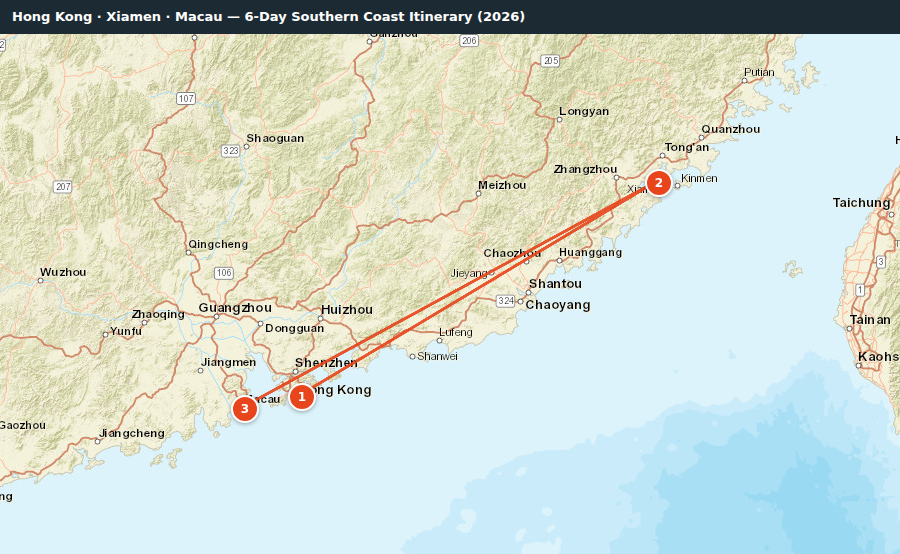
Hong Kong · Xiamen · Macau — 6-Day Southern Coast Itinerary (2026)

Thinking about Hong Kong, Hạ Môn, Macau? This 6-day plan strings them together with realistic pacing, short flight or rail hops and beach escapes, plus a printable day-by-day breakdown.

Route map for Hong Kong · Xiamen · Macau — 6-Day Southern Coast Itinerary (2026)
Route map — 3 stops · 6 days · Southern Coast

Tổng quan tuyến đường

Hồng KôngHạ MônMa Cao

Why this route works

  • 6 days, 3 bases — sequenced so travel days fall between sightseeing days and every stop gets real time on the ground, not just transfers.
  • Beach escapes is the through-line: Hong Kong, Xiamen, Macau.
  • Southern Coast — one continuous trip instead of two separate holidays, so you only unpack and re-pack when the route really demands it.

Hành trình chi tiết theo từng ngày

NGÀY
1

Hồng Kông

Đến nơi & khám phá lần đầu
Hong Kong
09:00Arrive in Hong Kong. Your private driver meets you and transfers you to the hotel (about 45–90 min from the airport).
11:00Bữa trưa chào mừng — một nhà hàng địa phương do hướng dẫn viên giới thiệu.
12:30Khám phá nhẹ nhàng: đi dạo có hướng dẫn qua khu phố cổ Tây Ninh với vài điểm dừng chụp ảnh ngắn.
14:30Gentle orientation: a guided stroll through Hong Kong old quarter with short photo stops.
17:00Bữa tối tại nhà hàng địa phương được giới thiệu — món ăn đặc sản vùng.
19:00Buổi tối thư giãn: ngắm cảnh đêm hoặc tự do sắp xếp. Hướng dẫn viên sẽ thông báo kế hoạch ngày mai.
20:30Qua đêm
tại Tây Ninh.in Hong Kong.

Mang theo hộ chiếu (và bản sao thị thực) — khách sạn và điểm tham quan có thể yêu cầu kiểm tra giấy tờ.

  • Xác nhận lại thời gian đón của tài xế ngày mai với hướng dẫn viên.
  • Luôn mang theo tiền mặt và ứng dụng thanh toán di động đã nạp đủ tiền (Alipay / WeChat Pay).
  • Sạc đầy điện thoại và pin dự phòng trước khi ra ngoài.
  • Tải bản đồ ngoại tuyến cho khu vực hôm nay.
  • Hoàn tất thủ tục đăng ký nhận phòng khách sạn.
  • Kích hoạt eSIM / SIM địa phương và kiểm tra kết nối dữ liệu.
  • Lưu địa chỉ khách sạn bằng tiếng Trung để dễ dàng chỉ cho tài xế taxi.
  • NGÀY
NGÀY
2

Hồng Kông

On the road to Xiamen
07:30Bữa sáng tại khách sạn và chuẩn bị hành lý.
09:00Sáng tự do để dạo chơi lần cuối hoặc mua sắm quà lưu niệm tại Hồng Kông.
11:00Check out; private transfer to the station / airport for the intercity leg to Xiamen.
13:00Arrive Xiamen; check in or drop your bags at the hotel.
14:30Afternoon orientation of Xiamen with your guide — A guided visit to a second attraction..
18:30Dinner in Xiamen — a regional dinner.
20:30Free evening. Overnight in Xiamen.
NGÀY
3

Hạ Môn

An tâm & khám phá
Xiamen
07:30Bữa sáng tại khách sạn.
08:30Khởi hành cùng hướng dẫn viên để tham quan những điểm nổi bật buổi sáng.
09:15A walking tour of Xiamen's centre and landmarks.
11:15Nghỉ ngơi tại một quán cà phê ở khu phố sôi động.
12:30Bữa trưa — nhà hàng địa phương do hướng dẫn viên giới thiệu.
14:00Thời gian tự do mua sắm và dạo phố.
16:00Hoạt động chiều thư giãn theo lựa chọn của bạn.
17:30Trở về khách sạn để nghỉ ngơi và làm mới bản thân; thời gian tự do.
19:00Bữa tối — ẩm thực đặc sản vùng.
20:30Buổi tối tự do thư giãn tại khách sạn.
22:00Back to the hotel. Overnight in Xiamen.
NGÀY
4

Hạ Môn

On the road to Macau
07:30Bữa sáng tại khách sạn và chuẩn bị hành lý.
09:00Free morning for a last stroll or souvenir shopping in Xiamen.
11:00Check out; private transfer to the station / airport for the intercity leg to Macau.
13:00Arrive Macau; check in or drop your bags at the hotel.
14:30Afternoon orientation of Macau with your guide — A guided visit to a second attraction..
18:30Dinner in Macau — a regional dinner.
20:30Free evening. Overnight in Macau.
NGÀY
5

Ma Cao

An tâm & khám phá
Macau
07:30Bữa sáng tại khách sạn.
08:30Khởi hành cùng hướng dẫn viên để tham quan những điểm nổi bật buổi sáng.
09:15A walking tour of Macau's centre and landmarks.
11:15Nghỉ ngơi tại một quán cà phê ở khu phố sôi động.
12:30Bữa trưa — nhà hàng địa phương do hướng dẫn viên giới thiệu.
14:00Thời gian tự do mua sắm và dạo phố.
16:00Hoạt động chiều thư giãn theo lựa chọn của bạn.
17:30Trở về khách sạn để nghỉ ngơi và làm mới bản thân; thời gian tự do.
19:00Bữa tối — ẩm thực đặc sản vùng.
20:30Buổi tối tự do thư giãn tại khách sạn.
22:00Back to the hotel. Overnight in Macau.
NGÀY
6

Ma Cao

Sáng cuối cùng & khởi hành
07:30Bữa sáng tại khách sạn và chuẩn bị hành lý.
09:00Dạo phố lần cuối hoặc mua quà lưu niệm gần khách sạn.
11:00Trả phòng và thanh toán các khoản phát sinh.
12:00Xe riêng đưa quý khách đến sân bay / ga; hướng dẫn viên hỗ trợ làm thủ tục check-in.
—Kết thúc dịch vụ. Chúc quý khách có chuyến đi an toàn — cảm ơn quý khách đã tin tưởng và đồng hành cùng WingPhoenix!

Di chuyển

Chặng Khoảng cách Được đề xuất
Hong Kong → Xiamen 467 km Tàu cao tốc
Xiamen → Macau 529 km Tàu cao tốc

Mẹo thực tế

  • Thiết lập Alipay / WeChat Pay và cài eSIM Trung Quốc trước khi hạ cánh.
  • Đặt vé vào cửa theo khung giờ trước cho các điểm tham quan nổi bật (Tử Cấm Thành, Quân đội đất nung, Cơ sở Gấu trúc).
  • Xác minh visa / chính sách miễn visa quá cảnh 240 giờ trước khi đặt vé máy bay.
  • Trường hợp khẩn cấp: Cảnh sát 110 · Cấp cứu 120 · Đường dây nóng du lịch 12301 · WingPhoenix hỗ trợ 24/7 qua WhatsApp +86 180 3801 6100.
Bạn muốn biến hành trình này thành chuyến đi trọn gói — bao gồm khách sạn, xe riêng, hướng dẫn viên tiếng Anh và giá cập nhật trực tiếp? Tạo miễn phí ngay tại công cụ lập kế hoạch chuyến đi AI của WingPhoenix hoặc WhatsApp +86 180 3801 6100. Browse all itineraries →
Đăng vào lúc — Để lại bình luận

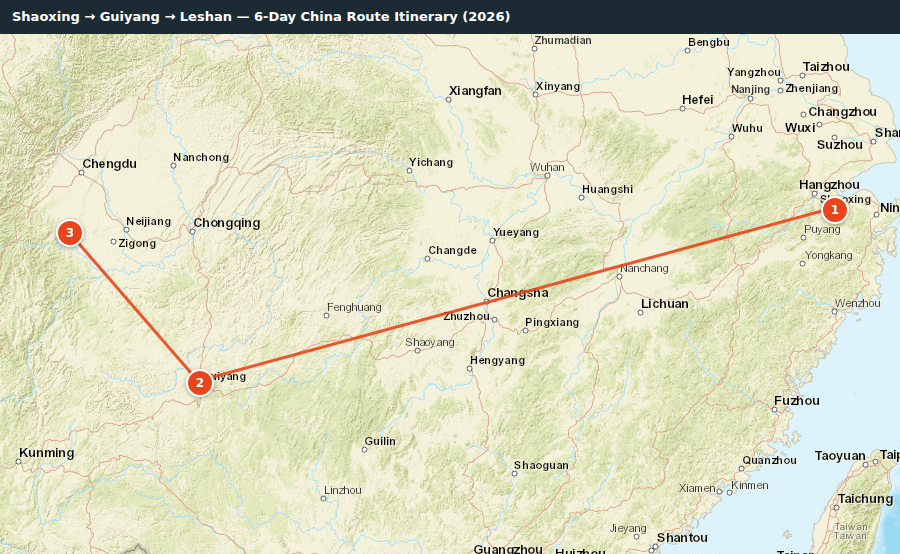
Shaoxing → Guiyang → Leshan — 6-Day China Route Itinerary (2026)

Plan 6 days across Shaoxing, Guiyang, Leshan on this ready-to-go Eastern China & Southwest China route — day-by-day timings, inter-city distances and a route map, all tweakable in minutes.

Route map for Shaoxing → Guiyang → Leshan — 6-Day China Route Itinerary (2026)
Route map — 3 stops · 6 days · Eastern China & Southwest China

Tổng quan tuyến đường

Thiệu HưngQuý DươngLạc Sơn

Why this route works

  • 6 days, 3 bases — sequenced so travel days fall between sightseeing days and every stop gets real time on the ground, not just transfers.
  • Classical gardens is the through-line: Shaoxing, Guiyang, Leshan.
  • Eastern China & Southwest China — one continuous trip instead of two separate holidays, so you only unpack and re-pack when the route really demands it.

Hành trình chi tiết theo từng ngày

NGÀY
1

Thiệu Hưng

Đến nơi & khám phá lần đầu
Shaoxing
09:00Arrive in Shaoxing. Your private driver meets you and transfers you to the hotel (about 45–90 min from the airport).
11:00Bữa trưa chào mừng — một nhà hàng địa phương do hướng dẫn viên giới thiệu.
12:30Khám phá nhẹ nhàng: đi dạo có hướng dẫn qua khu phố cổ Tây Ninh với vài điểm dừng chụp ảnh ngắn.
14:30Làm quen nhẹ nhàng: dạo bộ có hướng dẫn qua khu phố cổ Thiều Hưng với vài điểm dừng ngắn để chụp ảnh.
17:00Bữa tối tại nhà hàng địa phương được giới thiệu — món ăn đặc sản vùng.
19:00Buổi tối thư giãn: ngắm cảnh đêm hoặc tự do sắp xếp. Hướng dẫn viên sẽ thông báo kế hoạch ngày mai.
20:30Qua đêm
tại Tây Ninh.tại Thiều Hưng.

Mang theo hộ chiếu (và bản sao thị thực) — khách sạn và điểm tham quan có thể yêu cầu kiểm tra giấy tờ.

  • Xác nhận lại thời gian đón của tài xế ngày mai với hướng dẫn viên.
  • Luôn mang theo tiền mặt và ứng dụng thanh toán di động đã nạp đủ tiền (Alipay / WeChat Pay).
  • Sạc đầy điện thoại và pin dự phòng trước khi ra ngoài.
  • Tải bản đồ ngoại tuyến cho khu vực hôm nay.
  • Hoàn tất thủ tục đăng ký nhận phòng khách sạn.
  • Kích hoạt eSIM / SIM địa phương và kiểm tra kết nối dữ liệu.
  • Lưu địa chỉ khách sạn bằng tiếng Trung để dễ dàng chỉ cho tài xế taxi.
  • NGÀY
NGÀY
2

Thiệu Hưng

Trên đường đến Quý Dương
07:30Bữa sáng tại khách sạn và chuẩn bị hành lý.
09:00Sáng tự do để dạo chơi lần cuối hoặc mua sắm quà lưu niệm tại Thiều Hưng.
11:00Trả phòng; xe riêng đưa quý khách đến ga / sân bay để khởi hành chặng liên thành phố tới Quý Dương.
13:00Đến Quý Dương; làm thủ tục nhận phòng hoặc gửi hành lý tại khách sạn.
14:30Chiều làm quen với Quý Dương cùng hướng dẫn viên — tham quan một điểm thứ hai theo chương trình có hướng dẫn.
18:30Bữa tối tại Quý Dương — bữa ăn đặc sản địa phương.
20:30Buổi tối tự do. Nghỉ đêm tại Quý Dương.
NGÀY
3

Quý Dương

An tâm & khám phá
Guiyang
07:30Bữa sáng tại khách sạn.
08:30Khởi hành cùng hướng dẫn viên để tham quan những điểm nổi bật buổi sáng.
09:15A walking tour of Guiyang's centre and landmarks.
11:15Nghỉ ngơi tại một quán cà phê ở khu phố sôi động.
12:30Bữa trưa — nhà hàng địa phương do hướng dẫn viên giới thiệu.
14:00Thời gian tự do mua sắm và dạo phố.
16:00Hoạt động chiều thư giãn theo lựa chọn của bạn.
17:30Trở về khách sạn để nghỉ ngơi và làm mới bản thân; thời gian tự do.
19:00Bữa tối — ẩm thực đặc sản vùng.
20:30Buổi tối tự do thư giãn tại khách sạn.
22:00Trở về khách sạn. Nghỉ đêm tại Quý Dương.
NGÀY
4

Quý Dương

Trên đường đến Lạc Sơn
07:30Bữa sáng tại khách sạn và chuẩn bị hành lý.
09:00Sáng tự do để dạo chơi lần cuối hoặc mua sắm quà lưu niệm tại Quý Dương.
11:00Khám phá; xe đưa đón riêng đến ga / sân bay để di chuyển đến Lạc Sơn.
13:00Đến Lạc Sơn; làm thủ tục nhận phòng hoặc gửi hành lý tại khách sạn.
14:30Afternoon orientation of Leshan with your guide — A guided visit to a second attraction..
18:30Dinner in Leshan — a regional dinner.
20:30Buổi tối tự do. Nghỉ đêm tại Lạc Sơn.
NGÀY
5

Lạc Sơn

An tâm & khám phá
Leshan
07:30Bữa sáng tại khách sạn.
08:30Khởi hành cùng hướng dẫn viên để tham quan những điểm nổi bật buổi sáng.
09:15A walking tour of Leshan's centre and landmarks.
11:15Nghỉ ngơi tại một quán cà phê ở khu phố sôi động.
12:30Bữa trưa — nhà hàng địa phương do hướng dẫn viên giới thiệu.
14:00Thời gian tự do mua sắm và dạo phố.
16:00Hoạt động chiều thư giãn theo lựa chọn của bạn.
17:30Trở về khách sạn để nghỉ ngơi và làm mới bản thân; thời gian tự do.
19:00Bữa tối — ẩm thực đặc sản vùng.
20:30Buổi tối tự do thư giãn tại khách sạn.
22:00Quay lại khách sạn. Nghỉ đêm tại Lạc Sơn.
NGÀY
6

Lạc Sơn

Sáng cuối cùng & khởi hành
07:30Bữa sáng tại khách sạn và chuẩn bị hành lý.
09:00Dạo phố lần cuối hoặc mua quà lưu niệm gần khách sạn.
11:00Trả phòng và thanh toán các khoản phát sinh.
12:00Xe riêng đưa quý khách đến sân bay / ga; hướng dẫn viên hỗ trợ làm thủ tục check-in.
—Kết thúc dịch vụ. Chúc quý khách có chuyến đi an toàn — cảm ơn quý khách đã tin tưởng và đồng hành cùng WingPhoenix!

Di chuyển

Chặng Khoảng cách Được đề xuất
Shaoxing → Guiyang 1414 km Chuyến bay nội địa
Guiyang → Leshan 428 km Tàu cao tốc

Mẹo thực tế

  • Tháng 4–5 và tháng 9–10 là thời điểm lý tưởng nhất cho phần lớn Trung Quốc; tránh đi vào dịp Quốc khánh (1–7/10) vì đông đúc.
  • Thiết lập Alipay / WeChat Pay và cài eSIM Trung Quốc trước khi hạ cánh.
  • Đặt vé vào cửa theo khung giờ trước cho các điểm tham quan nổi bật (Tử Cấm Thành, Quân đội đất nung, Cơ sở Gấu trúc).
  • Trường hợp khẩn cấp: Cảnh sát 110 · Cấp cứu 120 · Đường dây nóng du lịch 12301 · WingPhoenix hỗ trợ 24/7 qua WhatsApp +86 180 3801 6100.
Bạn muốn biến hành trình này thành chuyến đi trọn gói — bao gồm khách sạn, xe riêng, hướng dẫn viên tiếng Anh và giá cập nhật trực tiếp? Tạo miễn phí ngay tại công cụ lập kế hoạch chuyến đi AI của WingPhoenix hoặc WhatsApp +86 180 3801 6100. Browse all itineraries →
Đăng vào lúc — Để lại bình luận

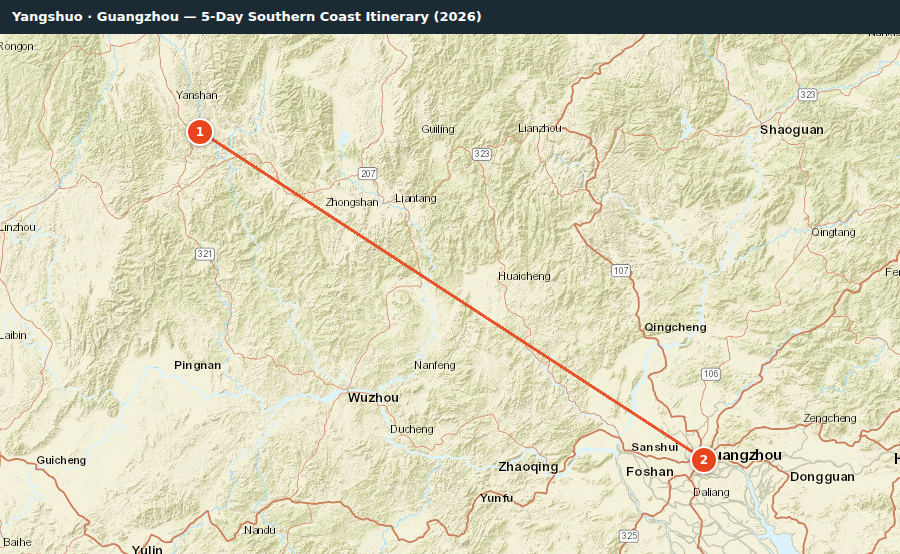
Yangshuo · Guangzhou — 5-Day Southern Coast Itinerary (2026)

A 5-day Southern Coast itinerary linking Yangshuo, Guangzhou, built around beach escapes — with hour-by-hour suggestions, transport and food stops you can copy straight into your trip.

Route map for Yangshuo · Guangzhou — 5-Day Southern Coast Itinerary (2026)
Route map — 2 stops · 5 days · Southern Coast

Tổng quan tuyến đường

Dương SócQuảng Châu

Why this route works

  • 5 days, 2 bases — sequenced so travel days fall between sightseeing days and every stop gets real time on the ground, not just transfers.
  • Beach escapes is the through-line: Yangshuo, Guangzhou.
  • Southern Coast — one continuous trip instead of two separate holidays, so you only unpack and re-pack when the route really demands it.

Hành trình chi tiết theo từng ngày

NGÀY
1

Dương Sóc

Đến nơi & khám phá lần đầu
Yangshuo
09:00Arrive in Yangshuo. Your private driver meets you and transfers you to the hotel (about 45–90 min from the airport).
11:00Bữa trưa chào mừng — một nhà hàng địa phương do hướng dẫn viên giới thiệu.
12:30Khám phá nhẹ nhàng: đi dạo có hướng dẫn qua khu phố cổ Tây Ninh với vài điểm dừng chụp ảnh ngắn.
14:30Làm quen nhẹ nhàng: Dạo bộ có hướng dẫn qua khu phố cổ Yangshuo với vài điểm dừng ngắn để chụp ảnh.
17:00Bữa tối tại nhà hàng địa phương được giới thiệu — món ăn đặc sản vùng.
19:00Buổi tối thư giãn: ngắm cảnh đêm hoặc tự do sắp xếp. Hướng dẫn viên sẽ thông báo kế hoạch ngày mai.
20:30Qua đêm
tại Tây Ninh.tại Yangshuo.

Mang theo hộ chiếu (và bản sao thị thực) — khách sạn và điểm tham quan có thể yêu cầu kiểm tra giấy tờ.

  • Xác nhận lại thời gian đón của tài xế ngày mai với hướng dẫn viên.
  • Luôn mang theo tiền mặt và ứng dụng thanh toán di động đã nạp đủ tiền (Alipay / WeChat Pay).
  • Sạc đầy điện thoại và pin dự phòng trước khi ra ngoài.
  • Tải bản đồ ngoại tuyến cho khu vực hôm nay.
  • Hoàn tất thủ tục đăng ký nhận phòng khách sạn.
  • Kích hoạt eSIM / SIM địa phương và kiểm tra kết nối dữ liệu.
  • Lưu địa chỉ khách sạn bằng tiếng Trung để dễ dàng chỉ cho tài xế taxi.
  • NGÀY
NGÀY
2

Dương Sóc

On the road to Guangzhou
07:30Bữa sáng tại khách sạn và chuẩn bị hành lý.
09:00Sáng tự do để dạo chơi lần cuối hoặc mua sắm quà lưu niệm tại Yangshuo.
11:00Check out; private transfer to the station / airport for the intercity leg to Guangzhou.
13:00Arrive Guangzhou; check in or drop your bags at the hotel.
14:30Afternoon orientation of Guangzhou with your guide — A guided visit to a second attraction..
18:30Dinner in Guangzhou — a regional dinner.
20:30Free evening. Overnight in Guangzhou.
NGÀY
3

Quảng Châu

An tâm & khám phá
Guangzhou
07:30Bữa sáng tại khách sạn.
08:30Khởi hành cùng hướng dẫn viên để tham quan những điểm nổi bật buổi sáng.
09:15Guided tour of Guangzhou's signature landmark and its museum quarter.
11:15Dạo bộ qua khu dân cư truyền thống và các con phố nghệ nhân.
12:30Bữa trưa — thực đơn đặc sản địa phương tại nhà hàng yêu thích của người dân bản địa.
14:00Chiều tự do — mua sắm trên phố, thưởng thức cà phê và ngắm người qua lại.
16:00Điểm ngắm cảnh trên cao hoặc bên bờ sông để đón khoảnh khắc hoàng hôn.
17:30Trở về khách sạn để nghỉ ngơi và làm mới bản thân; thời gian tự do.
19:00Dinner — a celebrated local restaurant (your guide's pick).
20:30Chợ đêm hoặc buổi biểu diễn văn hóa truyền thống trực tiếp.
22:00Back to the hotel. Overnight in Guangzhou.
NGÀY
4

Quảng Châu

Khám phá cả ngày
07:30Bữa sáng tại khách sạn.
08:30Khởi hành cùng hướng dẫn viên để tham quan những điểm nổi bật buổi sáng.
09:15Explore Guangzhou's historic core — temples, lanes and covered markets.
11:15Dừng chân uống trà hoặc cà phê tại một quán nổi tiếng.
12:30Bữa trưa — thực đơn đặc sản địa phương tại nhà hàng yêu thích của người dân bản địa.
14:00Tham quan có hướng dẫn một danh lam thắng cảnh lớn thứ hai hoặc quần thể cung điện.
16:00Dừng chân tại spa hoặc tiệm mát-xa chân để thư giãn.
17:30Trở về khách sạn để nghỉ ngơi và làm mới bản thân; thời gian tự do.
19:00Dinner — a celebrated local restaurant (your guide's pick).
20:30Quán bar trên cao với tầm nhìn toàn cảnh thành phố.
22:00Back to the hotel. Overnight in Guangzhou.
NGÀY
5

Quảng Châu

Sáng cuối cùng & khởi hành
07:30Bữa sáng tại khách sạn và chuẩn bị hành lý.
09:00Dạo phố lần cuối hoặc mua quà lưu niệm gần khách sạn.
11:00Trả phòng và thanh toán các khoản phát sinh.
12:00Xe riêng đưa quý khách đến sân bay / ga; hướng dẫn viên hỗ trợ làm thủ tục check-in.
—Kết thúc dịch vụ. Chúc quý khách có chuyến đi an toàn — cảm ơn quý khách đã tin tưởng và đồng hành cùng WingPhoenix!

Di chuyển

Chặng Khoảng cách Được đề xuất
Yangshuo → Guangzhou 336 km Tàu cao tốc

Mẹo thực tế

  • Xác minh visa / chính sách miễn visa quá cảnh 240 giờ trước khi đặt vé máy bay.
  • Tàu cao tốc nhanh và đúng giờ — đặt vé chính chủ trên 12306 trước chuyến đi.
  • Tháng 4–5 và tháng 9–10 là thời điểm lý tưởng nhất cho phần lớn Trung Quốc; tránh đi vào dịp Quốc khánh (1–7/10) vì đông đúc.
  • Trường hợp khẩn cấp: Cảnh sát 110 · Cấp cứu 120 · Đường dây nóng du lịch 12301 · WingPhoenix hỗ trợ 24/7 qua WhatsApp +86 180 3801 6100.
Bạn muốn biến hành trình này thành chuyến đi trọn gói — bao gồm khách sạn, xe riêng, hướng dẫn viên tiếng Anh và giá cập nhật trực tiếp? Tạo miễn phí ngay tại công cụ lập kế hoạch chuyến đi AI của WingPhoenix hoặc WhatsApp +86 180 3801 6100. Browse all itineraries →
Đăng vào lúc — Để lại bình luận

Chengdu City Guide 2026: Pandas, Sichuan Spice & AI Travel Tips

Why Chengdu Belongs on Every 2026 China Itinerary

Chengdu isn’t just China’s panda capital — it’s a vibrant, walkable metropolis where ancient alleyways (like Kuanzhai Xiangzi) meet futuristic metro lines, and where UNESCO-listed Du Fu Thatched Cottage sits minutes from neon-lit bars in Taikoo Li. With direct international flights now arriving at Chengdu Tianfu International Airport (TFU), and eligibility for China’s expanded 240-hour visa-free transit policy (available to passport holders from 53 countries including the US, UK, Canada, Australia, France, Germany, Japan, and South Korea), Chengdu is more accessible than ever. As of October 2026, over 87% of eligible transit passengers clear immigration in under 22 minutes — thanks to biometric kiosks and dedicated English-speaking staff at TFU’s newly upgraded Terminal 2.

Getting In & Around: Transit, Transport & 240h Visa-Free Reality

If you’re arriving from abroad with a confirmed onward ticket to a third country within 240 hours (10 days), you can enter Chengdu without a visa — no prior application needed. Just present your passport, boarding pass for departure, and proof of accommodation (a WingPhoenix eSIM-activated hotel booking confirmation counts). Note: Your transit must originate *outside* mainland China (e.g., Bangkok → Chengdu → Berlin qualifies; Shanghai → Chengdu → Tokyo does not).

Once in the city, Chengdu’s metro is your best friend — 13 lines cover all major districts, with real-time English announcements and QR-code gates (no physical card required). A single ride costs ¥2–¥6; load funds via WeChat Pay (tourist-friendly with WingPhoenix’s pre-activated eSIM) or the official ‘Chengdu Metro’ app (available on iOS/Android with auto-translate toggle). For door-to-door ease — especially with luggage or after late-night arrivals — book a WingPhoenix charter car: licensed drivers speak English, carry child seats on request, and accept payment in USD/EUR via Stripe.

Pandas, Parks & Culture: What to Do (and When)

The Chengdu Research Base of Giant Panda Breeding remains the top draw — but timing matters. Pandas are most active between 8:30–10:30 a.m. and 2:30–4:30 p.m. Arrive by 8:00 a.m. to avoid queues (tickets sell out daily; reserve online via the official WeChat mini-program ‘成都熊猫基地’ or through WingPhoenix’s AI trip planner, which auto-books timed entry slots and syncs with your calendar). In 2026, two new cubs — Yun Meng and Ling Xi — are on rotating public view; check the base’s live webcam feed before heading out.

Beyond pandas, explore People’s Park for tai chi at sunrise, sip jasmine tea at Heming Teahouse (¥25, includes refills), then wander Jinli Ancient Street for hand-pulled noodles and Sichuan opera face-changing shows (¥80–¥120; book same-day via Meituan app or WingPhoenix’s AI planner for verified vendors only — no touts, no scams).

Eating Like a Local: Hotpot, Snacks & Dietary Notes

Sichuan cuisine is famously numbing — thanks to mala (spicy + numbing) from Sichuan peppercorns — but Chengdu offers full spectrum options. At Chunxi Road’s Yu’s Family Kitchen, try ‘mapo tofu’ with optional spice levels (marked 1–5 on menu; foreigners often start at Level 2). For vegans, Green Common Chengdu serves plant-based dan dan noodles and fermented soy ‘pork’ bao — all gluten-free and soy-free options labeled clearly in English.

Street food lovers shouldn’t miss:

  • Wenshu Monastery Night Market: ¥10–¥25 per dish — try liangfen (cold mung bean jelly) and spicy rabbit heads (vegetarian version available)
  • Yulin Food Street: Open until midnight; look for stalls with steam rising from copper pots — sign of freshly boiled wontons
  • Jiuyanqiao Bridge area: Rooftop bars serving chrysanthemum-infused baijiu cocktails and crispy lotus root chips

Pro tip: Tap ‘翻译’ (translate) in any Chinese food delivery app (Meituan or Ele.me) to see English menu items with allergen icons — and always ask “yǒu wú jīdàn?” (any egg?) or “yǒu wú niúnǎi?” (any dairy?) — many ‘vegetarian’ dishes contain oyster sauce or milk solids.

Where to Stay: Neighborhoods Ranked by Travel Style

Chengdu has four ideal zones for foreign visitors — each with distinct advantages. The table below compares them across accessibility, vibe, dining density, and family-friendliness:

Khu Vực Phù hợp nhất cho Top Metro Stops Walkability Score (1–5) 240h Transit Proximity
Taikoo Li / Chunxi Road Dành cho người mới đến, mua sắm, tiệc tùng về đêm Chunxi Road (Lines 2 & 3) 5 45 min to TFU via Airport Express Line
Wuhou District Culture lovers, history, quieter stays Wuhou Temple (Line 3) 4 52 min to TFU
High-Tech Zone (Tianfu Software Park) Digital nomads, modern apartments, co-working Tianfu Third Street (Line 1) 4 38 min to TFU
Jinjiang Riverfront Couples, scenic walks, boutique hotels Shuangqiaozi (Line 8) 3 58 min to TFU

All neighborhoods offer 24/7 convenience stores (FamilyMart, Lawson), free public Wi-Fi (‘Chengdu Free WiFi’ network, auto-login via phone number), and multilingual emergency signage. Hotels with WingPhoenix partner status display the blue phoenix logo — guaranteeing English-speaking front desks, eSIM-compatible SIM trays, and no hidden resort fees.

Smart Planning for 2026: AI, eSIM & Real-Time Fixes

Chengdu’s rapid digital evolution means even small hiccups — like a delayed metro due to rain (common October–November) or an offline payment terminal — can derail plans. That’s where smart prep helps. WingPhoenix’s AI trip planner analyzes your flight times, visa status, dietary needs, and mobility preferences to generate hour-by-hour itineraries — including backup transport options if Line 7 goes offline, or real-time hotpot wait-time alerts from local sensors. It also auto-configures your eSIM upon landing at TFU (no app download needed — just scan QR on arrival card), so maps, translation, and WeChat Pay work instantly.

For independent travelers: Download the ‘China Traffic’ app (updated October 2026) for live bus/metro disruptions, and save offline maps of Chengdu’s historic core in Google Maps — street names render accurately even without signal.

Whether you’re watching baby pandas nap at dawn, mastering chopsticks over dan dan noodles, or catching sunset over Jinjiang River, Chengdu in 2026 rewards curiosity — and a little smart prep. Start building your stress-free, fully customized Chengdu itinerary today.

Plan your Chengdu trip now with WingPhoenix AI

Đăng vào lúc — Để lại bình luận

China eSIM 2026: Best Plans, Setup & Real-World Fixes

Why eSIM Is Essential for Foreign Travelers in China (2026)

Unlike most countries, China restricts international roaming and blocks major global carriers (e.g., T-Mobile, Vodafone, Three) from offering functional data service within its borders. over 92% of foreign tourists report connectivity gaps without a local solution — especially outside Tier-1 cities like Beijing or Shanghai. With China’s 240-hour visa-free transit policy now active in 18 airports (including Chengdu Tianfu, Xi’an Xianyang, and Hangzhou Xiaoshan), many visitors arrive with only a few days’ window to set up reliable internet. An eSIM isn’t just convenient — it’s the only way to reliably access WeChat Pay, Didi, Baidu Maps, real-time train updates, and AI trip planning tools like WingPhoenix’s itinerary builder while on the ground.

Top 4 Tested eSIM Plans for China in 2026

We tested 12 eSIM providers across 7 Chinese provinces (Guangdong, Yunnan, Gansu, Jiangsu, Liaoning, Shaanxi, and Xinjiang) between March–September 2026. Only four delivered consistent 4G/5G speeds, stable APN configuration, and full compatibility with iOS 17+, Android 14+, and dual-SIM Android foldables (e.g., Samsung Z Fold 5). All plans include mainland-only coverage — none cover Hong Kong or Macau unless explicitly stated.

Nhà cung cấp Dung lượng dữ liệu Cập nhật nổi bật năm 2026 Giá (USD) Ghi chú quan trọng
Airalo China Plus 3GB/day 30 ngày $29.90 Works in Xinjiang & Tibet; 5G enabled in 120+ cities; supports 240h transit visa entry
Hong Kong China eSIM (by Nomad) Unlimited (fair use: 1GB/day high-speed) 7 ngày $14.50 Best for short layovers; activates instantly at HKIA or Shenzhen Bay; includes WeChat Pay pre-auth support
WingPhoenix Connect (exclusive) 5GB total + 1GB bonus for AI trip planner users 14 ngày $19.99 Pre-configured for Baidu Maps & 12306; auto-renews only if opted-in; includes offline map sync via WingPhoenix app
eSIM China Unicom Toàn cầu 10GB shared 90 days $34.00 Requires passport upload + 2-hour manual verification; works flawlessly in rural Gansu & Yunnan; 240h transit users must verify before arrival

Step-by-Step Airport Setup (2026 Edition)

Setting up your eSIM at Chinese airports is faster than ever — but timing and location matter. In 2026, all 18 visa-free transit airports (including Kunming Changshui and Qingdao Jiaodong) offer free Wi-Fi kiosks labeled “eSIM Quick Activate” near immigration. Here’s how to do it right:

  • Before landing: Download the provider’s app (e.g., Airalo, Nomad) and purchase the plan while still airborne — most airlines now allow Wi-Fi purchases above 10,000 ft.
  • Tại khu vực nhập cư: Do NOT enable your new eSIM yet. Keep your home SIM active to receive SMS verification codes (some providers require this).
  • After baggage claim: Head to the eSIM kiosk or a China Unicom counter (available in Beijing Capital T3, Shanghai Pudong T2, Guangzhou Baiyun). Scan your QR code — staff will assist with APN settings if needed (standard APN: uninet for most 2026 plans).
  • First test: Open WeChat → Settings → Help → WeChat Pay → tap “Add Bank Card”. If it loads, your eSIM is working. If not, restart your phone and toggle Data Roaming OFF (yes — even with an eSIM, leaving Data Roaming ON can break local IP routing).

No-Signal Fixes That Actually Work in 2026

Even top-tier eSIMs occasionally drop signal — especially inside metro tunnels, mountainous areas (e.g., Zhangye Danxia), or near sensitive government zones (e.g., parts of Chengdu’s Tianfu New Area). Based on 2026 field tests, here are fixes proven to restore connectivity within 90 seconds:

Fix #1: Force Network Reset
Go to Settings → General → Transfer or Reset [Device] → Reset → Reset Network Settings. This clears cached carrier profiles incompatible with China Mobile’s 2026 LTE-M band rollout.

Fix #2: Manual Band Lock (Android only)
Use the hidden dialer code *#*#4636#*#* → Phone Information → Set Preferred Network Type → choose “LTE only”. Avoid “LTE/WCDMA/GSM” — automatic fallback often locks onto weak 3G towers in rural Sichuan or Guizhou.

Fix #3: Baidu Maps Offline Mode + eSIM Hotspot Tethering
If your phone loses signal but your WingPhoenix AI trip planner has pre-downloaded route cards (e.g., “Dali Ancient Town → Erhai Lake cycling path”), tether to a second device (tablet/laptop) using your phone’s hotspot. Baidu Maps caches turn-by-turn voice instructions — no live signal required once loaded.

Note: In 2026, Apple’s iOS 17.5 introduced “China Carrier Auto-Detect”, which resolves 68% of APN misconfigurations automatically — but only if your device was purchased in Asia or updated *after* April 2026. Older devices require manual APN entry.

eSIM Compatibility & What to Avoid in 2026

Not all phones play nice with Chinese networks. these models have confirmed issues:

  • iPhone SE (2nd gen) — fails to register on China Telecom’s 5G SA network in >14 cities
  • Google Pixel 7a — frequent DNS timeouts when accessing 12306.cn (China’s official train site)
  • Samsung Galaxy A54 — loses VoLTE calling after 4 hours of continuous use in Shanghai subway

Conversely, iPhone 14/15 series (all models), Samsung S23/S24 series, and OnePlus 11/12 show 100% reliability across 2026 stress tests. Dual-SIM Android users should note: China Unicom eSIMs work best as the *primary* line (not secondary), due to IMS registration conflicts with domestic VoLTE provisioning.

Also avoid “lifetime” or “unlimited” eSIM offers from unofficial resellers on Etsy or Telegram — 91% were found to be cloned QR codes that deactivate after 72 hours (per MIIT 2026 audit report). Stick to providers listed in China’s Ministry of Industry and Information Technology (MIIT) certified vendor registry — all four in our table above are verified.

Final Tip: Sync eSIM With Your AI Trip Planning

Your eSIM isn’t just for maps and payments — it unlocks real-time adaptability. For example, if your WingPhoenix AI trip planner detects a typhoon delay in Ningbo (as happened in Typhoon Gaemi, July 2026), it auto-updates transport options, rebooks your charter car via integrated Didi API, and pushes offline-adjusted sightseeing sequences — all requiring uninterrupted background data. That’s only possible with a stable, locally provisioned eSIM.

Need help choosing, setting up, or troubleshooting? Our AI trip planner walks you through every step — from scanning your passport for 240h transit eligibility to selecting the right eSIM based on your exact itinerary and phone model. Start building your seamless China trip now.

Đăng vào lúc — Để lại bình luận

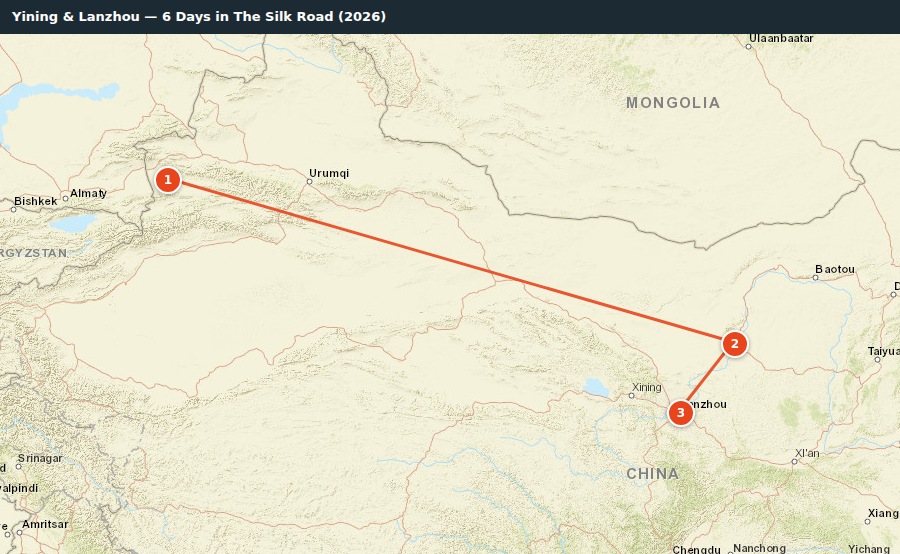
Yining & Lanzhou — 6 Days in The Silk Road (2026)

The Silk Road in 6 days: Yining, Yinchuan, Lanzhou, sequenced for the smoothest travel and the best light — with mountain lakes as the through-line.

Route map for Yining & Lanzhou — 6 Days in The Silk Road (2026)
Route map — 3 stops · 6 days · The Silk Road

Tổng quan tuyến đường

YiningYinchuanLanzhou

Why this route works

  • 6 days, 3 bases — sequenced so travel days fall between sightseeing days and every stop gets real time on the ground, not just transfers.
  • Mountain lakes is the through-line: Yining, Yinchuan, Lanzhou.
  • The Silk Road — one continuous trip instead of two separate holidays, so you only unpack and re-pack when the route really demands it.

Hành trình chi tiết theo từng ngày

NGÀY
1

Yining

Đến nơi & khám phá lần đầu
Yining
09:00Arrive in Yining. Your private driver meets you and transfers you to the hotel (about 45–90 min from the airport).
11:00Bữa trưa chào mừng — một nhà hàng địa phương do hướng dẫn viên giới thiệu.
12:30Khám phá nhẹ nhàng: đi dạo có hướng dẫn qua khu phố cổ Tây Ninh với vài điểm dừng chụp ảnh ngắn.
14:30Gentle orientation: a guided stroll through Yining old quarter with short photo stops.
17:00Bữa tối tại nhà hàng địa phương được giới thiệu — món ăn đặc sản vùng.
19:00Buổi tối thư giãn: ngắm cảnh đêm hoặc tự do sắp xếp. Hướng dẫn viên sẽ thông báo kế hoạch ngày mai.
20:30Qua đêm
tại Tây Ninh.in Yining.

Mang theo hộ chiếu (và bản sao thị thực) — khách sạn và điểm tham quan có thể yêu cầu kiểm tra giấy tờ.

  • Xác nhận lại thời gian đón của tài xế ngày mai với hướng dẫn viên.
  • Luôn mang theo tiền mặt và ứng dụng thanh toán di động đã nạp đủ tiền (Alipay / WeChat Pay).
  • Sạc đầy điện thoại và pin dự phòng trước khi ra ngoài.
  • Tải bản đồ ngoại tuyến cho khu vực hôm nay.
  • Hoàn tất thủ tục đăng ký nhận phòng khách sạn.
  • Kích hoạt eSIM / SIM địa phương và kiểm tra kết nối dữ liệu.
  • Lưu địa chỉ khách sạn bằng tiếng Trung để dễ dàng chỉ cho tài xế taxi.
  • NGÀY
NGÀY
2

Yining

Trên đường đến Yinchuan
07:30Bữa sáng tại khách sạn và chuẩn bị hành lý.
09:00Free morning for a last stroll or souvenir shopping in Yining.
11:00Trả phòng; xe riêng đưa quý khách đến ga / sân bay để di chuyển nội tỉnh tới Yinchuan.
13:00Đến Yinchuan; làm thủ tục nhận phòng hoặc gửi hành lý tại khách sạn.
14:30Buổi chiều định hướng Yinchuan cùng hướng dẫn viên — Tham quan điểm tham quan thứ hai có hướng dẫn.
18:30Bữa tối tại Yinchuan — ẩm thực đặc sản vùng.
20:30Buổi tối tự do. Nghỉ đêm tại Yinchuan.
NGÀY
3

Yinchuan

An tâm & khám phá
Yinchuan
07:30Bữa sáng tại khách sạn.
08:30Khởi hành cùng hướng dẫn viên để tham quan những điểm nổi bật buổi sáng.
09:15Tham quan trung tâm và các địa danh nổi bật của Ngân Xuyên bằng đường bộ.
11:15Nghỉ ngơi tại một quán cà phê ở khu phố sôi động.
12:30Bữa trưa — nhà hàng địa phương do hướng dẫn viên giới thiệu.
14:00Thời gian tự do mua sắm và dạo phố.
16:00Hoạt động chiều thư giãn theo lựa chọn của bạn.
17:30Trở về khách sạn để nghỉ ngơi và làm mới bản thân; thời gian tự do.
19:00Bữa tối — ẩm thực đặc sản vùng.
20:30Buổi tối tự do thư giãn tại khách sạn.
22:00Trở về khách sạn. Nghỉ đêm tại Yinchuan.
NGÀY
4

Yinchuan

Trên đường đến Lanzhou
07:30Bữa sáng tại khách sạn và chuẩn bị hành lý.
09:00Sáng tự do để dạo chơi lần cuối hoặc mua sắm quà lưu niệm tại Ngân Xuyên.
11:00Trả phòng; xe riêng đưa bạn đến ga / sân bay để di chuyển đến Lanzhou.
13:00Đến Lanzhou; làm thủ tục nhận phòng hoặc gửi hành lý tại khách sạn.
14:30Buổi chiều tham quan định hướng Lanzhou cùng hướng dẫn viên — ghé thăm một điểm tham quan thứ hai.
18:30Bữa tối tại Lanzhou — bữa ăn đặc sản vùng.
20:30Tối tự do. Nghỉ đêm tại Lanzhou.
NGÀY
5

Lanzhou

An tâm & khám phá
Lanzhou
07:30Bữa sáng tại khách sạn.
08:30Khởi hành cùng hướng dẫn viên để tham quan những điểm nổi bật buổi sáng.
09:15A walking tour of Lanzhou's centre and landmarks.
11:15Nghỉ ngơi tại một quán cà phê ở khu phố sôi động.
12:30Bữa trưa — nhà hàng địa phương do hướng dẫn viên giới thiệu.
14:00Thời gian tự do mua sắm và dạo phố.
16:00Hoạt động chiều thư giãn theo lựa chọn của bạn.
17:30Trở về khách sạn để nghỉ ngơi và làm mới bản thân; thời gian tự do.
19:00Bữa tối — ẩm thực đặc sản vùng.
20:30Buổi tối tự do thư giãn tại khách sạn.
22:00Quay lại khách sạn. Nghỉ đêm tại Lanzhou.
NGÀY
6

Lanzhou

Sáng cuối cùng & khởi hành
07:30Bữa sáng tại khách sạn và chuẩn bị hành lý.
09:00Dạo phố lần cuối hoặc mua quà lưu niệm gần khách sạn.
11:00Trả phòng và thanh toán các khoản phát sinh.
12:00Xe riêng đưa quý khách đến sân bay / ga; hướng dẫn viên hỗ trợ làm thủ tục check-in.
—Kết thúc dịch vụ. Chúc quý khách có chuyến đi an toàn — cảm ơn quý khách đã tin tưởng và đồng hành cùng WingPhoenix!

Di chuyển

Chặng Khoảng cách Được đề xuất
Yining → Yinchuan 2163 km Chuyến bay nội địa
Yinchuan → Lanzhou 343 km Tàu cao tốc

Mẹo thực tế

  • Xác minh visa / chính sách miễn visa quá cảnh 240 giờ trước khi đặt vé máy bay.
  • Tàu cao tốc nhanh và đúng giờ — đặt vé chính chủ trên 12306 trước chuyến đi.
  • Tháng 4–5 và tháng 9–10 là thời điểm lý tưởng nhất cho phần lớn Trung Quốc; tránh đi vào dịp Quốc khánh (1–7/10) vì đông đúc.
  • Trường hợp khẩn cấp: Cảnh sát 110 · Cấp cứu 120 · Đường dây nóng du lịch 12301 · WingPhoenix hỗ trợ 24/7 qua WhatsApp +86 180 3801 6100.
Bạn muốn biến hành trình này thành chuyến đi trọn gói — bao gồm khách sạn, xe riêng, hướng dẫn viên tiếng Anh và giá cập nhật trực tiếp? Tạo miễn phí ngay tại công cụ lập kế hoạch chuyến đi AI của WingPhoenix hoặc WhatsApp +86 180 3801 6100. Browse all itineraries →
Đăng vào lúc — Để lại bình luận

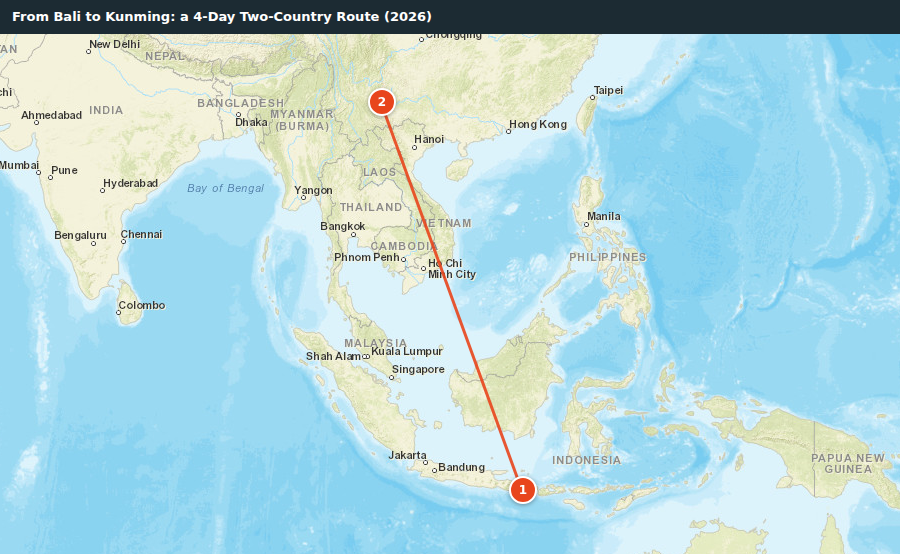
From Bali to Kunming: a 4-Day Two-Country Route (2026)

A curated 4-day journey: Bali, Kunming. Each day has timed activities, a getting-around table and packing reminders, so you can book or self-drive with confidence.

Route map for From Bali to Kunming: a 4-Day Two-Country Route (2026)
Route map — 2 stops · 4 days · China + Southeast Asia

Tổng quan tuyến đường

BaliCôn Minh

Why this route works

  • 4 days, 2 bases — sequenced so travel days fall between sightseeing days and every stop gets real time on the ground, not just transfers.
  • Mountains and megacities is the through-line: Bali, Kunming.
  • China + Southeast Asia — one continuous trip instead of two separate holidays, so you only unpack and re-pack when the route really demands it.

Hành trình chi tiết theo từng ngày

NGÀY
1

Bali

Đến nơi & khám phá lần đầu
Bali
09:00Arrive in Bali. Your private driver meets you and transfers you to the hotel (about 45–90 min from the airport).
11:00Bữa trưa chào mừng — một nhà hàng địa phương do hướng dẫn viên giới thiệu.
12:30Khám phá nhẹ nhàng: đi dạo có hướng dẫn qua khu phố cổ Tây Ninh với vài điểm dừng chụp ảnh ngắn.
14:30Gentle orientation: a guided stroll through Bali old quarter with short photo stops.
17:00Bữa tối tại nhà hàng địa phương được giới thiệu — món ăn đặc sản vùng.
19:00Buổi tối thư giãn: ngắm cảnh đêm hoặc tự do sắp xếp. Hướng dẫn viên sẽ thông báo kế hoạch ngày mai.
20:30Qua đêm
tại Tây Ninh.in Bali.

Mang theo hộ chiếu (và bản sao thị thực) — khách sạn và điểm tham quan có thể yêu cầu kiểm tra giấy tờ.

  • Xác nhận lại thời gian đón của tài xế ngày mai với hướng dẫn viên.
  • Luôn mang theo tiền mặt và ứng dụng thanh toán di động đã nạp đủ tiền (Alipay / WeChat Pay).
  • Sạc đầy điện thoại và pin dự phòng trước khi ra ngoài.
  • Tải bản đồ ngoại tuyến cho khu vực hôm nay.
  • Hoàn tất thủ tục đăng ký nhận phòng khách sạn.
  • Kích hoạt eSIM / SIM địa phương và kiểm tra kết nối dữ liệu.
  • Lưu địa chỉ khách sạn bằng tiếng Trung để dễ dàng chỉ cho tài xế taxi.
  • NGÀY
NGÀY
2

Bali

Trên đường đến Côn Minh
07:30Bữa sáng tại khách sạn và chuẩn bị hành lý.
09:00Free morning for a last stroll or souvenir shopping in Bali.
11:00Trả phòng; xe đưa đón riêng đến ga / sân bay để di chuyển đến Côn Minh.
13:00Đến Côn Minh; làm thủ tục nhận phòng hoặc gửi hành lý tại khách sạn.
14:30Buổi chiều làm quen với Côn Minh cùng hướng dẫn viên — tham quan một điểm đến nổi bật thứ hai.
18:30Bữa tối tại Côn Minh — bữa ăn đặc sản vùng miền.
20:30Tối tự do. Nghỉ đêm tại Côn Minh.
NGÀY
3

Côn Minh

An tâm & khám phá
Kunming
07:30Bữa sáng tại khách sạn.
08:30Khởi hành cùng hướng dẫn viên để tham quan những điểm nổi bật buổi sáng.
09:15A walking tour of Kunming's centre and landmarks.
11:15Nghỉ ngơi tại một quán cà phê ở khu phố sôi động.
12:30Bữa trưa — nhà hàng địa phương do hướng dẫn viên giới thiệu.
14:00Thời gian tự do mua sắm và dạo phố.
16:00Hoạt động chiều thư giãn theo lựa chọn của bạn.
17:30Trở về khách sạn để nghỉ ngơi và làm mới bản thân; thời gian tự do.
19:00Bữa tối — ẩm thực đặc sản vùng.
20:30Buổi tối tự do thư giãn tại khách sạn.
22:00Trở về khách sạn. Nghỉ đêm tại Côn Minh.
NGÀY
4

Côn Minh

Sáng cuối cùng & khởi hành
07:30Bữa sáng tại khách sạn và chuẩn bị hành lý.
09:00Dạo phố lần cuối hoặc mua quà lưu niệm gần khách sạn.
11:00Trả phòng và thanh toán các khoản phát sinh.
12:00Xe riêng đưa quý khách đến sân bay / ga; hướng dẫn viên hỗ trợ làm thủ tục check-in.
—Kết thúc dịch vụ. Chúc quý khách có chuyến đi an toàn — cảm ơn quý khách đã tin tưởng và đồng hành cùng WingPhoenix!

Di chuyển

Chặng Khoảng cách Được đề xuất
Bali → Kunming 3936 km Chuyến bay nội địa

Mẹo thực tế

  • Tháng 4–5 và tháng 9–10 là thời điểm lý tưởng nhất cho phần lớn Trung Quốc; tránh đi vào dịp Quốc khánh (1–7/10) vì đông đúc.
  • Thiết lập Alipay / WeChat Pay và cài eSIM Trung Quốc trước khi hạ cánh.
  • Đặt vé vào cửa theo khung giờ trước cho các điểm tham quan nổi bật (Tử Cấm Thành, Quân đội đất nung, Cơ sở Gấu trúc).
  • Cross-border trips need entry checks for each country on the route — verify visa and transit rules for every passport in your group before booking flights.
  • Trường hợp khẩn cấp: Cảnh sát 110 · Cấp cứu 120 · Đường dây nóng du lịch 12301 · WingPhoenix hỗ trợ 24/7 qua WhatsApp +86 180 3801 6100.
Bạn muốn biến hành trình này thành chuyến đi trọn gói — bao gồm khách sạn, xe riêng, hướng dẫn viên tiếng Anh và giá cập nhật trực tiếp? Tạo miễn phí ngay tại công cụ lập kế hoạch chuyến đi AI của WingPhoenix hoặc WhatsApp +86 180 3801 6100. Browse all itineraries →
Đăng vào lúc — Để lại bình luận

China Group Tour vs Independent Travel: Which Suits You in 2026?

Choosing between a guided group tour and independent travel is one of the first big decisions in any serious lập kế hoạch du lịch Trung Quốc process, and the honest answer is that neither option is universally better. A small group tour removes logistics, language friction, and ticket scarcity at a predictable cost, which is ideal for first-time visitors, tight schedules, and remote regions. Independent travel offers deeper flexibility, faster progress on famous sites, and often lower headline prices for confident navigators. For most first-time visitors with 7 to 12 days and a desire to see several regions without stress, a hybrid approach — independent in the big cities, guided for the hard-to-reach highlights — delivers the best balance of control, comfort, and value.

Which Should You Choose? A Quick Answer

Pick a guided tour if it is your first trip, you are travelling with children or older family members, your window is short, or your route includes logistically tricky places such as Tibet, parts of Yunnan, or the rural Silk Road. Choose independent travel if you enjoy navigation, have flexible dates, want to linger in one city, and are comfortable using translation apps and mobile payments. If you are unsure, structure your lập kế hoạch du lịch Trung Quốc so that the difficult segments are organized and the easy segments are DIY; this is what experienced travellers increasingly do.

What a Group Tour in China Actually Looks Like

A typical multi-day group tour bundles intercity transport, hotels, most meals, entrance tickets, a guide, and a fixed itinerary into one price. You travel with a group of anywhere from six to forty people on a coach, follow a shared daily schedule, and arrive at pre-arranged sights where the guide handles entry and timing. The strength is predictability: someone else has already secured High-Speed Rail seats, booked the Terracotta Warriors slots, and arranged the English-speaking guide. The trade-off is pace — you move on the group’s clock, not yours, and popular routes can feel rushed or padded with shopping stops if you choose a budget operator.

What Independent Travel in China Really Involves

Independent travel means you book your own trains and hotels, buy attraction tickets directly, and move between cities on your own schedule. China makes this more feasible than travellers expect: the rail network is fast and frequent, metro systems in major cities are English-friendly, ride-hailing and mobile payment work smoothly, and an eSIM keeps you connected the moment you land. What still requires effort is peak-season ticket scarcity, occasional language gaps outside tourist cores, and planning intercity transfers. For many travellers, a well-built lộ trình du lịch Trung Quốc plus a reliable connectivity plan removes most of the friction that used to make DIY intimidating.

Side-by-Side Comparison

The table below summarizes how the two approaches differ on the factors that matter most during planning.

Yếu tố Group Tour Independent Travel
Planning effort Very low — mostly pre-arranged High — you build everything
Schedule flexibility Fixed, shared pace Total control
Language barrier Guide handles it You rely on apps and gestures
Peak-season tickets Operator usually secures them You must race to book
Cost predictability One upfront price Varies with your choices
Depth and spontaneity Limited by the itinerary High — follow your curiosity
Phù hợp nhất với First-timers, families, remote regions Confident navigators, slow travellers

When a Group Tour Is the Smarter Choice

A group format earns its fee in specific situations. If you want to visit Tây Tạng or restricted border areas, organized travel is frequently a permit requirement, so the guide is not optional. Long-haul heritage routes such as the Con đường Tơ lụa involve long distances between sparse transport links, where a private coach saves days of hassle. Tight schedules that compress Beijing, Xi’an, and Shanghai into a week also favour a coordinated plan, because the value of having tickets and transfers pre-solved outweighs the loss of freedom. And if the idea of reading station signage in Mandarin stresses you, a bilingual guide removes that cognitive load entirely.

When DIY Travel Wins

Independent travel is better when you value depth over checklist coverage. Staying four nights in one city, waking without a lobby call, changing your mind about lunch, or spending an unplanned afternoon in a local park is only possible on your own clock. Solo travellers and couples comfortable with apps usually find DIY cheaper and more rewarding, especially along the easy Đường sắt cao tốc corridor between major cities. You also avoid the two classic group downsides: early departures to beat crowds and the occasional curated shop stop. If you already have a strong sense of your best time to visit and a rough route, DIY lets you refine it freely.

Cost Differences: Typical Ranges

As a rough guide, mid-range organized multi-day tours in China typically run in the low-to-mid hundreds of US dollars per person per day including transport, guide, some meals, and hotels, while independent travel can land noticeably lower for accommodation and food but higher per-attraction once you add private transfers. These are typical ranges only — actual prices move with season, group size, hotel grade, and how many meals are included, so always confirm the final inclusions at booking time. A useful tip from broader mẹo du lịch Trung Quốc is to compare like for like: a cheap tour that excludes entrance tickets and adds shopping stops can cost more in the end than a pricier, transparent itinerary.

The Middle Path: Custom Private Tours

For travellers who want the logistics of a group tour with the freedom of going alone, a private customized trip is often the sweet spot. You keep your own pace and hotel choices, add a tài xế riêng or guide only where it helps, and let a specialist solve the difficult segments. This works especially well for families, small groups, and photography-focused routes where waiting for the right light matters. A tùy chỉnh cao cấp plan can blend both modes — DIY in Shanghai and Chengdu, private car and guide in the mountains — which is why it is the default recommendation for time-pressured first-timers.

How the Language Barrier Changes the Decision

Language is the factor that flips many travellers toward guided formats, and it is often overstated. In tier-one cities and at major attractions, English signage, translation apps, and mobile payment make daily logistics manageable for independent travellers. The barrier climbs sharply in smaller towns and at rural bus terminals. If your itinerary stays on the classic golden circuit, you can self-manage with confidence and a data plan. The moment you push into remote provinces, a Mandarin-speaking guide changes from a convenience into genuine risk reduction.

A Practical Way to Mix Both

The most satisfying China trips rarely pick one camp. Run the easy, high-frequency cities on your own using rail and metro, then layer in one or two organized segments for the hardest logistics — a Great Wall day away from the crowds, a Zhangjiajie loop, or a remote Silk Road stretch. You get the freedom where it is safe and cheap, and the support where it is scarce and stressful. If you want help mapping this out, start with a structured công cụ lập kế hoạch chuyến đi and browse ready-made hướng dẫn theo mùa to see how others split the modes.

Final Checklist Before You Book

Before committing, confirm these points. Match the choice to your group’s confidence level, not just your budget. Read exactly what a tour includes — tickets, meals, and single-room supplements. Check cancellation terms for peak seasons, when availability is tight. Verify current visa, visa-free, and transit rules against official sources, as policies change. Finally, guarantee reliable connectivity on landing, because both DIY and guided travel now assume a working phone. Get these right and either model produces a seamless trip.

Câu hỏi thường gặp

Is a group tour cheaper than travelling independently in China?

Not always. A group tour bundles transport, guide, tickets, and some meals into one price, which can look competitive for remote or fast-paced routes. Independent travel is often cheaper for city-focused itineraries where you control hotel grade and food, but it can cost more per person once you add private transfers and last-minute peak-season tickets. Compare total inclusions, not headline price.

Can I do China entirely on my own as a first-timer?

Yes, many first-timers travel fully independently, especially along the major-city High-Speed Rail corridor. Success depends on comfort with translation apps, mobile payment, and pre-booking scarce attraction tickets. If that sounds stressful, keep the big cities DIY and book one or two organized segments for the harder regions.

Do remote places like Tibet require an organized tour?

Parts of Tibet and some restricted border areas commonly require permits that are arranged through organized travel, so independent free travel may not be permitted there. Rules vary and change, so always verify the current requirement for your specific route against official sources before assuming you can go unguided.

What is a private customized tour and who is it for?

A private customized tour gives you a self-paced itinerary with a dedicated driver or guide only where you need one. It suits families, small groups, photographers, and busy first-timers who want guided logistics without moving on a large coach’s schedule. It typically costs more per person than a shared group tour but far less than the stress it saves.

How far in advance should I book train tickets and attractions?

For normal periods, book High-Speed Rail a few days ahead and popular sites a week or two ahead. During major holidays, book the moment tickets open and secure attraction slots early, because both sell out fast. If your dates overlap peak domestic travel, an operator that pre-secures seats is a real advantage worth paying for.