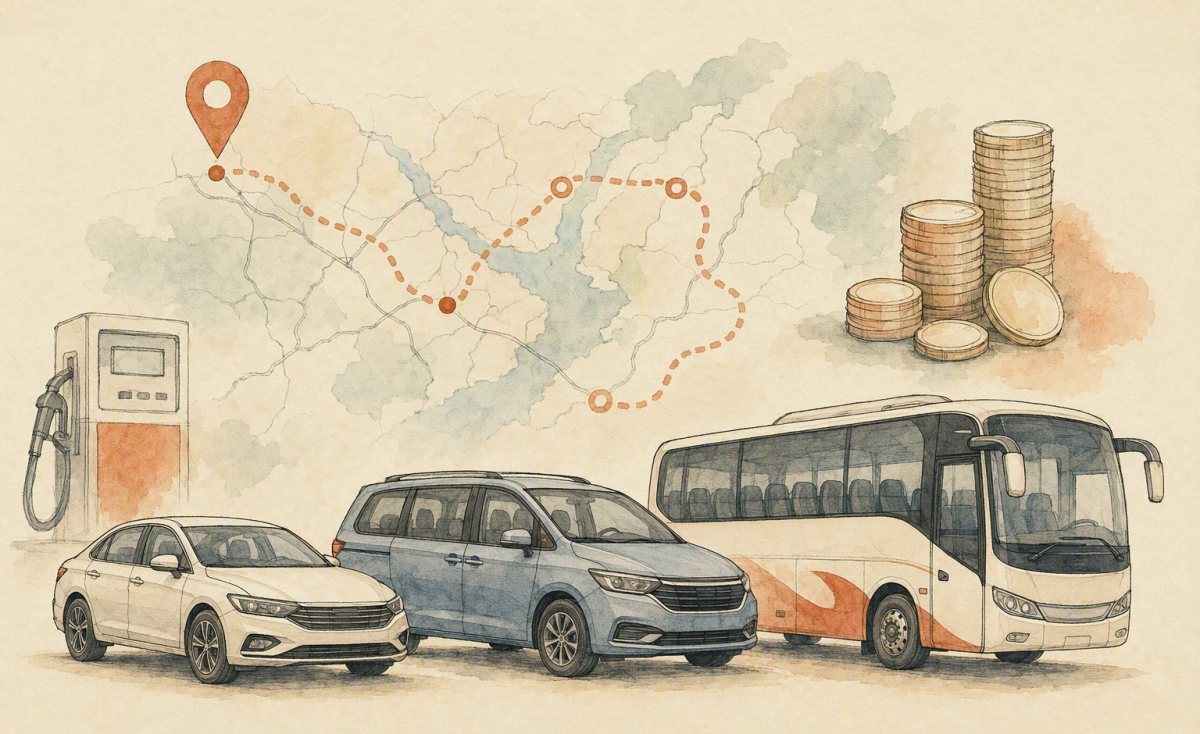
Chartering a car with a driver is one of the more practical ways to travel in China, particularly for families, small groups and anyone visiting sights that sit outside a city’s metro network. It also has a reputation for opaque pricing, which is partly deserved: quotes vary by vehicle class, city, season and how many days you book, and two operators can quote very different figures for what sounds like the same trip. This guide explains what actually drives the daily rate, how the main vehicle categories differ in use rather than just in size, when a charter makes more sense than trains, and what to confirm in writing before you pay a deposit. It does not list fixed prices, because rates move with fuel costs, local licensing rules and demand — treat any number you see online, including on this page, as a starting point for a quote rather than a published tariff.
What determines the daily charter rate
Four variables do most of the work. The first is vehicle class: a five-seat sedan, a seven-seat MPV, a van, a minibus and a full coach are priced in separate bands, and the gaps between them are not linear. The second is city. Tier-one cities such as Beijing and Shanghai carry a premium over Chengdu, Xi’an and similar cities, reflecting higher operating costs and tighter vehicle quotas. The third is season: the busiest travel periods, roughly late spring through early autumn plus the major public holidays, push rates up, while quieter weeks in late autumn and early spring tend to be cheaper and easier to book at short notice. The fourth is duration — multi-day hires are usually quoted at a lower daily rate than single-day hires, because the operator’s fixed costs are spread across more days.
Two further factors are worth asking about explicitly. Long transfers between cities, or days that involve several hours of motorway driving, may be priced differently from a day of short hops within one city. And scenic areas such as Guilin, Yangshuo and Zhangjiajie often add a surcharge for vehicles licensed to operate inside the scenic zone, which is a separate permission from an ordinary commercial licence.
Vehicle classes and what each one suits
Five-seat sedans suit one to three passengers with light luggage, and are the cheapest option for city days and airport transfers. Seven-seat MPVs are the most common choice for families and small groups: they carry four to six people comfortably with luggage, and on a per-person basis they often work out cheaper than buying individual train tickets for the same journey. Vans in the nine-to-eleven seat range sit between MPVs and minibuses and are useful when you have more luggage than people. Minibuses and coaches, from roughly sixteen seats upward, are for organised groups and typically come with a driver whose working hours and rest requirements are regulated — ask how many driving hours are included per day before you plan a long itinerary.
Note that the specific models an operator can supply depend on local availability, so confirm the class and seat count rather than a model name. If you are comparing a charter against rail for a specific route, our China High-Speed Rail Guide 2026: Routes, Tickets & Tips covers how to check timings and seat classes, and China High-Speed Rail Seat Classes and Onboard Food (2026) explains what you actually get on board.
City and regional differences
Beijing and Shanghai sit at the top of the range for most vehicle classes. Xi’an, Chengdu, Chongqing and Guangzhou generally come in lower for equivalent vehicles and similar hours. Scenic regions add their own layer: Guilin and Yangshuo, Zhangjiajie, Huangshan and parts of Yunnan frequently apply zone surcharges, and in Tibet the permit and guide requirements change the whole cost structure rather than just the vehicle rate. If your route includes Tibet, read Tibet Travel Guide 2026: Permits, Altitude & Lhasa Planning before requesting quotes, because the vehicle is only one line in that budget.
Also check whether your itinerary crosses provincial borders. Some operators are licensed for local work only, and a cross-province trip may need a different vehicle or a different company entirely.
What a quote should include
A properly itemised quote should state the vehicle class and seat count, the number of hours or the daily mileage allowance, whether fuel, tolls, parking and the driver’s meals and accommodation are included, and what happens if you run over the agreed hours. For multi-day trips, ask whether the driver’s overnight costs are bundled or billed separately. Airport pickups should specify whether the meeting point is inside the arrivals hall and how long the driver will wait if your flight is delayed. Insurance is another item to confirm: ask what cover applies to passengers and whether there is a written policy document you can see. Anything that is not in the written quote is best treated as not included.
When a charter beats public transport
Charters earn their cost in specific situations: rural and scenic areas with weak bus links, day trips where you want to stop at several dispersed sights, groups of four or more travelling together, travellers with mobility needs or heavy luggage, and tight schedules where waiting for a connection would cost you a day. For city-to-city travel between major hubs, high-speed rail is usually faster and cheaper — see China Train Travel Guide: Tickets, Apps & Tips 2026 for how booking works. For getting around a single city, the metro is almost always the better option; China Metro Guide: How to Ride in 2026 covers tickets and payment.
How to get an accurate quote
Send the operator a day-by-day outline: dates, cities, the number of passengers and large bags, the specific sights you want to reach, and your rough start and finish times. Ask for the quote in writing with the inclusions listed above, and ask what the cancellation terms are. If a figure seems unusually low, ask what has been left out — parking, tolls and driver accommodation are the usual omissions. Payment methods matter too: many operators accept WeChat Pay or Alipay, and foreign cards can now be linked to these wallets in many cases, but you should verify your own card works before you rely on it. Our China Cashless Travel Guide: WeChat Pay & Alipay 2026 explains how to check and set this up.
Frequently asked questions
Is a charter car cheaper than train tickets?
Sometimes, but only in specific cases. For a group of four to six people travelling to a scenic area with poor rail links, a seven-seat MPV split between passengers can compare well against individual tickets plus onward transfers. For city-to-city travel between major hubs, high-speed rail is usually cheaper and faster. Compare the full door-to-door cost, not just the ticket price.
Are prices per person or per vehicle?
Charter rates are quoted per vehicle per day, not per person, which is why larger groups get better value per head. Confirm whether the quote covers a fixed number of hours, a mileage allowance, or both, and what the overage charge is.
Do I need to tip the driver?
Tipping is not customary in mainland China the way it is in some other countries, and a charter rate is normally the full amount owed. If a driver has been particularly helpful over several days, a small gesture is appreciated but not expected. Our Tipping and Etiquette in China: What to Do and What to Avoid (2026) covers the details.
Can the driver act as a guide?
Usually not in any formal sense. A driver handles transport; a licensed guide provides commentary and, at some sites, is required for group entry. Many operators offer guide-plus-car packages, so ask for both if you want them. Note that some attractions require advance reservations for foreign visitors, which is a separate booking from your transport.
How far ahead should I book?
For ordinary city days, a few days is often enough. For public holidays, the busiest weeks of summer and autumn, and any trip involving a coach or a scenic-zone vehicle, book as early as your dates are fixed. Availability, not price, is usually the constraint at short notice.
Charter pricing in China is negotiable and locally variable, so the most useful thing you can do is describe your trip precisely and ask for an itemised written quote rather than comparing headline numbers. Verify current rates, inclusions and cancellation terms directly with the operator before paying a deposit, and check the official pages for any attraction or permit requirements on your route.
[…] you climb: summit beds and the Tangkou shuttle fill up in peak season — compare private car and driver pricing across China, and read the China SIM and eSIM guide so maps and translation work on the […]