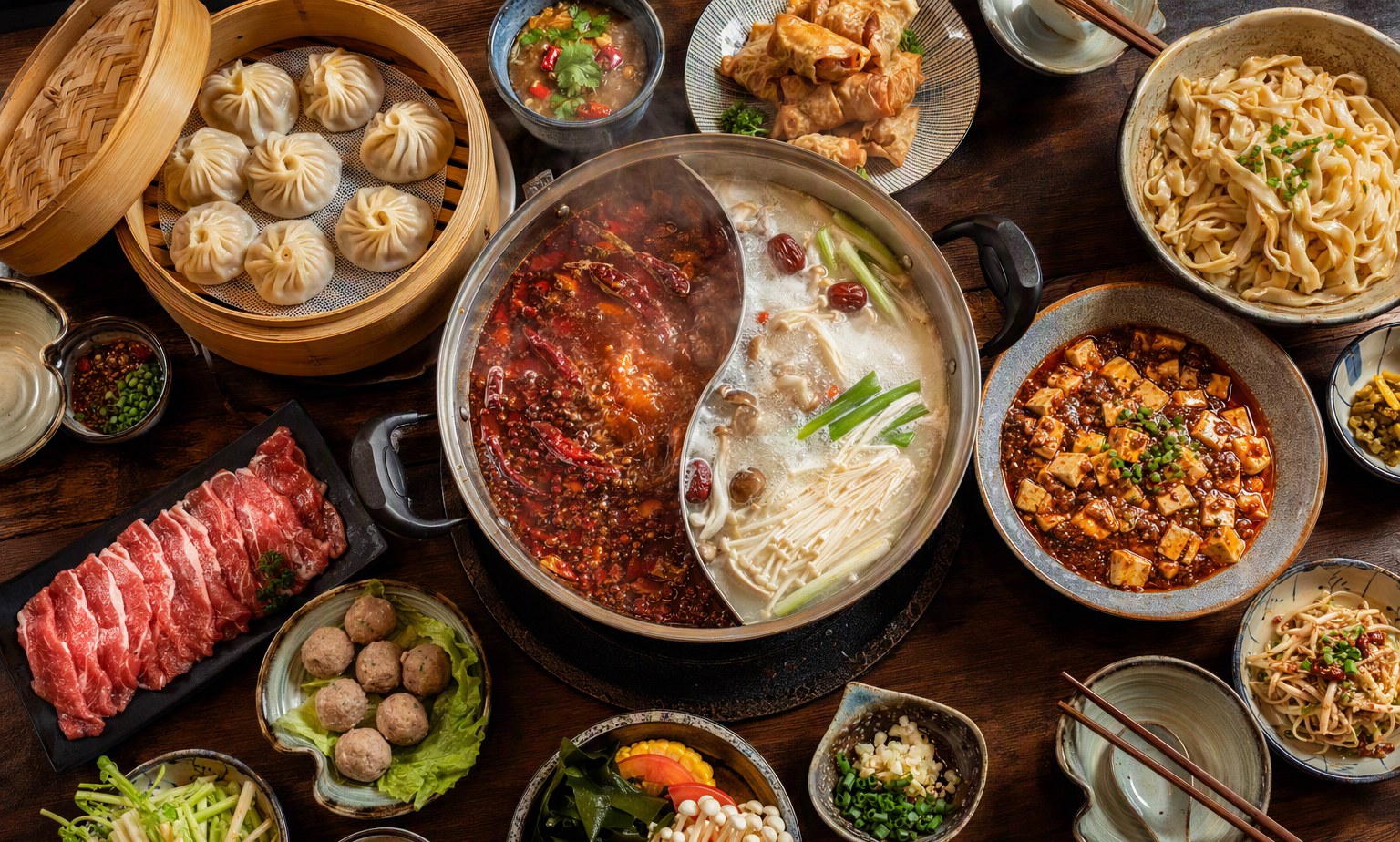
China’s regional cuisines differ so much that a single list can only ever be a starting point, but the 20 dishes below cover the range: banquet classics, street breakfasts, night-market staples and a few things that take nerve on the first bite. What follows is not a ranking. It is a working menu for a trip, grouped by how easy each dish is to find and what it asks of you. Prices, opening hours and seasonal availability change constantly, so treat any specific venue as something to confirm locally rather than a fixed fact.
The icons: dishes worth building a city stop around
Eight dishes anchor most first trips. Peking duck is carved tableside in Beijing, and the ritual matters as much as the meat: crisp skin first, then pancakes with spring onion and sweet bean sauce. Xiaolongbao, the soup dumplings of Shanghai and the wider Jiangnan region, reward a careful bite rather than a quick one. Sichuan hotpot in Chengdu is a social meal built on numbing peppercorns and chilli oil, ordered by choosing broth strength and ingredients rather than a fixed set menu.
In Xi’an, biangbiang noodles are wide, hand-pulled and usually dressed with chilli and vinegar. Guangzhou’s dim sum is a morning affair, ordered from a card or a phone rather than a trolley in many modern restaurants. Lanzhou beef noodles appear in almost every city, which makes them the easiest dish on this list to try without travelling far. Crawfish in garlic is a summer night-market fixture, and jianbing, the savoury breakfast crepe, is sold from street carts in the early morning. For a city-by-city breakdown, see the Xi’an city guide and the Chengdu city guide.
Regional legends: dishes tied to a place
Some dishes only make sense where they come from. Mapo tofu is at its best in Chengdu, where the balance of doubanjiang, peppercorn and silken tofu is a local standard rather than an approximation. Hairy crab is a Shanghai autumn ritual, generally eaten between October and December; check the current season with a restaurant or market before planning around it. Buddha jumps over the wall is a Fuzhou banquet soup with a long ingredient list and a price to match, so ask what is in it before ordering.
Yunnan mushroom hotpot depends on the foraging season and varies by month, so confirm what is available when you arrive. Crossing-the-bridge noodles in Kunming arrive as separate bowls you combine yourself. Xinjiang lamb skewers and naan reflect Uyghur cooking and are widely sold across northern and western cities. Tea-smoked duck is a Sichuan preparation distinct from the Beijing version. If you are travelling with dietary restrictions, the halal and vegetarian food guide covers how to ask and what to expect.
The adventurous five
Stinky tofu is fermented, deep-fried and far milder in taste than in smell; Changsha is often cited as the benchmark. Century egg with tofu is a cold dish of preserved duck egg, usually served with soy and sesame — the texture is the hurdle, not the flavour. Chicken feet are a standard dim sum item, braised and eaten with the fingers. Sea cucumber is a banquet ingredient valued for texture rather than taste. Mooncakes appear around the Mid-Autumn Festival only, so their availability is genuinely seasonal; if you want to try them, plan the trip around the festival rather than expecting them year-round.
How to eat through this list without wasting a trip
Two or three dishes per city is a realistic pace. Breakfast dishes such as jianbing and dim sum belong in the morning, while hotpot, skewers and crawfish suit late evenings. Payment is worth sorting before you arrive: many stalls and small restaurants take QR payments, and the cashless travel guide explains how WeChat Pay and Alipay work for foreign visitors.
Menus are the main practical barrier. Photographing a dish you want and showing the picture works well, and translation tools help with ingredient lists. The language barrier guide covers apps and phrases that hold up in restaurants. If you want to learn a dish rather than just eat it, cooking classes exist in most major cities; check what is included and whether the class is in English before booking.
Turning the list into an itinerary
A food-focused route usually follows the regions: Beijing for duck, Xi’an for noodles, Chengdu and Chongqing for heat, Guangzhou for dim sum, Shanghai for Jiangnan cooking. High-speed rail connects these cities comfortably, and seat classes and onboard food are explained in the rail seat classes guide. Book trains through the official 12306 channel or an agent, and verify current ticket rules rather than relying on older advice.
Frequently asked questions
Do I need to book restaurants in advance?
For popular Peking duck houses and high-end banquet restaurants, reservations are common, especially at weekends and during public holidays. For noodles, dumplings, street food and night markets, walk-in is normal. Where a restaurant takes bookings, the usual route is a phone call or a booking platform in Chinese, so ask your hotel to help if you cannot do it yourself.
Is street food safe to eat?
Stall food is widely eaten and generally fine, but use judgement: choose busy stalls with high turnover, watch food being cooked to order, and be cautious with anything left standing at room temperature. If you have a sensitive stomach, ease in over the first few days. Pharmacies are common in cities, and the healthcare guide for travellers explains what to do if something goes wrong.
Can I eat these dishes as a vegetarian?
Some translate easily, such as mapo tofu (ask for it without minced pork), mushroom hotpot and most vegetable dishes. Others do not: hotpot broths, banquet soups and many noodle bowls use meat stock. Clear communication matters more than the menu description, and it is worth learning the phrase for “no meat” in Chinese before you go.
When is the best time of year for a food trip?
Autumn is popular for hairy crab and comfortable temperatures, while summer brings night markets and crawfish. Mid-Autumn determines when mooncakes appear. Rather than chasing a single best month, match the season to the dishes you care about and confirm current availability locally.
How do I find the authentic version of a dish?
Look for the city or region in the restaurant’s name, expect a short menu focused on one speciality, and check whether locals are eating there at normal mealtimes. Guidebook listings age quickly, so cross-check recent reviews and ask staff at your hotel for a current recommendation.
Treat this list as a framework rather than a checklist to complete. Pick the dishes that match the cities already on your route, leave room for the things you find by accident, and verify anything time-sensitive — seasons, reservations, ticket rules — close to departure rather than months ahead.