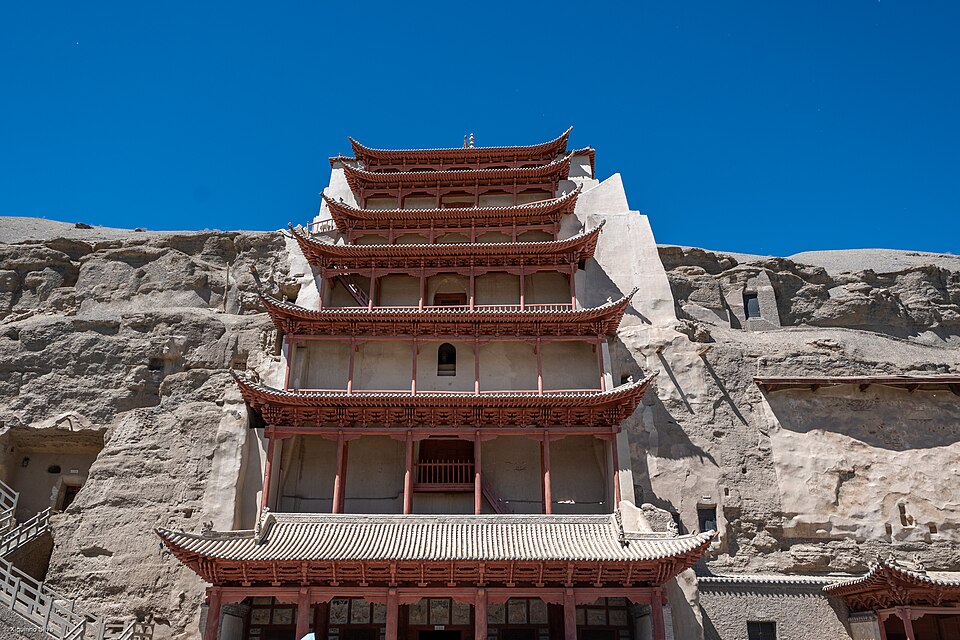
Dunhuang sits at the western edge of the Hexi Corridor, and the Mogao Grottoes sit roughly 25km southeast of the town itself. That distance is short, but the visit involves two separate places: the digital exhibition centre where you watch the introductory films, and the cave site itself, which you reach by dedicated shuttle from the centre. You cannot simply drive to the caves and buy a walk-up ticket. Understanding this two-stage structure is the single most useful thing to know before you plan the day. This guide covers how to get there, how the options compare, how to secure a ticket, and how to combine the caves with the rest of the Dunhuang desert circuit.
Where the Mogao Grottoes actually are
The site lies southeast of Dunhuang town, in the desert cliffs above a dried riverbed. The visitor flow works like this: you arrive at the Mogao digital exhibition centre (the main visitor centre), where booking is checked and the introductory films are shown; from there, shuttle transport runs to the cave area. The whole sequence takes several hours, not the 30 minutes a simple distance figure suggests.
Because the caves are a capped, timed-entry attraction, the constraint on your day is almost never transport. It is ticket availability. Build your itinerary around the ticket session you manage to secure, not the other way round. For general background on how timed reservations work at major Chinese sites, see our guide to booking attractions in China as a foreign visitor.
Option 1: shuttle bus from Dunhuang town
Shuttle services run between Dunhuang town and the visitor centre, generally timed to coincide with ticket sessions. This is the cheapest and least complicated option, and for a solo traveller or a couple it is usually the sensible default. The ride is short and the service is well established.
The practical issue is not the bus. It is that shuttle timings are tied to sessions, so if your ticket is for a late slot you may be waiting around town, and if you are staying outside the town centre you may need a taxi to reach the pickup point. Confirm the current pickup locations, departure times and whether your session is covered before relying on it, and check whether payment is by cash or mobile app. Our guide to cashless payment in China explains how to set up WeChat Pay or Alipay before you travel, which matters in a small city where card acceptance is patchy.
Option 2: private car with driver
Dunhuang’s sights are scattered across open desert, and the distances between them are real. Mogao, the Mingsha dunes and Crescent Lake, and the western line out to Yumen Pass and the Yardang landforms sit 60 to 90 minutes apart in different directions. Public transport does not chain them together in a single day.
A private car with driver is the standard solution for anyone wanting to see more than one site properly. It also removes the timing anxiety: the driver waits, you set the pace, and you are not dependent on a shuttle that runs to someone else’s schedule. For a group of three or four, the per-person cost is often comparable to assembling separate transfers. If you are weighing up whether to build the whole trip around a fixed itinerary or a flexible vehicle, our piece on what an AI travel planner handles well and where it breaks down is a useful reality check on the limits of automated planning for remote areas.
Option 3: combining the caves with the dunes
The classic Dunhuang day pairs a morning cave session with an afternoon and sunset at the Mingsha dunes and Crescent Lake, where camel rides and sand sledding operate and the light turns gold in the last hour. This works because the caves are a morning activity by default and the dunes are best late.
Two cautions. First, dune activities are separately ticketed and sold on site or nearby, so treat them as a distinct purchase rather than something bundled with your cave ticket. Second, the western line to Yumen Pass is a full day on its own and cannot be combined with the caves without cutting both short. Choose one desert day or the other, or allow two days in Dunhuang.
Tickets, timing and the reservation problem
Daily visitor numbers at Mogao are capped, and in high season sessions sell out. The reliable approach is to book well ahead through the official channel and to check, on the official booking page, the current session times, the release window for new dates, and the identification requirements for foreign passports. Do not rely on a number quoted in any third-party article, including this one; caps and session structures change.
On the visit itself: English-language guided tours run at set times, and an audio guide is the alternative if you miss them. Photography is prohibited inside the caves, and staff enforce this. The replica caves at the exhibition centre are a different matter and are generally photographable. Check current rules when you arrive rather than assuming.
When to go and how to reach Dunhuang
April to June and September to October are the most comfortable windows. Mid-summer afternoons regularly exceed 40°C by noon, which makes an afternoon dune visit punishing. Winter is cold and quiet, with better ticket availability.
Dunhuang has its own airport with connections from larger hubs such as Xi’an and Lanzhou, and it is also reachable by rail. Flight and train schedules change seasonally, so verify times and availability on the operator’s own site when you book. If you are arriving by air, arrange your airport transfer in advance; see our notes on airport transfers in China for how pickup arrangements usually work. For the rail side, our train travel guide covers booking and seat classes.
Frequently asked questions
Can I visit the Mogao Grottoes without booking ahead?
In low season there is sometimes same-day availability, but in high season sessions sell out and walk-up entry is not something to count on. Book through the official channel as early as the release window allows, and check that page for current session times and passport requirements.
How long should I allow for the caves?
Plan on several hours door to door, including the films at the visitor centre, shuttle transport to the cave area, the guided visit and the return. Do not schedule a tight onward connection immediately afterwards.
Is the shuttle bus or a private car better?
For a single site and a solo traveller, the shuttle is simpler and cheaper. If you want to combine Mogao with the dunes or the western desert line in one day, a private car with driver is the practical choice because public transport does not link those sites.
Can I take photographs inside the caves?
No. Photography is banned inside the caves themselves. The replica caves and exhibition areas at the visitor centre are generally a different case. Confirm the current policy on arrival.
What should I do if I only have one day in Dunhuang?
Book a morning cave session and spend the late afternoon and sunset at the Mingsha dunes and Crescent Lake. Accept that the western line to Yumen Pass needs its own day.
Dunhuang rewards planning more than most places in China, because the bottleneck is a capped ticket rather than a long journey. Secure your cave session first, then build transport and the rest of the desert circuit around it. If you would rather hand the logistics to someone who works this route regularly, our team can arrange tickets, transfers and sequencing for the Dunhuang sites as part of a wider Silk Road itinerary.