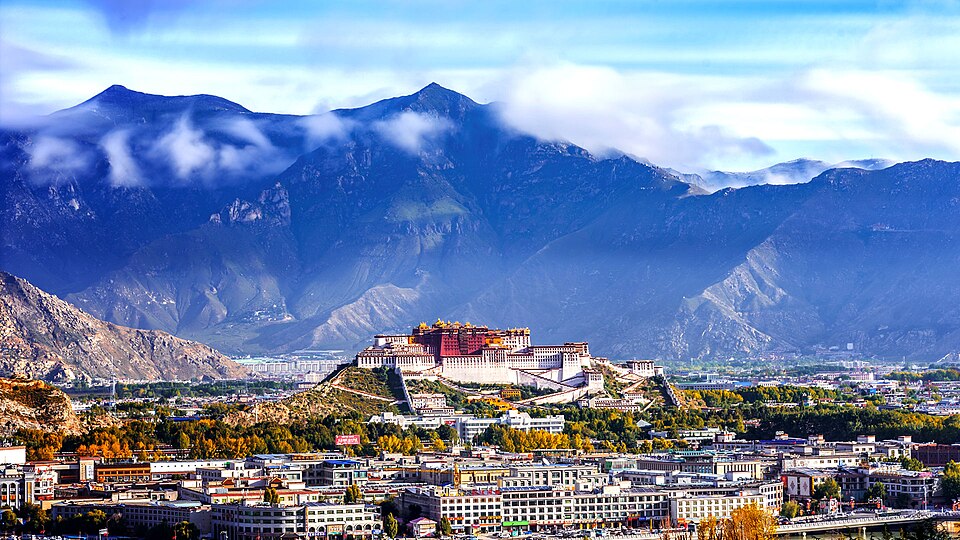
The Potala Palace sits on Red Hill (Marpo Ri) in central Lhasa, and reaching it is not simply a question of transport. For foreign visitors, access is tied to a permit system, a licensed guide, timed entry and altitude acclimatisation. The logistics are part of the safety planning, not an afterthought. This guide sets out the realistic options for getting there, what each one involves, and how to verify the details that change — ticket release rules, permit processing times and entry slots — before you commit to flights. For the wider context of permits and altitude, see our Tibet Travel Guide 2026: Permits, Altitude & Lhasa Planning.
Where the Potala Palace is and why access is controlled
The palace stands in central Lhasa, walkable from the Barkhor and the old town. It is an active heritage site with structural limits on how many people can be inside at once, which is why entry is managed in timed slots rather than as an open ticket. Foreign visitors cannot simply turn up and buy a ticket at the gate. A Tibet Travel Permit, arranged through a licensed operator, is required to enter Tibet at all, and the palace itself is subject to additional booking controls. Rules, quotas and slot-release timings are adjusted periodically, so confirm the current position with your operator or the official palace ticketing channel rather than relying on any figure you read online, including here.
Option 1: walking within Lhasa
If you are already acclimatised and staying in the old town, the palace is a 20–30 minute walk. That is the easy part. The visit itself involves a long climb inside the structure, with several hundred steps at an altitude above 3,600 metres. The ascent is steep in places and the air is thin. Treat the walk to the site as separate from the climb within it, and do not schedule anything demanding for the rest of that day. Anyone with heart or respiratory conditions should discuss the visit with a doctor before travelling.
Option 2: the timed entry system
Entry is organised around allocated time slots, and your passport and permit are checked against the booking. Slots are limited and the booking process for foreign visitors normally runs through your licensed guide or operator rather than directly. Morning slots are popular because of the light and because the pilgrim circuit around the base is busiest early, but availability depends on the day and the season. Ask your operator what slot they can secure, and confirm the current booking procedure, cancellation rules and any photography restrictions at the time of booking, since these are not fixed indefinitely.
Option 3: a guided Tibet tour
For most foreign visitors this is not one option among several — it is the route. Independent travel in Tibet is not permitted for foreign passport holders, so a licensed guide and arranged transport are part of the legal framework, not a convenience. A tour typically bundles permit handling, the guide, a vehicle, and a paced itinerary that builds in acclimatisation days. If you are arriving overland or by rail, our Chengdu to Lhasa by Train: 2026 Tibet Adventure Itinerary covers the rail approach and how to structure the first days.
Acclimatisation and timing
Build in at least two full days in Lhasa before attempting the palace climb. This is the single most useful piece of planning advice for this site. Use the first days for low-effort activity: the Barkhor circuit around the Jokhang, gentle walks, early nights. Save the palace for when your body has adjusted. Photography is not permitted inside the palace; the classic exterior views are from Potala Square, where the reflection pool gives a symmetrical shot, and from Chakpori Hill, particularly towards sunset. For general health preparation and what to do if altitude symptoms appear, see Healthcare in China for Travelers: Pharmacies, Clinics and Insurance (2026).
Permits, paperwork and practical checks
Permit processing takes time and cannot be rushed, so do not book international flights until your operator confirms your permit timeline in writing. You will also need your passport details to match exactly across every booking. Ask your operator to confirm, in writing: the current processing window for your nationality and dates, what the permit covers, whether any additional regional permits apply to your onward route, and what happens if a slot is unavailable on your preferred day. Verify visa and entry requirements through the relevant official channels, not through a tour page — our China Visa Rules 2026: Quick Entry Guide explains where to check.
Frequently asked questions
Can I visit the Potala Palace independently as a foreigner?
No. Foreign passport holders need a Tibet Travel Permit and a licensed guide, and independent travel in Tibet is not permitted. The palace booking is normally handled through your operator as part of that arrangement.
How many days should I allow in Lhasa before the palace visit?
Plan at least two full days at altitude before the climb. The palace involves several hundred steps above 3,600 metres, and the climb is far harder than the walking distance suggests.
How far in advance should I apply for the permit?
Processing windows change, so ask your operator for the current timeframe for your nationality and travel dates and get it confirmed in writing before booking flights. Do not rely on a fixed number quoted on a general page.
Can I take photographs inside the palace?
Photography is not permitted inside. Exterior photography from Potala Square and Chakpori Hill is the usual alternative. Confirm current restrictions with your guide on the day, as site rules can change.
What should I do if I feel unwell at altitude?
Stop, rest and descend if symptoms worsen. Do not push on to the palace climb. Seek medical advice promptly; your guide and hotel can direct you to a clinic in Lhasa.
Getting to the Potala Palace is straightforward once the permit, the guide and the acclimatisation days are in place; the difficulty lies in sequencing them correctly and confirming the current rules rather than assuming last year’s process still applies. Confirm every time-sensitive detail — permit windows, slot release, entry rules — with your operator or the official ticketing channel before you book anything non-refundable.