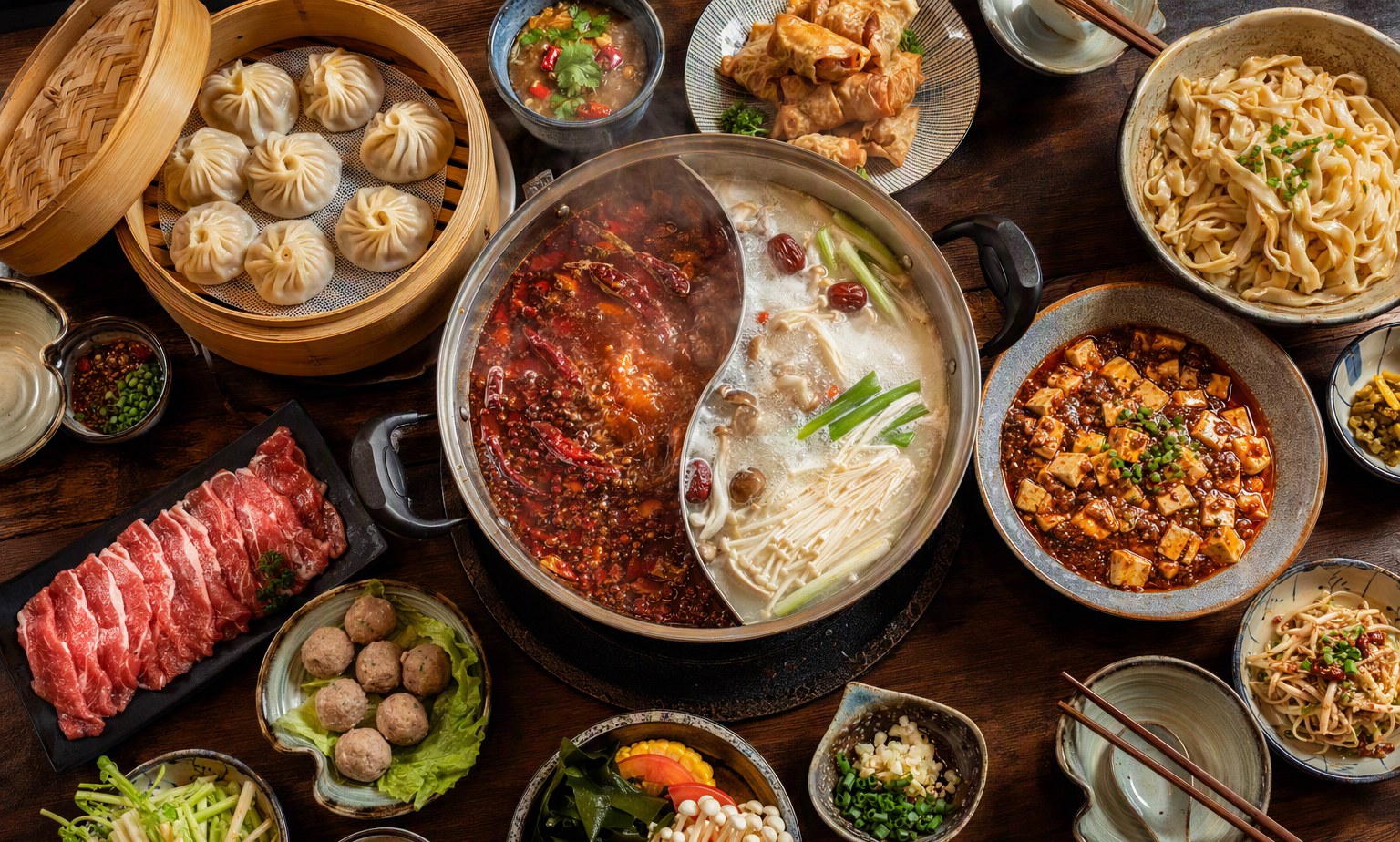
Eating vegetarian in China is easier than most first-time visitors expect, and harder than the phrase “I eat vegetarian” suggests. Buddhist susu restaurants are common, and temple kitchens serve some of the country’s most refined plant-based cooking. The difficulty is the everyday dish: a vegetable stir-fry finished with lard, a tofu plate seasoned with fish sauce, a “vegetable” noodle soup built on chicken stock. None of these are visible on the menu, and none are caught by simply saying “no meat”. This guide explains where the hidden ingredients live, which phrases actually work, and how to plan a trip around the cities with the strongest meat-free scenes.
Why “no meat” is not enough
The standard phrase wo chi su (我吃素, “I eat vegetarian”) is understood almost everywhere and signals a dietary preference rather than a medical restriction. The weaker phrase bu yao rou (不要肉, “no meat”) only removes visible meat; it does nothing about the stock, fat or seasoning underneath. A cook who hears “no meat” will happily serve greens stir-fried in lard, because lard is not meat.
The three recurring problems are animal fat used as a cooking medium, fermented fish sauce or shrimp paste used as a seasoning, and meat or bone stock used as a base. In Cantonese and coastal cooking, oyster sauce and dried shrimp appear in dishes described as vegetable. In the north, lamb fat and bone broth are common. None of this is deception; it is simply how the dish is made, and it is assumed rather than stated.
If your diet is strict, the practical solution is to show a written Chinese sentence rather than rely on speech. Tone and dialect make spoken requests unreliable, and a waiter repeating your phrase back does not confirm they have understood the detail. Our guide to translation apps and essential phrases covers how to prepare and display these cards offline.
Temple and monastery restaurants
Buddhist temple restaurants are the most dependable option in the country. They are fully plant-based by doctrine, so no lard, no fish sauce, no stock, and no need for a negotiation at the table. They are also usually inexpensive and often excellent, because the cooking tradition is old and serious. Hangzhou is the best-known centre, Shanghai has long-established temple dining, and Beijing has a wide spread of monastery-linked and Buddhist restaurants.
Two practical cautions. First, temple restaurants keep religious hours and may close early or on observance days, so check the day you intend to visit rather than assuming a standard restaurant schedule. Second, some temple complexes charge admission separate from the restaurant; confirm both on the site’s own page or by phone before travelling across the city. Note also that a small number of Buddhist kitchens use eggs or dairy in pastries and sweets, so if you are vegan rather than vegetarian, still ask.
Vegan specifics: egg, dairy and honey
Dairy is genuinely rare in Chinese cooking, which works in your favour. Egg is the bigger risk: fried rice is routinely made with egg unless you specify otherwise, and it is often not listed as an ingredient because it is considered part of the dish’s definition. Honey appears in glazes, some sauces and certain pastries. Mayonnaise and cream turn up in modern bakery and cafe food rather than traditional kitchens.
The most reliable approach is a written card stating that you do not eat meat, egg or dairy, in Chinese. A card reading 不含肉蛋奶 (no meat, egg or dairy) covers the essentials, and 不含肉蛋奶及蜂蜜 extends it to honey. Keep it as a screenshot with the text large enough to read across a table, and be prepared to show it more than once. For a broader look at dietary requests including halal options, see our practical guide to halal and vegetarian food in China.
Cities with the strongest meat-free scenes
Shanghai has the widest range, combining international vegan restaurants with old temple kitchens and a large Buddhist dining tradition. Chengdu is the standout for meat-free cooking that imitates meat convincingly, a Sichuan Buddhist speciality, alongside a strong general vegetarian scene. Hangzhou is the temple-cuisine capital and worth planning a meal around rather than fitting in. Beijing has a large and varied spread of Buddhist and vegetarian restaurants across the city. Guangzhou and Xi’an are workable rather than easy, and are covered in our Guangzhou street food guide and Xi’an street food guide, both of which flag which snacks are safe and which are not.
Outside these cities, temple restaurants remain your anchor. In smaller towns, look for the character 素 (su) on signage, and expect a narrower menu.
Ordering in practice
Ask for dishes that are structurally vegetarian rather than adapted: cold vegetable plates, plain steamed greens, plain rice or noodles, and tofu dishes you have confirmed are not seasoned with fish sauce. Avoid mixed dishes where the base is built before you order. At banquets and group meals, tell the organiser in advance rather than the waiter on the night; a set menu is decided long before you sit down.
If you are travelling on a package or food-focused tour, state your requirement in writing at the booking stage, including whether egg and dairy are excluded. A tour that adapts menus in advance will handle this far better than one improvising on the day. Carry your own snacks for long transport days, and check what is served on board in advance via our guide to high-speed rail seat classes and onboard food.
Frequently asked questions
Can I survive as a strict vegan in China?
Yes, in the larger cities and anywhere with a temple restaurant nearby. The risk is not starvation but accidental egg or stock in everyday dishes. Carry a written Chinese card, plan at least one reliable meal per day, and keep backup food for travel days.
Is Buddhist restaurant food always vegan?
Almost always vegetarian, and usually vegan, but not guaranteed. Some kitchens use egg or dairy in pastries and desserts. If you are vegan, show your card even in a temple restaurant.
Do I need to book temple restaurants in advance?
Some take reservations and some do not, and opening days vary with the religious calendar. Check the specific restaurant’s own page or call ahead on the day you plan to visit rather than relying on a listing.
How do I explain a vegetarian diet without speaking Chinese?
Use a written card in Chinese and show it before ordering. Screenshot it so it works without a data connection. Translation apps help, but a fixed card removes the risk of a mistranslation at the table.
Will a food tour accommodate a vegetarian or vegan diet?
Many will if you state the requirement in writing when booking, including whether egg, dairy and honey are excluded. Confirm before you pay, and ask what happens if a planned stop has no suitable option.
Vegetarian travel in China rewards preparation more than vocabulary. Learn one reliable written card, build each day around a temple restaurant or a known vegetarian kitchen, and treat everything else as a bonus rather than the plan. Verify opening days, reservation requirements and any admission charges on the restaurant’s or site’s own page before you travel, since these change with the religious calendar and the season.