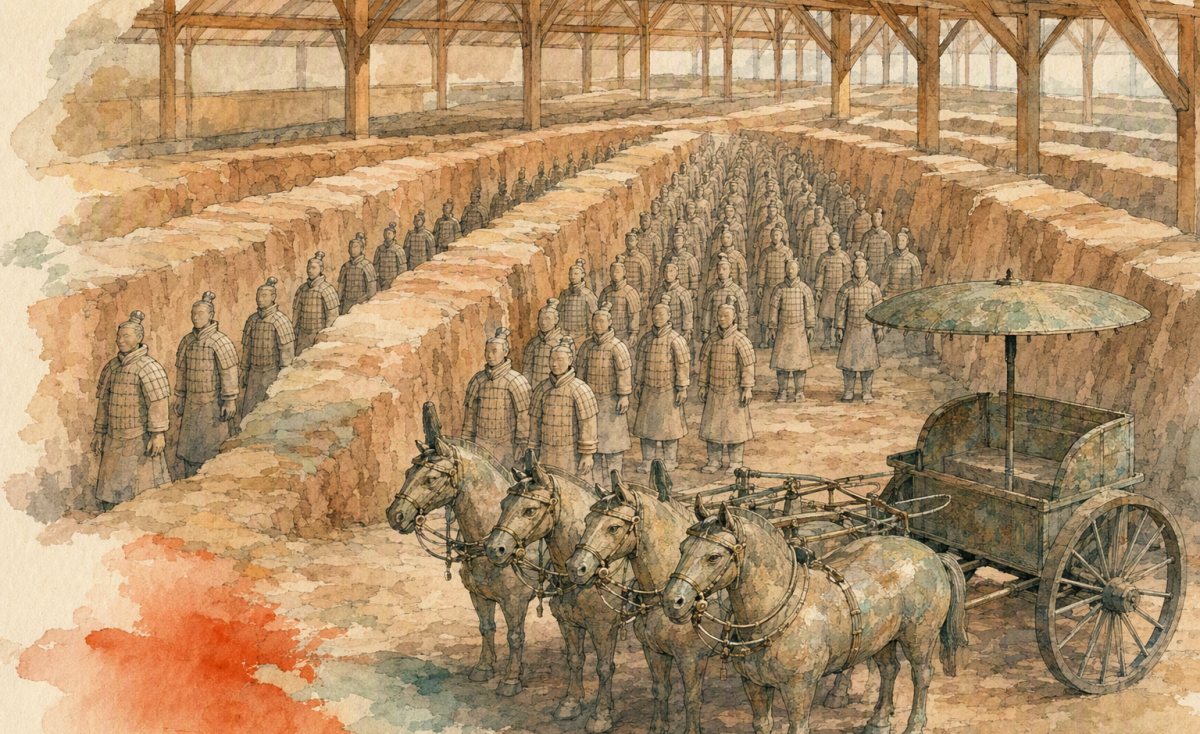
Most visitors see the Terracotta Warriors as a half-day stop on the way to somewhere else. That works, but it undersells the site: the museum is spread across three pits and a bronze chariot hall, and the surrounding Lintong district holds a second excavation museum most tours skip. This guide covers what a Terracotta Warriors tour from Xi’an actually involves, how to time your visit around the crowds, how to get there, and how to build a two-day Xi’an plan around it. It is written for independent travellers who may or may not book a guided service.
Where the site is and what you are visiting
The museum sits roughly 35–40 km east of central Xi’an in Lintong district, close to the mausoleum of Qin Shi Huang. The three pits are covered by hangar-like halls. Pit 1 is the largest and the one in most photographs; Pit 2 contains largely unexcavated ground with cavalry and archer figures; Pit 3 is small and appears to be a command post. A separate hall displays two bronze chariots and horses. Signage is in Chinese and English, and the on-site exhibition labels explain the excavation sequence reasonably well, but the site rewards context — either a guide, an audio guide, or reading up beforehand.
Opening hours, last admission and any seasonal closures change through the year and around public holidays. Check the museum’s own page or the official ticketing channel before you travel, and look specifically for the current entry window, the last-admission time, and whether same-day tickets are released. Do not rely on a number quoted in a blog post, including this one.
Timing your visit around the crowds
The site draws large domestic tour groups, and the pattern is fairly predictable: coaches arrive mid-morning, and the middle of the day is the busiest stretch. Arriving at opening gives you a quieter Pit 1 and better photographs. Late afternoon is the second-best window, though you need to confirm the last-admission time first.
Budget around three hours inside the gates if you want to read the panels, see all three pits and the bronze chariot hall, and walk between buildings. Add time for the shuttle bus between the ticket gate and the pit entrances, and for the walk out. A rushed 90-minute visit is possible but you will spend most of it in Pit 1.
Weekends, Chinese public holidays and the summer school-break period are significantly busier. If your dates are flexible, a weekday outside holiday periods makes a noticeable difference.
Tickets, guides and what to verify
Tickets for the museum are generally sold through official channels, and booking ahead is sensible in peak season. Because ticketing systems, ID requirements and release timings change, verify on the official site or the museum’s own booking page: look for the booking window (how many days ahead tickets open), whether a passport number is required per visitor, and whether entry is timed.
Guided tours vary widely. A good guide explains the excavation history, the differences between the pits, and the conservation problems — pigment loss, humidity, and why large areas remain unexcavated. A poor one recites dates. Ask any operator directly: how long is the guided portion, is the guide licensed, does the price include the museum ticket, and is the transfer private or shared. If a tour advertises “skip the line”, ask what that means in practice, since all visitors pass through the same security and ticket check.
If you are assembling your own itinerary rather than buying a package, an AI planner can draft the shape of a trip but tends to invent opening hours and travel times. Our notes on using AI for a China itinerary without invented opening hours explain where that breaks down.
Getting there from Xi’an
Options are a private car or taxi, a public bus from Xi’an railway station, or the metro plus a local connection. A private car is the simplest if you are combining the Warriors with Hanyangling or Mount Hua in one day, because those sites are not adjacent and public transport between them is slow. Public buses are cheaper but you are tied to their schedule.
If you are arriving by rail, Xi’an is well connected: high-speed services run from Beijing and Shanghai, among other cities. Booking, passport rules and app options for Chinese trains are covered in our China train travel guide. Note that Xi’an has more than one station, and they are not close to each other — check which one your train uses before arranging a pickup.
Within the city, the metro is fast and cheap. See the China metro guide for how payment and gates work.
A two-day Xi’an plan built around the Warriors
Day one: Terracotta Warriors in the morning, arriving at opening. In the afternoon, Hanyangling (the Han Yang Ling mausoleum site) if you want a second, quieter archaeological stop, then return to the city for an evening in the Muslim Quarter. Our Xi’an street food guide covers what to eat there without wasting meals.
Day two: the city wall in the morning, ideally early, then the Big Wild Goose Pagoda area, then the Shaanxi History Museum if you can get a slot — it is free but requires advance booking and fills quickly. The wall is a full circuit if you hire a bike; check current hire rates and deposit rules on site rather than trusting an old figure.
Beyond the Warriors
Mount Hua is a long day trip west of the city and needs an early start and a weather check. A Tang-dynasty dinner show with a dumpling banquet is an easy evening option in the city. For a wider look at what Xi’an offers, including transport and neighbourhoods, see the Xi’an city guide.
Frequently asked questions
How long do you need at the Terracotta Warriors?
Plan around three hours inside the site to see Pits 1, 2 and 3 plus the bronze chariot hall at a reasonable pace, and add travel time from Xi’an — roughly an hour each way depending on traffic and your mode of transport.
Should you book a tour or go independently?
Independently is entirely workable; the site is well signed and reachable by public transport. A guide adds most value if you want the excavation history and conservation context explained. If you book one, confirm whether the museum ticket and transfer are included.
What is the quietest time to visit?
Arriving at opening is the most reliable way to avoid the mid-morning tour-group peak. Weekdays outside Chinese public holidays and school breaks are noticeably calmer. Confirm current opening and last-admission times on the museum’s official channel before you go.
Can you combine the Warriors with other sights in one day?
Yes, but keep it to one addition. Hanyangling pairs well because it is in the same direction. Mount Hua does not combine comfortably with the museum — treat it as its own day.
Do you need to show ID to enter?
Chinese museums commonly require passport or ID registration, and ticketing rules change. Check the museum’s official booking page for what identification is required and whether entry is timed.
Treat every figure in this guide as something to confirm rather than assume: opening hours, ticket release windows, train times and transport prices all move. Verify on the operator’s or museum’s own page, then build your day around the confirmed details.
[…] it together: pair the eating with the Xi’an Terracotta Warriors and 2-day itinerary, and sort your phone data before you fly — China travel eSIM plans activate the moment you […]
[…] Book a private Terracotta Warriors tour […]