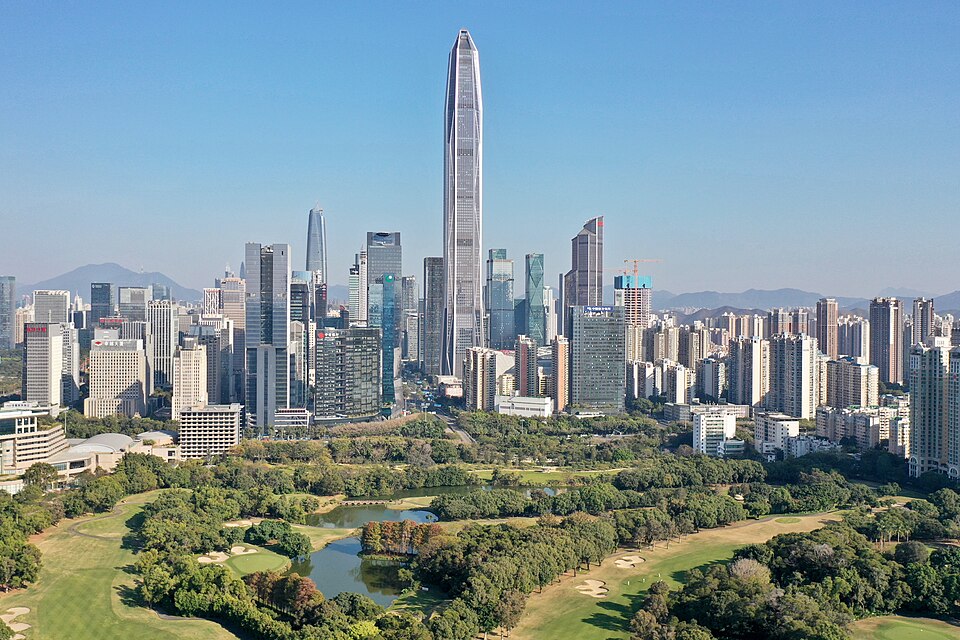
Shenzhen is often described as China’s Silicon Valley, but that undersells it as a place to visit. Forty years ago it was a fishing town on the Hong Kong border; today it is a subtropical metropolis of roughly 17 million people, with a skyline of supertalls, a working art scene in converted factories, city beaches on its east coast, and a location that makes it the easiest entry point between Hong Kong and the mainland. It is also one of the most convenient cities in China for a first-time visitor: the metro is signed in English, distances are short, and much of what is worth seeing sits within a few stops of a station.
What to see in Shenzhen
Start with the Ping An Finance Centre observation deck, which gives the widest view in South China; on a clear day the New Territories of Hong Kong are visible across the bay. Deck access is ticketed and sometimes closed for weather or private events, so check the tower’s own booking page for the day you plan to go rather than trusting an old price or timetable.
OCT-LOFT, in Nanshan, is a former factory compound turned gallery, bookstore and coffee district. It is the most walkable part of the city and the best place to spend a slow afternoon. Dafen Oil Painting Village in Longgang is a different kind of art stop: workshops producing everything from replica Van Goghs to commissioned portraits, useful if you want a souvenir that is not a fridge magnet. Bring a photo if you want a portrait done, and agree the price and the delivery date in writing before work starts.
On the east coast, Dameisha and Xiaomeisha are the city’s main beaches, reachable from downtown in around 40 minutes depending on traffic and your starting point. They are public and free to enter, but swimming depends on season, water quality notices and lifeguard cover, so check locally on the day. Closer in, Shenzhen Talent Park and the Shenzhen Bay promenade are the standard evening walk or bike ride, with the skyline lit across the water. Bike rental is app-based and requires a Chinese payment method; see our guide to China Cashless Travel Guide: WeChat Pay & Alipay 2026 for how that works in practice.
Window of the World and Splendid China are miniature-landmark theme parks. They are unashamedly kitsch and genuinely good with children. Opening hours and ticket tiers change with season and holidays, so verify on the park’s official page before you commit a day.
Where to eat
Shenzhen has almost no native cuisine of its own, because almost everyone here came from somewhere else. That is the advantage: Cantonese dim sum in Shekou, Hunan and Sichuan cooking around Huaqiangbei, northeastern dumplings and noodles in the older parts of Luohu, and late-night seafood along the Shenzhen Bay side. Dongmen in Luohu is the classic grazing street, busy and cheap. For regional comparison, our Guangzhou Street Food Guide: 16 Must-Try Bites in 2026 covers the Cantonese cooking an hour up the rail line. If you keep halal or vegetarian, read the Halal and Vegetarian Food in China: A Practical Guide (2026) before you arrive, since labelling is not always obvious.
How many days do you need
Two full days cover the core: one for the city (Ping An, OCT-LOFT, the bay), one for Dafen plus a theme park or the east-coast beaches. Four days lets you add a proper beach day and a side trip without rushing. Shenzhen is also a strong base for day trips by high-speed rail; Guangzhou is close enough for a morning, and longer routes reach Guilin and Changsha. Seat classes, luggage rules and onboard food vary by train type, so read China High-Speed Rail Seat Classes and Onboard Food (2026) before choosing. Book on the official 12306 channel or a licensed agent, and check the timetable for your date rather than relying on any figure quoted elsewhere.
Getting there and getting around
Shenzhen Bao’an International Airport (SZX) handles the flights; the other common arrival is by high-speed rail from Hong Kong West Kowloon, a very short hop once you clear border formalities. Note that entry rules, visa-free transit eligibility and the documents you need depend on your nationality and route, and they change; confirm on the official immigration or embassy page for your passport before booking. Our China Visa-Free Transit: 240-Hour Guide 2026 explains how the transit scheme is structured and what to check.
Within the city, the metro is clean, cheap and signed in English, and most of the sights above are a short walk from a station. Buy a single-journey ticket from the machines or use the metro app; both are covered in the China Metro Guide: How to Ride in 2026. Taxis and ride-hailing are plentiful but slower at peak times.
When to go
October to April is the dry, mild stretch and the most comfortable time to walk the city. Summer is hot, humid and in the typhoon season, which is precisely why hotel rates soften; if you travel then, build slack into your plans for cancelled ferries and delayed flights. Chinese public holidays, especially the Lunar New Year and the first week of October, fill beaches and theme parks — check the calendar before you fix dates.
Frequently asked questions
Is Shenzhen worth visiting if I am mainly going to Hong Kong?
Yes, if you have a spare day or two. The cross-border high-speed rail link is quick, and the city offers a completely different texture from Hong Kong: wider roads, newer buildings, cheaper food and a metro that is easy to navigate without Chinese. Treat it as a two-day add-on rather than a replacement.
Can I visit Shenzhen without speaking Chinese?
Largely yes. Signage on the metro and in malls is bilingual, and translation apps handle the rest. Restaurant menus in migrant neighbourhoods are less predictable, so having a few phrases and a translation app ready helps. See The Language Barrier in China: Translation Apps and Essential Phrases.
Do I need to book attractions in advance?
Some do require it, particularly around holidays, and the process often runs through a Chinese mini-program or official WeChat account. The rules differ by site and change over time, so check the individual attraction’s own page. Our overview of Booking Attractions in China 2026: Reservations Foreigners Actually Need explains the pattern.
How do I pay for things in Shenzhen?
Mobile payment dominates, and foreign cards can often be linked to the major wallets, but support depends on your bank and card type. Carry a small amount of cash as backup and verify the current setup before you fly rather than assuming either cash or card alone will work everywhere.
Is the internet the same as in Hong Kong?
No. Cross-border data behaves differently, and which apps and services work depends on your SIM, roaming arrangement or eSIM. Test your setup before departure and read Internet Access in China: Wi-Fi, eSIM and Roaming Explained so you are not troubleshooting at the airport.
Shenzhen rewards a loose plan: pick two or three anchors, leave room for a long lunch and an evening on the bay, and confirm every time-sensitive detail — tickets, opening days, train times, entry rules — on the operator’s own page close to your travel date. That habit matters more here than in almost any other Chinese city, because things change fast.