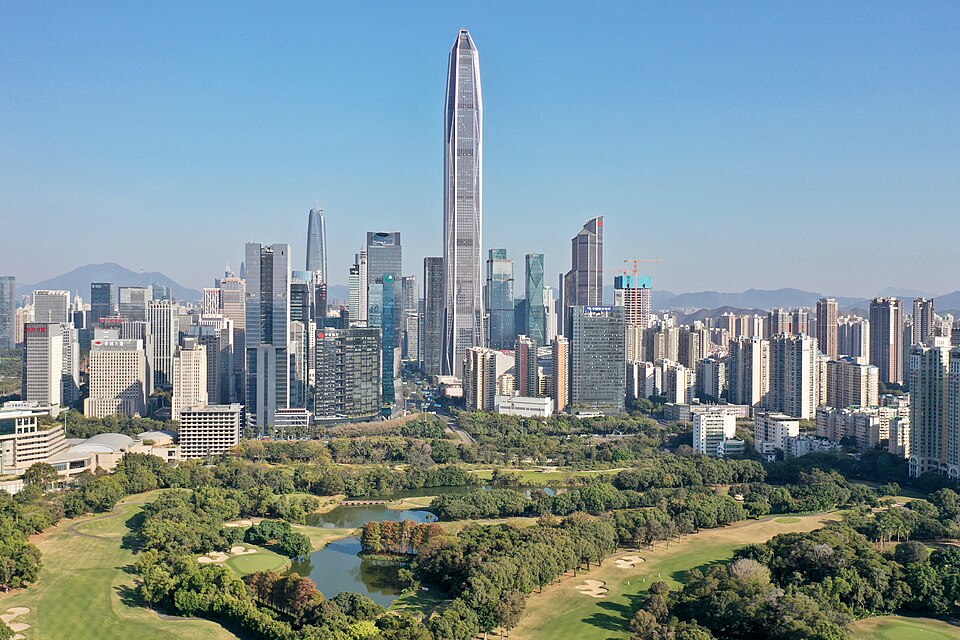
Shenzhen is often described as China’s Silicon Valley, but that undersells it as a place to visit. Forty years ago it was a fishing town on the Hong Kong border; today it is a subtropical metropolis of roughly 17 million people, with a skyline of supertalls, a working art scene in converted factories, city beaches on its east coast, and a location that makes it the easiest entry point between Hong Kong and the mainland. It is also one of the most convenient cities in China for a first-time visitor: the metro is signed in English, distances are short, and much of what is worth seeing sits within a few stops of a station.
What to see in Shenzhen
Start with the Ping An Finance Centre observation deck, which gives the widest view in South China; on a clear day the New Territories of Hong Kong are visible across the bay. Deck access is ticketed and sometimes closed for weather or private events, so check the tower’s own booking page for the day you plan to go rather than trusting an old price or timetable.
OCT-LOFT, in Nanshan, is a former factory compound turned gallery, bookstore and coffee district. It is the most walkable part of the city and the best place to spend a slow afternoon. Dafen Oil Painting Village in Longgang is a different kind of art stop: workshops producing everything from replica Van Goghs to commissioned portraits, useful if you want a souvenir that is not a fridge magnet. Bring a photo if you want a portrait done, and agree the price and the delivery date in writing before work starts.
On the east coast, Dameisha e la nostra Xiaomeisha are the city’s main beaches, reachable from downtown in around 40 minutes depending on traffic and your starting point. They are public and free to enter, but swimming depends on season, water quality notices and lifeguard cover, so check locally on the day. Closer in, Shenzhen Talent Park e la Shenzhen Bay promenade are the standard evening walk or bike ride, with the skyline lit across the water. Bike rental is app-based and requires a Chinese payment method; see our guide to Guida al viaggio cashless in Cina 2026: WeChat Pay e Alipay for how that works in practice.
Window of the World e la nostra Splendid China are miniature-landmark theme parks. They are unashamedly kitsch and genuinely good with children. Opening hours and ticket tiers change with season and holidays, so verify on the park’s official page before you commit a day.
Where to eat
Shenzhen has almost no native cuisine of its own, because almost everyone here came from somewhere else. That is the advantage: Cantonese dim sum in Shekou, Hunan and Sichuan cooking around Huaqiangbei, northeastern dumplings and noodles in the older parts of Luohu, and late-night seafood along the Shenzhen Bay side. Dongmen in Luohu is the classic grazing street, busy and cheap. For regional comparison, our Guida al cibo di strada di Guangzhou: 16 specialità imperdibili nel 2026 covers the Cantonese cooking an hour up the rail line. If you keep halal or vegetarian, read the Cibo halal e vegetariano in Cina: una guida pratica (2026) before you arrive, since labelling is not always obvious.
How many days do you need
Two full days cover the core: one for the city (Ping An, OCT-LOFT, the bay), one for Dafen plus a theme park or the east-coast beaches. Four days lets you add a proper beach day and a side trip without rushing. Shenzhen is also a strong base for day trips by treno ad alta velocità; Guangzhou is close enough for a morning, and longer routes reach Guilin and Changsha. Seat classes, luggage rules and onboard food vary by train type, so read Classi di posti e cibo a bordo dei treni ad alta velocità cinesi (2026) before choosing. Book on the official 12306 channel or a licensed agent, and check the timetable for your date rather than relying on any figure quoted elsewhere.
Come arrivare e muoversi
Shenzhen Bao’an International Airport (SZX) handles the flights; the other common arrival is by high-speed rail from Hong Kong West Kowloon, a very short hop once you clear border formalities. Note that entry rules, senza visto per 240 ore eligibility and the documents you need depend on your nationality and route, and they change; confirm on the official immigration or embassy page for your passport before booking. Our Transito senza visto in Cina: Guida alle 240 ore 2026 explains how the transit scheme is structured and what to check.
Within the city, the metro is clean, cheap and signed in English, and most of the sights above are a short walk from a station. Buy a single-journey ticket from the machines or use the metro app; both are covered in the Guida alle metropolitane cinesi: come muoversi nel 2026. Taxis and ride-hailing are plentiful but slower at peak times.
Quando andare
October to April is the dry, mild stretch and the most comfortable time to walk the city. Summer is hot, humid and in the typhoon season, which is precisely why hotel rates soften; if you travel then, build slack into your plans for cancelled ferries and delayed flights. Chinese public holidays, especially the Lunar New Year and the first week of October, fill beaches and theme parks — check the calendar before you fix dates.
Domande frequenti
Is Shenzhen worth visiting if I am mainly going to Hong Kong?
Yes, if you have a spare day or two. The cross-border high-speed rail link is quick, and the city offers a completely different texture from Hong Kong: wider roads, newer buildings, cheaper food and a metro that is easy to navigate without Chinese. Treat it as a two-day add-on rather than a replacement.
Can I visit Shenzhen without speaking Chinese?
Largely yes. Signage on the metro and in malls is bilingual, and translation apps handle the rest. Restaurant menus in migrant neighbourhoods are less predictable, so having a few phrases and a translation app ready helps. See La barriera linguistica in Cina: app di traduzione e frasi essenziali.
Devo prenotare le attrazioni in anticipo?
Some do require it, particularly around holidays, and the process often runs through a Chinese mini-program or official WeChat account. The rules differ by site and change over time, so check the individual attraction’s own page. Our overview of Booking Attractions in China 2026: Reservations Foreigners Actually Need explains the pattern.
Come posso pagare le cose a Shenzhen?
I pagamenti mobili dominano il mercato e spesso è possibile collegare carte estere ai principali portafogli digitali, ma la compatibilità dipende dalla vostra banca e dal tipo di carta. Portate con voi una piccola somma in contanti come riserva e verificate l’attuale configurazione prima della partenza, invece di dare per scontato che funzionino ovunque solo contanti o solo carte.
Internet è lo stesso di Hong Kong?
No. I dati transfrontalieri si comportano in modo diverso e la disponibilità di app e servizi dipende dalla vostra SIM, dall’accordo di roaming o dall’eSIM. Testate la vostra configurazione prima della partenza e leggete Accesso a Internet in Cina: Wi-Fi, eSIM e roaming spiegati per evitare di dover risolvere problemi all’aeroporto.
A Shenzhen conviene viaggiare con un piano flessibile: scegliete due o tre tappe principali, lasciate spazio per un pranzo lungo e una serata sul lungomare, e confermate ogni dettaglio legato al tempo — biglietti, giorni di apertura, orari dei treni, regole d’ingresso — direttamente sulla pagina ufficiale dell’operatore poco prima della data del vostro viaggio. Questa abitudine è più importante qui che in quasi qualsiasi altra città cinese, perché le cose cambiano molto velocemente.