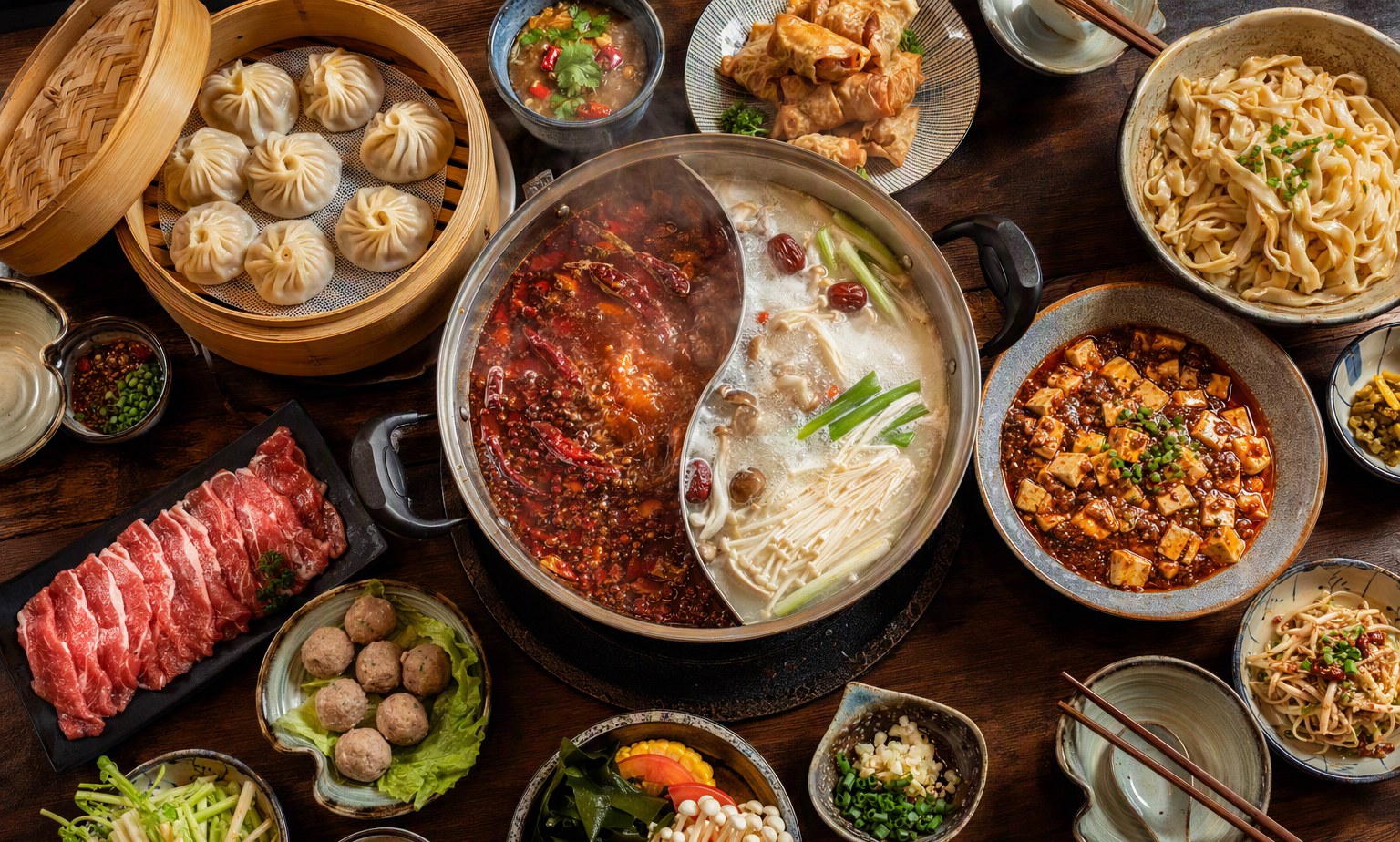
“Chinese food” abroad is a pale shadow of the real thing — a continent of eight great cuisines, thousands of regional dishes, and a street-food scene with no equivalent. Here’s the first-timer’s field guide.
The Regional Big Eight (And What to Order)
- Beijing: Peking duck (carved tableside, wrapped with hoisin and scallion), zhajiang noodles, jianbing egg crepes for breakfast, “hutong” lamb skewers.
- Sichuan/Chongqing: hotpot (numbing Sichuan peppercorn + chili oil — order the split “yuanyang” pot for a mild side), mapo tofu, dan dan noodles, wontons in chili oil.
- Cantonese (Guangzhou/HK): dim sum mornings — har gow shrimp dumplings, char siu bao barbecue pork buns, rice-noodle rolls; roast goose; congee.
- Shanghai/Jiangnan: xiaolongbao soup dumplings (nibble the skin, slurp the broth), red-braised pork, hairy crab in autumn, scallion oil noodles.
- Xi’an: Muslim Quarter’s roujiamo (“Chinese burger”), hand-pulled biangbiang noodles, lamb paomo soup, cold-skin liangpi.
- Yunnan: crossing-the-bridge rice noodles, grilled goat cheese, mushroom hotpot in summer, flower cakes.
- Hunan: hotter-and-prouder cousin of Sichuan — steamed fish with chopped chili, stinky tofu (better than it smells, truly).
- Fujian: Buddha Jumps Over the Wall (luxury slow-cooked soup), oyster omelets, supreme soup culture.
Spice Survival
“Mild” in Sichuan means “Western hot.” Learn “bú là” (不辣, “not spicy”) and “wēi là” (微辣, “mildly spicy”) — and point at them on your translation app. Sichuan peppercorns don’t add heat; they add a citrusy numbness (má). Milk beats water for chili emergencies. Every region has non-spine-tingling classics; spice is optional, not mandatory.
How Ordering Actually Works
Restaurants give you a paper menu to tick dishes — often with pictures. Point at what neighboring tables eat; it works. Dishes arrive as ready and are shared — order one dish per person plus one extra, rice as anchor. Lazy Susans are standard at round tables. Tea is usually free; napkins sometimes cost ¥1. Menus without pictures: your translation camera is your friend.
Street Food Rules
Busy stall = fresh oil = safe food. The queue is the review score. Breakfast streets and night markets are the two great arenas: jianbing (crepe), baozi (steamed buns), chuanr (skewers), stinky tofu, tanghulu (candied hawthorn). Bring small bills or Alipay. If a stall looks sleepy at lunch, skip it.
Eating With Your Guide = Eating Deeper
Menus hide the good stuff; locals order off-menu. Our food-forward tours include driver-guides who translate, order regional specialties you’d never find, and steer you to the stall their families actually eat at. Vegetarian, halal (excellent in Xi’an!) and allergy needs: tell us once, handled everywhere.
Drinks & Digestifs
Beer (Tsingtao, local craft everywhere now) is cheap and everywhere at meals. Baijiu is the nuclear option — toast with it, sip politely. Tea culture is the soul: Longjing greens in Hangzhou, pu-erh in Yunnan, jasmine with Cantonese meals. Bring some home from our tea collection — properly sourced, unlike airport “tea.”
The Five Dishes to Prioritize
If you only have two weeks: Peking duck in Beijing, soup dumplings in Shanghai, dim sum in Guangzhou or HK, hotpot in Chengdu, and the Muslim Quarter in Xi’an at night. That’s the pilgrimage. Everything else is glorious gravy.