Posted on — Leave a comment

Guilin to Yangshuo: Li River Cruise Complete Guide

The Li River runs roughly 83 kilometres from Guilin to Yangshuo, and the karst scenery along it is the image most people carry of southern China before they arrive. The practical question is not whether to see it but how: the full cruise and the short bamboo raft cover different water, suit different schedules and produce very different photographs. This guide sets out the options, the viewpoints worth building a day around, and the logistics that decide whether the trip runs smoothly.

The full cruise from Guilin to Yangshuo

The classic cruise departs from Zhujiang Wharf, usually mid-morning, and reaches Yangshuo in the early afternoon. It covers the whole navigable stretch, so you pass the well-known formations in sequence: Nine Horses Fresco Hill, Yellow Cloth Shoal near Xingping, and the long bend of peaks that appears on the twenty-yuan note.

Boarding arrangements, departure times, wharf names and what is included in the fare change by season and by operator, and third-party booking sites often carry stale information. Before you commit, check the current departure point and reporting time on the operator’s own page or at your hotel’s tour desk, and confirm whether lunch and the transfer from central Guilin to the wharf are part of the ticket or charged separately. Ask specifically what time you must be at the wharf, since it sits well outside the city and the transfer is not always included.

The trade-off is light. A mid-morning departure puts the best-known scenery in front of you around midday, when the sun is high and the haze flattens the layers between peaks. If photography is the priority, the cruise is a comfortable overview rather than the best shooting window.

The Yangdi to Xingping bamboo raft

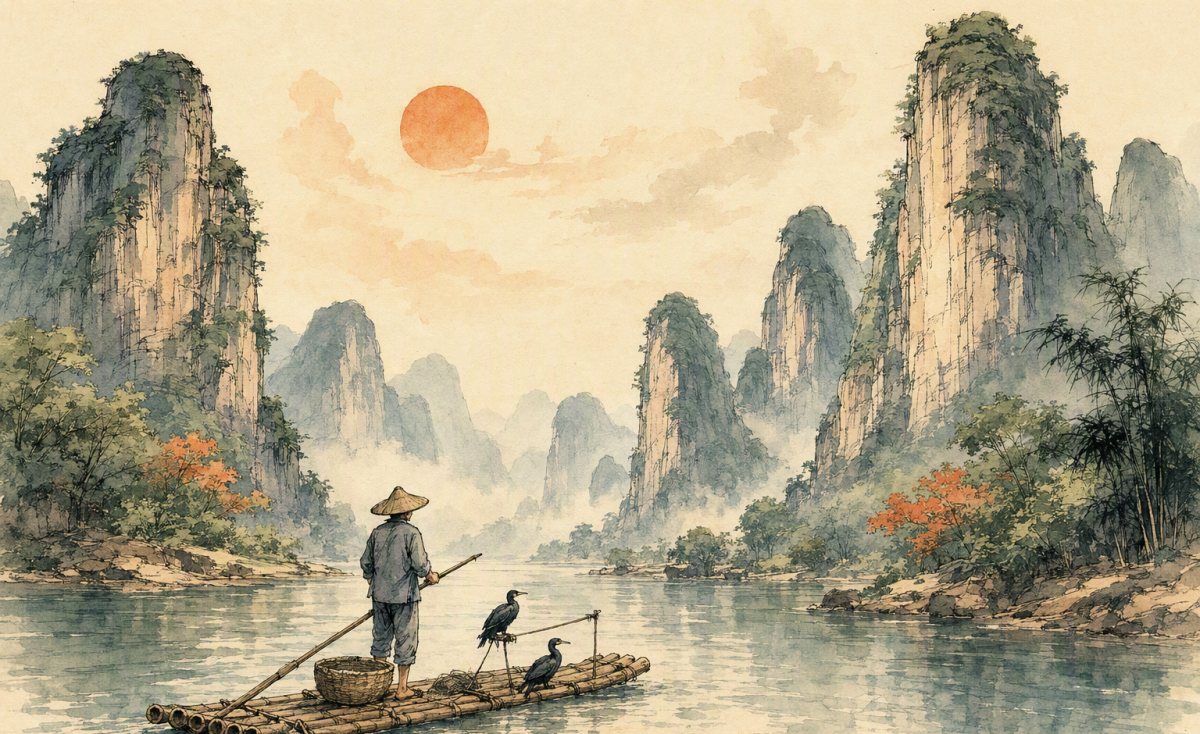
The motorised bamboo rafts cover the Yangdi–Xingping section, which holds the densest concentration of the scenery the full cruise passes through. The rafts are small, open and low to the water, which puts you closer to reflections and lets you change position as the river bends. The ride itself is short — plan on an hour and a half or so on the water — and rafts typically leave through the day rather than on a fixed timetable.

Because the section ends at Xingping, it pairs naturally with time in the old town and with the riverbank that frames the twenty-yuan view. This is the better choice if you are short on time, travelling with a camera, or based in Yangshuo rather than Guilin.

Operating hours, last departures and whether rafts run at all depend on water levels and weather, and services are suspended after heavy rain. Confirm on the day rather than assuming a schedule, and treat any published times as indicative. Life jackets are standard; expect to get slightly wet.

Where to shoot: Xingping, Xianggong Mountain and the Yulong River

Xianggong Mountain, above Xingping, is the classic elevated view over the river’s great bend. The climb takes around twenty minutes and the reward is a sunrise panorama with mist sitting in the valleys between peaks. You need to be on the summit before first light, which in practice means arranging a driver the night before — there is no convenient public transport at that hour.

Xingping old town keeps a compact grid of older streets without Yangshuo’s commercial intensity, and the riverbank just outside it is the twenty-yuan-note composition. It is a short walk from where the rafts finish.

The Yulong River, south of Yangshuo, is a different experience: pole-propelled rafts through farmland and gentler karst, quieter and slower than the main river. It is the better half-day if you want countryside rather than spectacle.

Bring both a wide-angle and a telephoto. The wide lens handles the river bends; the telephoto compresses the layered ridges, which is what makes misty mornings work. A light tripod is useful at dawn but not essential on the rafts.

Timing, seasons and booking

In high season, book the full cruise at least a day ahead, and further out around public holidays. Rafts are more flexible but still sell out on busy mornings. December to February is the quiet season: cold, often misty, and photogenic in a way the summer months are not, though you should expect some services to run reduced schedules.

For payment, transport and connectivity around Guilin, the China cashless travel guide covers how WeChat Pay and Alipay work for foreign cards, and the China eSIM setup guide explains how to get data working before you land, which matters when you are confirming a dawn pickup by message.

Building the river into a wider trip

The river works best as the centre of a two- or three-day Guilin module rather than a single excursion. A workable shape: one day for the cruise or raft plus Xingping, one dawn for Xianggong Mountain, one day cycling the Yulong valley or heading out to the Longji rice terraces. A detailed day-by-day version is set out in this Guilin to Yangshuo three-day itinerary.

If you are assembling a longer route, the wider Li River cruise guide covers the cruise in more depth, and a general China travel starter guide is useful for the surrounding logistics. For onward planning, train connections and tickets are covered in the China train travel guide.

Frequently asked questions

Is the full cruise or the bamboo raft better for photography?

The raft, generally. It covers the strongest section of scenery, sits low on the water and gives you freedom to move. The cruise is comfortable and comprehensive but puts the headline views in front of you around midday, when light is harshest. If you want the best images, combine a raft with a dawn trip up Xianggong Mountain.

How far ahead should I book?

At least a day ahead in high season, and earlier around national holidays. Raft places are usually easier to secure but still fill on busy mornings. Rather than relying on a fixed figure, check current availability and cancellation terms directly with the operator or your hotel.

Can I do the river as a day trip from Guilin?

Yes, but it is tight. The cruise ends in Yangshuo, so a same-day return means a road transfer back in the evening. Most people are better off staying a night in Yangshuo and travelling onward from there.

What happens if it rains?

Raft services are suspended when water levels are unsafe, and cruises can be affected too. Build a flexible day into your plan so a cancellation does not cost you the whole trip, and confirm running status on the morning itself.

Do I need cash?

Mobile payment is dominant, but a small amount of cash is sensible for rural stalls and for the rare case where a card or QR payment fails. See the cashless travel guide above for how to set up foreign-card payments before you arrive.

Treat the river as the anchor of a few days rather than a single ticked-off sight, verify departure points and timings with the operator rather than a booking aggregator, and give yourself one flexible morning for weather. That combination is what turns a rushed boat ride into the part of the trip you remember.

Posted on — Leave a comment

Changsha Travel Guide: Food, Nightlife & Orange Isle

Changsha is the capital of Hunan and one of China’s most rewarding food cities, though it rarely appears on a first-timer’s itinerary. It is the home of Hunan chilli cooking, the birthplace of the black-skinned stinky tofu most visitors have only heard about, and a city whose nightlife runs later than almost anywhere else in the country. It is also unusually cheap to sightsee: the river island, the mountain, the old university and the provincial museum are all within a short metro ride of one another. This guide covers what to eat, what to see, when to go and how Changsha fits into a wider Hunan route.

What to eat in Changsha

Hunan food is not Sichuan food. It is sharper, drier and more purely chilli-driven, with sour pickles and smoked pork doing much of the work. The dishes below are the ones locals actually queue for.

Stinky tofu (chou doufu). Changsha’s version is fermented until the skin turns black, then deep-fried so the outside crisps and the inside stays soft, and served with chilli sauce and chopped garlic. Huogongdian, in the old fire-palace building, is the best-known address; the queues are long and the portions small, which is normal.

Crayfish. From late spring through summer, whole streets fill with tables of red-shelled crayfish eaten by hand with beer. The season is genuinely seasonal, so if this is the point of your trip, check before you book.

Rice noodles for breakfast. Changsha eats noodles in the morning, either in broth or dry-tossed with shredded pork, pickles and chilli. Corner shops open early and sell out; go before mid-morning.

Milk tea and retro streets. Chayan Yuese and Wenheyou both began here and have since expanded across China. Both are cheaper and less crowded at the source, though Wenheyou’s themed dining complex is as much a spectacle as a restaurant.

If you are travelling with dietary restrictions, Hunan cooking uses lard and meat stock freely, so read our guide to halal and vegetarian food in China before you rely on a menu translation.

What to see

Orange Isle (Juzizhou). A long island in the Xiang River, reachable by metro, with a statue of the young Mao Zedong at its southern tip. Weekend firework displays over the river have run on and off for years; schedules change and are sometimes suspended, so confirm current arrangements locally rather than assuming a Saturday show.

Yuelu Mountain and Yuelu Academy. A forested hill on the west bank containing a university founded in the tenth century and still operating. The summit paths are at their best in autumn, when the gingko and maple turn. Allow most of a day if you walk up rather than take the cable car.

Hunan Provincial Museum. Home to the Mawangdui tomb finds, including a remarkably preserved 2,100-year-old body and a large collection of silk. Entry has historically been free, but Chinese museums increasingly require advance booking with a passport, and daily quotas fill quickly in peak season. Check the museum’s own page for the current reservation process before you travel.

Taiping Old Street and IFS. A restored Qing-era lane of snack stalls sits a few minutes from a luxury mall topped by a large sculpture that has become the city’s most photographed object. The contrast is the point.

Wuyi Square at night. The commercial centre of a city that eats, drinks and shops very late. It is loud, bright and best experienced on foot.

When to go and how to get there

Spring and autumn are the most comfortable seasons. Summer in Changsha is genuinely punishing, with high humidity and temperatures to match the cuisine; winter is damp and grey rather than cold in the northern sense. October is a strong month across central China, and our guide to China in October covers what that means for crowds and weather.

Changsha South station is a major high-speed rail hub. Services connect it to Zhangjiajie, Guangzhou and Wuhan among other cities, with journey times that make day-trip and loop itineraries practical. Timetables and seat classes change, so confirm times and availability on the official 12306 platform or your booking app rather than trusting any fixed figure, including ours. Our step-by-step guide to booking on 12306 explains how to register with a foreign passport.

Practicalities for foreign visitors

Changsha is a cashless city. WeChat Pay and Alipay both accept foreign cards, but setup is easier before you arrive than after. Mobile data matters more here than in most Chinese cities, because you will be scanning QR codes to order, pay and book. An eSIM installed before departure avoids the airport SIM queue entirely.

English is limited outside hotels and major attractions. A translation app with offline Chinese downloaded will carry you through menus and taxi conversations. Metro signage is bilingual and easy to follow. For the wider picture, see our China travel tips and the beginner’s checklist for first-time visitors.

Building a Hunan itinerary

Changsha works best as the start or end of a loop. The classic combination pairs it with Zhangjiajie’s sandstone pillars and the riverside old town of Fenghuang, both reachable overland, with Changsha functioning as the rail gateway. Two nights in Changsha is enough for the food and the main sights; three if you want the museum and Yuelu properly.

If you are planning with an AI tool, be careful: these tools routinely invent opening hours and reservation rules. Our guide to using AI for a China itinerary without invented opening hours explains how to use them safely.

Frequently asked questions

Is Changsha worth visiting for the food alone?

Yes, for anyone who likes chilli. The city’s food culture is deep, cheap and available at almost any hour, and it is distinct from the Sichuan cooking most visitors already know. If you dislike heat, you will find the local cuisine difficult.

Do I need to book the Hunan Provincial Museum in advance?

Chinese museums commonly require a timed reservation made through their own WeChat account or website, with passport details, and quotas can fill days ahead in high season. Check the museum’s official channel for the current rule rather than relying on older guides.

How many days should I spend in Changsha?

Two full days covers the main food streets, Orange Isle and either Yuelu or the museum. Three days lets you do both properly and still eat well. Most travellers combine it with Zhangjiajie.

Are the Orange Isle fireworks still running?

They have been suspended and reinstated at various points, and the schedule is not fixed. Ask at your hotel or check local announcements during your stay rather than planning a trip around a specific night.

Can I pay with a foreign card in Changsha?

Large hotels and malls usually accept international cards, but small restaurants and street stalls generally do not. Set up WeChat Pay or Alipay with your foreign card before arrival, and carry a small amount of cash as a backup.

Changsha rewards travellers who treat it as more than a rail stop between better-known destinations. Eat where the queues are, confirm museum and firework arrangements on official channels before you go, and build the trip around the high-speed network rather than a fixed schedule.

Posted on — Leave a comment

Harbin Travel Guide 2026: Ice Festival & Russian Heritage

Every January, Harbin builds a city of ice the size of a theme park, lights it from inside, and invites the world. The rest of the year, this northeastern Chinese city with a strong Russian imprint still charms with onion domes, cobblestones and bread ovens. This guide covers the winter headline event, the quieter snow-sculpture side of the season, the Russian-era architecture, what to wear when the temperature drops well below freezing, and how to build Harbin into a wider China route.

Ice and Snow World (冰雪大世界)

The headline event: hundreds of full-scale buildings carved from ice blocks cut from the Songhua River, illuminated from dusk. Full-size replicas of palaces, towers and bridges go up each season, and the site is large enough that you will walk several kilometres without noticing. The giant ice slides are the joy of it — queue early and ride repeatedly, because lines lengthen quickly after dark.

The season is short and weather-dependent. It typically opens in the second half of December, runs through Chinese New Year and closes when the ice begins to soften, usually by late February. Exact opening and closing dates, daily hours and ticket prices change every year, so check the operator’s official ticketing page before you book travel, and look specifically for the current-season dates, entry slots and whether tickets are sold by timed session.

A practical rhythm: arrive in the afternoon for daylight, when the slides are less crowded and you can photograph the structures without glare, then stay as the lights come on. Plan for three to four hours minimum, and longer if you want to queue for the biggest slides. Night temperatures at the site feel colder than the city centre because of wind off the river, so treat the visit as an outdoor evening, not a quick stop.

The rest of the winter programme

Sun Island snow-sculpture expo: the elegant counterpart to the neon. These are carvings in packed white snow rather than lit ice, often the size of a football pitch, and they read best in daylight. Go in the morning before the crowds and before the light flattens.

Songhua River: in deep winter the river freezes hard enough for organised activities. You can walk on it, skate on it and ride ice-sleds. Conditions vary year to year and operators set their own safety limits, so follow local signage rather than assuming the ice is open everywhere.

Siberian Tiger Park: a safari-bus route through an enclosure holding a large population of Amur tigers. It is a popular half-day add-on; check current opening arrangements and bus schedules directly, as these change seasonally.

Yabuli ski resort: roughly two and a half hours away by road, and the usual choice for proper slopes in the region. Lift passes, rentals and transport are all sold separately — confirm current details with the resort or your hotel rather than relying on older trip reports.

The Russian city

Harbin’s Russian heritage is the reason the city feels unlike anywhere else in China. St Sophia Cathedral, with its green onion domes and clouds of pigeons, is the obvious starting point. Central Avenue (Zhongyang Dajie) is the spine of the old commercial district: cobblestones lined with Baroque and Art Nouveau storefronts, now shops and cafés. Eating Madier ice cream outdoors at minus twenty is a local ritual and worth doing once.

The Old Market, known as Laodaowai, holds Chinese-Baroque blocks where European facades meet Chinese courtyard planning. For food, look for Russian restaurants serving borscht, red sausage and kvass, alongside the city’s own northeastern Chinese cooking — hearty stews, pickles and dumplings that suit the climate. If you are comparing regional food across the country, our Xi’an street food guide shows how differently northern cities eat.

Cold-weather kit

At minus twenty and below, ordinary winter clothing is not enough. What matters:

  • Layered down: a thermal base layer, a mid layer, and a proper down or insulated outer shell.
  • Hat, gloves and scarf, plus a second pair of gloves if you plan to use a camera or phone outdoors.
  • Warm boots with grip. Pavement and ice-sculpture sites get polished and slippery.
  • Phone-battery insulation. Powerbanks and phone batteries drain fast in the cold; keep them in an inside pocket and expect shorter screen time.
  • Hand-warmers for the ice-slide queues, which are the coldest place you will stand still.

If you are sorting out connectivity and payments before you fly, our first-time in China checklist covers the practical groundwork.

When to go and how to plan it

Ice season runs from late December to February, with the busiest stretch around Chinese New Year. Expect higher prices and larger crowds then; check the public holiday calendar before fixing dates, since domestic travel surges. A summer alternative exists: Harbin at around 22°C works as a cool-city escape, with Euro-flavoured beer gardens and the architecture without the ice.

Most visitors pair Harbin with a Beijing start, either by high-speed rail or by direct flight. Rail timings and seat availability change with the timetable, so verify schedules and book through the official rail channel or a reputable agent — our guide to buying China train tickets with a foreign passport explains the process. A private heated car with an English-speaking driver is genuinely useful at these temperatures, particularly for the out-of-town sites.

For wider seasonal context, see our China winter travel guide.

Frequently asked questions

How cold does Harbin get in winter?

Daytime temperatures often sit well below freezing and nights drop further, with wind chill making it feel colder. Check a forecast for your exact dates and pack for the coldest number you see, not the average.

How long should I spend at Ice and Snow World?

Allow at least three to four hours to walk the site and ride the slides, more on peak evenings. Arriving mid-afternoon gives you daylight for the slides and darkness for the lights in one visit.

Are tickets sold in advance?

Usually yes, and popular dates do sell out. Check the operator’s official ticketing page for current-season dates, session times and prices rather than relying on older figures.

Can I visit Harbin without coming for the ice festival?

Yes. The Russian architecture, Central Avenue and the food scene operate year-round, and summer is a comfortable alternative if you want to avoid extreme cold.

Do I need cash or a phone payment app?

Mobile payment dominates in China. Set up a payment app before you travel and keep a small cash backup; our cashless travel guide walks through the setup.

Harbin rewards planning more than most Chinese cities, because the season is short and the cold is real. Fix your dates against the ice festival’s confirmed opening, pack for the worst of the weather, and the city will deliver something you will not see anywhere else.

Posted on — Leave a comment

Tianjin Weekend Guide: A Colonial Port City Break

Tianjin sits roughly half an hour from Beijing by high-speed train, which makes it one of the easiest two-day additions to a Beijing itinerary and one of the most rewarding. The city was carved into foreign concessions in the nineteenth and early twentieth centuries, and the architecture, river frontage and food culture still carry that layered history. This guide covers the main districts, how to move between them, what to eat, and how to check the details that change, such as opening hours, reservations and train times.

Getting there and getting around

High-speed trains run between Beijing South and Tianjin several times an hour, and the journey is short enough to treat as a day trip, though two days suits the city better. Schedules and seat classes change, so check the current timetable rather than relying on any figure you read elsewhere. If you are booking independently, the step-by-step process for the official booking channel is covered in How to Book Train Tickets in China: 12306 Step by Step, and seat categories are explained in China High-Speed Rail Seat Classes and Onboard Food.

Within Tianjin, the metro is the simplest way to link the train stations, the Five Great Avenues and the river. Taxis and ride-hailing work well for shorter hops. The Binhai district, where the library and coastal sights sit, is a separate trip east and is best done as a dedicated half or full day rather than squeezed into a city-centre afternoon.

The Five Great Avenues (Wudadao)

This grid of streets holds around two thousand villas built in the 1920s and 1930s, when nine nations administered concessions here. The architecture ranges from English cottages to Italianate villas and German-style townhouses, and many former residences of warlords, officials and writers now function as cafés, guesthouses or small museums. The lanes themselves are the attraction; walking is the best way to see them, with bicycles and horse-carriages available if you prefer. Some individual houses charge admission and keep limited hours, so check at the door or on the site’s own listing before planning around a specific building.

The Hai River, the skyline and Italian Style Town

The Hai River is the spine of the city, crossed by bridges of different eras and lined with walking paths that are pleasant in the evening. The Tientsin Eye Ferris wheel is built over the river on a bridge, and the surrounding promenades fill with families after dark. Italian Style Town, a short walk from the river, has arcaded piazzas, cafés and restaurants that are at their best at lantern-hour, when the lighting comes on.

The Binhai Library, with its curved book terraces around a central sphere, is the most photographed interior in the region and sits in the Binhai cultural district. It is a working public library, so entry arrangements, reservation requirements and opening days are subject to change. Check the library’s own official page for current visitor rules and whether a booking is needed before you travel out there.

What to eat and where to laugh

Tianjin takes its breakfast and its snacks seriously. Goubuli baozi is the city’s best-known dumpling brand, with a flagship that draws visitors and branches that locals tend to prefer; quality and pricing vary by branch, so treat the name as a starting point rather than a guarantee. Jianbing guozi, the savoury breakfast crêpe with a crisp fried cracker inside, originated here and is sold from street stalls across the city in the morning. Erduoyan fried cake and mahua, the twisted fried dough, are traditional snacks associated with the Ancient Culture Street area.

Crosstalk, or xiangsheng, is Tianjin’s signature performance form, staged in teahouses around the old town and the river. Even without following the Chinese, the timing and audience reaction carry the show. Tickets are usually bought at the venue or through local booking platforms; confirm the current performance schedule directly, as teahouse programmes shift seasonally. If dietary restrictions matter to you, the practical guidance in Halal and Vegetarian Food in China: A Practical Guide is worth reading before you go.

The Binhai add-on

Beyond the library, Binhai has a decommissioned aircraft carrier opened as a theme park and stretches of coastal wetland that make a modern counterpoint to the concession-era centre. These are spread out and not walkable from one another, so plan transport in advance and check each site’s official page for current opening arrangements, since seaside attractions in particular operate seasonally.

When to go and how to plan it

Spring and autumn, roughly April to May and September to October, give the most comfortable walking weather. Winter brings sharp river winds but often clear skies, and the indoor sights remain open. Tianjin slots neatly into a Beijing trip as a two-day branch, and the combined route is the kind of thing a planning tool handles well if you verify the details it produces; see AI Travel Planner for China: What It Plans Well and Where It Breaks for where those tools tend to go wrong. A private car with driver is a reasonable option if you want to cover the Five Great Avenues and the Binhai circuit in a single day without depending on public transport.

Frequently asked questions

Is Tianjin worth visiting from Beijing?

Yes, if you have two spare days. The concession architecture, riverfront and food scene are distinct from Beijing’s, and the train journey is short. A single rushed day covers only the Five Great Avenues and the river; two days allow for Binhai as well.

Do I need to book the Binhai Library in advance?

Possibly. Public libraries in China sometimes require advance reservation and sometimes restrict entry on certain days. Check the library’s official page or its official booking channel shortly before your visit, and look specifically for visitor reservation rules and closed days.

Can I see the main sights without speaking Chinese?

Largely yes. Signage in the main tourist areas is often bilingual, and translation apps handle the rest. For teahouse crosstalk, the performance is enjoyable without full comprehension, but booking by phone may be difficult, so ask your hotel to help or use a booking platform. See The Language Barrier in China: Translation Apps and Essential Phrases for practical setup.

How do I pay for things in Tianjin?

Mobile payment dominates, and foreign cards can often be linked to the main payment apps, though support varies by card issuer and app version. Carry some cash as a backup and verify your app works before you leave Beijing.

Should I stay overnight or day-trip?

Overnight is better. Evening is when the riverfront and Italian Style Town are at their most atmospheric, and a day trip forces you back to Beijing before that. Two nights gives a comfortable pace.

Treat every specific detail here, from train times to library entry rules, as something to confirm on the operator’s or venue’s own page close to your travel date, and build the trip around what you find rather than what any guide, including this one, states as fixed.

Posted on — Leave a comment

Zhangjiajie Travel Guide: Glass Bridges & Tianmen Mountain

Zhangjiajie confuses first-timers because three separate headline attractions sit within a couple of hours of each other, and all three lean on the word “glass” in their marketing. They are not the same place, they are not run by the same operator, and they do not share a ticket. This guide explains what each one actually is, how long each deserves, how to sequence them, and which practical details to verify yourself before booking.

The National Forest Park (Wulingyuan): the reason most people come

This is the UNESCO-listed core, a landscape of thousands of narrow sandstone pillars rising out of forested valleys. The ticket operates as a multi-day pass rather than a single-day entry, and the validity period is set by the operator, so check the current terms on the official ticketing page before you commit to a plan — look for the stated number of days of validity and whether it is consecutive.

The classic scenery loop runs between Yuanjiajie (the formations most often associated with the floating-mountain imagery) and Tianzi Mountain, connected by a network of free shuttle buses inside the park. These buses are included with entry, but they are slow, crowded at peak times and stop running in the evening, so plan your last descent with margin. Golden Whip Stream is the other essential: a mostly flat valley-floor walk of several kilometres that puts you at the base of the pillars rather than above them. Doing the park properly takes two full days at minimum. Three is better if you want Bai Long Elevator, Ten-Mile Gallery and the quieter upper paths without rushing.

Tianmen Mountain: the adrenaline day, inside the city

Tianmen is a separate mountain in Zhangjiajie city itself, not part of the forest park, and it is reached by a long cableway that starts from the lower town. The route up is usually a combination of cableway, shuttle bus along a very winding road, and escalators, and the exact sequence and opening times change with season and maintenance. Verify the day’s arrangements on the operator’s official channel the evening before, and check what time the first cableway departs, because that is what determines whether you beat the queues.

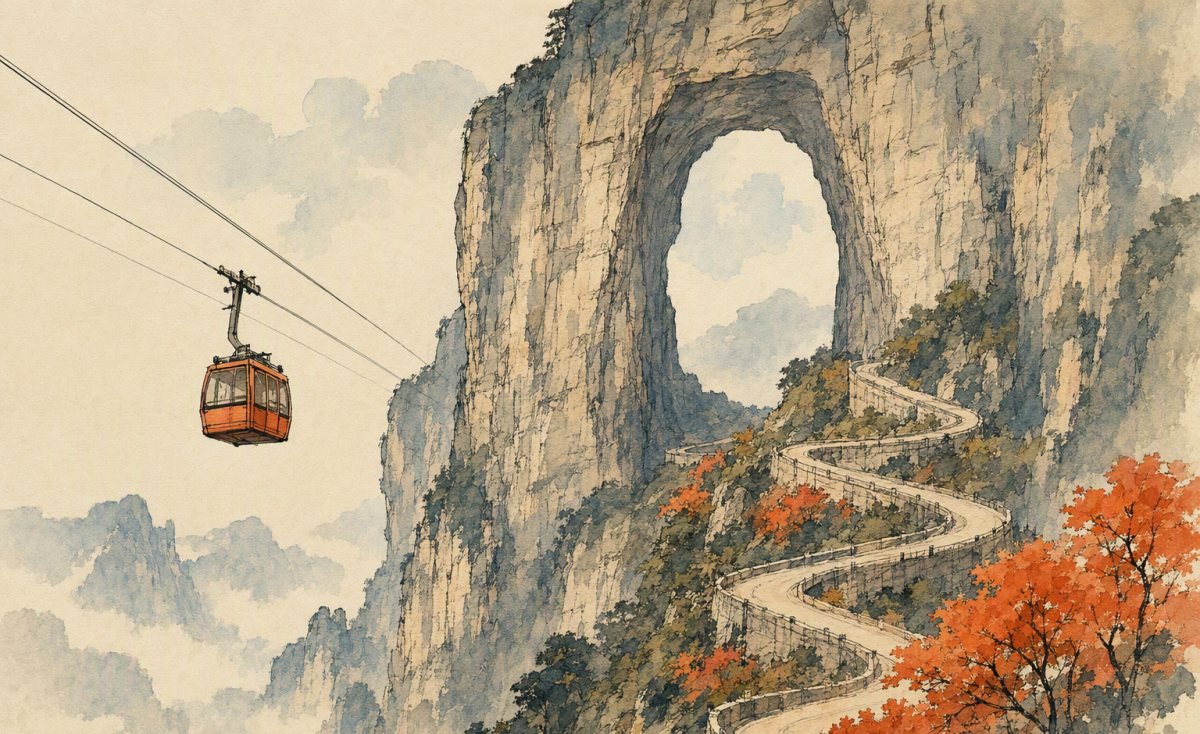
At the top you get cliff-hugging walkways bolted to the rock face, glass sections on some of them, and the huge natural arch of Tianmen Cave reached by a long, steep flight of steps. It is one very full day. If you have limited tolerance for heights or crowds, this is the day to consider skipping, and it is the one where weather matters most: cloud can erase the entire view.

Grand Canyon and the glass bridge: the photo stop

The Zhangjiajie Grand Canyon is a separate scenic area with its own ticket, and the glass bridge is the transparent span across it that appears in most social media posts. The bridge crossing itself takes only minutes; the rest of the visit is the canyon-floor walk past pools and waterfalls. Treat it as a half day, and if you are already in the Wulingyuan area, pairing it with Baofeng Lake makes a sensible single outing.

Two things to verify rather than assume: whether the bridge requires a separate timed reservation from canyon entry, and what the current rules are on bags, cameras, shoe covers and stiletto heels, since these have changed over the years. Check the official scenic area page for the day’s arrangements.

How many days total, and in what order

A workable four-day shape is: two days in the national park, one day at Tianmen, and one half-day at the glass bridge, with the remaining half-day given to Baofeng Lake, Huanglong Cave or the drive to Fenghuang. If you are adding Fenghuang, budget a night there rather than a day trip — the old town is at its best in the evening and early morning, and the road transfer eats a large chunk of any single day.

Order matters less than geography. Stay in Wulingyuan town for the park days and move to Zhangjiajie city for Tianmen, which removes two long daily commutes. For the wider picture of how this fits a longer route, see this 2-week China travel itinerary planner, and if Zhangjiajie is your first stop in the country, the basics in China travel for beginners cover payments, SIMs and bookings.

Practical points that actually affect the trip

Tickets at all three attractions are real-name, which means you need your passport — the physical one, matching the document used to book — at every entry gate. Peak-season slots (Chinese public holidays, summer weekends, the October golden week) can sell out days ahead, so book as soon as your dates are fixed. For the mechanics of booking transport and timed entries, the guide to using AI for a China itinerary without invented opening hours is a useful caution about tools that guess at details.

Weather at the top changes fast and is often several degrees colder and much windier than the valley. A light shell belongs in your bag even in midsummer. Mist after rain produces the best photographs; flat fog produces whiteout. Many hotels and visitor pages run live webcams of the pillars — check one before deciding which day to spend where, and keep your plan flexible enough to swap days.

Finally, cash and connectivity. Cards are widely accepted at ticket offices but small vendors and shuttle-side stalls often are not, so read the China cashless travel guide before you fly, and sort a data plan in advance rather than at the airport.

Frequently asked questions

Is the glass bridge inside the national forest park?

No. The Grand Canyon and its glass bridge are a separate scenic area with a separate ticket from the national forest park in Wulingyuan. They are in the same county but not the same site, and you cannot walk between them.

Can I see the park and Tianmen Mountain in one day?

Not realistically. The park’s shuttle network alone takes an hour or more to cross, and Tianmen needs most of a day once you include the cableway queues. Attempting both leaves you rushing through each.

How far ahead should I book?

Outside holidays, a few days is usually enough. Around Chinese public holidays and summer weekends, book as soon as your dates are fixed and check the official ticketing page for release windows and any timed-entry slots.

Do I need my passport for entry?

Yes. Tickets are issued against your identity document, and staff check it at the gate. Carry the same passport you booked with, and keep a photo of the details page as backup.

Which attraction should I drop if I only have two days?

Drop the glass bridge. It is the shortest experience and the easiest to substitute elsewhere in China. Two days in the national park, or one park day plus Tianmen, gives you far more for the time.

Zhangjiajie rewards people who accept that it is three trips in one, not one attraction with three entrances. Decide which two matter most to you, build the days around those, and leave the rest for a return visit.

Posted on — 1 Comment

Huangshan Travel Guide: Sunrise, Sea of Clouds & Villages

Huangshan, the Yellow Mountain, is the peak that defines “Chinese mountain” in a thousand ink paintings: granite spires, weather-beaten pines and seas of cloud that swallow the valleys below. It sits in southern Anhui, a few hours from Shanghai or Hangzhou, and the classic move is still one overnight on the summit so you catch both sunset and sunrise. This guide covers the standard two-day route, how the sunrise and cloud sea actually work, the logistics that trip people up, and the Ming and Qing villages an hour away that most summit-focused visitors skip.

The classic two-day route

Day one: take the cable car up from Yungu station on the eastern side, then walk the ridge past Begin-to-Believe Peak and along the West Sea canyon rim. The West Sea Grand Canyon loop is the demanding highlight of the mountain, all stone steps cut into cliff faces, and it closes in ice or high wind, so check conditions at the station before committing. Sleep at a summit hotel in the Beihai or Xihai area.

Day two: rise for sunrise near Refresh-Fresh Peak or Lion Peak, walk to Guangmingding (Bright Summit), the highest of the main viewing points, continue past Flying-Over Rock, and descend by the Jade Screen cable car, passing the Guest-Greeting Pine on the way down. This is a full day of steps even with the cable cars doing the vertical work.

Sunrise, sunset and the cloud sea

Summit hotels post sunrise and sunset times at reception each day; use those rather than any figure you read online, because they shift through the year and the hotels adjust for the actual forecast. Leave your room well before the posted time in peak season, as the popular platforms fill.

The cloud sea is not guaranteed and cannot be booked. It needs moisture in the valleys and clear air above, so the reliable pattern is the morning after rain, or the days following a cold front. Late spring and autumn generally give the best odds; winter brings ice-coated pines and near-solitude on the paths, but some sections close. Summer is warm, wet and crowded. If you are weighing dates, our notes on China in October and China in November cover what the rest of the country is doing in those months.

Tickets, bookings and what to verify

Entry to the scenic area and the cable cars are separate charges, and the cable car is effectively mandatory unless you plan to walk up several thousand steps with luggage. Prices, opening hours and last-entry cut-offs change by season and are set by the scenic area, so check the official Huangshan scenic area page or the ticket counter on the day and look specifically for the entry ticket, the per-cable-car fare, and the last downward cable car time, which is earlier than you expect.

Foreign visitors book with a passport, and some attractions in China now require advance reservation slots. The mechanics of that are covered in Booking Attractions in China 2026. Carry your passport on the mountain; it is checked at the gate and at hotel check-in.

Luggage, summit hotels and difficulty

Leave large bags at Tangkou town at the base, where guesthouses store luggage for a small fee, or arrange a porter to carry them to your summit hotel. Porters exist and are used, but confirm the arrangement and the price in person rather than assuming it is included.

Summit hotels are basic for the price and sell out in peak season and on public holidays, so reserve as early as your dates allow. Rooms are cold and damp outside summer; ask what heating and bedding are provided. Expect shared dormitories as well as private rooms.

The walking is stone steps throughout, up and down, with handrails in places and long exposed sections. Anyone of reasonable fitness can do the standard route in two days, but knees suffer on the descents and the West Sea loop adds real time. Trekking poles help.

The villages below: Hongcun, Xidi and Tachuan

Hongcun, the village with the moon pond and the filming location for Crouching Tiger, Hidden Dragon, and nearby Xidi are both UNESCO-listed Ming and Qing settlements, roughly an hour’s drive from the mountain base. They are worth a night rather than a rushed afternoon. Tachuan, next door to Hongcun, is known for autumn colour and is quieter.

Village entry is ticketed and the same verification rule applies: check the official site or the gate for current prices and hours.

Getting there and onward

High-speed rail runs to Huangshan North station from Shanghai and from Hangzhou, with journey times varying by service, so check schedules and seat classes on the official booking channel rather than relying on a remembered figure. Our 12306 booking walkthrough covers the passport registration step that trips up most first-timers.

From the station, a private driver linking station, mountain base and villages in one arc removes a lot of bus transfers and is the usual choice for a two- or three-night trip. If you are planning the whole loop from the coast, the Huangshan from Shanghai guide handles the longer version.

Frequently asked questions

Do I need to book the cable car in advance?

Usually you buy the cable car ticket at the station on the day, but in peak periods advance booking through the scenic area’s official channels is safer. Check the official page for whether timed slots apply on your dates, and note the last downward departure time.

Is one night on the summit enough?

Yes for the classic route, if you accept an early start and a full second day of walking. Two nights suits photographers chasing both a sunset and a sunrise, or anyone wanting the West Sea loop without rushing.

Can I see the cloud sea for certain?

No. It depends on weather. The best odds come the morning after rain or after a cold front passes, most often in spring and autumn. Treat it as a possibility, not a plan.

How fit do I need to be?

Moderate fitness is enough for the standard route with cable cars, but the steps are relentless and the descents are hard on knees. The West Sea Grand Canyon loop adds significant time and effort.

Should I add Hongcun and Xidi?

If you have a spare day, yes. They are an hour from the base, UNESCO-listed, and a genuine contrast to the mountain. Stay overnight in or near Hongcun rather than day-tripping from the station.

Plan the mountain around weather rather than a fixed date, verify every price and time at the official source, and book summit beds and village accommodation early. That combination is what turns a rushed cable-car dash into the trip the paintings promise.

Posted on — Leave a comment

Huangshan Hiking Guide: Routes, Cable Cars & Where to Stay

You do not need to be a mountaineer for Huangshan. Almost every path on the mountain is cut as stone steps with railings, and the walking itself is straightforward. What decides whether your legs survive day two is route choice: which cableway you take up, how much of the ridge you try to cover, and whether you sleep on the summit or at the base. This guide sets out the realistic options, the order that works best, and the things worth checking before you commit.

Cable car or steps: choosing your ascent

Huangshan has several cableways, and the two most useful for a first visit serve different parts of the massif. The Yungu cableway on the eastern side is the standard ascent, running up towards the ridge near the main summit hotel cluster. It is the sensible choice if you plan to sleep up top, because it puts you close to where you will stay and leaves the afternoon free for the West Sea. The Jade Screen cableway serves the southern side and lands near the Guest-Greeting Pine, which makes it the natural exit if you are doing the mountain in a single day and want to finish at the famous pine before descending.

Walking up instead of riding is possible on the eastern steps. It is a long, relentless staircase rather than a trail, and it takes most fit walkers a good half-day with a pack. Do it because you want the climb, not because you think it saves time. Cableway operating hours, seasonal closures for maintenance, and last-run times change through the year, so check the official Huangshan scenic area page or your hotel before you travel and look specifically for the current first and last departure times for each cableway.

The two-day route, and why it works

Go up by the Yungu cableway, walk out to Begin-to-Believe Peak, then check into a summit hotel and drop your bag. In the afternoon, walk the West Sea Grand Canyon, the deep slot between the rock pillars that is the most dramatic section of the mountain. Allow two to three hours, and note that a sightseeing monorail climbs out of the first section if your legs have had enough. Finish with sunset from Danxia Peak or Bright Summit, both a short walk from the summit hotels.

Day two starts with sunrise, then Flying-Over Rock, Bright Summit, and the walk down past the Guest-Greeting Pine to the Jade Screen cableway. This order puts the hardest walking on day one while you are fresh and keeps the second morning short, which matters when you are up before dawn in the cold.

The one-day version

If you only have a day, take the Yungu cableway up, walk to Begin-to-Believe Peak, shuttle across the ridge to Bright Summit, then descend via Jade Screen past the Guest-Greeting Pine. You will see the essence of the mountain. You will miss the sunrise, and you will sleep well afterwards. Trying to add the West Sea on top of this in one day is where people get caught out by the last cableway.

Training, packing and money on the mountain

Walk stairs with a loaded daypack for a couple of weeks before you go. That is the specific fitness the mountain asks for. Pack layers, because the summit runs noticeably colder than the valley below; a headlamp for the pre-dawn walk to a viewpoint; gloves for the chain sections; and snacks, since food on the mountain is carried up by porters and priced accordingly. Cards and phone payments are widely used in China, and our China cashless travel guide explains how WeChat Pay and Alipay work for foreign visitors, including how to check whether your card is supported before you rely on it.

Connectivity on the ridge is patchy in places. Sort your data before you arrive rather than on the cableway; the guide to Wi-Fi, eSIM and roaming in China covers the options and how to test them before you fly.

Where to stay

Summit hotels around Beihai, Shilin and Xihai are basic and expensive, and worth it for a zero-commute sunrise. Tangkou, at the base near the gates, is the budget option and works if you accept an early start and a queue. Hongcun, the village below the mountain, is the atmospheric choice for the night before or after. Availability at the summit is limited and peak-season dates sell out, so book early and confirm directly with the property that they accept foreign guests; our guide to hotels that accept foreign guests explains what to check.

Getting there and combining the trip

Most visitors reach Huangshan by high-speed rail and then take a bus or private car to Tangkou. Train seats on the relevant routes fill on weekends and holidays, so read the step-by-step guide to booking on 12306 and book as soon as your dates are fixed. Many travellers pair the hike with Hongcun and Qiandao Lake; a private car and driver solves the luggage-and-station problem, and an AI planner can draft the sequence, though you should verify every time and ticket against the operator.

Frequently asked questions

Do I need to be very fit to climb Huangshan?

No, but you need to be comfortable with stairs. The paths are stepped and railed, and cableways remove most of the ascent. The West Sea and the ridge walks involve hours of up-and-down steps, so train on stairs with a pack beforehand.

Can I see Huangshan in one day?

Yes, via the Yungu cableway up and Jade Screen down, with Bright Summit and the Guest-Greeting Pine in between. You will not see sunrise or the West Sea, and you must keep an eye on the last cableway departure time, which you should confirm on the official scenic area page.

Is it worth sleeping on the summit?

For sunrise, yes. Summit rooms are basic and costly, but they remove a pre-dawn descent and climb. If you are on a tight budget, stay in Tangkou and accept the early start.

How do I pay for things on the mountain?

Mobile payment is standard across China, including at many mountain vendors, but coverage and acceptance vary. Carry a backup card and check in advance whether your card works with the payment apps.

When should I go?

Spring and autumn are the most comfortable for walking. Whatever you choose, check the forecast for the summit rather than the valley, and verify current cableway hours and any maintenance closures before booking.

Plan the mountain around verified timings rather than optimistic ones: confirm cableway hours, summit availability and train seats first, then build the rest of the trip around them.

Posted on — Leave a comment

Chengdu Travel Guide: Pandas, Teahouses & Hotpot

Chengdu’s official city slogan is “a city you won’t want to leave”, and the pandas, teahouses and chilli-laced food do make a strong case. This guide covers how to see the pandas without wasting the morning, where the city slows down, how to order hotpot without regret, and which day trips are worth the travel time. It deliberately avoids quoting ticket prices, opening hours or train times, because these change; where a figure matters, check the operator’s own page before you go.

Pandas done right

The Chengdu Research Base of Giant Panda Breeding is the main reason many visitors come. The single most useful habit is to arrive for opening and walk directly to the outdoor enclosures rather than lingering near the entrance. Pandas eat in the cool of the morning; by late morning, heat pushes them into sleep and the enclosures become much less interesting.

Check the base’s official channels for current opening times, last entry and ticket rules, and note whether booking in advance is required on your date. If newborn cubs are on show, the nursery is usually the busiest area, and viewing windows are brief. Half a day is a sensible allocation. The Dujiangyan panda volunteer programmes run separately, with their own application process and conditions, so confirm details with the operator rather than assuming availability.

For a realistic walk-through of the day, including how the timing works in practice, see Chengdu & the Giant Panda Base: A Realistic Day in 2026.

Slow Chengdu: teahouses, lanes and temples

People’s Park is the classic introduction to Chengdu’s pace: bamboo chairs, tea refilled from long-spouted kettles, ear-cleaning masters working with tuning forks, and match-making corners where parents advertise their adult children’s prospects. Prices for tea vary by house and leaf, so ask before sitting down. Mornings are the most unhurried.

Kuanzhai Alleys, restored Qing-era lanes, mix teahouses, brick courtyards and snack stalls; they are touristy but pleasant early. Jinli Street is at its best after dark, when the lanterns are lit. Wenshu Monastery is a working temple with a vegetarian restaurant and a garden teahouse, and it rewards a slower visit than the commercial streets.

For orientation, transport and neighbourhood detail, the Chengdu City Guide 2026: Pandas, Sichuan Spice & Metro Tips covers the ground this page does not.

Hotpot school

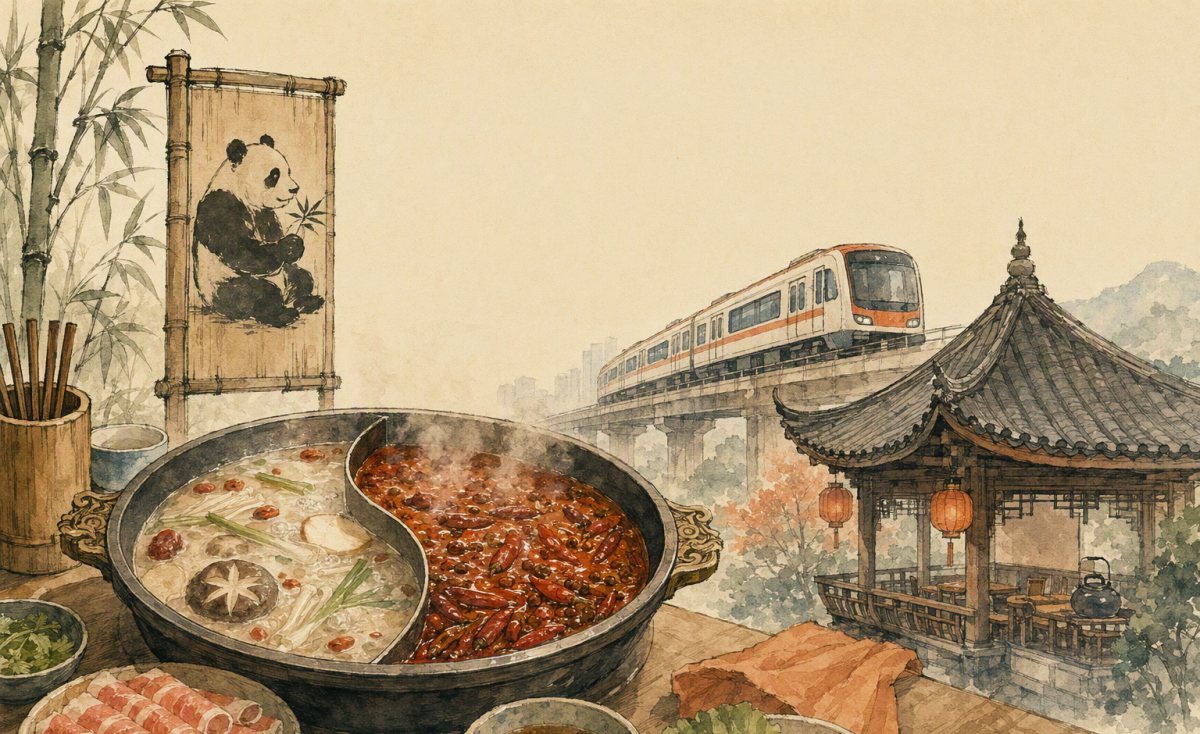
Sichuan hotpot is a shared pot of simmering broth, and the split “yuanyang” pot is the sensible order: clear broth on one side for cooling and tasting, red chilli and Sichuan peppercorn on the other for the real thing. Peppercorn produces a tingling numbness rather than pure heat, which is the point.

Dip in sesame oil with garlic, which coats the tongue and tames the fire. Common orders include tripe, duck blood, lotus root, potato slices and beef in oil. Cooking times matter: tripe is swished briefly, not left to boil. Sweat is part of the experience, and so is ordering more than you think you need.

If you want to compare regional styles before you commit, the Chongqing City Guide 2026: Mountains, Hotpot & Metro Tips explains how the neighbouring city’s version differs.

Day trips: Leshan, Dujiangyan and Qingcheng

The Leshan Giant Buddha is a 71-metre figure carved into a cliff above the confluence of three rivers, roughly a couple of hours from Chengdu by road or rail depending on your route. Queues for the stairway descent can be long; check current arrangements and whether timed entry applies. Dujiangyan pairs the ancient irrigation works, still functioning, with Mount Qingcheng, a wooded Daoist mountain and a good half-day on its own.

Within the city, Taikoo Li and the surrounding eastern districts are Chengdu’s modern face, best seen after dark. If you are extending the trip, the Chengdu → Lijiang → Kunming 7-day route shows how Chengdu fits into a longer Sichuan and Yunnan itinerary.

Practical planning

March to June and September to November are the mildest periods; summer is humid and hot, and winter is grey but quiet. The metro is efficient and easy to use, though for the panda base’s early start a private car or a pre-booked driver removes the guesswork. For payment, transport and connectivity basics, see the First Time in China: 12 Things to Sort Before You Book checklist.

Verify anything with a number attached — tickets, hours, train departures, visa-free eligibility — on the official operator or government page, and check the date on the page you are reading. Third-party summaries, including AI-generated itineraries, are useful for shape but not for figures; the guide to using AI for a China itinerary without invented opening hours explains where those tools go wrong.

Frequently asked questions

How long do I need at the panda base?

Half a day is right for most visitors if you arrive at opening. Add time if you are combining it with the Dujiangyan area, and check the base’s official page for current opening times and any advance-booking requirement.

Is Chengdu’s metro enough, or do I need a driver?

The metro covers the centre, Jinli, Kuanzhai Alleys and the main rail stations well. For the panda base at opening time, a car or pre-booked driver is simpler, particularly if you are travelling with children or luggage.

Can I visit Leshan and Dujiangyan on the same trip?

They sit in different directions from Chengdu, so doing both usually means two separate days or an overnight. Check current train times and ticket availability on the official rail booking channel before fixing your plan.

What should I order at a Sichuan hotpot restaurant?

Start with the split yuanyang pot, sesame-oil and garlic dipping sauce, and a mix of tripe, beef, lotus root and vegetables. Ask staff for cooking times if you are unsure, and confirm prices from the menu rather than assuming.

When is the best time to visit Chengdu?

Spring and autumn are the most comfortable. Summer heat affects both your comfort and panda activity, so plan early mornings outdoors and keep afternoons for teahouses, museums and indoor sights.

Chengdu rewards a slower itinerary than most Chinese cities: one early panda morning, one long teahouse sit, one hotpot dinner and one day trip is a fuller trip than a checklist of sights. Confirm the details that matter on official pages, leave room for an unplanned afternoon, and the slogan starts to make sense.

Posted on — Leave a comment

48 Hours in Chengdu: The Perfect Layover Guide

Chengdu suits a short stop better than most Chinese cities. The sights that matter most sit within a compact centre, the metro connects both airports to downtown, and two full days is enough to see pandas, old lanes, teahouses and a Sichuan opera show without sprinting. What follows is a realistic two-day structure, plus the logistics that decide whether a layover works: arrival timing, visas, payments and data.

Before you fly: the three things that make or break a layover

First, the visa question. China operates visa-free transit arrangements at selected ports, and Chengdu is one of the cities involved, but eligibility depends on your nationality, your route and which entry point you use. Do not assume you qualify because a friend did. Read the current rules on the official immigration or embassy page for your country, and check the specific conditions: the permitted length of stay, whether your onward destination must be in a different country or region from where you arrived, and which ports allow the arrangement. Our 240-hour transit checklist walks through what to confirm before booking.

Second, payments. Foreign cards are widely accepted in Chengdu, but small teahouses, market stalls and some taxis still work more smoothly with a mobile wallet. Set up WeChat Pay or Alipay before departure rather than in the arrivals hall — verification can take time. See our cashless travel guide for the setup sequence.

Third, data. Maps, translation and ride-hailing all need a working connection from the moment you land. Sort an eSIM or SIM before you fly and test it at home. Our eSIM versus physical SIM comparison covers the trade-offs.

Getting in from the airport

Chengdu has two airports serving international and domestic traffic. Both connect to the city centre by metro, and the journey is straightforward if you have a metro app or a stored payment method ready. Journey times vary by line and terminal, so check the current metro map on the operator’s site rather than trusting an old blog post. Note the last-train times for your arrival terminal — they differ between airports and change seasonally.

If you land late or carry heavy bags, a taxi or pre-booked transfer is simpler. Confirm the pickup point in writing with your driver, since both airports have multiple exits. Our airport transfers guide explains how the options compare.

Day one: pandas in the morning, old Chengdu after

The Giant Panda Base opens early and the animals are most active in the first hours. Aim to arrive for opening rather than mid-morning; by around 10am the crowds thicken and the pandas often settle down to sleep. Buy tickets through the official channel and check current opening hours and any timed-entry requirement on the base’s own page before you go. Our realistic panda base day covers transport, timing and what to expect.

After lunch, slow down. Wenshu Monastery’s garden teahouse is the classic place to sit for an hour with a covered cup and no agenda. Then walk the Kuanzhai Alleys, the restored Qing-era lanes of teahouses, snack stalls and craft shops — touristy, but pleasant in the late afternoon light.

For dinner, try hotpot. Order a split pot if you are unsure about the spice level, and use the sesame-oil dip rather than soy sauce; it cools the chilli rather than amplifying it. In the evening, a Sichuan opera face-changing performance is the standard introduction to the city’s performing arts. Book through a reputable operator and confirm the venue and showtime directly, as schedules rotate.

Day two: teahouses, temples and a last stroll

Start at People’s Park, where you can drink tea, watch tai chi and see the marriage market boards that local families still use. It is a genuine slice of city life rather than a staged attraction. Lunch on mapo tofu and dan dan noodles at a neighbourhood Sichuan restaurant — the quality is generally high and the prices modest.

In the afternoon, Taikoo Li’s low-rise designer courtyards sit directly beside the ancient Daci Temple, a contrast that sums up modern Chengdu. Finish with Jinli Street’s lanterns in the early evening, then find skewers and beer somewhere with a rooftop view.

Extending beyond two days

If you have more time, the Leshan Giant Buddha and the Dujiangyan irrigation works are the two easiest additions, both reachable as day trips. Beyond that, Chengdu is a natural starting point for Sichuan and Yunnan routes. Our Chengdu to Lijiang and Kunming route shows how a layover can grow into a week. If you are building the plan yourself, an AI planner can help with sequencing but should never be trusted for opening hours or prices — see our notes on using AI for a China itinerary.

Frequently asked questions

Is two days enough for Chengdu?

Yes, for the core sights: pandas, a teahouse, the old lanes, hotpot and an opera show. You will not see everything, but you will not feel rushed either. Three days allows a day trip to Leshan or Dujiangyan.

Can I leave the airport on a transit visa-free entry?

Often yes, but eligibility depends on your nationality, route and entry port. Check the current rules on the official immigration or embassy page for your country, and confirm the permitted stay length and onward-travel conditions before booking.

Do I need cash in Chengdu?

Not much, but carry a small amount as backup. Mobile wallets work almost everywhere; foreign cards work in many places but not all. Set up your wallet before you fly.

When should I visit the Panda Base?

As close to opening as you can manage. The pandas are most active early and the site gets busy later. Verify current opening hours and ticketing on the official site, as these change by season.

Is the metro easy to use from the airport?

Yes, both airports connect to the centre by metro. Check the current map and last-train times for your terminal on the operator’s site, and have a payment method ready before you arrive.

Chengdu rewards a slow pace more than a packed one. Build the two days around the pandas and the teahouses, verify the visa and ticketing details on official pages before you fly, and the rest of the trip tends to look after itself.

Posted on — 1 Comment

Zhangjiajie 4-Day Itinerary: Avatar Mountains Complete Guide

Four days is the right number for Zhangjiajie. Two days go to the national park at Wulingyuan, one to Tianmen Mountain above the city, and one to a choice: the glass bridge over the Grand Canyon, Fenghuang Ancient Town, or Huanglong Cave. This guide sets out how to sequence those days, what to book in advance, how to move between the sites, and what to check before you commit. Prices, opening hours and transport schedules change, so where a figure matters this guide tells you where to verify it rather than quoting one.

Day 1: Wulingyuan and the Avatar pillars

Start at the Wulingyuan gate, the park’s main entrance. The Hundred Dragon Elevator, a cliff lift built into the sandstone, takes you up towards Yuanjiajie — the dense pillar forest usually described as the inspiration for Avatar’s floating mountains. From the top, a boardwalk circuit links the main viewpoints. Expect crowds mid-morning; arriving at opening is the simplest way to stay ahead of the tour groups.

In the afternoon, take the park shuttle to Tianzi Mountain for the west-sea stone forest, a broader and often quieter panorama. Overnight in Wulingyuan town, which puts you close to the gate for day two. Note that the park entry ticket and the elevator, cable cars and shuttle network are separate: check the official Wulingyuan park page for the current entry ticket validity, which lifts are included, and whether real-name booking with your passport is required for your dates.

Day 2: Streams, galleries and the cloud sea

Golden Whip Stream is a flat riverside walk of roughly two and a half hours beneath the towers, with macaques along the path. Keep food out of sight; the monkeys are quick and persistent. In the afternoon, choose between the Ten-Mile Gallery scenic tram and the quieter boat on Baofeng Lake.

If it rained overnight, change the plan. The cloud sea — mist pooling between the pillars — is the single best reason to re-climb Yuanjiajie, and it only appears after rain. Check the park’s live notices or ask at your guesthouse before committing; visibility forecasts for the park are unreliable, and a clear morning in town does not mean a clear morning up top.

Day 3: Tianmen Mountain

Tianmen Mountain sits directly above Zhangjiajie city and is a separate ticket from the national park. The long cable car runs from the city up to the summit; below it, the 99-bend road climbs to the same plateau. At the top, cliff-hung walkways trace the rim, and the Tianmen Cave arch is reached by a long staircase — count the steps on the day rather than trusting a number, as access sections close for maintenance.

The glass skywalk section is optional and costs extra; it is a short segment, so decide when you see the queue. Descend in the late afternoon for better light on the road below. Cable car operating hours, last ascent times and any closure days vary by season and weather — confirm on the official Tianmen Mountain operator page before you travel, and build in a spare half-day in case high winds stop the cable car.

Day 4: Glass bridge, Fenghuang or Huanglong Cave

Option A is the glass bridge over the Grand Canyon, a structure spanning the gorge with a transparent deck. Option B is Fenghuang Ancient Town, roughly two and a half hours away by road, with its stilt houses and lantern-lit riverfront — it deserves an overnight if you can spare one. Option C is Huanglong Cave, whose chambers are among the largest in the region and make a good wet-weather substitute.

Whichever you pick, book timed entry where the operator offers it. The glass bridge in particular uses timed slots and caps daily numbers; check the official Grand Canyon scenic area page for slot times, passport requirements and whether bags or cameras are restricted on the deck.

Tickets, booking and timing

Two things trip people up. First, the national park entry ticket does not cover the elevator, cable cars or the Tianmen cableway — budget separately and verify each price on the operator’s own page. Second, most sites now use real-name booking, so carry the passport you booked with. Payment inside the park is overwhelmingly mobile; if you have not set up WeChat Pay or Alipay, sort that before you arrive — see this China cashless travel guide.

On seasons: spring and autumn generally give the best mix of mist and visibility, while winter brings snow on the pillars and far shorter queues at the cost of cold and occasional ice closures. Summer is hot, wet and busy. Before fixing dates, check the China public holidays calendar — national holiday weeks fill hotels and park shuttles well beyond comfort.

Getting there and getting around

Zhangjiajie has its own airport and a high-speed rail station, Zhangjiajie West, connected to the main national network. For booking trains with a foreign passport, see this guide to buying China train tickets. Inside the park, free shuttle buses link the gates, lifts and viewpoints, and they are the only practical way to move between zones.

For the Fenghuang and Huanglong Cave days, a private car with driver removes a lot of logistics, since public buses run to fixed timetables and drop you short of some entrances. Mobile coverage inside the park is patchy in the valleys; if you rely on maps, download offline copies and check your data allowance against a realistic estimate — this day-by-day data estimate is a useful starting point.

Frequently asked questions

Is four days enough for Zhangjiajie?

Yes, for the national park, Tianmen Mountain and one further day trip. It is tight if you want both Fenghuang and the glass bridge; add a night in Fenghuang rather than trying to do it as a day return.

Do I need to book park tickets in advance?

Real-name booking is standard at the main sites and timed slots apply at some. Check each operator’s official page for your dates, and carry the passport used for the booking.

What if it rains?

Rain is not necessarily bad news — it produces the cloud sea over Yuanjiajie. Cable cars and the glass bridge can close in high wind or storms, so keep one flexible day in your plan.

Can I visit without speaking Chinese?

Yes, with preparation. Signage at major viewpoints is bilingual, but shuttle announcements and guesthouse staff may not be. Translation apps and offline maps help; set up mobile payment before arrival.

Where should I stay?

Wulingyuan town for the park days, Zhangjiajie city for Tianmen Mountain, and a night in Fenghuang if you choose that option. Verify current reviews rather than relying on older write-ups.

Treat the itinerary above as a framework rather than a fixed schedule: confirm tickets, lift operating times and transport on the official operator pages close to your travel dates, keep one day flexible for weather, and the four days will cover the essentials without feeling rushed.