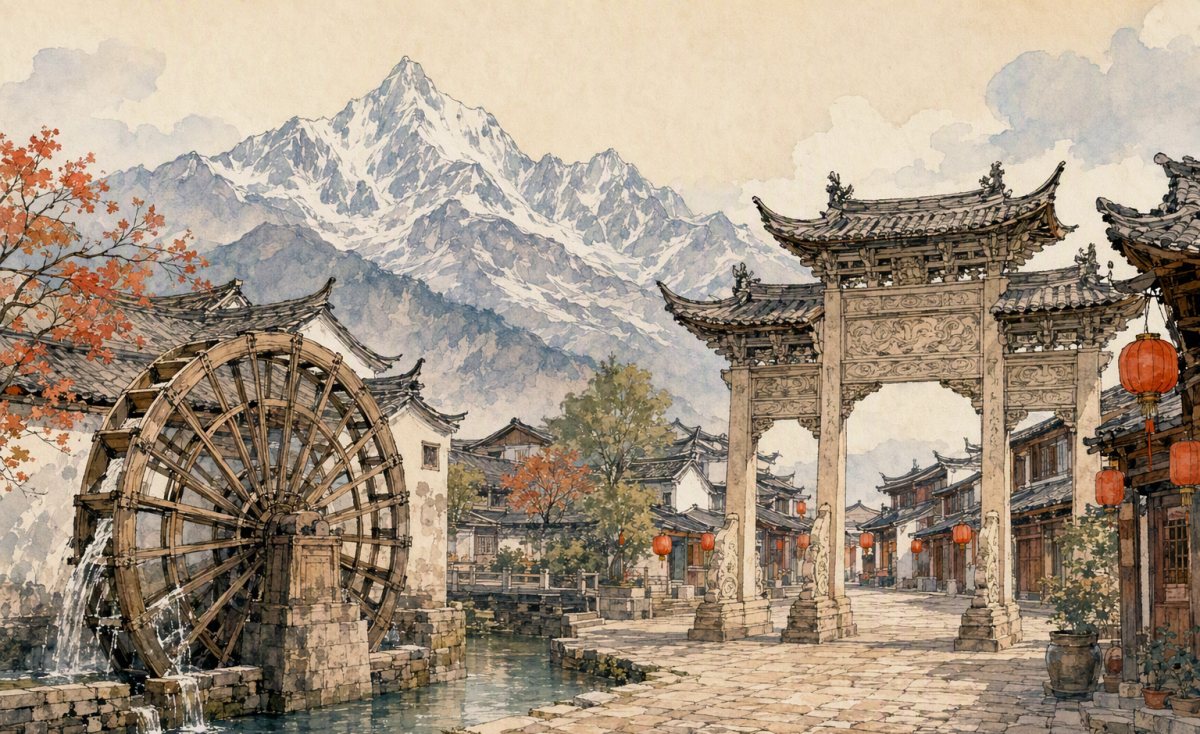
Lijiang sits in a high valley in northwest Yunnan, where cobbled canals run beneath a glacier peak, the Naxi people still write in a pictographic script, and wooden bridges carry more foot traffic than most Chinese cities see in a week. The Old Town is a UNESCO World Heritage Site, and the surrounding county holds enough for several days rather than one. This guide covers what to see, how the altitude works, when to go, and how to plan the rest of a Yunnan route around it.
The Old Town: Daybreak, Lanterns and Crowds
Lijiang’s Old Town is a grid of stone lanes, willow-lined canals and wooden bridges, with the Naxi in traditional dress still a visible presence rather than a staged one. Daybreak is the honest time to walk it: shopfronts shuttered, water audible, mist on the rooftops. Midday brings tour groups in volume, and the lanes around Sifang Square become slow. After roughly 9pm the day-trippers leave, red lanterns come on over the square, and rooftop bars turn toward the snow mountain.
Two practical points. The Old Town charges a maintenance fee, collected at various entry points and sometimes checked at attractions; the amount and enforcement change, so confirm the current position at your accommodation or at the official visitor centre before you budget for it. The lanes are uneven stone, slippery after rain, and wheeled luggage is genuinely awkward — many guesthouses send someone to meet you at a vehicle-accessible point, so ask when booking.
Monte della Neve del Drago di Giada
The mountain is the reason most people come. The Glacier Park cable car climbs to around 4,506m, and access is capped: tickets are tied to timed slots and frequently sell out in peak season, so book through the official channel or a licensed operator well ahead and confirm the current booking rules rather than assuming you can turn up. Above the cable car station the air is thin and the walkways are stepped — pace yourself, and treat any headache or nausea as a signal to descend.
Below the glacier, Blue Moon Valley’s terraced turquoise pools are the most photographed spot in the county, and the spruce meadows offer gentler walking at lower elevation. The Impression Lijiang outdoor show, directed by Zhang Yimou and performed by a large cast at roughly 3,100m, is staged in an open amphitheatre; check the current performance schedule and whether it runs in your season, and dress for cold wind even in summer.
Naxi Culture and the Dongba Script
The Dongba script is the world’s only living pictographic writing system, and you can see it taught and demonstrated in Lijiang rather than only in a museum case. Workshops and small cultural centres around the Old Town and Baisha run sessions; ask your guesthouse which ones are currently operating and what they charge, since these are small operations that open and close.
Naxi ancient music performances use instruments and repertoire that predate much of what survives elsewhere in China, and the ensembles are usually happy to explain what you are hearing. Further out, the Mosuo communities around Lugu Lake are known for a matrilineal family structure — often loosely described as matriarchal. Visiting properly takes time: Lugu Lake is a long drive from Lijiang and realistically needs two extra days. Treat Mosuo culture as a living community, not an exhibit, and book any homestay through operators who work with local families.
Tiger Leaping Gorge, Baisha and Shuhe
Tiger Leaping Gorge, roughly two hours north of Lijiang, is one of China’s great walks. The high trail is usually done as an overnight with a guesthouse stop, or as a long single day on the lower path if you are fit and the weather is stable. Path conditions, guesthouse openings and trailhead access shift with landslides and season, so check locally before setting out rather than relying on an old route description.
Baisha village, closer to the mountain, has murals that predate the Old Town’s rise and a far quieter pace. Shuhe, often called Lijiang’s mellower cousin, is a smaller old town with the same architecture and a fraction of the footfall — a good base if you want evening calm. Both are easy half-days by taxi or bicycle.
Altitude, Timing and Getting There
Lijiang itself sits at about 2,400m, which most visitors handle without trouble, but the mountain goes far higher and the transition is quick. Build in a gentle first day, drink more water than usual, and avoid heavy drinking before the cable car. If you are continuing to Tibetan plateau destinations, sequence the altitude gradually rather than jumping from Lijiang to somewhere much higher; our guida al viaggio in Tibet explains how that ramp works.
The most reliable windows are April to June and September to November, with clear mountain views and comfortable walking temperatures. July and August bring rain and cloud that can hide the peak entirely; winter is cold but often bright. Lijiang has its own airport and rail connections to Kunming and beyond — check current schedules and book trains with your passport details in advance, as outlined in our guida all’acquisto di biglietti ferroviari con passaporto straniero. For a longer regional route, see this Chengdu to Lijiang and Kunming itinerary.
Practical Planning
Payments, connectivity and bookings are the three things that trip up first-time visitors. Set up a mobile wallet before you fly and carry a small cash backup, as described in our guida ai pagamenti cashless. Sort a data plan before departure — an eSIM installed and tested at home avoids a scramble at the airport. For everything else, start with the checklist per primi viaggi in Cina.
Domande frequenti
Is Lijiang’s altitude a problem?
The town is around 2,400m, which most healthy visitors tolerate well. The risk is the rapid jump to over 4,500m at Glacier Park. Take the first day easy, hydrate, and descend if you feel unwell.
Do I need to book the snow mountain cable car in advance?
Access is capped and busy periods sell out. Book through the official channel or a licensed operator as early as you can, and confirm the current ticketing and timed-entry rules directly, since they change.
How many days should I give Lijiang?
Three full days covers the Old Town, the mountain and one outlying village comfortably. Add two days for Tiger Leaping Gorge and two more if you want Lugu Lake.
Qual è il periodo migliore per visitare Hong Kong?
April to June and September to November give the clearest mountain views. Summer is wet and often cloudy; winter is cold but frequently sunny.
Can I see the Dongba script without a tour?
Yes. Small workshops and cultural centres in the Old Town and Baisha demonstrate it. Ask locally which are open, as these are small operations with variable hours.
Lijiang rewards a slower pace than its popularity suggests: walk early, book the mountain ahead, and leave room for the villages and the gorge rather than treating the Old Town as the whole trip. Verify fees, cable car slots and show schedules close to your dates, and the rest of the planning falls into place.