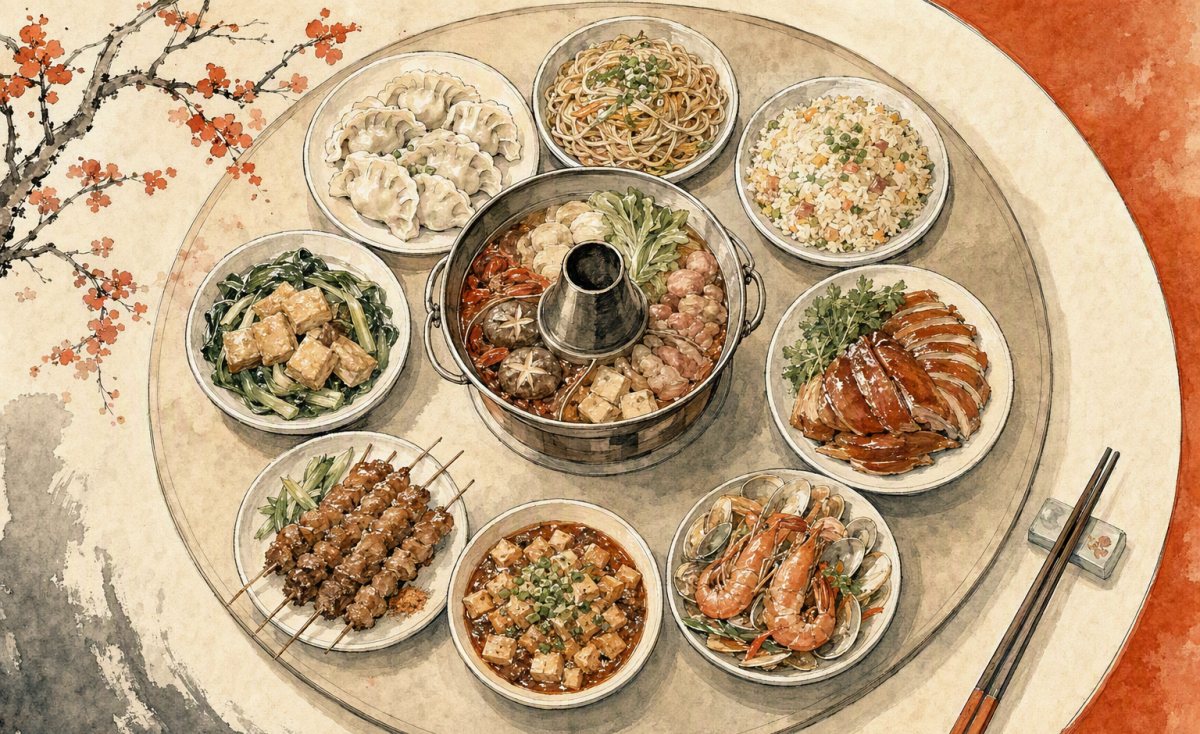
A food tour in China can mean many things: a guided walk through a wet market, a dumpling class in a family kitchen, a hotpot dinner with a translator at the table, or a multi-city itinerary built around regional cooking. This guide explains what the eight great cuisines actually are, what to eat in the main cities, how to handle dietary needs, and what to verify before you pay a deposit. It does not quote prices or opening hours, because these change and vary by operator; where a number matters, you will be told exactly where to check it.
What the eight great cuisines cover
Chinese cooking is often summarised as eight regional traditions, and knowing them helps you choose a route rather than a single dinner.
Cantonese, from Guangdong and Hong Kong, is built on steaming, roasting and dim sum. Sichuan cooking is famous for heat, but the numbing ma la profile comes from Sichuan peppercorn rather than chilli alone; hotpot and mapo tofu are the entry points. Shandong cuisine leans on seafood, braising and clear soups. Jiangsu cooking is delicate and often sweet, with river fish and dumplings. Zhejiang is lighter and fresher, built around bamboo shoots, freshwater fish and tea. Fujian is known for soups, slow braises and umami depth. Hunan cooking is spicy and fermented, distinct from Sichuan in its use of smoke and sour notes. Anhui uses wild herbs, mountain ingredients and long braising.
You do not need to eat all eight in one trip. Two or three regions, done properly, gives a better sense of how much Chinese food varies than a rushed sweep.
Eating city by city
Beijing: roast duck is the obvious centrepiece, but breakfast matters too. Jianbing, a savoury crepe with egg and crisp fried dough, is the local morning staple.
Xi’an: the Muslim Quarter is the densest eating area, and biangbiang noodles, wide hand-pulled ribbons, are the dish to try first. Our Xi’an street food guide lists specific bites.
Chengdu: hotpot, teahouse snacks and, if you want a day away from the table, the panda base. See the Chengdu and Giant Panda Base guide for how to combine the two.
Shanghai: xiaolongbao, soup dumplings, and scallion oil noodles. The Shanghai street food guide covers the main neighbourhoods.
Chongqing and Guangzhou are worth adding if hotpot or dim sum is your priority; both have dedicated street food guides on this site.
Hands-on experiences and how to judge them
Dumpling-making classes, hotpot spice-blending sessions and market tours with a chef are the most common add-ons, and most can be attached to an existing itinerary rather than booked as a standalone trip. When comparing providers, ask three questions before paying: how many people are in the group, whether the class is taught in English or through a translator, and whether the market visit happens at a time when the market is actually trading. A market tour at four in the afternoon is a different experience from one at seven in the morning.
If a provider quotes a fixed menu, ask whether substitutions are possible. This matters most for vegetarians, halal travellers and anyone avoiding shellfish.
Dietary needs, safety and comfort
Busy street stalls with high turnover are generally a reasonable bet, but “generally” is doing work in that sentence. Vetted spots, arranged through a guide, remove most of the guesswork. Vegetarian and halal food is widely available across China, but finding it depends on knowing which dishes contain hidden pork stock, lard or alcohol. Our halal and vegetarian guide explains what to ask for and how to phrase it.
Two practical points. First, tipping is not standard in mainland China, so check the tipping and etiquette guide before a guided meal where you may feel unsure. Second, if you have allergies or a medical condition, carry a written card in Chinese and know where the nearest pharmacy or clinic is; the healthcare guide for travellers covers this.
Booking, payments and what to verify
Food tours are usually booked through a platform, a hotel concierge or a specialist operator. Whatever the route, confirm in writing: the meeting point, the group size, the language, the cancellation terms, and whether food and drinks are included or charged separately. If a listing quotes a price per person, check whether it is per adult, whether children are discounted, and whether a service fee is added at checkout.
Payment is largely cashless. Foreign cards can be linked to the main mobile wallets, but the setup process and any limits change; our cashless travel guide explains how to check your own card works before you rely on it. Carry a small amount of cash as backup.
If your tour involves a train between cities, book seats through the official 12306 channel or an authorised agent, and verify the current rules rather than assuming. The 12306 step-by-step guide walks through the process, and the seat classes guide explains what you are actually buying.
Frequently asked questions
Do I need to speak Chinese to join a food tour?
No, but it helps to have translation ready for menus and stall signs. Most guided tours are conducted in English or with a translator. For independent eating between tours, a translation app plus a handful of phrases covers most situations; see our language barrier guide for what to install before you fly.
Is street food safe for visitors?
High-turnover stalls are usually fine, and guides tend to steer groups towards places they know. If you have a sensitive stomach, start with cooked, freshly fried or boiled food and avoid anything sitting out at ambient temperature. Bring any medication you rely on.
Can a food tour accommodate vegetarian, halal or allergy requirements?
Often yes, but it must be arranged in advance, not on the day. Ask the operator directly, in writing, and be specific about stocks, lard, alcohol and cross-contamination. Our halal and vegetarian guide sets out the wording that works.
How much should I budget for a food tour?
Prices vary widely by city, group size and whether drinks are included, so any figure quoted here would be unreliable. Check the operator’s own booking page for the current per-person rate, what it includes, and the cancellation policy before you commit.
Can I build a food-focused itinerary myself?
Yes. Pick two or three cities, allow at least two full days in each, and leave one meal a day unplanned so you can follow a recommendation. An AI planner can help with sequencing, though you should verify every opening time and reservation rule yourself; our guide to using AI for itineraries explains where it tends to go wrong.
Treat any food tour as a starting point rather than the whole trip. The best meals in China are often the ones you did not book: a breakfast stall near your hotel, a noodle shop a guide points out on the way to somewhere else. Use the tour to learn what to order and how to order it, then spend the rest of your stay practising.
[…] China’s eight regional cuisines […]