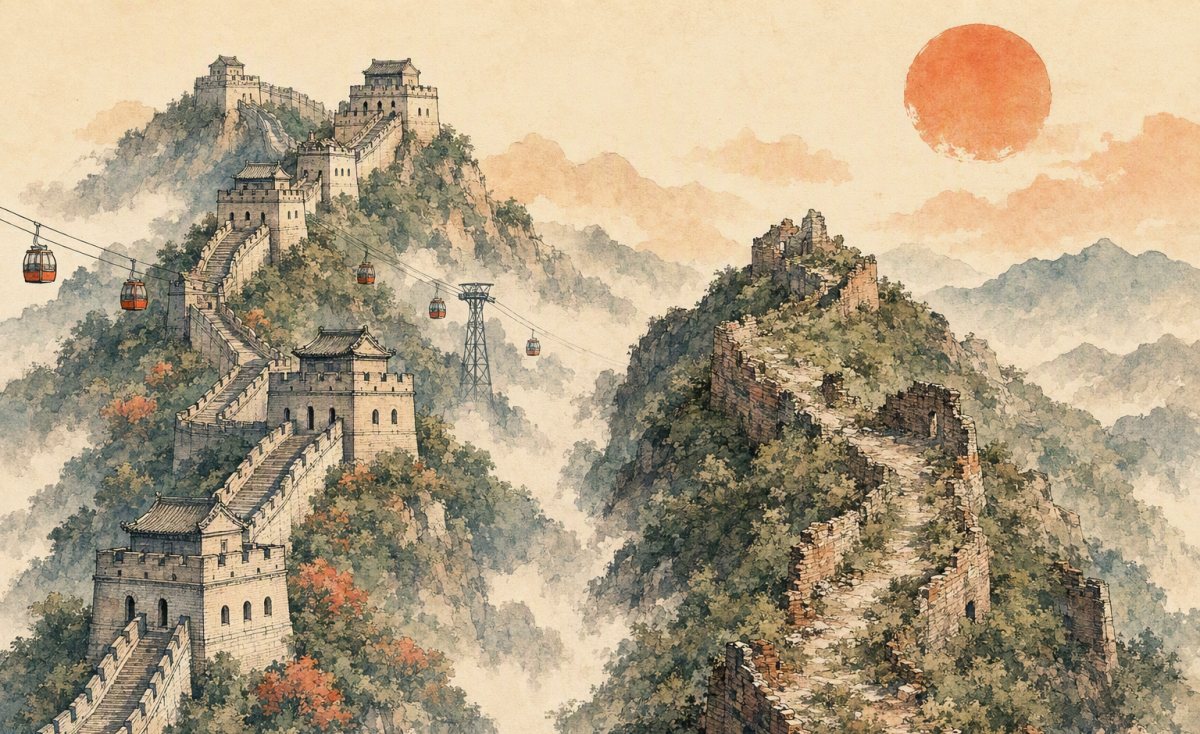
Mutianyu and Badaling are the two Great Wall sections most visitors from Beijing actually choose between, and the decision is less about which wall is “better” than about what kind of day you want. Badaling is the closest, the most fully restored and the most heavily visited. Mutianyu is further out, less crowded in practice, and offers a cable car up with a toboggan option down. This guide compares them on access, transport, crowd patterns and practical logistics, and explains how to check the details that change — ticket rules, opening times and transport schedules — before you commit.
Mutianyu: the traveller’s choice
Mutianyu sits roughly 1.5 hours from central Beijing by road, depending on traffic. The wall here has been restored, but the surrounding landscape retains a wilder feel than Badaling, with forested ridges in every direction and long stretches you can walk with relatively few people around you.
The main practical advantage is the ascent. A cable car carries you up to the wall, and a toboggan run brings you back down — a detail that makes the day considerably more fun for children and for anyone who does not fancy a long stair climb. You can also walk up if you prefer, but the steps are steep and uneven in places.
Because it is further from the city, Mutianyu absorbs crowds better. It is still busy on public holidays and weekend mornings, but the experience is generally calmer than Badaling. If you are weighing up how to structure a first trip, our China travel for beginners guide covers how the Wall fits into a wider itinerary.
Badaling: convenience and history
Badaling is the closest major section to Beijing and the most comprehensively restored. It is also the section most associated with state visits and official photography, which is part of its appeal. For visitors with limited time — a long layover, a single free day, or a tight schedule — it is often the only realistic option.
The trade-off is volume. In peak season, and especially on weekends and national holidays, the crowds at Badaling can be extreme, particularly around the main access points and the steepest restored stretches. Accessibility is better here than at most sections, with infrastructure designed to accommodate visitors with limited mobility, though you should confirm current facilities rather than assume.
If your Beijing time is short and you are combining the Wall with city sights, it is worth understanding how attraction reservations work before you build a plan — see our guide to booking attractions in China for foreign visitors.
Getting there: train, bus or private car
Badaling is reachable by public transport, including the suburban rail line from Beijing North and various tour bus services. Schedules, departure points and whether advance booking is required change over time, so check the current timetable on the operator’s own page or at the station rather than relying on older blog posts. Look specifically for the departure station, the first and last departure times, and whether a reservation is needed.
Mutianyu has no comparable direct rail link. Most independent travellers reach it by private car, hired driver or organised tour. A private transfer removes the transfer points and lets you arrive before the main coach groups, which materially changes the experience. Our China airport transfers guide explains how driver bookings generally work if you are arranging this yourself.
Whichever section you choose, confirm the meeting point and return time in writing, and keep the driver’s contact details offline — mobile data can be unreliable on the mountain.
Practical tips for either section
Go on a weekday and start early. The first hour or two after opening is consistently the quietest, and the light is better for photographs. Wear shoes with real grip: the restored stone steps are steep, polished by foot traffic and slippery when wet or icy.
Bring your own water and snacks. Vendors on and near the wall charge premium prices, and in summer you will drink more than you expect. In winter, the wall is dramatic and largely empty, but wind chill is serious — layer properly and check whether cable car or toboggan services are running, as these can be suspended in bad weather.
Carry your passport. It is required for many attraction tickets and reservations in China, and the Wall is no exception. For payment, most vendors now prefer mobile payment; our China cashless travel guide explains how to set this up before you arrive.
Which should you choose?
Choose Badaling if time is the binding constraint, if you need step-free access, or if you want the classic, fully restored version of the wall with the easiest logistics. Choose Mutianyu if you have a full day, want fewer people around you, and value the cable car and toboggan. If you have two days in Beijing, doing both is a legitimate plan — they feel genuinely different.
Do not treat any ticket price, opening time or transport schedule as fixed. Check the official ticketing page or the operator’s own site for the section you are visiting, and look for the current opening hours, last entry time, whether advance online reservation is mandatory, and whether the cable car or toboggan is operating that day.
Frequently asked questions
Is Mutianyu or Badaling better for a first visit?
For most first-time visitors with a full day available, Mutianyu gives a more comfortable experience because it handles crowds better and the cable car reduces the physical effort. Badaling is the better pick if your schedule is tight or you need easier accessibility.
Can I visit the Great Wall without a tour?
Yes. Both sections can be visited independently. Badaling is reachable by public transport, while Mutianyu is more practical with a private car or driver. You will still usually need a ticket, and many sections require advance reservation — verify the current rule on the official ticketing page before you travel.
How long should I allow for a Great Wall day?
Budget a full day for either section once transport is included. Badaling takes less travel time; Mutianyu takes longer to reach but rewards an early start. Allow extra time in peak season for queues at ticket checks and the cable car.
Is the toboggan at Mutianyu always open?
No. Toboggan and cable car operations can be suspended because of rain, snow, ice or high wind. Check on the day, either at the site or via the operator’s own channel, and have a walking plan as a fallback.
What should I bring?
Your passport, water, snacks, grippy shoes, weather-appropriate layers and a charged phone. In winter add windproof layers and check the forecast; in summer bring sun protection and more water than you think you need.
Whichever section you pick, the day works best when you treat the logistics as the main planning task and the wall itself as the reward. Confirm your transport, your ticket and your return time in advance, arrive early, and leave the rest to the walk.