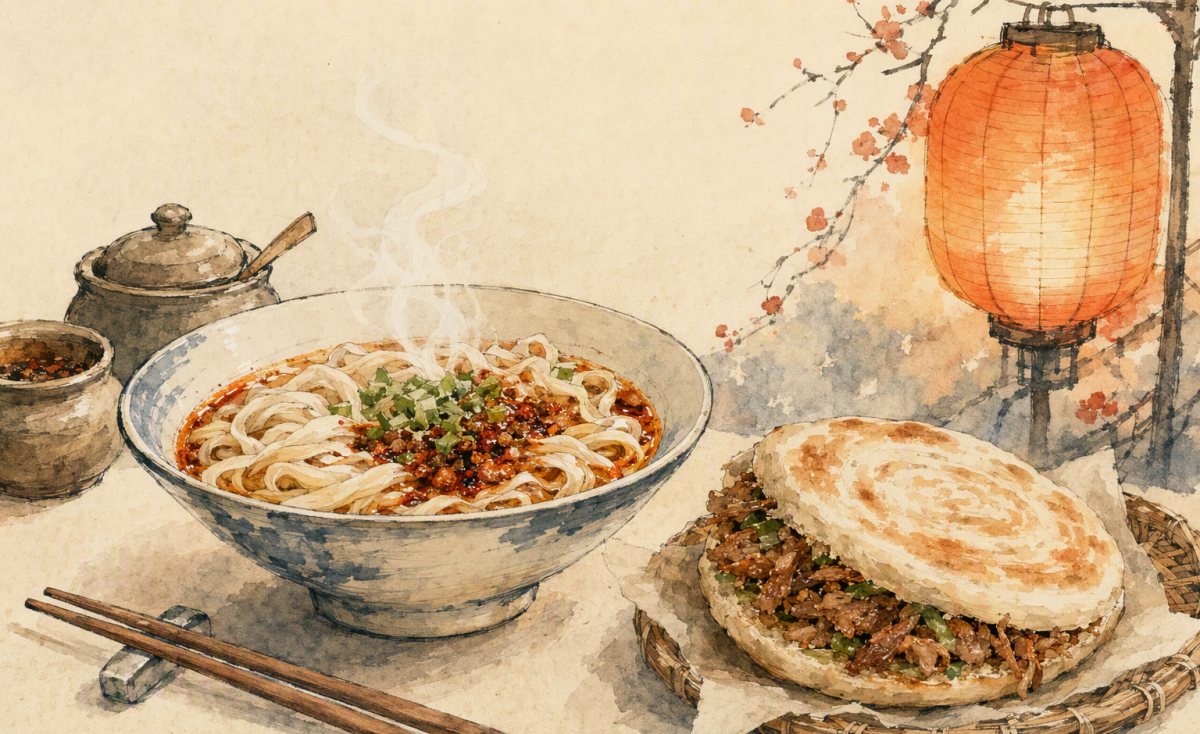
Xi’an eats like a Silk Road caravan town: wheat instead of rice, lamb instead of pork, and chilli oil on almost everything. The city sits at the eastern end of the old trade routes, and its kitchen carries the memory of it — hand-pulled dough, cumin, vinegar, slow-braised meat and bread used as both plate and spoon. This guide covers the dishes worth planning a day around, the districts where they are actually eaten, and the practical details — payment, timing, transport — that decide whether a food crawl goes smoothly.
The five dishes to build a day around
Roujiamo. Slow-braised pork, chopped and packed into a toasted flatbread. The version worth queuing for comes from vendors who bake the bread to order in a clay oven — you want a crisp shell that shatters slightly, not a soft bun from a warming tray. Lamb versions exist and are common in Muslim-owned shops.
Biangbiang noodles. Belt-wide hand-pulled noodles named for the sound of dough hitting the board. They arrive dressed with chilli, vinegar and cumin, and the chilli is usually a slick of oil rather than a dry powder. Ask for less chilli if you need to; the vinegar and cumin carry the flavour anyway.
Yangrou paomo. Lamb soup with flatbread you tear yourself. The ritual matters: tear the bread into small pieces in your bowl, hand it to the kitchen, and it comes back flooded with broth. Tearing it too large is the classic beginner’s mistake — small pieces absorb better.
Lamb skewers. Cumin-heavy and charcoal-smoked, sold in clusters of ten or twenty. They are street food in the truest sense: eaten standing, one hand holding the skewer, the other holding a drink.
Liangpi. Cold wheat-noodle ribbons in chilli oil and vinegar. This is the cooling counterpart to everything above and the dish to order when the chilli has caught up with you.
For a longer list beyond these five, see this Xi’an street food guide.
Where to eat: three districts, three different evenings
The Muslim Quarter, centred on Beiyuanmen, is the lantern-lit spectacle: busy, photogenic, and priced for visitors. It is worth one evening for the atmosphere and the fresh pomegranate juice. Two blocks north, Sajinqiao is where locals actually eat — fewer lights, lower prices, and a more everyday rhythm. Yongxingfang is a food court covering Shaanxi specialities province by province, useful if you want to sample widely in one stop rather than walk between stalls.
Timing matters more than most guides admit. Stalls tend to be busiest from early evening; some close once they sell out rather than at a fixed hour, so a late arrival can mean a shortened menu. Verify current opening patterns locally or on the venue’s own page rather than trusting a printed schedule.
How to order, pay and eat without friction
Payment in Xi’an is overwhelmingly mobile. WeChat Pay and Alipay are the default at stalls and small restaurants, and cash is accepted but can slow things down. Setting either up before you travel is the single biggest quality-of-life improvement for a food trip — see this China cashless travel guide for how the setup works and what to check.
A few habits help. Point at what someone else is eating if the menu is only in Chinese. Confirm whether a dish is priced per skewer or per portion before ordering a round. And carry tissues: many small shops do not provide them.
Drinking alongside the food
Xifeng baijiu is the local spirit and it is strong; order it in small quantities and treat it as a sipping drink rather than a chaser. For everyone else, iced sour-plum drink is the standard pairing — sweet, sharp and effective against chilli. In winter, look for frozen persimmon cakes, which appear seasonally and are worth trying when you see them.
Combining eating with sightseeing
The classic Xi’an evening is a circuit of the city wall by bike at sunset, then straight down into the Muslim Quarter for dinner. It works because the wall and the food streets are close together, so you are not losing an hour to transport between the two.
If you want the Terracotta Warriors and the food in the same trip without improvising the logistics, a planned route helps — an AI travel planner for China is useful for sequencing days like this, provided you check anything it tells you about hours and tickets against the official source.
Practical notes before you go
Xi’an is well served by metro, and most food districts sit within walking distance of a station; the China metro guide covers how to buy and use tickets. Sort your phone data before you fly so maps, translation and payment apps work the moment you land. If your trip extends beyond Xi’an, the wider Xi’an city guide covers the non-food side of the city.
Frequently asked questions
Is Xi’an street food safe for visitors with sensitive stomachs?
Generally yes, with normal precautions. Eat at busy stalls where turnover is high, avoid anything that has been sitting out, and be cautious with cold dishes if you are prone to problems. Tap water is not for drinking; bottled water is widely available.
How much should I budget for a day of eating?
Costs change, so treat any figure you read online as indicative only. Street food is inexpensive relative to restaurant dining, and skewers, noodles and bread-based dishes are the cheapest way to eat well. Check current prices at the stall before ordering.
Do I need to speak Chinese to order?
Not fluently, but some Mandarin helps. Photos, pointing, and a translation app cover most situations. Learning the names of the five dishes above in Chinese will get you further than general phrases.
Can I eat well as a vegetarian in Xi’an?
It is harder than in China’s larger coastal cities because the signature dishes are meat-based. Liangpi, bread dishes and vegetable skewers are the reliable options; asking clearly and checking whether broth is meat-based is essential.
When is the best time of year for a food-focused visit?
Spring and autumn are the most comfortable for walking between stalls. Summer heat makes a cold liangpi lunch appealing but long evening crawls tiring. Winter brings frozen persimmon cakes and fewer crowds.
Xi’an rewards eating on its own terms: order the bread, tear it yourself, and let the chilli and cumin do the work. Plan the logistics — payment, data, transport — before you arrive, and the food becomes the easy part of the trip.