Hiring a private driver in China is one of the simplest ways to remove friction from a trip. It suits travellers who want to reach sights outside city centres, move between provinces without juggling rail connections, or simply avoid explaining destinations in a language they do not speak. This guide explains what a private driver service normally covers, how to check that a driver and vehicle are properly licensed, which routes benefit most, and what to confirm before you pay a deposit. Prices vary by city, vehicle type, distance and season, so treat any figure you see online as indicative and confirm the current rate directly with the operator.
Why a private driver changes the trip
The practical case rests on four things. First, language: outside major hotels and transport hubs, English is uncommon, and a driver who handles navigation, tolls and parking removes most daily negotiation. Second, navigation: some foreign mapping and ride-hailing apps behave unpredictably in mainland China, and coverage of smaller roads and scenic areas is uneven. A driver who knows the region does not depend on them. Third, luggage: if you are moving between cities with bags, a car avoids repeated taxi transfers and station stairs. Fourth, access: many of the best viewpoints, tea villages and rural photography spots sit well away from metro lines and are awkward or impossible to reach by public transport in a single day.
That said, a driver is not a substitute for a guide. Driving and guiding are separate licensed roles in China, and a driver is not permitted to act as a tour guide inside attractions. If you want commentary, context and someone to handle tickets and reservations, book a guide as a separate service. For background on how much English you will actually encounter, see our notes on the language barrier in China.
What to check before you book
Ask the operator to confirm, in writing, the following points. None of these are unreasonable requests, and a reputable company will answer them without hesitation.
Vehicle and driver licensing: commercial passenger transport in China requires the correct vehicle classification and a commercial driving permit, not an ordinary private licence. Ask whether the vehicle is registered for commercial passenger use and whether the driver holds the corresponding permit.
Insurance: confirm that the vehicle carries passenger liability cover and ask what happens in the event of an accident involving a foreign passenger.
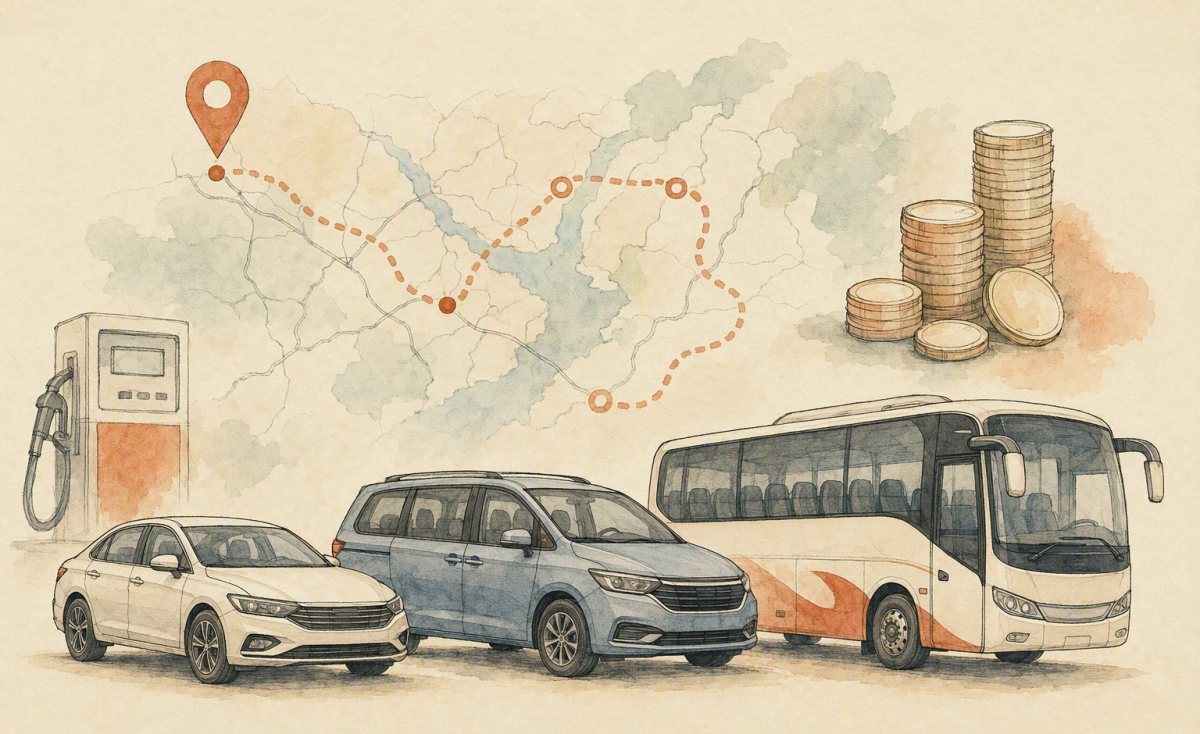
Inclusions: establish whether fuel, tolls, parking, driver meals and accommodation on multi-day trips are included or billed separately. On long-distance routes, driver overnight costs are a common source of disagreement.
Working hours: agree a daily driving limit and an overtime rate before departure.
Payment: ask what deposit is required, what the cancellation terms are, and whether payment can be made by international card or requires a Chinese payment app. Our guide to cashless payment in China explains the options.
Typical itineraries that work well with a driver
Beijing and the Great Wall. A driver lets you reach sections beyond the standard tour-bus circuit and start early enough to avoid the worst crowding. Confirm which section you are visiting, as driving times differ substantially.
Xi’an and the Terracotta Warriors. The site sits outside the city and fills quickly. A driver can position you near opening time, then continue to lesser-visited tombs in the same area. See our Xi’an city guide for what else is worth adding.
Guilin and Yangshuo. Rural photography loops, rice terraces and riverside villages are spread across a wide area with limited public transport. A driver is close to essential here. For the river itself, see the Li River cruise guide.
Zhangjiajie and surrounding parks. The park entrances, cable cars and shuttle systems are separate and spread out. A driver handles the transfers between gates while you handle the internal transport.
Chengdu and the panda base. Early arrival matters more than anything else. A driver gets you there before the gates open rather than after the first shuttle wave.
How a driver fits with trains and flights
A driver does not replace China’s high-speed rail network, which remains faster and more reliable over long distances. The sensible pattern is usually rail between distant cities and a driver for the days in between, when you are covering dispersed sights. If you are arriving by air, a pre-booked transfer avoids the taxi queue and the language problem at the kerbside. For the rail side, see our guides to booking train tickets on 12306 and to high-speed rail seat classes.
Accessibility, families and group size
Tell the operator in advance if you need a child seat, step-free access, extra luggage space or a vehicle that can accommodate a wheelchair. Availability is not universal and cannot be assumed. For groups above four people, a larger vehicle usually needs to be booked specifically rather than arranged on the day. If you are travelling with dietary requirements, note that this affects where the driver can stop for meals; our guide to halal and vegetarian food in China covers how to plan around that.
Frequently asked questions
Is a private driver in China expensive?
It depends on distance, vehicle class, city and season, and rates change. Rather than relying on a figure from an article, ask the operator for a written quote covering the full itinerary, then compare it against the cost of trains, taxis and guided transfers for the same days. Confirm what the quote excludes before deciding.
Can the driver act as my guide?
No. Driving and guiding are separately licensed in China. A driver can transport you, wait, and advise on timing, but cannot provide guided commentary inside attractions. If you want a guide, book one as an additional service.
Do I need to tip the driver?
Tipping is not customary in mainland China, though it is increasingly common in some tourism contexts. Our guide to tipping and etiquette in China sets out the norms. Agree any gratuity separately from the quoted rate.
How far in advance should I book?
For peak periods, public holidays and popular scenic regions, book well ahead, as licensed vehicles and English-speaking drivers are limited in smaller destinations. For ordinary weekdays in major cities, shorter notice is often workable. Confirm current availability with the operator rather than assuming.
What happens if the itinerary changes on the day?
Most operators allow reasonable flexibility within the agreed hours, but additional distance or extra days will usually be charged. Agree in advance how changes are priced, and get any variation confirmed in writing before it happens.
Before you commit, verify the operator’s licensing, insurance and cancellation terms directly, and check current attraction reservation requirements, since many sites in China now require advance booking for foreign visitors. Our guide to attraction reservations for foreigners explains which ones typically need it. Once those two things are confirmed, a private driver is a straightforward way to spend less time on logistics and more time at the places you came to see.