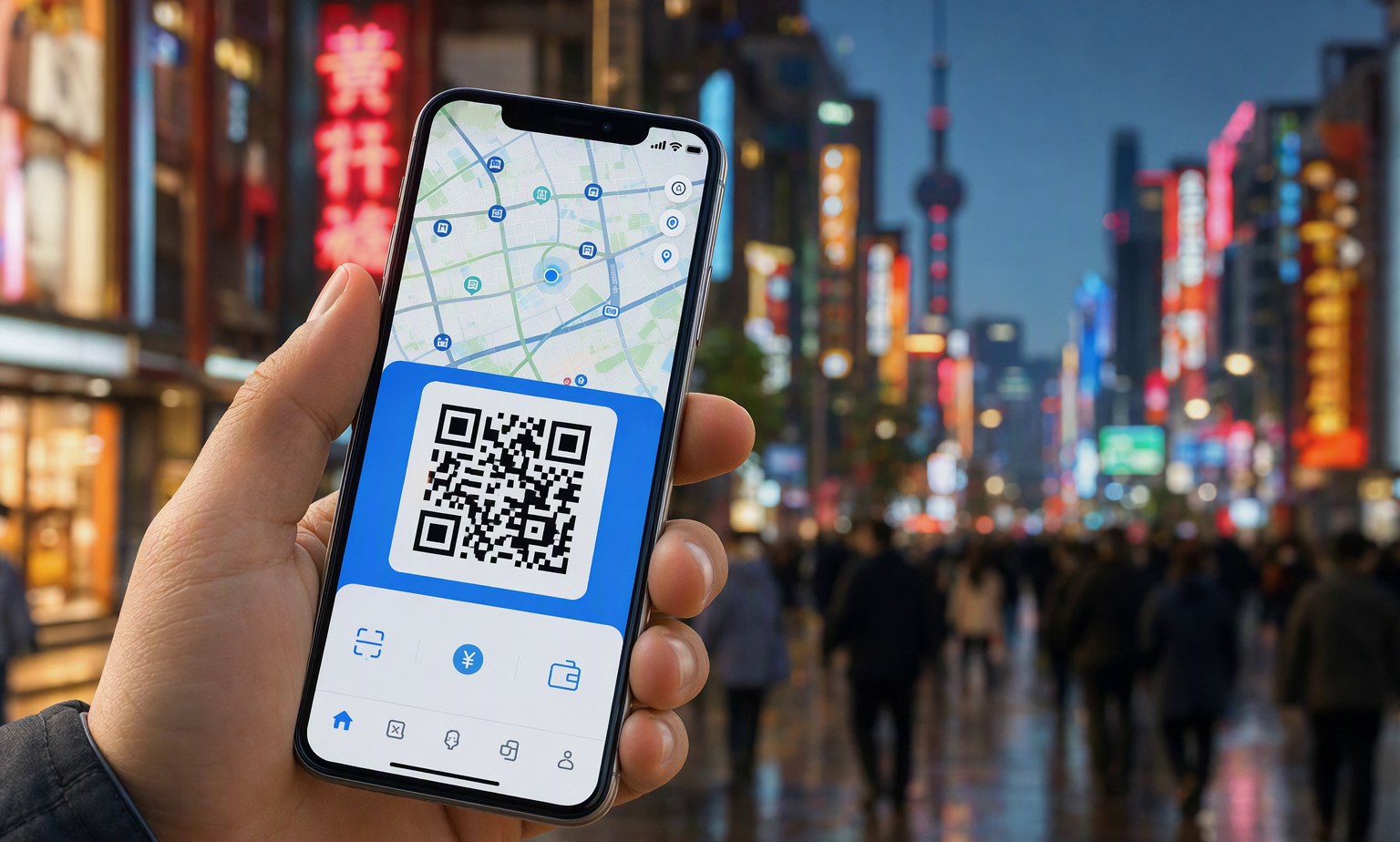
China went cashless well before most Western countries, and the shift is visible at street level: QR codes taped to market stalls, noodle counters and taxi dashboards. For foreign visitors the practical news is that the two dominant apps, Alipay and WeChat Pay, both support international cards, so you can pay almost anywhere without a Chinese bank account. The setup is quick, but it is far easier to do at home than on arrival. This guide covers what to install, how payments actually work, where physical cards still function, and the mistakes that catch first-time visitors.
Setting up Alipay and WeChat Pay before you fly
Do this at home, on your normal mobile connection, roughly a week before departure. Both apps require identity verification and a card binding step, and both send SMS codes that can be slow or unreliable on foreign numbers roaming inside China.
For Alipay: download the app, register with your home phone number, complete passport verification when prompted, then add your Visa, Mastercard or Amex under the account and bank card section. For WeChat Pay: install WeChat, register, then go to Me, Services, Wallet and add your card there. The WeChat interface is slightly clunkier, but once a card is bound it is accepted just as widely. Set both apps to English before you travel, because menu labels are easier to follow when you are not rushing at a till.
If you want to understand how these apps fit alongside data and roaming choices, our guide to truy cập internet tại Trung Quốc explains the connectivity side, and the broader hướng dẫn thanh toán không tiền mặt covers the same ground in more detail.
How a payment actually works in a shop
There are two directions, and both are common. In the first, you open the app, tap Pay, scan the merchant’s printed QR code, check the merchant name and amount shown on screen, then confirm. In the second, typically at convenience stores and supermarkets, the cashier scans the payment code displayed on your phone. Either way, the app shows you who you are paying and how much before anything is deducted.
Foreign cards generally work for merchant payments but not for person-to-person transfers. That distinction matters: a small vendor whose QR code is a personal account rather than a registered merchant account may decline your card. If that happens, pay cash rather than trying the code repeatedly. Refunds on card-funded payments normally reverse automatically to the same card, so keep the in-app transaction record for anything expensive.
Fees, limits and what to check
Fee structures and per-transaction thresholds change, and they also depend on your own card issuer. Rather than relying on any figure quoted in a blog, check two things yourself. First, open the relevant help or fee section inside Alipay and WeChat Pay and look for the current terms on international card payments, including any threshold above which a percentage fee applies. Second, check your card issuer’s foreign transaction fee, because that is charged independently and is often the larger cost. Do both before you travel, not at the till.
Cash: how much to carry and why
Cash is not dead in China, just demoted. Withdraw or exchange a modest float on arrival, at an airport or a bank counter, and keep it for the situations where QR payment fails: tiny vendors with personal codes, rural stalls, temple donation boxes, and the occasional technical problem with your phone. Small notes matter more than a large total, because breaking a large note is genuinely difficult in a cashless economy. Treat your float as insurance rather than your main method, and top it up only if you find yourself using it.
Where physical cards still work
International cards are accepted at international hotels, upscale restaurants and shops aimed at tourists. Almost everywhere else, from taxis and metro ticket machines to convenience stores and noodle joints, payment is QR-based. Do not assume that carrying a UnionPay-branded card solves this; the practical universal key is a bound Alipay or WeChat Pay account. Note also that Apple Pay and Google Pay only work where physical card terminals exist, which is a small minority of places you will actually spend money. If you are booking accommodation, our guide to khách sạn chấp nhận khách nước ngoài covers the booking side.
Common pitfalls and how to avoid them
The most frequent failure is registering inside China: verification codes sometimes never arrive on a foreign number that is roaming. Set both apps up before departure. The second is assuming your phone alone is enough; carry a backup, either a second card bound in the app or a cash float, in case your phone is lost, stolen or out of battery. The third is tipping confusion. Tipping is not expected in China, and our tiền boa và nghi thức ứng xử explains the exceptions. Finally, remember that if you are paying a tour operator or driver directly, agree the method in advance and ask for a receipt.
Câu hỏi thường gặp
Can I use Alipay or WeChat Pay with a foreign credit card?
Both apps support binding international cards, but the exact card networks accepted and any verification requirements are set by the apps and can change. Check the current supported card list inside each app’s help section before you rely on it, and bind your card at home so you can test it.
What should I do if a vendor’s QR code declines my card?
This usually means the code is a personal transfer account rather than a registered merchant. Pay cash instead. Do not keep retrying, as repeated failed attempts waste time and may trigger a security check on your account.
Tôi nên mang bao nhiêu tiền mặt?
Enough to cover a few days of small purchases and emergencies, in small notes. The right amount depends on your itinerary and how rural it is, so judge it against where you are going rather than a fixed figure, and withdraw more only if you actually use it.
Do I need a Chinese bank account?
No. A foreign card bound to Alipay or WeChat Pay covers the overwhelming majority of day-to-day spending. A Chinese account is only relevant for long stays or for features such as person-to-person transfers, which foreign cards generally cannot access.
What happens to refunds?
Refunds on card-funded payments normally return automatically to the same card. Timelines vary by merchant and issuer, so keep the in-app transaction record and, for large purchases, ask the merchant how long they expect the reversal to take.
Ten minutes of setup at home removes most day-to-day friction from a China trip. Bind your cards to both apps before you fly, test that a payment screen loads, carry a small cash float in low denominations, and keep a second payment method available in case your phone lets you down. Do that, and money stops being something you think about, which leaves more attention for everything else. For the wider pre-departure picture, our Danh sách kiểm tra cho người lần đầu đến Trung Quốc is a sensible next read.