Most visitors see the Terracotta Warriors as a half-day stop on the way to somewhere else. That works, but it undersells the site: the museum is spread across three pits and a bronze chariot hall, and the surrounding Lintong district holds a second excavation museum most tours skip. This guide covers what a Terracotta Warriors tour from Xi’an actually involves, how to time your visit around the crowds, how to get there, and how to build a two-day Xi’an plan around it. It is written for independent travellers who may or may not book a guided service.
Wo sich die Stätte befindet und was Sie besichtigen
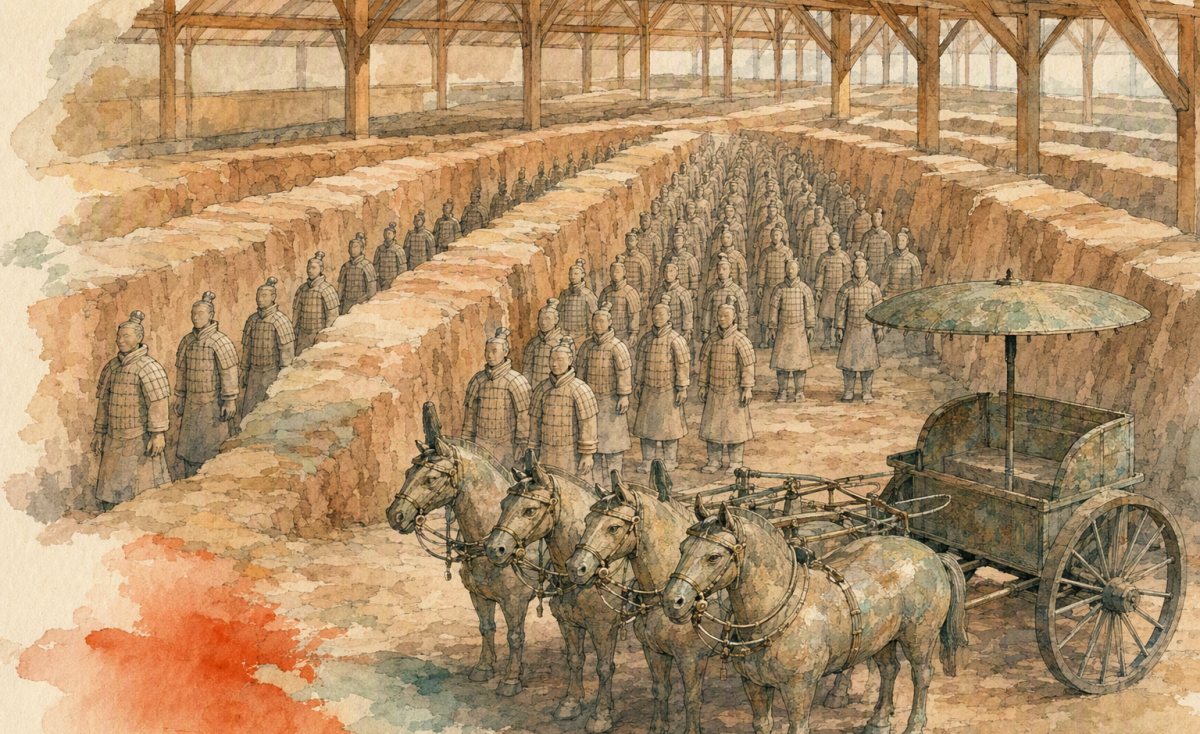
The museum sits roughly 35–40 km east of central Xi’an in Lintong district, close to the mausoleum of Qin Shi Huang. The three pits are covered by hangar-like halls. Pit 1 is the largest and the one in most photographs; Pit 2 contains largely unexcavated ground with cavalry and archer figures; Pit 3 is small and appears to be a command post. A separate hall displays two bronze chariots and horses. Signage is in Chinese and English, and the on-site exhibition labels explain the excavation sequence reasonably well, but the site rewards context — either a guide, an audio guide, or reading up beforehand.
Opening hours, last admission and any seasonal closures change through the year and around public holidays. Check the museum’s own page or the official ticketing channel before you travel, and look specifically for the current entry window, the last-admission time, and whether same-day tickets are released. Do not rely on a number quoted in a blog post, including this one.
Ihren Besuch so legen, dass Sie den Menschenmassen ausweichen
Die Stätte zieht zahlreiche chinesische Gruppenreisen an – und das Muster ist ziemlich vorhersehbar: Reisebusse treffen gegen Mittag ein, und die Mittagszeit ist der belebteste Abschnitt. Ein Besuch bei Öffnung bietet Ihnen ruhigere Verhältnisse in Grube 1 und bessere Fotomöglichkeiten. Der späte Nachmittag ist die zweitbeste Zeit – allerdings müssen Sie vorher unbedingt die letzte Einlasszeit prüfen.
Rechnen Sie mit rund drei Stunden innerhalb des Geländes, wenn Sie die Informationstafeln lesen, alle drei Gruben sowie die Halle der bronzenen Streitwagen besichtigen und zwischen den Gebäuden laufen möchten. Fügen Sie Zeit für den Shuttlebus vom Ticketausgabepunkt zu den Grubeneingängen sowie für den Rückweg hinzu. Ein gehetzter 90-Minuten-Besuch ist möglich – doch dann verbringen Sie den Großteil Ihrer Zeit in Grube 1.
Wochenenden, chinesische Feiertage und die Sommerferienzeit sind deutlich voller. Falls Ihre Reisedaten flexibel sind, macht ein Wochentag außerhalb der Ferien- und Feiertagszeiten einen spürbaren Unterschied.
Tickets, Guides und was Sie prüfen sollten
Tickets for the museum are generally sold through official channels, and booking ahead is sensible in peak season. Because ticketing systems, ID requirements and release timings change, verify on the official site or the museum’s own booking page: look for the booking window (how many days ahead tickets open), whether a passport number is required per visitor, and whether entry is timed.
Guided tours vary widely. A good guide explains the excavation history, the differences between the pits, and the conservation problems — pigment loss, humidity, and why large areas remain unexcavated. A poor one recites dates. Ask any operator directly: how long is the guided portion, is the guide licensed, does the price include the museum ticket, and is the transfer private or shared. If a tour advertises “skip the line”, ask what that means in practice, since all visitors pass through the same security and ticket check.
Falls Sie Ihre eigene Reiseroute zusammenstellen statt ein Paket zu buchen: Ein KI-Reiseplaner kann grob den Rahmen einer Reise vorschlagen, erfindet aber oft Öffnungszeiten und Fahrzeiten. Unsere Hinweise zu der Nutzung von KI für eine China-Reiseroute ohne erfundene Öffnungszeiten beschrieben erklären, wo diese Hilfsmittel an ihre Grenzen stoßen.
Getting there from Xi’an
Options are a private car or taxi, a public bus from Xi’an railway station, or the metro plus a local connection. A private car is the simplest if you are combining the Warriors with Hanyangling or Mount Hua in one day, because those sites are not adjacent and public transport between them is slow. Public buses are cheaper but you are tied to their schedule.
If you are arriving by rail, Xi’an is well connected: high-speed services run from Beijing and Shanghai, among other cities. Booking, passport rules and app options for Chinese trains are covered in our Reiseführer für Züge in China. Note that Xi’an has more than one station, and they are not close to each other — check which one your train uses before arranging a pickup.
Innerhalb der Stadt ist die U-Bahn schnell und günstig. Siehe die Leitfaden zur chinesischen U-Bahn zur Funktionsweise von Bezahlung und Zugangskontrollen.
A two-day Xi’an plan built around the Warriors
Tag 1: Terrakotta-Armee am Vormittag – idealerweise bei Öffnung. Am Nachmittag Hanyangling (die Han-Yang-Ling-Mausoleumsstätte), falls Sie eine zweite, ruhigere archäologische Sehenswürdigkeit wünschen, danach Rückkehr in die Stadt für einen Abend im Muslimischen Viertel. Unser Xi’an street food guide erklärt, was Sie dort essen können – ohne Mahlzeiten zu verschwenden.
Tag 2: Morgenstunde an der Stadtmauer – idealerweise früh, dann das Gebiet um den Großen Wildganspagoden-Turm, anschließend das Shaanxi-Historische-Museum, falls Sie einen Platz ergattern – es ist kostenlos, erfordert aber eine Vorreservierung und ist rasch ausgebucht. Die Stadtmauer lässt sich komplett umrunden, wenn Sie ein Fahrrad mieten; prüfen Sie vor Ort aktuelle Mietpreise und Kautionregeln – vertrauen Sie nicht veralteten Angaben.
Über die Terrakotta-Armee hinaus
Mount Hua is a long day trip west of the city and needs an early start and a weather check. A Tang-dynasty dinner show with a dumpling banquet is an easy evening option in the city. For a wider look at what Xi’an offers, including transport and neighbourhoods, see the Xi’an city guide.
Häufig gestellte Fragen
Wie viel Zeit benötigen Sie an der Terrakotta-Armee?
Plan around three hours inside the site to see Pits 1, 2 and 3 plus the bronze chariot hall at a reasonable pace, and add travel time from Xi’an — roughly an hour each way depending on traffic and your mode of transport.
Sollten Sie eine geführte Tour buchen oder selbstständig reisen?
Selbstständig reisen ist völlig machbar – die Stätte ist gut beschildert und mit öffentlichen Verkehrsmitteln erreichbar. Ein Guide bringt vor allem dann Mehrwert, wenn Sie Hintergrundwissen zur Ausgrabungsgeschichte und zu Konservierungsfragen wünschen. Falls Sie einen Guide buchen, klären Sie vorab, ob das Museumsticket und der Transfer bereits im Preis enthalten sind.
Wann ist die ruhigste Zeit für einen Besuch?
Arriving at opening is the most reliable way to avoid the mid-morning tour-group peak. Weekdays outside Chinese public holidays and school breaks are noticeably calmer. Confirm current opening and last-admission times on the museum’s official channel before you go.
Können Sie die Terrakotta-Armee an einem Tag mit anderen Sehenswürdigkeiten kombinieren?
Ja – doch begrenzen Sie es auf eine weitere Attraktion. Hanyangling passt gut, da sie in derselben Richtung liegt. Der Berg Hua lässt sich jedoch nicht komfortabel mit dem Museum kombinieren – planen Sie ihn als eigenständigen Tag ein.
Müssen Sie beim Einlass einen Ausweis vorzeigen?
Chinese museums commonly require passport or ID registration, and ticketing rules change. Check the museum’s official booking page for what identification is required and whether entry is timed.
Treat every figure in this guide as something to confirm rather than assume: opening hours, ticket release windows, train times and transport prices all move. Verify on the operator’s or museum’s own page, then build your day around the confirmed details.