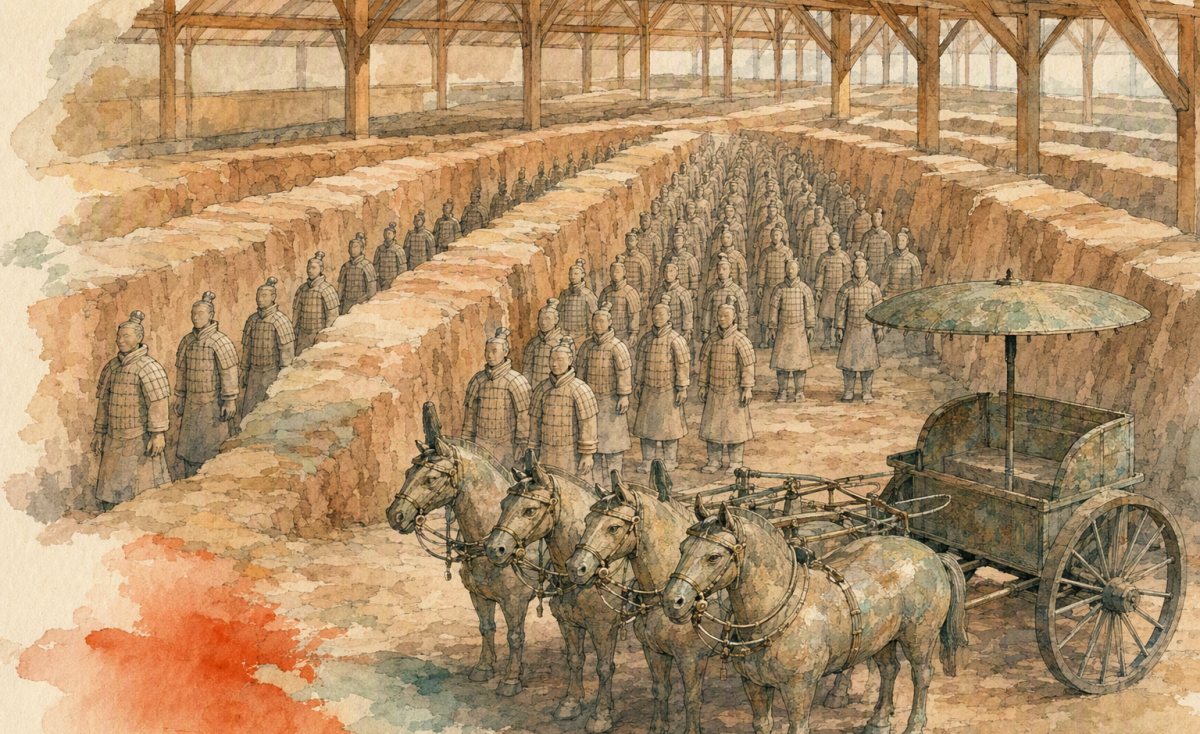
Most visitors see the Terracotta Warriors as a half-day stop on the way to somewhere else. That works, but it undersells the site: the museum is spread across three pits and a bronze chariot hall, and the surrounding Lintong district holds a second excavation museum most tours skip. This guide covers what a Terracotta Warriors tour from Xi’an actually involves, how to time your visit around the crowds, how to get there, and how to build a two-day Xi’an plan around it. It is written for independent travellers who may or may not book a guided service.
Dove si trova il sito e cosa visiterete
The museum sits roughly 35–40 km east of central Xi’an in Lintong district, close to the mausoleum of Qin Shi Huang. The three pits are covered by hangar-like halls. Pit 1 is the largest and the one in most photographs; Pit 2 contains largely unexcavated ground with cavalry and archer figures; Pit 3 is small and appears to be a command post. A separate hall displays two bronze chariots and horses. Signage is in Chinese and English, and the on-site exhibition labels explain the excavation sequence reasonably well, but the site rewards context — either a guide, an audio guide, or reading up beforehand.
Opening hours, last admission and any seasonal closures change through the year and around public holidays. Check the museum’s own page or the official ticketing channel before you travel, and look specifically for the current entry window, the last-admission time, and whether same-day tickets are released. Do not rely on a number quoted in a blog post, including this one.
Come pianificare la visita evitando le folle
Il sito attira numerosi gruppi turistici nazionali, con un andamento abbastanza prevedibile: i pullman arrivano a metà mattina e il periodo centrale della giornata è quello più affollato. Arrivare all’apertura vi garantisce una Fossa 1 più tranquilla e foto migliori. Il tardo pomeriggio è la seconda finestra migliore, ma prima dovete verificare l’orario ultimo di ammissione.
Prevedete circa tre ore all’interno del sito se volete leggere le didascalie, visitare tutte e tre le fosse e la sala dei carri in bronzo, oltre a camminare tra i vari edifici. Aggiungete il tempo necessario per il bus navetta tra il cancello d’ingresso e le entrate alle fosse, e per uscire dal sito. Una visita accelerata di 90 minuti è possibile, ma trascorrerete quasi tutto il tempo nella Fossa 1.
Weekend, festività nazionali cinesi e il periodo delle vacanze estive scolastiche sono significativamente più affollati. Se le vostre date sono flessibili, scegliere un giorno feriale al di fuori dei periodi festivi fa davvero la differenza.
Biglietti, guide e cosa verificare
Tickets for the museum are generally sold through official channels, and booking ahead is sensible in peak season. Because ticketing systems, ID requirements and release timings change, verify on the official site or the museum’s own booking page: look for the booking window (how many days ahead tickets open), whether a passport number is required per visitor, and whether entry is timed.
Guided tours vary widely. A good guide explains the excavation history, the differences between the pits, and the conservation problems — pigment loss, humidity, and why large areas remain unexcavated. A poor one recites dates. Ask any operator directly: how long is the guided portion, is the guide licensed, does the price include the museum ticket, and is the transfer private or shared. If a tour advertises “skip the line”, ask what that means in practice, since all visitors pass through the same security and ticket check.
Se state organizzando autonomamente il vostro itinerario anziché acquistare un pacchetto, un pianificatore AI può suggerire una struttura di viaggio, ma tende a inventare orari di apertura e tempi di spostamento. Le nostre note su l’uso dell’IA per creare un itinerario in Cina senza inventare orari di apertura spiegano dove questo approccio fallisce.
Getting there from Xi’an
Options are a private car or taxi, a public bus from Xi’an railway station, or the metro plus a local connection. A private car is the simplest if you are combining the Warriors with Hanyangling or Mount Hua in one day, because those sites are not adjacent and public transport between them is slow. Public buses are cheaper but you are tied to their schedule.
If you are arriving by rail, Xi’an is well connected: high-speed services run from Beijing and Shanghai, among other cities. Booking, passport rules and app options for Chinese trains are covered in our guida ai treni in Cina. Note that Xi’an has more than one station, and they are not close to each other — check which one your train uses before arranging a pickup.
All’interno della città, la metropolitana è veloce ed economica. Consultate la guida alla metropolitana in Cina per sapere come funzionano pagamenti e tornelli.
A two-day Xi’an plan built around the Warriors
Giorno 1: Eserciti di Terracotta al mattino, arrivando all’apertura. Nel pomeriggio, Hanyangling (il sito del mausoleo Han Yang Ling) se desiderate una seconda tappa archeologica più tranquilla, quindi rientro in città per una serata nella Via Musulmana. La nostra Xi’an street food guide spiega cosa mangiare lì senza sprecare pasti.
Giorno 2: mura della città al mattino, preferibilmente presto, poi la zona della Grande Pagoda dell’Oca Selvatica, quindi il Museo Storico dello Shaanxi, se riuscite a ottenere un posto — è gratuito ma richiede prenotazione anticipata ed esaurisce rapidamente. Per fare il giro completo delle mura potete noleggiare una bicicletta; verificate sul posto le tariffe correnti e le regole per il deposito, invece di fidarvi di dati vecchi.
Oltre agli Eserciti di Terracotta
Mount Hua is a long day trip west of the city and needs an early start and a weather check. A Tang-dynasty dinner show with a dumpling banquet is an easy evening option in the city. For a wider look at what Xi’an offers, including transport and neighbourhoods, see the Xi’an city guide.
Domande frequenti
Quanto tempo serve agli Eserciti di Terracotta?
Plan around three hours inside the site to see Pits 1, 2 and 3 plus the bronze chariot hall at a reasonable pace, and add travel time from Xi’an — roughly an hour each way depending on traffic and your mode of transport.
Conviene prenotare un tour o visitare in autonomia?
Visitare in autonomia è perfettamente fattibile: il sito è ben segnalato e raggiungibile con i mezzi pubblici. Una guida aggiunge valore soprattutto se volete approfondire la storia degli scavi e il contesto della conservazione. Se ne prenotate una, verificate se il biglietto del museo e il trasferimento sono inclusi.
Qual è l’orario meno affollato per visitare?
Arriving at opening is the most reliable way to avoid the mid-morning tour-group peak. Weekdays outside Chinese public holidays and school breaks are noticeably calmer. Confirm current opening and last-admission times on the museum’s official channel before you go.
È possibile abbinare gli Eserciti di Terracotta ad altre attrazioni in un’unica giornata?
Sì, ma limitatevi a una sola aggiunta. Hanyangling si abbina bene perché si trova nella stessa direzione. La Montagna Hua non si combina agevolmente con il museo — trattatela come una giornata a sé.
È obbligatorio mostrare un documento d’identità per entrare?
Chinese museums commonly require passport or ID registration, and ticketing rules change. Check the museum’s official booking page for what identification is required and whether entry is timed.
Treat every figure in this guide as something to confirm rather than assume: opening hours, ticket release windows, train times and transport prices all move. Verify on the operator’s or museum’s own page, then build your day around the confirmed details.