Most visitors see the Terracotta Warriors as a half-day stop on the way to somewhere else. That works, but it undersells the site: the museum is spread across three pits and a bronze chariot hall, and the surrounding Lintong district holds a second excavation museum most tours skip. This guide covers what a Terracotta Warriors tour from Xi’an actually involves, how to time your visit around the crowds, how to get there, and how to build a two-day Xi’an plan around it. It is written for independent travellers who may or may not book a guided service.
Onde fica o local e o que você vai visitar
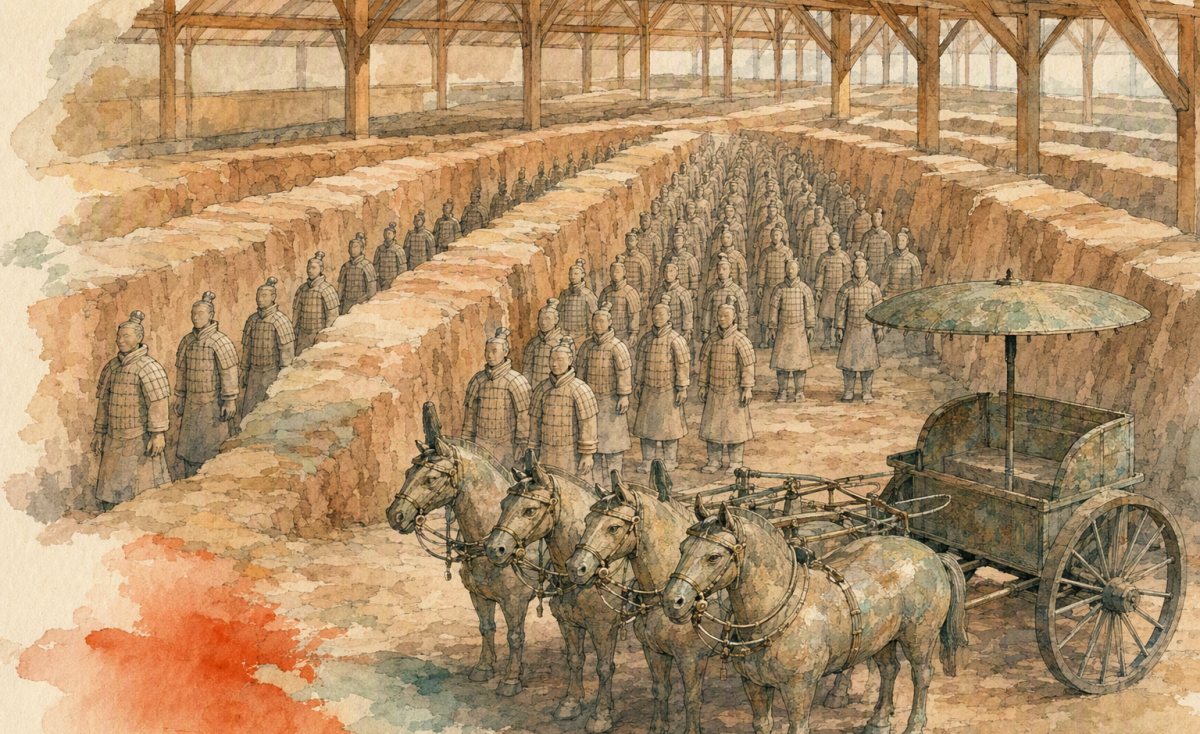
The museum sits roughly 35–40 km east of central Xi’an in Lintong district, close to the mausoleum of Qin Shi Huang. The three pits are covered by hangar-like halls. Pit 1 is the largest and the one in most photographs; Pit 2 contains largely unexcavated ground with cavalry and archer figures; Pit 3 is small and appears to be a command post. A separate hall displays two bronze chariots and horses. Signage is in Chinese and English, and the on-site exhibition labels explain the excavation sequence reasonably well, but the site rewards context — either a guide, an audio guide, or reading up beforehand.
Opening hours, last admission and any seasonal closures change through the year and around public holidays. Check the museum’s own page or the official ticketing channel before you travel, and look specifically for the current entry window, the last-admission time, and whether same-day tickets are released. Do not rely on a number quoted in a blog post, including this one.
Como planejar sua visita evitando multidões
O local atrai grandes grupos turísticos domésticos, e o padrão é bastante previsível: os ônibus chegam por volta do meio da manhã, e o período entre o meio-dia e o início da tarde é o mais movimentado. Chegar na abertura garante um Fosso 1 mais tranquilo e melhores fotos. A final da tarde é a segunda melhor janela — mas confirme primeiro o horário limite de entrada.
Reserve cerca de três horas dentro do recinto se quiser ler os painéis, ver os três fossos e a sala das carruagens de bronze, além de caminhar entre os prédios. Acrescente tempo para o ônibus circular entre o portão de entrada e as entradas dos fossos, e para a caminhada de saída. Uma visita apressada de 90 minutos é possível, mas você passará a maior parte dela no Fosso 1.
Fins de semana, feriados públicos chineses e o período de férias escolares de verão são significativamente mais movimentados. Se suas datas forem flexíveis, opte por um dia útil fora dos períodos festivos — faz toda a diferença.
Ingressos, guias e o que verificar
Tickets for the museum are generally sold through official channels, and booking ahead is sensible in peak season. Because ticketing systems, ID requirements and release timings change, verify on the official site or the museum’s own booking page: look for the booking window (how many days ahead tickets open), whether a passport number is required per visitor, and whether entry is timed.
Guided tours vary widely. A good guide explains the excavation history, the differences between the pits, and the conservation problems — pigment loss, humidity, and why large areas remain unexcavated. A poor one recites dates. Ask any operator directly: how long is the guided portion, is the guide licensed, does the price include the museum ticket, and is the transfer private or shared. If a tour advertises “skip the line”, ask what that means in practice, since all visitors pass through the same security and ticket check.
Se você está montando seu próprio roteiro em vez de comprar um pacote, um planejador de IA pode esboçar a estrutura da viagem, mas costuma inventar horários de funcionamento e tempos de deslocamento. Nossas observações sobre uso de IA para montar um roteiro na China sem inventar horários de funcionamento explicam onde essa abordagem falha.
Getting there from Xi’an
Options are a private car or taxi, a public bus from Xi’an railway station, or the metro plus a local connection. A private car is the simplest if you are combining the Warriors with Hanyangling or Mount Hua in one day, because those sites are not adjacent and public transport between them is slow. Public buses are cheaper but you are tied to their schedule.
If you are arriving by rail, Xi’an is well connected: high-speed services run from Beijing and Shanghai, among other cities. Booking, passport rules and app options for Chinese trains are covered in our guia de viagem de trem na China. Note that Xi’an has more than one station, and they are not close to each other — check which one your train uses before arranging a pickup.
Na cidade, o metrô é rápido e barato. Veja o Guia do metrô da China para saber como funcionam pagamento e catracas.
A two-day Xi’an plan built around the Warriors
Dia 1: Guerreiros de Terracota pela manhã, chegando na abertura. À tarde, visite Hanyangling (o sítio do mausoléu Han Yang Ling), se quiser um segundo ponto arqueológico mais tranquilo, depois volte à cidade para uma noite no Bairro Muçulmano. Nosso Xi’an street food guide explica o que comer lá sem desperdiçar refeições.
Dia 2: Muralha da Cidade pela manhã — idealmente cedo — seguida pela área da Grande Pagode da Ganso Selvagem e, se conseguir uma vaga, pelo Museu de História de Shaanxi (gratuito, mas exige reserva antecipada e lota rapidamente). Dar a volta completa na muralha é possível alugando uma bicicleta; confira as tarifas atuais e regras de depósito no local, não confiando em valores antigos.
Além dos Guerreiros
Mount Hua is a long day trip west of the city and needs an early start and a weather check. A Tang-dynasty dinner show with a dumpling banquet is an easy evening option in the city. For a wider look at what Xi’an offers, including transport and neighbourhoods, see the Xi’an city guide.
Perguntas frequentes
Quanto tempo você precisa nos Guerreiros de Terracotta?
Plan around three hours inside the site to see Pits 1, 2 and 3 plus the bronze chariot hall at a reasonable pace, and add travel time from Xi’an — roughly an hour each way depending on traffic and your mode of transport.
Vale a pena contratar um tour ou ir de forma independente?
Ir de forma independente é totalmente viável: o local é bem sinalizado e acessível por transporte público. Um guia agrega valor principalmente se você quiser entender a história das escavações e o contexto de conservação. Ao contratá-lo, confirme se o ingresso do museu e o traslado estão inclusos.
Qual é o horário mais tranquilo para visitar?
Arriving at opening is the most reliable way to avoid the mid-morning tour-group peak. Weekdays outside Chinese public holidays and school breaks are noticeably calmer. Confirm current opening and last-admission times on the museum’s official channel before you go.
É possível combinar os Guerreiros com outros pontos turísticos num único dia?
Sim, mas limite-se a um acréscimo. Hanyangling combina bem porque fica na mesma direção. O Monte Hua não se encaixa confortavelmente com o museu — reserve-o para um dia exclusivo.
É necessário apresentar documento de identificação para entrar?
Chinese museums commonly require passport or ID registration, and ticketing rules change. Check the museum’s official booking page for what identification is required and whether entry is timed.
Treat every figure in this guide as something to confirm rather than assume: opening hours, ticket release windows, train times and transport prices all move. Verify on the operator’s or museum’s own page, then build your day around the confirmed details.